Elliott Templeton Fine Arts
Chinatown, New York, NY
105 Henry Street
New York art space verified from current gallery listings or gallery website.
Sign in to save this gallery, log a visit, or add a show to a shared list.
Exhibitions
- On viewRecent Paintings
Richard Tinkler
May 17 – Jun 15
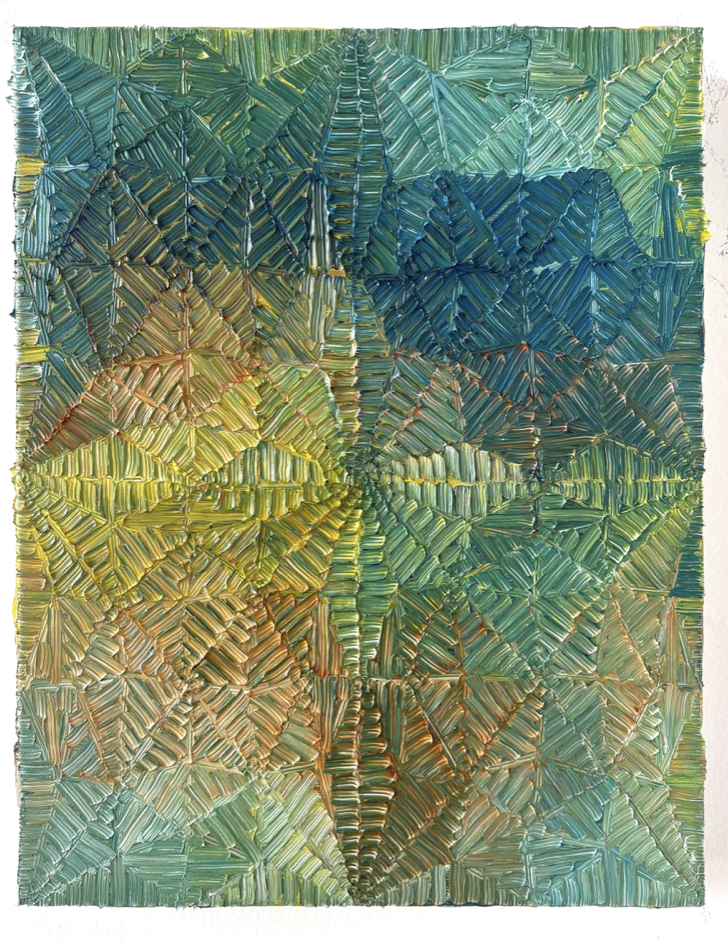
I’m happy to have the opportunity to show some of my recent paintings at Elliott Templeton Fine Arts. I feel like my main job as an artist is to learn to be as open as possible. Open to myself, to the world around me, to my materials, and to my process. And the point of this is to create work which is in itself open and creates more space and possibilities. For me there’s really no inspiration there’s just work. I make a painting and I’m dissatisfied with it so I make another in which somethings get better but new problems arise. I plan the paintings out as a series of procedures. And I make them without thinking too much but also from time to time I stop myself and look at the painting more objectively because what I’ve learned is that the painting is often done before I’ve finished all my plans. They fail because I’ve overworked them never because I’ve underworked them. I’ve learned to leave the paintings in a place that feels awkward or kinda wrong to me. If I try and fuss with it and fix it I end up making it just like other paintings I’ve already made and never make any progress. Your eye and mind tend to hold you back and keep you making the same thing over and over again but your body can help you break out of this. That’s way my process is more organized around activities than ideas or images. These paintings start with a layer of white paint and on top of that I scrape my palette filled with paint across the surface. Then I take a brush and make marks into the wet paint mixing it as I go. Everything that happens happens on the surface of the painting. I often have this idea that I want to make every step of the process apparent to the viewer and the more I try and do this the more mysterious the process becomes but also interestingly the mystery is often what attracts people and pulls them into the paintings. —Richard Tinkler, 2026
Past
Actual Queers Kissing!David Carrino & Alex Jovanovich
Nov 16 – Jan 12
Elliott Templeton Fine Arts is delighted to present a two-person exhibition by the New York artists David Carrino and Alex Jovanovich. Their explorations of language and visuality can be captured by what Carrino describes as the "alchemy of turning a phrase into form." In Carrino's new body of work, he continues his excavation of language as form by physically sewing text into silk panels. The two-dimensional alphabet, when stitched, pulls the fabric into sculptural form, creating a new sense of materiality. As a result, the phrases he selects, which he characterizes as "unarticulated thoughts and emotions," take on physical shape in the process. Carrino's use of golds and jewel tones draws inspiration from the symbolist use of color in Sienese art and from the hues of sacred textiles in Buddhist and Catholic practices. Alex Jovanovich's black-and-white ink and pencil drawings weave language through a meticulously rendered graphic style. He employs letters as filaments, lacing them into dense compositions where text is at once emergent and camouflaged. His arch yet visceral phrasings, such as "lesbienne betrayal," stretch and coil into floral or textile-like forms. His imagery draws from mid-century BDSM illustration, embedding eroticism into the works' structure. The effect is a study between the lines of control and desire. The salon room features a presentation of new ceramic work by Lizzi Bougatsos.
Past
The Schizo LifeFrisco Pete
Oct 12 – Nov 10
Elliott Templeton Fine Arts is delighted to present Frisco Pete's solo exhibition. Frisco Pete's paintings of cowboy figures and frontier vignettes have retained a near-mythic status in his Texas locale. However, through recent curatorial efforts, the enigma of Frisco Pete has come into public view. This exhibition presents a rare display of new paintings by the artist. In his New York debut, Frisco Pete's body of work portrays the psychological trials of Western men and exposes the underside of cowboy culture. Through his signature deadpan and grisaille palette, he escorts viewers into the backrooms and dark saloons where these melodramas take shape. Frisco Pete: New Paintings
Past
The Devotional FigureJohn Brock Lear
Jun 15 – Jul 28
Elliott Templeton Fine Arts is delighted to present a solo exhibition of selected works by the artist John Brock Lear. This is the first solo exhibition of Lear's work in New York and his first solo presentation since 2013. Lear was born in 1910 in the Chestnut Hill neighborhood of Philadelphia, where he spent the entirety of his life. He studied illustration at the Pennsylvania Museum School of Industrial Art, where he was trained to produce work in a social realist style. In his sole departure from Chestnut Hill, Lear served in the US Army during WWII in a non-combat position where he was hired as an illustrator for manuals and booklets. In response to the war, Lear shifts to a style that places his subjects in surrealist environments, often ones of architectural decay, which became his signature focus for the remainder of his career. The works in this exhibition represent the later works of Lear, which focus on the male form, featuring classical-like figures in surreal, minimalist landscapes. Lear worked from imagined subjects, often dressing them in a thin cloth wrap or tight-fitting garments that highlight their musculature—they might resemble gladiators, circus performers, or Biblical personae. This meditation on the male body in magical realist settings readily evokes the work of Paul Cadmus and Jared French, although Lear's body of work reveals a quieter devotion: he repeats these male subjects for decades, producing statuesque, mythical embodiments of perfect form well into his late nineties, as a kind of sacred, private practice. Lear taught illustration at Rosemont College, the Hussian School of Arts, and the Philadelphia College of Art. He exhibits his work regularly in galleries across Philadelphia and contributes illustrations to various publications throughout his career. His work is held in the permanent collections of the Woodmere Art Museum, the Detroit Museum, the Florida Gulf Coast Art Center, the Philadelphia Museum of Art, and the Reading Public Museum.
Past
PaintingsMaureen Dougherty
Apr 27 – Jun 9
Elliott Templeton Fine Arts is delighted to present a solo exhibition of paintings by the New York artist Maureen Dougherty. This is Maureen's first exhibition with the gallery and her second solo exhibition in New York City, following her 2023 show at Cheim & Read. Dougherty's portraits in this exhibition leap across art historical time. The characters appear cast from a parade of historical milieus—most notably the interwar styles of Weimar and Deco—yet float just outside of a fixed temporality. They take their stage in a theatrical mode indicative of Walt Kuhn's portraits of circus and vaudeville performers. In this way, the subjects' psychologies seem tethered to their historical disjunction, as witnesses to the passing of time (and perhaps, its cultural consequences). Abstraction is introduced into the paintings in the shifting, dreamlike grounds that the subjects occupy. Ranging from thinned, textured gestures to the crystallization of geometric motifs, Dougherty's strokes contain a powerful tension that suspends her personae in pictorial space. The effect is often a subtle manipulation of figure and ground amid the broader, more figurative scene at hand. Additionally, included in this exhibition are abstract works from Dougherty's Harlequin series, capturing a similar choreography of tension within the brightly colored diamond weaves. Maureen Dougherty (b. 1958, New York) studied painting at Carnegie Mellon University and the New York Studio School. Recent solo exhibitions include Blum Gallery, Los Angeles (2024) and Cheim & Read, New York (2023). As a documentary filmmaker, Dougherty runs her own production company, Mojo Films. Dougherty lives and works in New York.
Past
Think of It as a WholeJames Cabaniuk
Mar 8 – Apr 21
Elliott Templeton Fine Arts is delighted to present James Cabaniuk's exhibition, Think of It as a Whole. This is the artist's first exhibition in New York. Cabaniuk's paintings employ abstraction to embed ideas and images "hidden in plain sight" as visual double entendre, specifically as gestures to the experiences of queer people. Within the artist's compositions of thickly layered and expressively applied oil paint, Cabaniuk inserts interpretive figurative elements—although originating as the artist's in-group communication to other queer people, Cabaniuk's images can be read freely by the viewer. Their use of opacity is intended to mimic cultural constructions such as Polari, through which homosexuals and social deviants adopted a language that could be heard by all but only understood by them. In this body of work, Cabaniuk considers the boundaries of one's autonomy as they relate to psychological states of spiraling and dissociation. Expressed through their vivid brushwork, Cabaniuk grapples with the mechanics of self-control in moments of vulnerability. In this way, for Cabaniuk, the exhibition title refers to a tender utterance that may be offered as a form of care amid these episodes, but also, playfully, as a more explicit sexual double entendre. Cabaniuk lives and works between Manchester and London. They recently earned an MFA in Fine Arts from Goldsmiths in 2023. This exhibition is presented courtesy of Workplace (London, UK).
Past
HelloDana Garrett
Jan 18 – Mar 3
Elliott Templeton Fine Arts is delighted to present a solo exhibition by the artist Dana Garrett. This presentation comprises a decade of work by the artist from 1980-1990, including painting and sculpture. Our presentation is the first exhibition of Garrett's work since 1987 and has been curated by Evan Lincoln. Dana Garrett was born in Los Angeles in 1953 and spent his childhood and adolescence between California and Connecticut. In the mid-seventies, Garrett lived in San Francisco, where he entered a milieu of artists that included Arch Connelly and Roberto Juarez. After a few years, the artists gravitated towards New York—Garrett and Juarez each presented their first solo exhibitions at Robert Miller Gallery in the 1980-81 season. Also exhibiting at Robert Miller was Dana’s younger brother, Jedd Garet (Dana modified the spelling of his surname from Garet to Garrett to avoid confusion with his brother). In 1981, Dana and Jedd, as well as Juarez and Connelly, were included in the landmark exhibition New York/New Wave at P.S.1., curated by Diego Cortez, credited with launching the careers of the preeminent Eighties superstars Keith Haring and Jean-Michel Basquiat. In these early exhibitions, Garrett introduced an iconography of objects and creatures from a shadowy realm—skeletons, jack-o’-lanterns, architectural forms, and planets in orbit—articulated in a dusky grisaille. His muted palette and memento mori imagery unmistakably thematize the representation of death as a totalizing cultural and psychological force. As noted by artist and close friend David Carrino, these pieces are not marked by bleakness, as the inclusion of Hallows’ Eve characters makes apparent, where Garrett’s deadpan slips through: "they approach this uncomfortable subject with an unusually disarming lightness of spirit and subtle humor." Amid the vibrant and boisterous artwork indicative of the Eighties wave of “Neo-Expressionism,” Garrett adopted a more gothic and introspective form of expression. Garrett produced this work in his 42nd Street studio, in a building shared with fellow artists David Carrino, James Brown, Philip Taaffe, and Donald Baechler. He maintained a particular mise en scène in this space, where the untamed display of colossal sheets of raw canvas pinned to the wall contrasted his luxurious self-presentation, as detailed by Carrino: "In his velvet slippers, hand-tailored pants, and silk ascot, Garrett himself appears as elegant, seductive and displaced as one of his own images of dancing skeletons or black butterflies." In the mid-eighties, he began exhibiting at Tracey Garet Gallery in the East Village. He was included in the 1984 exhibition An International Survey of Recent Painting and Sculpture at the Museum of Modern Art, curated by Kyanston McShine, as well as The End of the World at the New Museum, curated by Bill Olander in 1985. Garrett’s final solo exhibition was presented at The Space in Houston, Texas in 1987. Dana Garrett died in December 1991 of AIDS-related complications.
Past
Imagined AncestorsHugo Guinness
Dec 15 – Jan 13
Elliott Templeton Fine Arts and John Derian Company present a solo exhibition of paintings by the New York artist Hugo Guinness. Guinness's portraits of "imagined ancestors" emerge from his fascination with the ambiguous truths encoded into one's family history, laden with mystery, secrecy, and potential falsehoods. In this body of work, Guinness envisions family members across an array of historical settings. Considering what bodily features or temperaments might have crossed over, Guinness imbues these characters with overt personality and touches of his present self. Each painting is executed in oil on cardboard, a favored ground for one of his favorite painters, Édouard Vuillard. Rendered in a bright palette and whimsical humor, these pieces, for Guinness, celebrate the statistical miracle that is one's existence. Guinness believes in the dubious relevance of this act (of looking into one's lineage) not only for educational purposes but to invoke the realization that one is, as he describes, "a strange mixture of old and new." Hugo Guinness has worked in New York for over thirty years as a printmaker and painter. His work has been exhibited at the John Derian Company in New York and internationally. Additionally, his work has appeared in publications such as the New Yorker and The New York Review of Books, among others. He lives in Brooklyn with his wife, the painter Elliott Puckette, and has two daughters and no pets.
Past
SinterJonathan Cross
Oct 25 – Dec 9
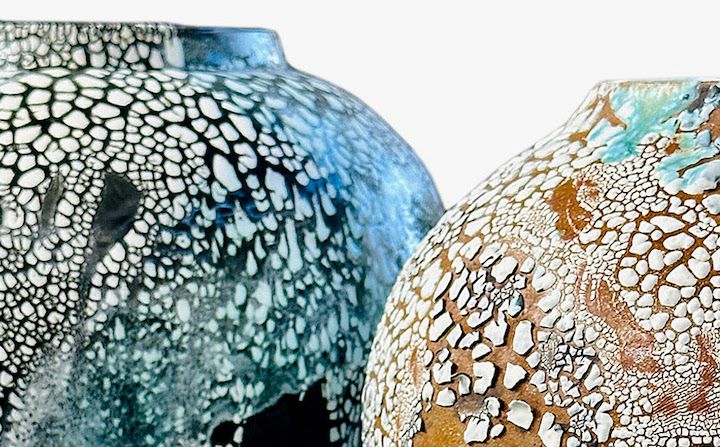
Elliott Templeton Fine Arts is delighted to present a solo exhibition of ceramics by Los Angeles and Wonder Valley-based artist Jonathan Cross. Cross’s stoneware works begin as thick slabs of clay that are carved into their striking angular forms. The objects are then wood-fired in his colossal handmade kiln for extended periods, requiring hours of attentive shifts for Cross and his assistants, all against the barren backdrop of the Wonder Valley desert. Each piece achieves its unique coloration and patina from a range of variables: the type of wood being fired, the kiln’s temperature, and the various materials such as salt and sand sprayed onto them. In certain cases, the ash from the wood lodges itself into their surfaces. The result of this process, derived from ancient Japanese ceramic practice, are objects of rich earth tones, their exterior marked with rock-like texture and softly blended hues. This exhibition features freestanding and wall sculptures, alongside a selection of vessels. They achieve a decidedly minimalist effect in their geometric austerity and brutalist materiality. But concurrently, the works evoke the primitivism of their ancient technique. In this way, they appear archaic and time-worn yet imbued with the life and spontaneity of the natural world.
Past
Posture Study PhotographsWilliam H. Sheldon
Sep 20 – Oct 14
This exhibition presents, for the first time publicly, original prints from the research project The Posture Study by the American psychologist and eugenicist William H. Sheldon (1898-1977). The depiction and perceptions of naked bodies in photography have evolved over time. Factors such as the purpose of photographing and the context in which the images are viewed can significantly impact viewers’ reactions. Shifts in social norms or new research findings can turn once-acclaimed photos into sources of controversy or even taboos. Eugenics, Somatotype, and The Posture Study In the early 20th-century, the Eugenics movement in Europe and the United States aimed to “improve” the genetic quality of the human population and extensively used photography to advance its pseudo-scientific notions of racial purity and genetic superiority. Sir Francis Galton, the “father” of Eugenics, used “composite photography” to create “average” images of various groups, claiming these could identify and promote desirable hereditary traits. William H. Sheldon, directly influenced by Galton, developed the field of Somatotype and Constitutional Psychology, categorizing human bodies into three types: “endomorph” (relative fatness), “mesomorph” (muscularity), and “ectomorph” (linearity). Rooted in behavioral genetics and social Darwinism, his work attempted to correlate physical attributes with personality traits, such as intelligence, temperament, moral worth, and probable future achievement. The Eugenics movement flourished in American universities, with elite institutions like Yale, Harvard, Columbia, and Wellesley College, implementing “postural analysis” programs and “corrective classes” for freshmen students. These programs aimed to identify “postural deficiencies” among students and use targeted exercises and education to “correct” them. Sheldon utilized these programs to support his studies, gaining him financial and logistical backing with little resistance. Throughout his decades-long academic career, he successfully published several books, including The Varieties of Human Physique: An Introduction to Constitutional Psychology, The Varieties of Temperament: A Psychology of Constitutional Differences, and his magnum opus Atlas of Men: A Guide for Somatotyping the Adult Male at All Ages. Sheldon's study had clear racial biases. In his data collection, he predominantly focused on white males; Jewish people were indicated separately, Asian people were omitted completely, while Black people were initially excluded and were sporadically included post-1945. In this extensive work, Sheldon formulated his research by creating rigorous instructions for photographing, collecting, and comparing body measurements and ratios. He and his team meticulously visited schools, military facilities, and mental health institutions, collecting photos and data of tens of thousands of men, women and teens. Most individuals were fully naked when photographed, with Aluminum pointers attached and markers drawn on their bodies to indicate their posture. Approximately 20,000 people were photographed, most of whom were freshman male students from universities across the country, with around 9,000 men photographed at Yale alone. This exhibition features photos taken at Yale after the spring of 1952, when Sheldon’s team installed the “PhotoMetric equipment” to create four-view images of the individuals photographed. —Omer Ben-Zvi, “Body Mechanics”
Past
PaintingsDavid Johansen
Jun 9 – Jul 29
Elliott Templeton Fine Arts is delighted to present a solo exhibition of paintings by New York City-based artist David Johansen. These are not portraits, they are icons. The men Johansen has painted seem to represent an inscrutable ideal; a louche, detached masculinity, equal parts provocative and serene. A pencil-mustachioed street fighter cleaning his painted nails with a knife. A hollow-eyed drunk picking his vampire sharp teeth with a straw. A young doctor (or a student? or a savant?) posing as if for an identification photo before a glittery gold backdrop. An olive-suited man in a fez on a rooftop, lounging before a midnight crescent moon. Each is presented within a painted ornate gold frame, securing their iconography. Many of the men in Johansen’s paintings wear red fez caps, a motif which he explains with characteristic ambiguity: “Sometimes if I think it needs some red, I’ll put a fez on it.” Johansen makes saints out of sinners; the fez caps may function as halos. As Johansen says, “put a halo on it, and it’s a quasi-icon.” A further hint at the apotheosis at work is the inclusion of the Hindu deity Shiva, pictured here with his consort Shakti and the baby form of the elephant god Ganesh. In this context, the bejeweled technicolor religious image seems more like a quotidian family. When anyone can be a figure of worship, maybe the gods are free to be people. The portraits are textured, embellished, and bedazzled. Johansen sculpts the acrylic metallic paint by adding layer upon layer to create a relief map—noses and eyebrows protrude impishly, jewelry glitters, and hair parts in sculptured tresses. They have the look of being painted in nail polish, shimmering wet pop frozen glamor. David Johansen is best known as a singer and songwriter, beginning his career as the frontman of the seminal rock band The New York Dolls. In later musical projects, he reinvented himself as the pompadoured Buster Poindexter. He was recently the subject of the Martin Scorsese documentary Personality Crisis: One Night Only. This is the first solo exhibition of Johansen’s paintings. —Leah Hennessey
Past
Fassbinder PaintingsLucky DeBellevue
Apr 18 – Jun 3
Elliott Templeton Fine Arts is delighted to present a solo exhibition of new paintings by New York City-based artist Lucky DeBellevue depicting scenes from films by the director Rainer Werner Fassbinder. DeBellevue’s impetus for his new series of work was the death of a friend, curator, and early supporter, Frank Wagner, who happened to be a former lover of the German auteur. Deep within quarantine during the coronavirus pandemic, DeBellevue descended into a marathon of all Fassbinder’s films—exhilarated by the distinctive sensibility and intricate construction of images, DeBellevue began to paint. This series marks a move toward figuration and more classical methods by the artist, a contrast from previous bodies of work ranging from large-scale chenille stem sculptures, pistachio paintings, and block-printed geometric experiments. The pieces on display feature finely rendered snapshots of psychological and compositionally rich moments from films such as The Bitter Tears of Petra von Kant, Veronika Voss, Querelle, and Fox and His Friends, among others. DeBellevue is primarily interested in the “exploitability of feelings,” as coined by Fassbinder, a central theme concerning how the characters across his oeuvre fall victim to cruel schemes and coercive relationships in a manner that—bleakly—reveals the psychological vulnerabilities of us all. For DeBellevue, this theme resonated during the heightened political moment at the time of his creation of the series, similar to Fassbinder’s interest in the culture and politics of postwar Germany. In this way, DeBellevue’s paintings take on a range of meanings: on one level, a painter’s sharp eye applied to cinematic aesthetics, but collectively, a looming undertone of the susceptibility of a society’s social fabric. In the salon room, selections on display include an installation of ceramics by Doug Bacho entitled “Underwater” and textile works by Daniel Albuquerque.
Past
MobilesJulia Condon
Feb 16 – Apr 1
Elliott Templeton Fine Arts is delighted to present a solo exhibition of glass mobiles by the British artist Julia Condon. These mystical works reflect the cosmos and the natural world as the multicolored orbs transform light in their delicate, web-like array. The individual elements of the mobiles originate widely: hand-blown glass commissioned by the artist, found glass from India and Mexico, vintage chandelier beads, rock crystals, and she further hand-paints a selection of these objects. She constructs the pieces through an instinctive process, intricately weighting the mobiles’ elements across the network of wire, guided by the energy of the moment. They move in a soft, mesmeric rotation that is intended by the artist to transport the viewer to a higher realm of consciousness. For Condon, the works’ central importance is their physical display of balance that translates into a spiritual experience. Additionally on view are a selection of five paintings by Condon from her Mandala series. For Condon, the mandalas hold a spiritual significance through healing properties. Accordingly, Condon renders the works through a gradual and meticulous process of building up between fifty and eighty layers of glaze, establishing a visual complexity that entrances the viewer in a manner aimed toward an inner transformation. In the salon room, selections on display include a series of photographs by Doug Inglish, paintings by Lucky DeBellevue, Brianna Lance, and Keith Mayerson, and sculptures by Jonathan Cross and the late Dana Garrett.
Past
Tommy PuettMark Flood
Jan 11 – Feb 12
Elliott Templeton Fine Arts is delighted to present a solo exhibition by the artist Mark Flood. Tommy Puett is a retired actor and former teen idol best known for his performance in the television series Life Goes On, where in 1989, he starred as Tyler Benchfield—the best friend to a teenager with Down’s Syndrome, his character dies tragically while driving drunk. With his mullet, chiseled body, and sweet face, he remained in relative obscurity even at the height of his career but maintained a teen heartthrob status, retiring at 26 years old in 1997. Mark Flood seems transfixed with Puett in the late 1990s, which led to the frequent recurrence of printed teen magazine photographs of Puett in his work. Puett’s face would sometimes appear dozens of times in a single painting, and he made guest appearances in pieces for several years. The seriality of Puett’s imagery indicates a mechanism of obsession. In Mark Flood in the 1990s, Flood (in the third-person) describes Bodies in Space (1998) as “a diagram of Mark repeatedly stopping his obsessive thoughts about Puett by making art…I can act out my sex addiction or stay home and make art.” This exhibition includes three of Flood’s Puett works: Bodies in Space (1998), Me and My Dad (1999), and the final Puett painting, The God (1999), alongside a more recent work by Flood, Soldier Boy (2017).
Past
Selected WorksAlessandro Raho
Nov 10 – Dec 11
Elliott Templeton Fine Arts is delighted to present a selection of five works from the British artist Alessandro Raho in the gallery’s first solo exhibition. Raho is best known for his series of portraits that feature intimate studies of figures—friends, family, and cultural icons alike—posed informally against a white backdrop. This show marks twenty years since his previous New York solo presentation at Cheim and Read in 2003, which followed Raho’s first showing in the United States as part of the landmark 1996 exhibition Brilliant! at the Walker Art Center, which introduced America to the phenomenon of Young British Artists. In this show, Raho’s paintings and drawings highlight his close friend and fellow artist, Ewan Gibbs. In Ewan (2023), Raho's newest work underscores the Elliott Templeton focus on the male form, as Gibbs models in the nude, quietly staring at the viewer. Raho’s refined hand elicits a soft blur at every detail’s edge, through which the subject emerges out of a luminescent sfumato. The ethereal white surroundings assert the figure into a mutually contemplative presence with the audience. Two tropical beachside landscapes complement the portraits, depicting tranquil snapshots from the artist’s birthplace in Nassau, Bahamas. In the back room, two drawings by Gibbs are displayed alongside a selection of drawings from the British artist and poet David Robilliard (1952-1988).