
GladstonePast
Sculptures, Drawings, Models
Walter Pichler
Jun 27 – Aug 2 · Upper East Side
Gladstone presents Walter Pichler: Sculptures, Drawings, Models, marking the artist's first exhibition with the gallery since 2001, curated by Olivia Shao. Comprising fourteen works from across Pichler's rich career, the show highlights the wide range of mediums in which he practiced, including photography, sculpture, and drawing, as well as his exploration of architecture, history, and the relationship between the human body and technology. This exhibition marks a special tribute to late gallery founder Barbara Gladstone, as it was the last presentation she actively oversaw, in close dialogue with Shao and the Walter Pichler Estate. "When Barbara Gladstone invited me to organize an exhibition of Walter Pichler’s work in the summer of 2023, she did so with one important condition: that I travel to Vienna and the Austrian countryside to see his extensive body of work firsthand—his drawings, sculptures, models, experiments, and architecture. Visiting Vienna offered invaluable insight into the inner workings of a brilliant artist, architect, and craftsman. In contrast, traveling to Pichler’s compound in the Burgenland countryside felt like stepping back in time—an immersive experience revealing the deep interconnection between his studio practice, domestic life, and natural surroundings. It was there that I fully understood his uncompromising commitment to working entirely on his own terms. Inside his workshop, surrounded by sculptures and models, one witnesses a deeply disciplined, labor-intensive process, where humble materials such as clay, plaster, concrete, wood, and metal, are transformed through meticulous care and intentions. Set amid the expansive landscape of his farm, seven architectural structures built by Pichler himself house his sculptures. These buildings are not mere containers but extensions of the work—integrated with the environment, built to endure the seasons, and responsive to the changing natural light. As light shifts throughout the day, perception of the work changes, fostering a deeply personal and evolving relationship with each piece. In this idyllic setting, time seems to stand still, dissolving the boundaries between art, architecture, and life. Walter Pichler: Sculptures, Drawings, Models brings together a range of works exploring themes central to Pichler’s practice: the relationship between the body, perception, and time; reflections on technology; and traces of personal and cultural history. References to ancient civilizations are evident in his materials and forms. One important work, Finds from Crete (1970), evokes the concept of the readymade by juxtaposing an aluminum hook found by the artist with a marble-scale reconstruction of a “Horn of Consecration,” an artifact uncovered by archaeologist Sir Arthur Evans. These horns, once placed atop Minoan and Mycenaean tombs and shrines, are believed to mark sacred structures. They may represent bull horns, or, as recent scholarship suggests, connect to the “Egyptian symbol of the mountain or horizon.” This layered symbolism echoes Pichler’s enduring interest in the horizon line, a formal and conceptual thread woven throughout his sculptures, models, drawings, and architectural works. The exhibition also highlights personal relationships that shaped Pichler’s life and work. These include a poignant photograph of Woman in bronze and lead, unfinished (1990), taken by the artist’s wife Elfi Tripamer; the previously unseen The Lonely Friend (1981), a sculpture made for his daughter Anna; a photograph of Stone (1962), which functions as both a beautiful sculpture and a grave marker for a friend, Horst Hutterer; and Butterfly (1962), a favorite piece of Barbara’s. Barbara spoke with such warmth and admiration for Walther Pichler and his family—her eyes lit up as she recounted memories of his many projects and the remarkable architecture he created to house his work. This exhibition serves as a tribute to her as much as to Pichler, honoring the personal connections that bring new and intimate perspectives to his art. It has been a privilege to work closely with Anna Tripamer, Walter Pichler’s daughter and director of the estate, whose knowledge and generosity made this exhibition possible. I am deeply grateful to both Anna and Elfi Tripamer. My sincere thanks also to Kathy Halbreich for her enduring friendship, insight, and support." —Olivia Shao Walter Pichler was born in 1936 in Deutschnofen, Italy and lived in Austria until he passed in 2012. Pichler was the subject of numerous solo exhibitions at the Arthur Ross Architecture Gallery, Columbia University, New York; Tiroler Landesmuseen, Innsbruck, Austria; Stedelijk Museum, Amsterdam; Generali Foundation, Vienna; Galerie Museum, Bolzano, Italy; Museum fur Angewandte Kunst, Vienna; Haus der Kunst, Munich, Germany; and Kunsthalle Tubingen, Germany, among others. He has also been included in group exhibitions at institutions including: MAK Study Collection Furniture, Vienna; Austrian Cultural Forum, New York; The Generali Foundation, Vienna; Museum of Contemporary Art, Zagreb, Croatia; Museum of Modern Art, New York; Shanghai Art Museum, Shanghai; and the Kunsthalle Wien, Vienna. Pichler participated in Documenta 6 (1976) and Documenta 4 (1968) in Kassel, Germany.
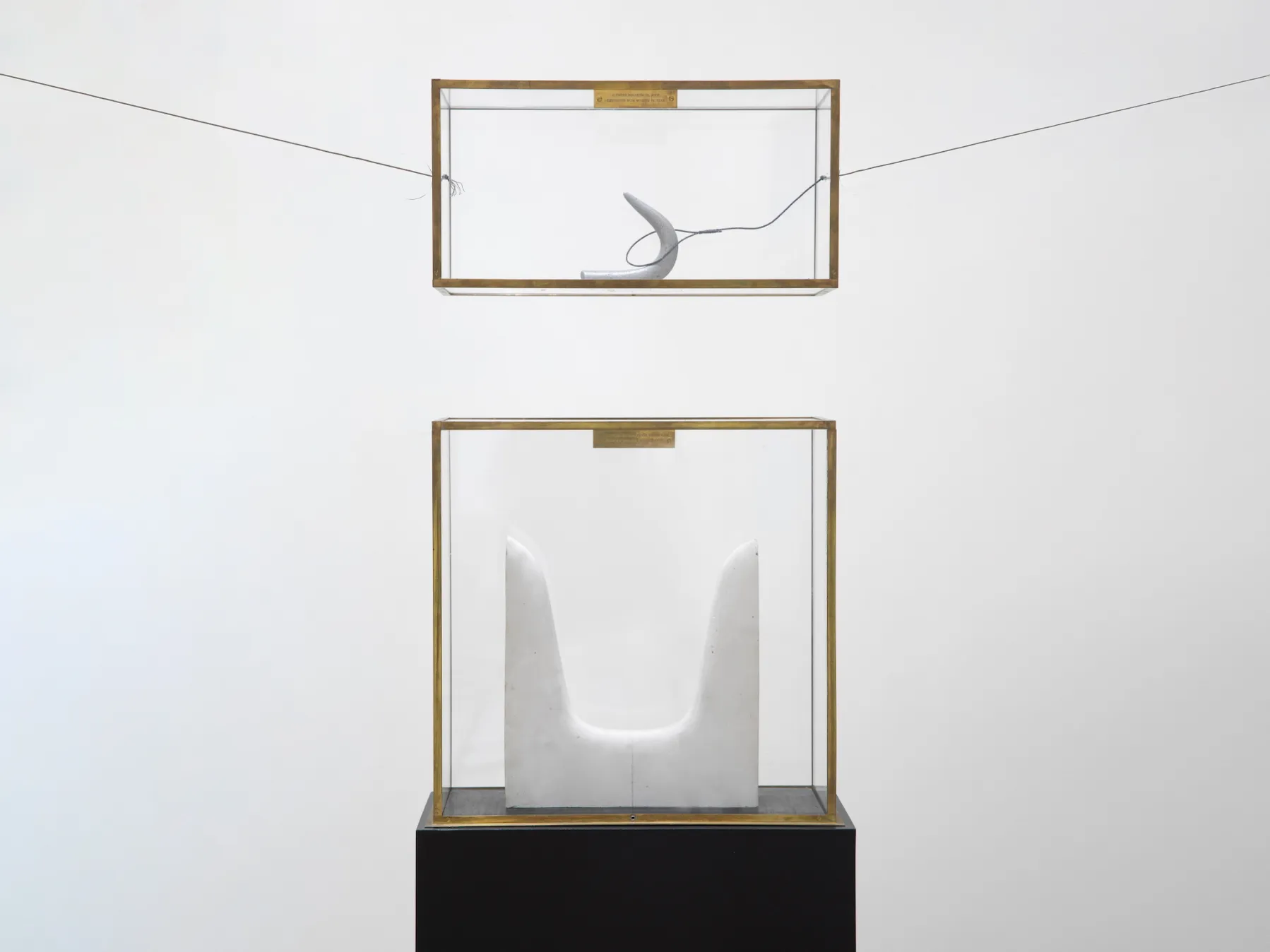
Installation views
At the gallery
Gladstone
Upper East Side · 130 E 64th St