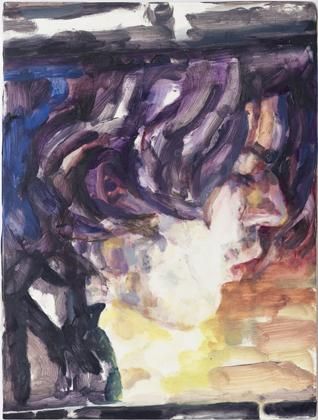
Gladstone
Upper East Side, Uptown, NY
130 E 64th St
Sign in to save this gallery, log a visit, or add a show to a shared list.
Exhibitions
- On viewWomen
Gustav Klimt
May 15 – Jun 18
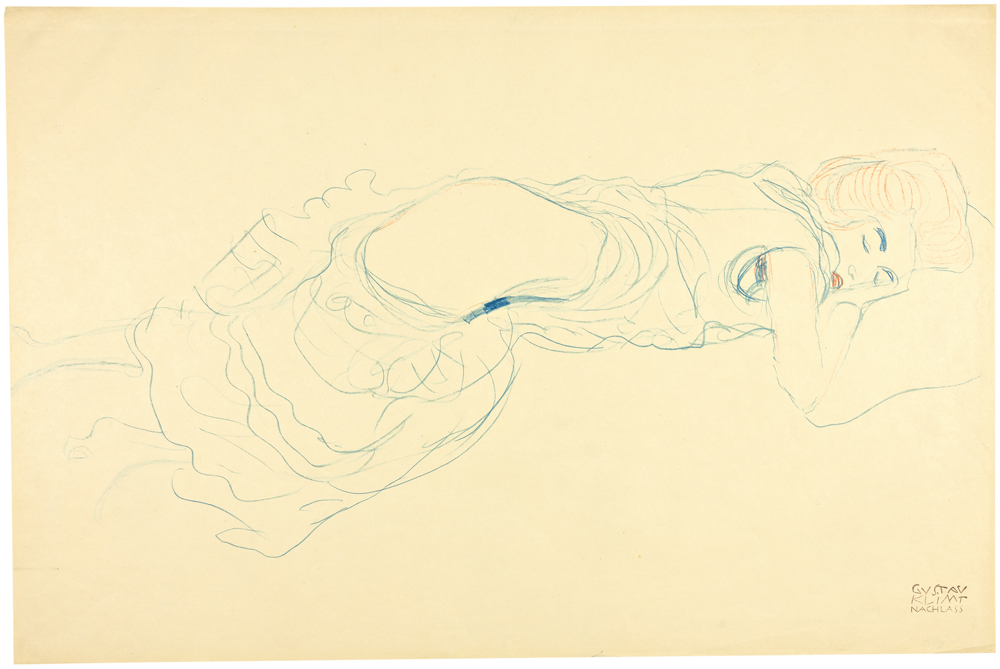
"I never painted a self-portrait. I am not interested in myself as a subject; rather, I am drawn to other people, especially women. Whoever wishes to understand me as an artist - which is the only remarkable aspect - should look at my paintings and discern through them who I am and what I seek to express." —Gustav Klimt If Klimt's paintings offer a way to understand the artist, his drawings bring us closer still—distilling his vision into its most direct and intimate form. Gladstone and Richard Nagy Ltd. present Women, an exhibition of studies and drawings by Gustav Klimt. Both sublimely sensual and modern, the exhibition is an overview of Klimt's mature style of drawing, one that owes more to the Austrian artistic movement Jugendstil than the academic. Notably, Klimt's extensive collection of erotic drawings, which sparked controversy both during his lifetime and after, remains a significant aspect of his oeuvre. Today, the preparatory drawings related to his paintings are regarded as some of Klimt's finest works.
 PastThe Rest
Rachel Rose
Mar 13 – Apr 26
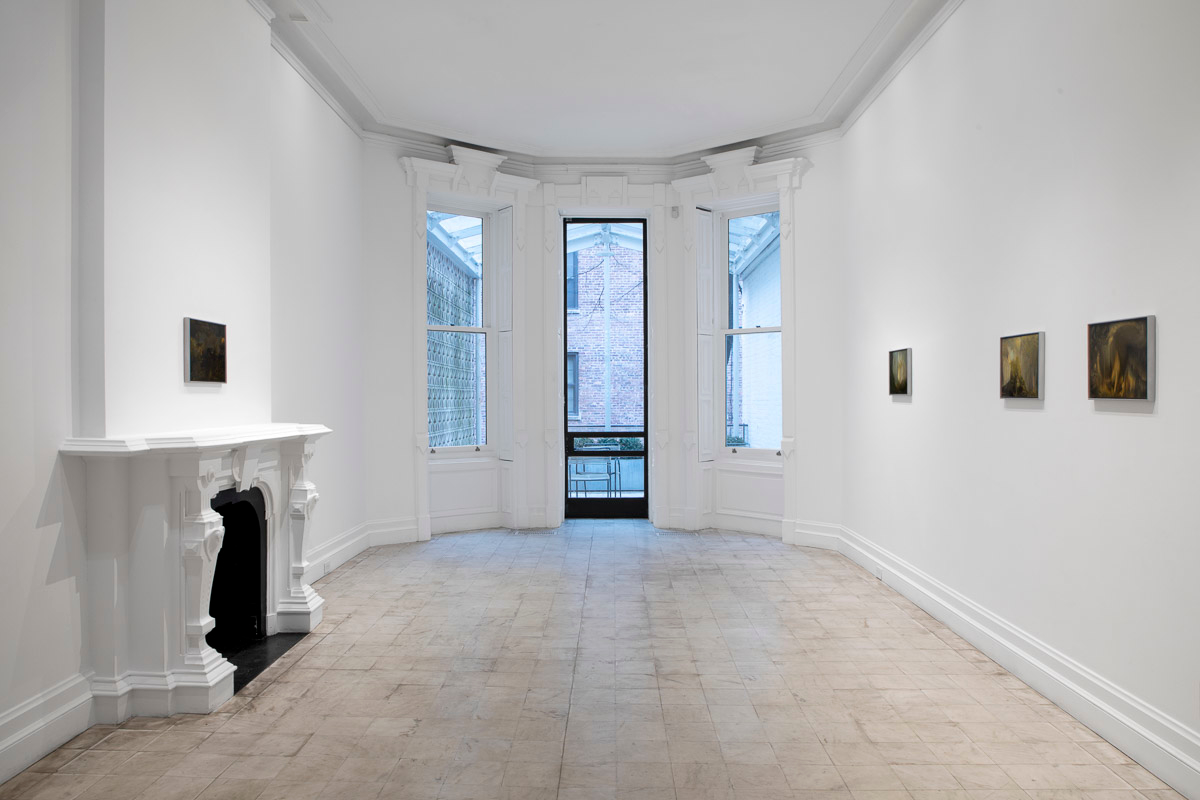
Gladstone is pleased to present The Rest, an exhibition of new paintings by Rachel Rose. This body of work expands upon the artist's past investigations into the relationship between storytelling, landscape, and the structuring of our belief systems. Rose here addresses the canon of devotional paintings that depict the biblical allegory of the holy family's flight to Egypt. Illustrating a pause in the journey of Mary, Joseph, and the newborn Jesus as they escape the threat of King Herod, these images typically conflate the natural world with indications of serenity, danger, or the miraculous, situating the story's protagonists in a world driven by symbolism. For The Rest, Rose has chosen to address this moment exclusively from the perspective of Mary, depopulating the picture plane and extracting all imagery extraneous to this singular point of view. Through this lens, we see the edge of a forest, the drift of clouds passing through the sky or over a moon, the prismatic refraction of the sun's light, branches bending towards the earth. The 13 paintings included in the series expand this moment to a full day, charting the shift from dawn to morning, afternoon to dusk, and dusk to night. In these works, Rose’s smearing, blurring, and flashes of focus suggest that the suspension of time is as much a subject of painting as is the landscape. In the history of this apocryphal moment, Mary is often seated breastfeeding her baby. The world pauses and warps for her. Rose’s technique in the depiction of nature, to envision it as bleeding and yielding, reveals how the Virgin Mary might have experienced it in the moment. The paintings are an expression of the unconscious state of non-time we might enter when guarding, protecting, or loving. The Rest is an abbreviation of the longer, commonly used title invoked across Europe for centuries, from Caravaggio to Patinir. The original title is descriptive yet vague. What does “the rest” mean? Under the influence of some kind of magic, evoked by some kind of love, mother and child find repose, alluding to a moment when time stops and the universe intervenes. Nature reflects these powers at work, presenting a surreal reality that is embedded the natural world. Rachel Rose (b. 1986) works in film, painting, sculpture and drawing. Her practice explores how landscape shapes storytelling and belief systems, and investigates from different vantages how the everyday holds the sublime. She has held numerous solo exhibitions throughout the world and her work is held in major public collections including the Hessel Museum of Art, Bard College, NY; Julia Stoschek Foundation, Düsseldorf; Los Angeles County Museum of Art (LACMA), Los Angeles; LUMA Foundation, Arles; Musée d'Art Moderne, Paris; Ishikawa Foundation, Tokyo; Tate Modern, London; Whitney Museum of American Art, New York; and the Dallas Museum of Art, Dallas, among many others. She was the recipient of the Frieze Artist Award in 2015 and the Illy Present Future Prize in 2014. She participated in the 57th Venice Biennale, 57th Carnegie International, 32nd São Paulo Biennial, and 3rd Jeju Biennale. Rose lives and works in New York, and is represented in New York, Brussels, and Seoul by Gladstone Gallery and in London by Pilar Corrias Gallery.
Past
Karen KilimnikKaren Kilimnik
Sep 26 – Nov 2
Gladstone Gallery presents an exhibition of works by Karen Kilimnik from the late 1980s onward, following the gallery’s presentation of new paintings earlier this year. Surveying Kilimnik’s career-long devotion to diverse media, the exhibition attests to both her central role in the revitalization of painting, as well as to her masterful and genre-transgressing impulse to negate the distance between personal, art historical, and cultural archives. Karen Kilimnik has been a singular and expansive force in contemporary art for more than four decades. From dioramas to mise-en-scène, painted portraits and landscapes, to video, Kilimnik has constructed an immersive and interconnected world, a vision that offers us passage into the environs of our shared cultural fantasies. Her constellation of titles and her rich visual vocabulary reveal a body of work that is both personal and conceptual. Kilimnik’s works of this period seem to confer her complex perspective on the notion of public image, moving between the grandeur of European history and iconography of the contemporary day. The exhibition features rarely seen works including the single-channel video Heathers (1992-93), as well as paintings such as Mary Calling up a Storm (1996), featured in the artist’s F::G exhibition at the Musée d’Art Moderne de la Ville de Paris. Reflecting Kilimnik’s pioneering role in constructing environments and sculptures in dialogue with her paintings, works such as Eau de Joy (2005) an artificial bird’s nest incorporating audio and olfactory elements, underscore the breadth and innovation of her practice. Karen Kilimnik (b. 1995, Philadelphia, Pennsylvania) studied architecture at Temple University, Philadelphia. Kilimnik’s work has been included in major exhibitions at the Institute of Contemporary Art Philadelphia, Museum of Contemporary Art Chicago, Musée d'Art Moderne de la Ville de Paris, and Carnegie Museum of Art, among others. Her works are held in leading institutional collections across the U.S. including the Metropolitan Museum of Art, National Museum of Women in the Arts, Solomon R. Guggenheim Museum, Museum of Contemporary Art Chicago, Los Angeles Museum of Contemporary Art, Museum of Modern Art, Carnegie Museum of Art, San Francisco Museum of Modern Art, and Whitney Museum of American Art, among others; and international collections including Fondazione Prada, Fondazione Di Vignola, and Statens Museum for Kunst.
Past
Sculptures, Drawings, ModelsWalter Pichler
Jun 27 – Aug 2
Gladstone presents Walter Pichler: Sculptures, Drawings, Models, marking the artist's first exhibition with the gallery since 2001, curated by Olivia Shao. Comprising fourteen works from across Pichler's rich career, the show highlights the wide range of mediums in which he practiced, including photography, sculpture, and drawing, as well as his exploration of architecture, history, and the relationship between the human body and technology. This exhibition marks a special tribute to late gallery founder Barbara Gladstone, as it was the last presentation she actively oversaw, in close dialogue with Shao and the Walter Pichler Estate. "When Barbara Gladstone invited me to organize an exhibition of Walter Pichler’s work in the summer of 2023, she did so with one important condition: that I travel to Vienna and the Austrian countryside to see his extensive body of work firsthand—his drawings, sculptures, models, experiments, and architecture. Visiting Vienna offered invaluable insight into the inner workings of a brilliant artist, architect, and craftsman. In contrast, traveling to Pichler’s compound in the Burgenland countryside felt like stepping back in time—an immersive experience revealing the deep interconnection between his studio practice, domestic life, and natural surroundings. It was there that I fully understood his uncompromising commitment to working entirely on his own terms. Inside his workshop, surrounded by sculptures and models, one witnesses a deeply disciplined, labor-intensive process, where humble materials such as clay, plaster, concrete, wood, and metal, are transformed through meticulous care and intentions. Set amid the expansive landscape of his farm, seven architectural structures built by Pichler himself house his sculptures. These buildings are not mere containers but extensions of the work—integrated with the environment, built to endure the seasons, and responsive to the changing natural light. As light shifts throughout the day, perception of the work changes, fostering a deeply personal and evolving relationship with each piece. In this idyllic setting, time seems to stand still, dissolving the boundaries between art, architecture, and life. Walter Pichler: Sculptures, Drawings, Models brings together a range of works exploring themes central to Pichler’s practice: the relationship between the body, perception, and time; reflections on technology; and traces of personal and cultural history. References to ancient civilizations are evident in his materials and forms. One important work, Finds from Crete (1970), evokes the concept of the readymade by juxtaposing an aluminum hook found by the artist with a marble-scale reconstruction of a “Horn of Consecration,” an artifact uncovered by archaeologist Sir Arthur Evans. These horns, once placed atop Minoan and Mycenaean tombs and shrines, are believed to mark sacred structures. They may represent bull horns, or, as recent scholarship suggests, connect to the “Egyptian symbol of the mountain or horizon.” This layered symbolism echoes Pichler’s enduring interest in the horizon line, a formal and conceptual thread woven throughout his sculptures, models, drawings, and architectural works. The exhibition also highlights personal relationships that shaped Pichler’s life and work. These include a poignant photograph of Woman in bronze and lead, unfinished (1990), taken by the artist’s wife Elfi Tripamer; the previously unseen The Lonely Friend (1981), a sculpture made for his daughter Anna; a photograph of Stone (1962), which functions as both a beautiful sculpture and a grave marker for a friend, Horst Hutterer; and Butterfly (1962), a favorite piece of Barbara’s. Barbara spoke with such warmth and admiration for Walther Pichler and his family—her eyes lit up as she recounted memories of his many projects and the remarkable architecture he created to house his work. This exhibition serves as a tribute to her as much as to Pichler, honoring the personal connections that bring new and intimate perspectives to his art. It has been a privilege to work closely with Anna Tripamer, Walter Pichler’s daughter and director of the estate, whose knowledge and generosity made this exhibition possible. I am deeply grateful to both Anna and Elfi Tripamer. My sincere thanks also to Kathy Halbreich for her enduring friendship, insight, and support." —Olivia Shao Walter Pichler was born in 1936 in Deutschnofen, Italy and lived in Austria until he passed in 2012. Pichler was the subject of numerous solo exhibitions at the Arthur Ross Architecture Gallery, Columbia University, New York; Tiroler Landesmuseen, Innsbruck, Austria; Stedelijk Museum, Amsterdam; Generali Foundation, Vienna; Galerie Museum, Bolzano, Italy; Museum fur Angewandte Kunst, Vienna; Haus der Kunst, Munich, Germany; and Kunsthalle Tubingen, Germany, among others. He has also been included in group exhibitions at institutions including: MAK Study Collection Furniture, Vienna; Austrian Cultural Forum, New York; The Generali Foundation, Vienna; Museum of Contemporary Art, Zagreb, Croatia; Museum of Modern Art, New York; Shanghai Art Museum, Shanghai; and the Kunsthalle Wien, Vienna. Pichler participated in Documenta 6 (1976) and Documenta 4 (1968) in Kassel, Germany.
Past
Anna ZemánkováAnna Zemánková
May 3 – Jun 15
Gladstone Gallery presents an exhibition of drawings by Czech artist Anna Zemánková (1908–1986), spanning her oeuvre from the 1960s-1970s. This exhibition emphasizes the remarkable foresight of Zemánková's work through an art historical lens, reflecting her trailblazing influence in abstraction and seeks to expand the psychological and spiritual realms of the form. The works in the show comprise rarely seen incandescent botanical drawings and pastel works on paper. To engage with Zemánková's art is to enter a realm of fluid metamorphosis. Her compositions pulse with biological urgency, as if each line were a living organism. Untitled (1970s), reminiscent of the zither her father once played at weddings, radiates effervescent yellows laced with electrifying blues, its thorns piercing velvety curves. Fibrous strings extend like tentacles or arpeggios of color. Here, sound becomes substance in a stunning manifestation of synesthesia: a shimmering grid of magnified cork-cells vibrate with Charles Lloyd's spatial melisma. Zemánková's visual language thrives on the duality of microscopic precision and cosmic abstraction, a tension mirroring her process—trance-like improvisation guided by innate musicality. A dentist, mother, and grandmother, Zemánková channeled life's multiplicities into creations that defy simple categorization. While often compared to mediumistic artists such as Kunz or Klint, Zemánková's work rarely touches on spirituality directly, instead rooting itself in the subconscious—what the Surrealists termed "pure psychic automatism." In her quotidian back-and-forth between labor and leisure, Zemánková found a way to forge her cellular patterns into networks of visual information and stimulation, liberating herself from the physical confinement imposed by her diabetes. Her refusal to title works, another deliberate act of liberation, invites viewers to project their own narratives onto her wildly imaginative botany. Cleaving open otherworldly spaces with her art, Zemánková's legacy lies in her fantastical elsewhere. Born in Moravia, Zemánková came of age during the collapse of the Austro-Hungarian Empire and the birth of an independent Czechoslovakia in 1918. This era fostered a fervent patriotism, marked by a devotion to preserving cultural traditions such as folk costumes, songs, fairy tales, and ornamental drawings. These influences ignited Zemánková's early passion for painting. Though gifted in depicting colorful, realistic landscapes, her parents discouraged her from attending art school, redirecting her toward dentistry. Amid the turmoil of political and social upheaval, Zemánková followed a conventional path: marriage, motherhood, and grandmotherhood—roles that temporarily eclipsed her artistic ambitions. Zemánková's artistic rebirth began serendipitously. In the late 1950s, her sons Slavomír and Bohumil discovered a forgotten suitcase filled with her early paintings in the family basement. Recognizing the vitality of these works, they encouraged her to resume painting—a therapeutic act that blossomed into an astonishing late-career surge. Though self-taught, Zemánková was no recluse. Her son Bohumil and daughter-in-law Markéta, both trained sculptors, admired her intuitive genius, as did a circle of cultural figures including artist Jan Reich, filmmaker Vlastimil Venclík, and even First Lady of the Czech Republic, Olga Havlová. Zemánková actively courted public recognition, hosting an open house several times over the years (1964, 1967, 1968 and 1970). Her work was exhibited at Prague's Theatre on the Balustrade in 1966 and later shown at London's Hayward Gallery in 1979. In the quiet hours before dawn, she would rise in her Prague apartment, surrounded by real and artificial flowers, and surrender to the classical music of Beethoven and Janáček or the Jazzy Blues of Charles Lloyd. These solitary sessions, lit by the soft glow of imagination, became her sanctuary. With paper as her stage, she conjured a universe of pulsating tendrils, succulent petals, and coiled organic forms—a paradise of biomorphic flowers that blurred the boundaries of reality. Born from the shadows of personal suffering, her work invites the viewer into a kaleidoscopic garden where beauty and the grotesque intertwine, where music morphs into matter, and where creation itself becomes transcendence. This exhibition is presented in collaboration with the Estate of Anna Zemánková and Cavin-Morris Gallery. "Sure, I'll draw you something, I'll draw you one of my fantasies." —Anna Zemánková
Past
Gillian CarnegieGillian Carnegie
Mar 12 – Apr 27
"Painting may find its subjects in everyday life, but it removes from them, precisely, their reality, like the moisture extracted from flowers in order to preserve them." —Barry Schwabsky Though the artworld in recent years has privileged explicit narrative over formal nuance, Gillian Carnegie insists that her subject matter remains secondary to the act of painting itself. The artist's recurring motifs—cats, staircases, dried flowers, portraits, and trees—serve merely as the foundations for her process. Liberated from narrative convention, Carnegie's approach allows the viewer to focus solely on the paintings themselves, inviting us to experience her imagery as a series of ephemeral moments that document pure visual perception. Carnegie's work doesn't demand excessive analysis yet paradoxically offers a wealth of analytical possibilities. The artist's quiet demeanor and avoidance of the artworld's spotlight manifests in works that are introspectively evocative of stillness. Carnegie remarks, "I never felt the need to feel informed about the experience of seeing a painting in order to understand it… I'd like to think someone would still want to look at a painting rather than inform themselves about it beforehand." Carnegie makes just two to three paintings a year, and though she consistently revisits a handful of motifs, she is also known for presenting strikingly novel interpretations of her subjects within these confines. The artist utilizes a similarly enigmatic approach to titling, often reusing names across different subject matters so that her works are distinguishable only by the year of their creation. Deeply emotional and unwavering in their focus on form, these paintings communicate powerfully through their silence. Deftly navigating the semiotic structures that frustrate a perfect union between the signified and the signifier, Carnegie's paintings knowingly invite varied interpretations. Her recurring inclusion of her black and white cats, Prince and Elgar, evoke parallels to both Édouard's Olympia (1863) and Charles Baudelaire's feline poetry. This literary and art-historical analogy enriches these paintings, which she has been creating since the early 2000s, exploring themes of perception, recognition and perspective. By complicating her seemingly simple subjects with layered symbols of cultural and philosophical meaning, Carnegie demonstrates her ability to imbue the ordinary with extraordinary meaning, inviting a rich dialogue between past and present, art and literature. The solemn melancholy that permeates Carnegie's paintings is particularly evident in her still lifes, which depict the desiccated bouquets she has kept in her studio for over 20 years. Bridging the gap between portraiture and memento mori, these works signify the passage of time, the idea of life itself, and the notion of the trace. This idiosyncratic practice is not mere repetition; it serves as a documentation of the essential mundanity and banality of life. Formally, these dried flower paintings differ not only in lighting and angle, but also in their stylistic approaches—sometimes more naturalistic, other times more geometric, they represent a conflation of observation and imagination. Carnegie's portraits typically depict herself or those within her inner circle. These subjects are captured in contemplative poses and against minimalist backdrops, exuding an air of self-possessed elegance. Though painted in color, the portraits are executed with a subdued palette, echoing the restrained beauty found in her other works. Intriguingly, these figurative pieces share a kinship with Carnegie's enigmatic cat paintings, and the emotional states of the sitters remain as inscrutable as those of the cats. This deliberate—or perhaps instinctive—evasion of overt emotional display imbues the works with a hallmark restraint and invites us to return to the fundamental act of seeing, encouraging a direct and unmediated engagement with the visual world.
Past
Jaider EsbellJaider Esbell
Jan 29 – Mar 2
Featuring a selection of significant paintings from Indigenous Brazilian artist, curator, and activist Jaider Esbell (b. 1979, Brazil; d. 2021, Brazil), this exhibition comprises scenes of exuberant dreamscapes rendered with acrylic markers in an exhilarating palette. In combination with his interest in environmentalism and land rights, Esbell’s work evokes a potent altruistic sense of collectivism.
Past
The Oklahoma Nature TheaterBrook Hsu
Nov 8 – Dec 21
Gladstone Gallery is pleased to present an exhibition of new paintings by American artist Brook Hsu. The 14 works in this show reflect an artist in transition. She nostalgically revisits past motifs while finding joy in experimenting with new ones. The leap from piece to piece is a nod to the exquisite corpse of narratives and the agency of stories. “Who tells whose story?” she asked. “What do you mean?” he replied. They were sitting high up on a ridge, overlooking the valley below to the West. It was early in the morning and the world was saturated with dew, vapor rising up breathily from the boggy areas surrounding the sharp bends in the river below. As if she hadn’t heard his reply, she continued, “Sometimes I wonder, how did I get here?” “Well you’re here on this mountain with me,” he reassured her, turning her chin to look her in the eyes, “and there’s no where else in the world I’d rather be.” She was happy, and also in love, but ostensibly adrift. She had the habit of wandering the cul de sacs of her memories, unable –at times– to discern between her own and those that belong to history. The skeletons of her past were alive and well. She observed the brown, shrubby valley below. The chirp of the frogs oscillated from a fuzzy murmur to a choral uproar as the breeze shifted directions, as it was prone to do at this altitude. A moment passed. She responded, tenderly yet detached, “No, I mean, how did I get here as a painter. As an artist? All of these hundreds of years of history and painting, culminating upon me, and I find myself painting the image of a sexy frog in a cowboy hat, over and over, on repeat. What does this have anything to do with Titian or Poussin, Holbein or Cole? Where is the throughline from Mannerism to Romanticism? I feel a deep connection to everything from the myths of Ovid to Buffalo Bill's Wild West Shows, from Tsai Ming-liang's watermelon sex to Silence of the Lambs. I’m desperately seeking to situate my paintings in the referential supermarket of taste.” She sighed. At ease, he wrapped his rugged, sun-tanned arm around her frame and chuckled –as if accustomed to these rants– “I don’t know babe. I love you for what you are, not what you paint.” (Little did he know how insulting that can sound to a painter) He kissed her temple, which she accepted. “I read books, and I travel and I research, and I have this mental map that connects everything from Murakami, Klossowski, Oklahoma, Polke, Kafka, Kippenberger, Kawara... each cover I close I'm drawn to open a new one. I feel I’m in a labyrinth." She paused, eyes wide open, staring at a darner that sat aperch a sturdy blade of sawgrass, wobbling slightly underneath the insect’s weight. Then, like a knee jerk reaction (or even like vomiting), she guffawed. It was a gaggle, not just a giggle. She was pleased at how her body could surprise her. As her uproar calmed into a giggle, he joined in, picked up the grey-green suede cowboy hat from her side and placed it atop her head, where it fit perfectly. As they looked out on the landscape, the fog was rising along with the sharp angle of the first rays of sun, distorting the perspective of everything in front of them. It was at that moment that she realized that the colors in her paintings of this place were just an emotional projection, not based in reality. She realized that figure and ground could just be a theory; it didn’t have to be a fact. She thought about how the act of painting had been a cathartic action throughout all of her life. All along it was more in the body than in the mind. For a fleeting moment, she achieved the peace of those who are incomplete, but who belong. —Amanda Schmitt Brook Hsu (b.1987) lives and works in New York and Wyoming. Hsu received her BFA from the Kansas City Art Institute in 2010 and her MFA from Yale University in 2016. Recent solo exhibitions include: Kiang Malingue, Hong Kong (2022); Kraupa-Tuskany Zeidler, Berlin (2021); Manual Arts, Los Angeles (2021); Bortolami Gallery, New York (2019). Hsu has presented in group exhibitions at Oriole, Hamburg (2024); Et al. Gallery, San Francisco (2024); New York (2024); 14th Shanghai Biennale (2023); K11 Shanghai (2023); Zürich Biennial, Kunsthalle Zürich (2023); Paul Soto, Los Angeles (2023); Adler Beatty, New York (2022); Derosia Gallery, New York (2022); Hannah Hoffman, Los Angeles (2022); kaufmann repetto, New York and Milan (2021); TANK, Shanghai (2020); Clearing, New York (2020); Jan Kaps, Cologne (2020); Insect Gallery, Los Angeles (2019-2020); Château Shatto, Los Angeles (2019); in lieu, Los Angeles (2019); and The Renaissance Society, Chicago (2018-2019). Hsu’s work is held in the collections of the X Museum, Beijing; Long Museum, Shanghai; and Musée d’Art Moderne de Paris.
Past
ArcanumsRobert Rauschenberg
Sep 21 – Nov 3
In collaboration with the Robert Rauschenberg Foundation, Gladstone presents an exhibition of Rauschenberg’s Arcanum series (1979). Derived from the Latin word for secret, arcanus, the title of these artworks and this exhibition underscores Rauschenberg's ongoing fascination with the esoteric aspects of both the spiritual and physical worlds. The drawings in the series explore the fragmented and layered nature of thought and communication, demonstrating Rauschenberg’s instinctual ability to transpose the human experience into his artistic practice. Since the beginning of the artist’s career, Rauschenberg’s work has been rooted in experimentation and pushed boundaries across a myriad of media. Resisting conventional modalities and avoiding association with a singular historical movement or style, he was guided by an ideology that intersected art and life. In a 1989 interview, he was asked “How would you describe the importance of the metaphysical, the transcendental content of art?” to which he replied, “I don’t think you can separate them. The object of art is to not separate those things. You don’t make an icon for either of them. You just indulge in the process of putting them together.”[1] Rauschenberg’s practice was centered around looking beyond the sole possibilities apparent in real-world objects, deftly bringing together an expanse of ideas that contend with the interplay of mysticism and technological innovation within his work. In the late 1960s, after an astrologer advised him to “head for the water and the sun,” Rauschenberg frequented trips to Captiva, Florida, a remote island off the coast where he would eventually relocate his residence and studio from New York in 1970. Captiva became a major source of inspiration for the artist, who continued to integrate found objects and readymade materials into his later works. Fabric was a key material in Rauschenberg's Arcanum series. While Rauschenberg had used fabric in his earlier works, his new drawings were invigorated by the richly colored cloth that inspired him during his visit to a textile center in Ahmedabad, India in 1975. Expanding the potential of recognizable imagery across artistic mediums and forms, Rauschenberg transferred images depicting religious iconography, natural phenomena, popular culture, symbolic diagrams, and architectural monuments onto his drawings. This imagery was incorporated into his drawings using a solvent transfer technique, where a printed source is treated with a solvent, placed face down, and then the image is transferred through pressing. The resulting images are low-resolution and fragmented, and Rauschenberg further obscured the legibility of the initial image by adding grids and meshes of fabric, and layers of pencil, gouache, and watercolor. This process, both mechanical and spiritual, reflects the artist's desire to connect with the incomprehensible and communicate the sublime. Rauschenberg's work examines the complexities of human perception and understanding, often juxtaposing handmade and machine-made imagery and techniques. In the Arcanum drawings, the artist’s compositions attempt to define a symbiotic relationship between art and technology using imagery drawn from mass media. The source imagery communicates more than the fragments transposed on the works, reflecting Rauschenberg’s emphasis on the process of connecting objects and ideas—glimpses of technological innovation contrast with decorative illustrations of architecture and old master paintings within his abundant visual fields. A sense of relevance permeates these works as Rauschenberg integrates images into his drawings of contemporary advancements and digital tools from scientific magazines and newspapers. The Arcanum series manifests Rauschenberg’s enduring dedication to capturing the elusive relationship between images and ideas in his work, underscoring his relentless pursuit of understanding and innovation throughout his career. A catalog featuring an essay by Jennifer Higgie accompanies the exhibition. 1 - Robert Rauschenberg, quoted 13 September 1989, Captiva, Florida, in Art Meets Science and Spirituality in a Changing Economy (The Hague: SDU Publishers, 1990), p. 45.
Past
The Secret HistoryJun 20 – Aug 3
Chino Amobi, Hope Atherton, Matthew Barney, Nicholas Bierk, Matt Hilvers, David Jones, Karyn Lyons, Ruby McCollister, Michele O’Marah, Kayode Ojo, Shigeo Otake, Micki Pellerano, Adam Putnam, Rachel Rose, Arisa Yoshioka, Marissa Zappas “‘And if beauty is terror,’ said Julian, ‘then what is desire? We think we have many desires, but in fact we have only one. What is it?’ ‘To live,’ said Camilla. ‘To live forever,’ said Bunny, chin cupped in his palm. The tea kettle began to whistle.” —Donna Tartt, The Secret History I’ve been thinking about Pompeii a lot lately. It’s maybe a funny thing that the subject has only just now attracted my attention, but I was never interested in those gruesomely contorted bodies before, I never saw the poetry in the carbonized loaves of bread still embossed with the melancholic trace of a baker’s thumbprint. I don’t know what it is that changed in me, but I know for sure that nothing at all has changed about Pompeii. I suppose that’s exactly what we like about it; as the contemporary world convulses under an avalanche of self-renewing catastrophes, it’s a relief to know that there is at least one place that stays exactly the same. Last night I watched a documentary that follows a group of archeologists as they begin excavating a previously unexamined area of the ruins. I noticed that each one of these people appears visibly moved when their little sieves produce 2000-year-old shards of eggshell or a casually discarded fishbone, that they are breathless with anticipation when the flick of a brush reveals inscrutable graffiti scrawled across a limestone wall. I think it must be hard to maintain that level of enthusiasm, but I do find it kind of touching that even the most insignificant of discoveries is treated with reverence and dignity. I guess the truth is that it’s a cumulative effect, that every unearthed object brings us closer to understanding the mystery of what it means to be subsumed by the unspeakable violence of our world. I recently learned that the etymological root of mystery can be traced back to the Greek musteria, which is a word that was used to describe a secret series of ancient Greco-Roman religious rites known only to initiates. Derived from muo, the Greek verb for “to close or shut,” the term itself implies the compulsory code of silence that protected the esoteric rituals, cultic practices, and sacral laws that flourished in the time of Pompeii. Sometimes comprised of a surprisingly diverse socio-economic cross section of devotees, these Mystery Cults not only aimed to momentarily collapse the distance between birth, death, and the afterlife, but promised epiphanic experiences in which participants could fill themselves with the material presence of a deity. These mergers were not interpreted as purely spiritual events, but rather as radically transformative physical interactions, divine encounters that dissolved persona, eradicated mortal rationality, and breached the barricades that quarantine man from the gods. In 1909, archeologists on the outskirts of Pompeii uncovered a structure that has come to be known as Villa dei Misteri, a 1st century BC private home outfitted with a series of remarkably well-preserved frescos that depict a young woman receiving initiation rites into a Dionysian Mystery Cult. Devoted to the god of wine, fruit, pleasure, fertility, and madness, rituals oriented around Dionysus encouraged a frenzied abandonment of the self that aimed to briefly return believers to their primordial nature. Accessing altered states of consciousness through the consumption of ergot-laced wine, ecstatic dancing, omophagia, and orgiastic sex, these rituals satisfied a profound human fantasy for transcendence that time has not yet liberated us from. The ancient pursuit of the cultic trance state is just another version of the belief that maybe things are better somewhere else, in the past or in the future, in a different city or a different bed... Maybe, these fantasies whisper to our subconscious minds, there is some way to run away from ourselves and still manage to find our way back again. This exhibition is titled after The Secret History— Donna Tartt’s beloved mystery told in reverse— and though I have spent a lot of time thinking about the book and could certainly summarize its plot, I feel it would still be a difficult task to explain to someone who hasn’t read it what it’s actually about. On its surface, the novel tells the story of a group of young classical studies students who accidentally set off a series of disastrous events when their intellectual hubris, social alienation, and misplaced romanticism inspire a ritual invocation of Dionysus. Fixated on a dead language and its obsolete world, Tartt’s protagonists suffer a schizophrenic crisis; while their fantasies ricochet around a technicolor past filled to overflowing with gods and mysteries and the seismic tragedies of Homer, their bodies remain tethered to a Taco Bell present. I suppose in many ways, I think The Secret History is a book that ponders why we so often fail to calculate that world doesn’t always change in the ways we think it does; it’s not just us who are dissatisfied, people have always looked for ways to escape. I think of Pompeii and the blanket of ash that filled its mystery rooms and covered its outdoor fast-food counters, its laundromats and its gardens. I think of the landscape, now depopulated to zero save for its famous plaster ghosts, those tortured figures caught frozen in shock as they crawl away toward a future that never comes.
Past
Drawings (1974–2006)Elizabeth Murray
Apr 30 – Jun 13
Gladstone presents Elizabeth Murray: Drawings (1974-2006), an exhibition of over sixty rarely seen works, curated by Kathy Halbreich. Familiar with Murray’s oeuvre across mediums, Halbreich co-organized the first retrospective of her work, Elizabeth Murray: Paintings and Drawings in 1987, which originated at the Dallas Museum of Art and traveled to major institutions nationally. Halbreich once again contributes to shaping Murray’s legacy as an inventive painter whose drawings provide insight into her drive to blur traditional distinctions between abstraction and figuration in order to make work that was both intimate and formally muscular. This exhibition expands understanding of how Murray used drawing as a critical tool. It also highlights how her hybrid experimentation laid the foundation for innovative artists working today, particularly those who embrace and portray the tensions of everyday life. Elizabeth Murray’s expressive and often poignant work unites carefully crafted three-dimensional structures and layered surfaces that appear to be found through an almost jazz-like improvisation. Her works are starkly contrarian, avoiding easy categorization and resisting association with a singular historical movement or style. While painting as a medium fluctuated in popularity during the latter half of the 20th century, Murray’s aesthetic ambition, distinctive style and gestural certainty mined the ongoing rebellious qualities inherent in painting. Undeterred by the rise of conceptual art in New York in the 1960s and the growing popularity of video and performance art in the 1970s, Murray challenged the prevailing belief that painting was a less innovative and timely medium with her irregularly shaped and often monumental canvases, destabilized and surreal interiors, and biomorphic often cartoon-like forms. Through this presentation of drawings spanning from 1974 to 2006, Halbreich foregrounds work of all sizes and finishes that has remained largely unseen. Unencumbered by the demands of large-scale painting, Murray found, through drawing, an explosive freedom in mark-making that also served as a quick way to work through compositional problems before beginning her complex paintings. Murray's drawings serve as both studies for paintings and standalone works, capturing the gradual emergence of images and ideas from initial sketches to polished pictorial illusions, reflecting her unwavering experimentation and dissatisfaction with pat or pre-determined solutions. In Elizabeth Murray: Drawings (1974-2006), the artist’s compositions capture a haptic reality representative of her conceptually and sensorily driven practice. Throughout her career, Murray embraced the precarious, humorous, and zany aspects of domestic life, allowing an emotional awkwardness and vulnerability to emerge that also is visible in Cezanne’s still lifes and portraits of his wife, which Murray knew well. Out of a web of repeating and often anxious gestures, identifiable interiors or objects such as tables, chairs, shoes, and cups emerge and shatter. Murray finds the line she needs to express her emotions, navigating a breadth of diverse and nuanced mark-making—ranging from rushed and labored to smooth and jagged, from nervous to joyful. By installing these drawings in Gladstone’s Upper East Side townhouse, Halbreich underscores the domestic subject matter as well as small scale of many of the artist’s sketches and drawings. The curator’s choice of drawings also reflects upon Murray's deep knowledge of the history of painting and her relationship to artists such as Jasper Johns and Pablo Picasso. For Halbreich, “the freedom Elizabeth managed to fight her way towards is especially vivid in her drawings. She was fearless and joyful even when the shadow of doubt surfaced; she explored throughout her career how to use uncertainty to push her inventiveness forward. Her humor, intelligence, and intensity are clear in this exhibition, providing, I hope, a vision of how much of a model Elizabeth was for her peers as well as artists of all stripes working today. Those who appreciate her most understand the honesty of her endeavor: how she never shied away from displaying the life force found in her daily life, in the studio and at the kitchen table. This has nothing to do with style and everything to do with being human.” Accompanying the exhibition is an idiosyncratic brochure written and designed by artist and writer Paul Chan that thoughtfully explores Murray's sensitivity in her approach to drawing, highlighting the delicate connection between pencil and page.
Past
Unique ConstructionsRobert Mapplethorpe
Mar 19 – Apr 21
In collaboration with the Robert Mapplethorpe Foundation, Gladstone presents an exhibition of rarely seen three-dimensional objects, photographic assemblages, and mixed media collages. Spanning from 1971 to 1984, the works in this special presentation offer a compelling new perspective into the artist’s deeply intertwined life and practice. Through an exploration of less familiar imagery and juvenilia significant to Mapplethorpe’s artistic development, the exhibition examines the artist’s innate mastery of form evident across his oeuvre, revealing a deeper understanding of both his work and his world. Mapplethorpe began his artistic endeavors at the Pratt Institute in Brooklyn where he studied graphic art and design from 1963 to 1969. Mapplethorpe’s education spanned various mediums including sculpture, drawing, painting, and graphic design, introducing the young artist to formalist principles that would be influential to a lifetime of aesthetic sensibilities. Mapplethorpe’s discerning eye for symmetry and composition, developed through his studies, is evident in the graphic identity of his earlier works known for their geometric motifs and iterative presentation. This is shown in the artist's photomontage Champagne (1975) where Dom Pérignon bottles are arranged in a triangular pattern following the rule of thirds. Self-portraits, in a photo booth strip format, and arrangements of colorful dollar bills also engage ideas of sequencing; the imagery is presented in multiples, with slight adjustments made in each iteration, whether that be the expression made on Mapplethorpe’s face or the hue overlaid onto George Washington’s. Mapplethorpe’s long-standing interest in formal perfection and experimentation can be traced throughout the artist’s practice, influential from his studies and early works, to his later classically composed studio photographs. Mapplethorpe’s work shares a distinctive visual language of familiarity that can be attributed to the connections the artist had with his subjects and the objects he presented. Photographed by Mapplethorpe in 1988 for House & Garden, the artist’s Chelsea apartment functioned as both a home and a studio, displaying a remarkable collection of art and decorative objects of his time while serving as the backdrop for his radical practice. The pleasure Mapplethorpe took in curating the belongings in his home accompanied a sophisticated eye for elegance and design, exemplifying the artist’s belief that, “the whole point is to try to integrate your life into your work if you’re an artist.”[1] Expanding upon the relationship between form and familiarity, the works on view at Gladstone’s Upper East Side townhouse share similar sculptural sensibilities and stylistic rigor to those that resided in the artist’s own apartment. Presenting this exhibition in a gallery setting reminiscent of a domestic interior blurs the boundaries between personal possessions and artwork. A coat rack, topped with an exposed light bulb, is shown both as an assemblage on view and in a photograph featuring a nude figure posing dramatically with the piece – in both instances, the works exude a rawness with the human body and light source laid bare. Although individual details about these objects remain elusive, collectively they offer valuable insight into Mapplethorpe’s artistic practice, underscoring the thematic importance of form, contrast, and composition. 1 - Filler, Martin. “Robert Mapplethorpe,” House and Garden, June 1988, p.158–63.
Past
Ed AtkinsEd Atkins
Nov 17 – Jan 21
Gladstone is pleased to present an exhibition of new works by British artist Ed Atkins. The dual-venue installation marks the artist’s first New York show with the gallery. Known for creating videos in which computer-animated proxies reflect on themes of loss, intimacy, abjection and melancholy, the artist’s multidisciplinary approach to artmaking examines the increasingly permeable boundaries that separate life from its digital simulations. Addressing contemporary culture’s fetish for media that painstakingly mimics the aesthetic contours of reality but fails to accommodate the burden of its subject, Atkins mines performance, theater, cinema, literature, and himself to examine the alive/dead dichotomy that ricochets between all bodies and their cybernated doppelgangers. A new booklet featuring an excerpt of the artist’s recent writing accompanies the exhibition. Premiering at 21st street is Pianowork 2, a new computer-generated animation that depicts the artist playing Jürg Frey's piano composition, Klavierstuck 2. Realized via a motion capture process that translated Atkins’ real-time performance into a hyper-realistic 3D digital model, the video is charged with the task of maintaining its self-aware artificiality while also remaining faithful to the event it resuscitates. Eschewing his typical preference for generic digital surrogates and choosing instead to animate a model with his own likeness, the artist unmasks himself under the skin of a new avatar that edges incrementally closer to “Ed Atkins,” but inevitably misses its mark. Captured in a single 20-minute performance, the film is a recursive compendium of duff chords, anxious grimaces, and phobic uncertainty. Though each failure is rendered in high-definition detail that suffuses Atkins' digital effigy with something familiarly human, the figure consistently exposes its own artifice. Running parallel to the insufficiencies of Atkins’ performance are the video’s own intentional technological shortcomings; here the real and the virtual shadow one another, becoming twinned models of inadequacy that unfold in alternate dimensions. Like the ventriloquist’s dummy, the artist’s double is fraught with the disorienting contradictions inherent to the uncanny; imbued with a surplus of artificial life, it cannot help but indicate death. Shown in concert with Pianowork 2 is Sorcerer, the cinematic adaptation of a play written and produced in collaboration with writer Steven Zultanski. Documenting an uneventful evening at home among friends, Sorcerer examines the casual horror that often undergirds banality. Written, staged, and filmed to exploit our understanding of the structural tropes that drive sit-coms and teleplays, Sorcerer teases what Atkins and Zultanski refer to as a “counterintuitive realism.” Though the script is constructed from transcripts of real conversations between a group of friends, the production remains formally bound to both dramaturgical strategy and televisual sleights of hand. Just as we slip in and out of believing the figure in Pianowork 2 is a representation of the artist himself, we encounter Sorcerer with a series of narrative expectations that remain dissatisfied when the first act collapses into the last without climax. The film’s closing scene dramatizes this intentional failure; alone at the end of the evening, one of the players sits calmly down and disassembles his face, revealing himself as a double agent who straddles the parallel constructed realities unfolding both on the stage, and in the audience. A pair of mechanized beds conceived by Zultanski and Atkins as props for Sorcerer dominate the artist’s 64th street exhibition. Undulating as though occupied by some nebulous unknown, the sculptures function as both trespassers and referents, material indexes of the intractable distance between performance and life. Further activating the connection between the works in both galleries is a group of ten self-portraits rendered in colored pencil on paper. Executed in excruciating detail, these drawings formally present themselves as documentation of material reality, but like the artist’s self-referential avatar, they are simply another series of Ed Atkins masks. Drawn from a perspective so close that the artist's face appears almost magnified, these works intentionally over identify with what Atkins refers to as a “slavish fidelity” to the image. Recalling the unheimlich qualities inherent to his computer-authored virtual body, these portraits probe at issues of time, aging, and the possibilities for objective truth within the realm of representation. Also included at 64th street is Voilà la verité, a short video in which Atkins reworks a single scene from Dimitri Kirasnoff’s 1926 silent film Ménilmontant. The sequence depicts a distressed young woman who seems to be recalling the downward slope of her life while sitting on a park bench, locked in a reverie of trauma until an elderly man sits next to her and wordlessly begins to share his lunch. After Atkins digitized, colorized, and re-rendered the scene with the assistance of artificial intelligence software, he added a Foley soundtrack of naturalistic ambient sounds. Reanimated by technology, the video rejects its status as projection and gestures towards something more akin to the haunted house. The past has returned to the future, but it doesn’t look quite the same. The title of the video is taken from the only discernible text in the film: the fragment of a headline visible on the newspaper in which the food is wrapped. “Voilà la vérité” — “This is the truth.” In Atkins’ world, we know that what we’re seeing is never exactly the truth, but perhaps it’s something even closer.
Past
Tintin, Nina & DiscoVivian Suter
Sep 19 – Nov 5
Gladstone Gallery is pleased to present Vivian Suter: Tintin, Nina & Disco, an exhibition of exclusively mixed media paintings from the artist’s decades-long career. This presentation is emblematic of Suter’s singular style of installation, in which painted canvases flood the gallery space, welcoming viewers into the artist’s cosmos. Suter’s work draws inspiration from Abstract Expressionism, Color Field, and most significantly, the natural environment. Since the 1980’s, the artist’s home and studio has been based in the lush climate of the Guatemalan lowlands. Suter’s paintings abstractly recall the natural forms and environmental stimuli that surround her through gestural references of mountain peaks, water bodies, trees, wind, and the sun. Further embracing a physical embodiment of nature within her works, eroded soil, plant matter, rainwater, and signs of animal life find a second home on the surfaces of her untreated canvases. The artist’s admittance of natural phenomena into her oeuvre disrupts a material hierarchy and places the components of her studio on equal footing with the biological world. Expanding upon Suter’s investigation of using the painted medium to create surreal three-dimensional spaces, this installation employs the gallery’s modern architecture to transpose elements of her tropical studio onto the gallery. The unique installation of unstretched canvases activate the gallery’s walls, floor, and ceiling, transforming the exhibition space into an interconnected painterly biome. While each piece is conceived of individually, the placement of the works over, alongside, across, and underneath one another creates compositions that continually and infinitely discover new relevance and importance within Suter’s work. This permission for recontextualization similarly democratizes the artist’s work for viewers, allowing for different permutations and transformations with each new immersive installation.
Past
Marisa MerzMarisa Merz
Apr 29 – Jun 18
Gladstone is pleased to present an exhibition of works by Marisa Merz (1926 – 2019). The show brings together significant works by Merz whose artistic debut was distinctly different from the rest of the Arte Povera cohort. Webs of delicate copper wire coalesce into geometric forms, faces materialize through smoky charcoal shadows, and eyes peer out from beneath Byzantine veils of gold. Strong or delicate, finished or unfinished, ancient or contemporary, the art of Marisa Merz is intensely dialogical. Viewing her works entails entering into a conversation with them. Meanings, and our understandings, deepen through a process of engagement with the seemingly opposed forces, states, or materials she harnesses in each work. We explore the edges of a gestural drawing to discover traces of a compositional scaffolding, we interrogate a block of wax to understand if it is liquid or solid, and we seek a figure emerging from a lump of unfired clay. The persistently enigmatic qualities of her works have frequently been understood as a feminist strategy, a way to side-step an aesthetic language that was inaccessible to, or at least ill-fitting for, women in mid-century Italy. Others have argued that such a lens limits our ability to understand her contributions to the broader history of sculpture, of postwar figuration, and of conceptual art. Understanding her works as invitations to dialogue–to investigate materials, sensations, and imagery–allows us to see the way Merz questioned the traditional role of the artist in ways that aligned with the most radical perspectives of her (male) Arte Povera colleagues, and, simultaneously, recast artistic identity in her own (female) image. Merz’s artistic debut was distinctly different from the rest of the Arte Povera cohort in that it did not come in an essay or exhibition organized by curator Germano Celant or hosted by Gian Enzo Sperone’s gallery, rather it can be traced to when she invited friends to see the pendulous sewn-aluminum forms known as Living Sculpture (1966) that had been steadily taking over the Turin home/studio she shared with her husband, artist Mario Merz, and their young daughter. That she understood raising a child and being an artist part of the same lived experience is evidenced in several works, such as the swing she built in their apartment and exhibited as a sculpture, or the “interview” she gave art critic Mirella Bandini, the entirety of which comprised a transcript of Merz and her daughter Bea discussing what to eat for lunch (not cake, but potatoes and homemade mayonnaise). Merz’s artworks graced Italian art galleries soon enough, as well as Turin’s experimental Piper Pluri Club, and she was invited to crucial international exhibitions of the era, where she contributed conceptual works and delicately balanced installations of organic and inorganic materials: knit copper and nylon threads, wax casts, or vessels filled with salt. In the early 1980s she began to make and exhibit the figurative drawings and small ceramic sculptures that would occupy so much of the subsequent four decades. This simple chronology belies a more complex story, one in which Merz challenged the boundaries of how historians assess a career, how galleries market a body of work, and how viewers approach an artwork. As Merz was reticent to date or even title most of her works, each remained theoretically open to the possibility of being changed, renewed, or subsumed into another project throughout her life. Several works embody this in their very structures. A knit piece might be unraveled and reformed like any other skein. A rolled-up blanket displayed in one installation might be unfurled in another. In the current exhibition, a small, untitled, clay-and-pastel head sits on a low pedestal of wax, a material that is effortlessly transmuted from solid to liquid with a modest introduction of heat. Might the unfired clay just as easily return to dust and be reformed? This realization evokes reflection on other organic life cycles such as our own. In this Merz’s works typify one of the most salient features of the art produced by her Torinese colleagues (Giovanni Anselmo, Piero Gilardi, Mario Merz, Giuseppe Penone, Michelangelo Pistoletto, GIlberto Zorio) in the late 1960s: the work of art serves as a catalyst for a greater understanding of the nature of being through corporeal, multi-sensory experience. Beyond this, her mostly untitled drawings refuse the kind of particularity that would pin down and ultimately limit our readings of them. When fortunate enough to see them in groups, we see resonances among them, hints of recurrent figures but without any identifying subjectivity. Does it really matter if the artist considered the image as a self-portrait, an angel, or a marian figure? Can the answer be “all of the above”? From a feminist perspective, the refusal of specificity bears witness to the intersectionality of female experience as overlapping, multiple, diachronic identities clash and meld. Identity cannot be fixed any more than the artwork can result in a single message. Rather, the encounter with the image and its constituent materials in the present time of the viewer is what gives rise to meaning. In this refusal to fix her works with words or dates, Merz rejected the measures of artistic production that would otherwise seek to quantify, in industrial-capitalist terms, both her own labor and the experience of the viewer. We might read this as connected to the way women’s familial labor is often unpaid and invisible, but deeply felt. At the same time, we can connect it to the theoretical framework introduced by Umberto Eco, whose 1962 publication Opera aperta or “open work” dispensed with the Crocean notion of art as a mental phenomenon in favor of a more aleatory, collaborative, and phenomenological definition of exchange between the artist and the viewer through the object or text. Rather than seeking information or knowledge from the work, delivered in a monologic address from artist to viewer, the viewer is tasked with searching the work for traces of meaning, learning from the process for which the object is a prompt or proposition. Look, for example, at Merz’s gold-covered clay sculpture (Untitled, undated): barely larger than a closed fist, it bears three carved mandorla, or almond-shaped depressions, through which two eyes and a mouth may be read. A figure starts to emerge from the depths of the solid form, and the viewer begins to feel protective of this diminutive object, this coming-into-being. Or is it slipping away from our world? The gilding might recall the material treatments in Italian art, from the Quattrocento through the Baroque, that were reserved for the backgrounds, garments, and aureola of holy figures, while the unfired clay beneath it testifies to a terrestrial core. Together these materials reinforce the sense that this fragile figure is between heaven and earth, between formlessness and solidity, between the ephemeral and the everlasting. Is this an ancient artifact, a recently unearthed ritual object, or a rebuttal to the modern cult of the individual, the easily identifiable, or the commodified body interpolated by data-driven technologies? The figure’s oscillation autonomous and fragmentary in Merz’s drawings and sculptures indicates the lived body’s imbrication with its environment. A large, untitled work on paper enacts this searching in-betweenness in its image and structure. A face materializes on the upper right, sketched in cerulean blue on a shimmering gold surface that suggests the sun in the sky as much as a figure on a ground. Is the sun an object like a body? If so, should we consider its light matter, rather than energy? To such existential questions the drawing responds by exceeding the paper’s border on the upper left, extending onto the support (response: this is both an image and an object). Strands of copper wire collaged on top of the paper radiate out from the lower left, as if to reign in the drawn figure, or, alternatively, to transmit its energy through the conductive elemental wire. By staying with such works, and investigating the materials and imagery that reoccur in Merz’s practice, we can begin to understand the power of her dialogical approach. Beyond the strictures imposed by language, chronological history, and artistic disciplines, the openness of Marisa Merz’s works force us to stay in the moment, in the conversation. They ask us to be present in the experience of an object, our bodies, a space, the world. —Elizabeth Mangini
Past
AlvenariasAlfredo Volpi & Fábio Miguez
Mar 11 – Apr 16
Gladstone is pleased to present an exhibition of works by Alfredo Volpi (1896 – 1988) and Fábio Miguez. The show brings together significant works by Volpi, one of the most celebrated Brazilian painters of the 20th century, as well as a series of new and recent paintings and a sculpture by Brazilian contemporary artist Miguez. Though working decades apart, these artists utilize similar techniques and art historical references, resulting in two distinct yet interconnected approaches to artmaking. Infusing Brazilian architecture, design, and art historical traditions, with a focus on Italian Renaissance, into their compositions, the presentation demonstrates the powerful, intergenerational bond between these two visionary artists. Alfredo Volpi was born in Lucca, Italy in 1896 and emigrated to Cambuci, São Paulo as a young child. Without many resources afforded by his family, he worked in residential construction, specifically as a decorative painter for houses, from an early age. It was through this work that he learned to make tempera paint from egg whites and pigment, which he would use throughout his future career as an artist. Although he was academically untrained, Volpi was influenced by art history and movements like Concretism, the mid-century Brazilian artistic development that artists such as Tarsila do Amaral and Waldemar Cordeiro were affiliated with, which focused on a celebration of geometric abstraction. Angular forms and the everyday elements that he came across while walking through the city, such as streetscapes, building facades, and flags, became critical to the development of his visual language. Teetering between figuration and abstraction, Volpi’s singular style did not fit neatly into one category of artmaking during his lifetime, but has helped distinguish him as a pioneering artist who left behind an impressive oeuvre of works that continue to have a remarkable impact on contemporary art. Working since the 1980s, São Paulo-born Fábio Miguez has continued to develop an interdisciplinary approach to artmaking that incorporates many significant throughlines seen in Volpi’s work. Early in his career and alongside Carlito Carvalhosa, Nuno Ramos, Paulo Monteiro, and Rodrigo Andrade, Miguez founded the artist’s space Casa 7, which was created to reaffirm painting as an essential art form. Later, Miguez began to explore the potential in mediums such as sculpture and photography, which have contributed to the multidimensional, conceptual rigor of his layered practice. In 2011, he began a series called Atalhos (Shortcuts in English), which acted as a small-scale, painterly complement to his ambitious three-dimensional works and connected his work to his background studying as an architect. Certain forms and architectural vignettes, like doorways, arches, and walls, are transposed with precision while employing a vibrant palette of colors. This body of work led to Miguez’s more recent Volpi series, which further abstracts these structural details into inventive color field compositions. Paying direct homage to Volpi’s influence on his own inventive approach to exploring the everyday elements that encompass his life, these works continue the legacy and importance of abstraction in Brazilian art. On view in this exhibition are a series of paintings from Volpi’s most significant series’, which demonstrate his curious eye and perceptive ability to form abstractions through the figurative elements that encompassed his everyday life and art historical studies. Similarly, the works presented by Miguez are carefully considered, with some revisiting paintings by Renaissance masters and others by Volpi himself. Stripping their referents of all extraneous elements and thus presenting often abstract fragments, both artists offer tableaux that examine the spacial elements of the canvas and the illusory qualities of the painterly field. What brings these two artists together is this shared fascination with the worlds they inhabit, from the art historical traditions they have studied, to the overlooked, everyday objects and structures they have encountered while living in their respective environments. Through the modality of painting and artmaking, Volpi and Miguez offer entry points through which the viewer can access the lived experiences of these formidable and curious artists.
Past
A Mind of WinterJan 13 – Mar 5
Jim Hodges, Arthur Jafa, Robert Mapplethorpe, Philippe Parreno, Rachel Rose, Salvo, Vivian Suter, Rosemarie Trockel Gladstone is pleased to present a selection of works by gallery artists, entitled A Mind of Winter. What coheres this carefully chosen mix of paintings, sculptures, works on paper, and photographs is a sense of frigidity, and the colors and motifs that evoke feelings of winter's desolation. The show includes both figurative and abstract compositions that allude to the amalgamation of sensations inherent to this darkest season come together to form a quiet and layered installation. The presentation concludes with a blizzard-like collaging of blue, purple, black, and gray paintings on unstretched canvas by Vivian Suter, which powerfully demonstrates the vibrancy, energy, and unpredictability of winter.
Past
Here Comes My Face 28 Days KarlRirkrit Tiravanija & Karl Holmqvist
Nov 10 – Dec 24
Rirkrit Tiravanija and Karl Holmqvist, veterans of the dirty edges of the New York before this one, always found common ground in the ephemeral, the uncontainable and in the passage of time - which can go slowly if you stop to watch it pass. Yet one is a peripatetic, running, flying, fleeing. The other sitting, reading, writing. Both consume the fleeting - curry/word - and saw in each other the ‘first artist’ - the poet and the cook, always attached to, always of the body and its journey through linear existence. In 2018, they found themselves stranded, deliberately, far, far outside Manhattan/Berlin. Spending 28 static days in each other’s company. In one place, in silence. One observing the other. Now, four years on they are reunited in this funny little prism of their comradeship in time. THE GREATEST THING YOU’LL EVER LEARN IS TO BE LOVED AND TO LOVE IN RETURN Active since the 1990s, Rirkrit Tiravanija (b. 1961, Buenos Aires, Argentina) has had solo exhibitions include the ICA London (permanent installation), Hirschhorn Museum and Sculpture Garden, Smithsonian, Washington D.C. (2019), the National Gallery of Singapore (2018); Stedelijk Museum, Amsterdam (2016); the Garage Museum of Contemporary Art, Moscow (2015), the Kunsthalle Bielefeld (2010), the Kunsthalle Fridericianum, Kassel (2009), the Musée d’Art Moderne de la Ville de Paris, the Guggenheim Museum, New York; the Serpentine Gallery in London (2005), as well as the Museum Boijmans Van Beuningen in Rotterdam (2004). Tiravanija's work has been recognized with numerous awards and grants including the 2010 Absolut Art Award, the 2004 Hugo Boss Prize awarded by the Guggenheim Museum, and the 2003 Smithsonian American Art Museum's Lucelia Artist Award. Tiravanija lives and works in New York, Berlin, and Chiang Mai. Tiravanija is on the faculty of the School of Visual Arts at Columbia University, and is a founding member and curator of Utopia Station, a collective project of artists, art historians, and curators. Tiravanija is also President of an educational-ecological project known as The Land Foundation, located in Chiang Mai, Thailand, and is part of the collective space l VER in Bangkok. Karl Holmqvist (b. 1964, Västerâs, Sweden) lives and works in Berlin, Germany. Holmqvist utilizes various media - including performance, painting, sculpture, film, video, audio, and design. Holmqvist has held solo shows at the Camden Art Center, London, U.K.; The Power Station, Dallas, TX; Bergen Kunsthall, Bergen, Norway; and Moderna Museet, Stockholm, Sweden.
Past
Sea CutAndro Wekua
Sep 14 – Oct 23
In his exhibition at Gladstone 64, Georgian artist Andro Wekua presents a series of new paintings that continue upon his multimedia approach in articulating familiar yet strange, specific yet ambiguous representations of memory. Utilizing processes of layering, silk-screening, and collaging with oils, charcoals, and pencils, Wekua builds upon many layered surfaces to bring forth complex narratives that combine facets of history, geography, fantasy, and memory into physically and conceptually dense compositions. These impenetrable characters and spaces, borne from both universal and deeply personal places and experiences, do not allow for strict interpretation but require a deeper look into the universal condition. Working across various physical mediums – such as painting, sculpting, drawing, filmmaking, installation – and his own feelings and understandings, Wekua’s expansive body of work questions and visualizes the intersections of recent history and psychological space. Deeply personal and bursting with vibrant greens, blues, and yellow fields, Wekua reconfigures elements and subjects from earlier works offering the viewer a complex web of artifacts to be untangled and excavated with each presentation of the artist’s work. In this exhibition, Wekua continues upon his painting practice with a series of works on canvas and aluminum panel. Set amidst wholly abstracted landscapes, figures float and dangle within the confines of geometric space. The otherwise abstract forms are reminiscent of lava, carrying discernable forms, like palm leaves, human limbs, flames, complex geometric shapes, and complementing fields and blotches of color. Faces and human figures stare longingly back at the viewer or just outside of frame. Each surface is layered with heavy yet delicate expanses of tactile paint, alluding to a progression of time and time-based process that transcends the confines of each final image. Wekua’s ongoing reinterpretation of scenes and images that have helped define his oeuvre suggest a recurring impulse to bring renewed structure and understanding to the past in order to find alternative outcomes.
Past
Die Sein: Para Psychics IKerstin Brätsch
Apr 28 – Jun 19
"The soil was a horizonless external gut—digestion and salvage everywhere—flocks of bacteria surfing on waves of electrical charge—chemical weather systems—subterranean highways—slimy infective embrace—seething intimate contact on all sides." —Merlin Sheldrake, Entangled Lives Kerstin Brätsch began making the Para-Psychics (2020–2021) during prolonged periods of self-isolation in which the artist committed to a daily ritual or diaristic routine of visualizing one’s own psychic realm. A long-standing interest in the mediumistic directly links this series of drawings to her earlier Psychics (2006-2008). While visiting fortune tellers, Brätsch was simultaneously beginning to explore the medium of painting itself, which she has continued to channel through other art forms, artisanal techniques, and collaborations since. Missing those social bonds, the Para-Psychics nevertheless symbolizes another form of clairvoyance, this time a move towards interiority. Rendered in simple colored pencil, a kaleidoscopic array of softly shaded foliage-like forms, labyrinthine tubular tendrils, and angular, refracted shapes mutate, unfold, and coalesce on the surface of the paper. Here, the manifestation of inner, mental space is envisioned as a vividly baroque or ornamental metaphysics rather than, say, the artistic byproduct of the unconscious the result of psychic automatism. While there appears to be no discernable geometry, structure, or possible portraiture to these drawings, their composition could be thought of as perhaps akin to an ‘architecture of roots’ as described by Merlin Sheldrake in his study of Fungi, Entangled Lives. In this regard, Brätsch’s arrangements are suitably rhizomatic given they share attributes below ground. ‘For humans, identifying where one individual stops and another starts is not generally something we think about. It is usually taken for granted—within modern industrial societies, at least—that we start where our bodies begin and stop where our bodies end’, writes Sheldrake. The Para-Psychics reject this straightforward, progressive narrative as well. Yet, within the transference of the biological to an ecology of the self, there remain inevitable remnants of the past dragged forth like sediment on a seabed. Figures occasionally appear in various states of becoming or disintegrating into their surroundings. Depictions of human anatomy are repeatedly splayed apart, dissected, sprouting and vegetative, or drained and ghostly. Some manifest as spectral, bodiless bodies reduced to what looks like floating arteries and organs. ‘[...] the grotesque image of the reordered body seems, on the surface, to be an extension of organic abstraction’, writes Mike Kelley, is a reminder that grottesca were first found in subterranean grottos in Ancient Rome, once favored by artists during the Renaissance. Writing about reduction as a form of distortion in modernism, Kelley uses the example of J.G Ballard’s 1966 novel The Crystal World in which an ecological phenomenon causes rapid crystallization. This reduction is ‘deadening and ultimately apocalyptic’, leading to homogenization as well as a common condition in the Ballard’s protagonists: the compulsion to depersonalize. Some of Brätsch’s imagery is tinged with the crystalline as if touched by a similar cataclysmic process that was taking place outside concurrently. Yet the Para-Psychics resist inertia because they represent a collapsing of time rather than the linear procession of crystallization that solidifies it. In this sense, the artist’s relationship to the exterior world is fundamentally diffuse like the network logic of Mycelium, ‘better thought of not as a thing but as a process: an exploratory, irregular tendency’ channeled through a hyper-connectivity to one’s surroundings. —Saim Demircan
Past
MasksDamían Ortega
Mar 15 – Apr 24
A few months ago, I read something that felt to me like a new reality: the need to go back to artmaking in the kitchen, optimizing what we have on hand in the fridge, or in the garden. An art of the immediate, which resulted from improvisation and acknowledging needs, that affects our most nuclear and close community. An art that was intimate and self-referential, like jokes among friends, or spectators on board the same boat in which we ship-wreck along with the ghosts and demons that accompany us. The need to share and dialogue led me to start making up characters. Masks always entail a narrative and a dramaturgy. They are complex characters, and I would say they have a life of their own. They create themselves. Many times, I surprised myself using unsuspected materials, charged with a very particular energy and symbolism that seemed to be dictated by their own shapes. The variables of place and time made them very contemporary. The experience of animating the dead or giving another life to waste or leftovers makes them rather universal and extemporaneous. In the end, the masks are as old as fire and edge. The quest for these faces is an eternal pursuit, like searching for one’s identity while trying to remain loyal to oneself. As they say, masks don't lie. Collecting the residual and surplus material from other pieces is a great reality check exercise. What has been made is important, but even more so everything that was left out, squandered, undervalued or abandoned. It is like all of these are telling you that your plans and your will have consequences, like all that is left at the side of the road. To make and follow my intuition was the rule, leaving my imagination to flow with no complaints nor demands of addressing in a certain way or to over conceptualize. I think in this case I was especially interested in listening to the objects and it was a real pleasure. The masks appeared one after the other, like a manifestation or an unexpected visit of people that arrive at a party. They appeared to me! I found someone I didn't know I was. We played and had lots of fun dancing in the workshop. At the end of this process, I felt like the party had come to an end and that it became that sort of after hours situation, in which one can start cleaning up the house and make something for breakfast for the last guests in the kitchen again! Then, we make a toast and laugh at all those crazy people that came. And what is left is a feeling of wishing to make another scandal and celebrate life. —Damián Ortega
Past
Location ProximityJim Hodges
Jan 26 – Mar 6
30 degrees 56’46”N, 92 degrees 10’56”W 30 degrees 57’12’’N, 92 degrees 10’52”W 42 degrees 02’38”N, 70 degrees 11’38”W 42 degrees 03’21”N, 70degrees 11’04”W 37 degrees 48’14”N, 122 degrees 25’02”W 40 degrees 44’16”N, 74degrees 00’01” W 40 degrees 44’16”N, 74degrees 00’19”W 42 degrees 02’35”N, 70 degrees 11’33”W 42 degrees 02’04”N, 70 degrees 11’45”W 29 degrees 57’27”N, 90 degrees 03’42”W 44 degrees35’24”N, 104degrees 42’56”W 47 degrees 41’48”N, 117degrees 29’51”W 47 degrees 45’06”N, 117degrees 28’56”W 47 degrees 43’27”N, 117degrees 24’58”W 47 degrees 37’56”N, 117degrees 25’47”W 33 degrees 48’40”N, 117degrees 55’15”W 25 degrees 18’22”N, 83 degrees 00’37”E 31 degrees 42’15”N, 35 degrees 12’26”E 31 degrees 46’36”N, 35 degrees 14’03”E 31 degrees 46’48”N, 35 degrees 14’21”E 31 degrees 46’42”N, 35 degrees 13’46”E 42 degrees 52’57”N, 8 degrees 32’18”W 37 degrees 45’19”N, 122degrees 24’16”W 37 degrees 53’17”N, 122degrees 33’58”W 38 degrees 01’41”N, 122degrees 57’28”W 47 degrees 54’17”N, 116degrees 42’35”W 26 degrees 56’00”N, 75 degrees 50’11”E 38 degrees 53’18”N, 77 degrees 01’22”W 45 degrees 26’02”N, 12 degrees 20’22”E 40 degrees 45’39”N, 73 degrees 58’37”W 40 degrees 43’15”N, 73 degrees 57’22”W 40 degrees 44’19”N, 74 degrees 00’01”W 40 degrees 44’40”N, 74 degrees 00’17”W 40 degrees 44’44”N, 73 degrees 59’44”W 40 degrees 43’03”N, 73 degrees 57’17”W 41 degrees 50’03”N, 74 degrees 10’55”W 42 degrees 06’08”N, 73 degrees 45’18”W 48 degrees 51’22”N, 2 degrees 21’53”E 48 degrees 51’11”N, 2 degrees 20’56”E 51 degrees 30’31”N, 0 degrees 10’33”W 40 degrees 44’02”N, 74 degrees 00’06”W 40 degrees 44’26”N, 74 degrees 00’22”W 40 degrees 44’44”N, 73 degrees 59’09”W 40 degrees 43’59”N, 74 degrees 00’14”W 36 degrees 59’56”N, 109degrees 02’42”W 35 degrees 01’55”N, 111 degrees 01’08”W 34 degrees 00’44”N, 116degrees 10’07”W 36 degrees 07’16”N, 115 degrees 10’11”W 25 degrees 46’29”N, 80 degrees 11’47”W 41 degrees 53’50”N, 87 degrees 37’16”W 40 degrees 43’17”N, 74 degrees 00’07”W 48 degrees 51’41”N, 2 degrees 21’26”E 38 degrees 53’50”N, 77 degrees 02’09”W 40 degrees 44’11”N, 73 degrees 59’44”W 40 degrees 44’28”N, 74 degrees 00’02”W 40 degrees 44’08”N, 74 degrees 00’01”W 40 degrees 44’17”N, 74 degrees 00’07”W 40 degrees 43’39”N, 73 degrees 59’04”W 37 degrees 47’27”N, 112 degrees 26’41”W 45 degrees 27’11”N, 12 degrees 21’04”E 47 degrees 33’37”N, 122degrees 16’53”W 37 degrees 51’42”N, 122 degrees 29’40”W 11 degrees 26’06”S, 37 degrees 19’45”W 22 degrees 59’25”S, 43 degrees 11’28”W 45 degrees 40’28”N, 118degrees 46’19”W 44 degrees 53’01”N, 93 degrees 12’55”W 40 degrees 45’27”N, 73 degrees 59’21”W 40 degrees 41’21”N, 74 degrees 02’40”W 40 degrees 44’01”N, 73 degrees 58’57”W 40 degrees 34’35”N, 73 degrees 58’56”W 40 degrees 42’54”N, 73 degrees 53’48”W 40 degrees 44’16”N, 73 degrees 59’43”W 25 degrees 41’25”N, 80 degrees 10’31”W 25 degrees 47’30”N, 80 degrees 07’34”W 40 degrees 44’07”N, 74 degrees 00’11”W 40 degrees 45’04”N, 74 degrees 00’13”W
Past
An Intimate PortraitJames Ensor
Nov 12 – Jan 16
Gladstone Gallery is pleased to present an exhibition of historic works by Belgian artist James Ensor, a monumental figure in the late 19th-century Belgian avant-garde and a singular influence in the development of Expressionism. Curated by Sabine Taevernier, this show brings together paintings, drawings, and etchings, made between 1888 and 1896, alongside one of the most prolific and significant periods of creation during Ensor’s lifetime. Spanning a diverse collection of subjects and figures, the works in this exhibition demonstrate the artist’s perceptive eye in capturing both his internal strife and the external variables that impacted him and the artists, friends, and family he was surrounded by. Born in 1860 in the seaside town of Ostend, Belgium, Ensor would spend time between his hometown and Brussels, which offered him a diversity of experiences and friendships with significant figures who deeply influenced Ensor throughout his lifetime. He had a challenging childhood in Ostend with his merchant parents, as he and family members dealt with depression, anxiety, and alcoholism that eventually led to his father’s death and caused great internal strife for the artist. His main refuge was his attic studio, where Ensor surrounded himself with his paintings, drawings, and collection of found masks that inspired his realistic and imaginary narratives. In Brussels, where Ensor spent most of his winters, he found companionship with the Rousseau family, who housed him during his excursions away from the beachfront. Comprised of academics, artists, and doctors, the Rousseau family would discuss science and politics, but also music, literature, and visual art, opening him up to a variety of interdisciplinary perspectives and multifaceted modes of thinking. Primarily perceived as a reclusive thinker and worker, Ensor’s interpersonal relationships were essential forms of communication and understanding of the political, cultural, and fantastical world around him that greatly influenced the nature of and approach to his practice. A comprehensive exhibition catalogue published by the gallery with essays by Susan M. Canning, Sabine Taevernier, Herwig Todts, and Xavier Tricot accompanies the show, and includes a series of essays that further explore the themes presented in this presentation.
Past
Electromagnetic FieldsAllora & Calzadilla
Sep 28 – Oct 31
Gladstone Gallery is pleased to present Electromagnetic Fields, an exhibition by Allora & Calzadilla that draws inspiration from “Les Champs Magnétiques” (The Magnetic Fields) by Andre Breton & Philippe Soupault. Published in 1920 in the aftermath of World War I and the Spanish flu, this foundational work in automatic writing eerily echoes the hallucinatory imagery of our troubling present a century later. With a similar desire to explore hidden realms, Allora & Calzadilla experiment with electromagnetism to create forms that are at once abstract and referential. The artists drop iron filings on top of a canvas and place it above an array of copper cables connected to an electrical breaker in their studio in San Juan, Puerto Rico. When the breaker is turned on, the electrical current forces the particles into an arrangement of shapes and patterns governed by the electromagnetic field. To set them in motion, the taut canvas is continuously tapped which sends the heavy bits airborne and towards the positive and negative poles. The artists have further divided the picture plane into two separate yet interconnected fields, joined by a common boundary that transforms the overall composition into a single system. Attraction and repulsion, strength and weakness, accumulation and dispersal are some of the tools the artists employ to find formal resolution in the canvases. However, the rhythmic balance achieved does not mute the pulsing forces that condition the very appearance of the artwork—from stock market cycles to fossil fuel combustions. Allora & Calzadilla’s artistic experiments with electromagnetism are in equal part an exploration of formal principals and way of confronting the complex nexus that is the energy grid. Jennifer Allora (b. 1974, Philadelphia) and Guillermo Calzadilla (b. 1971, Havana) live and work in San Juan, Puerto Rico. Solo exhibitions have taken place at The Menil Collection, Houston, Texas; Tate Modern, London; Serpentine Gallery, London; Kunsthalle Zürich, Zürich; Stedelijk Museum, Amsterdam; Haus derKunst, Munich; Museum of Modern Art, New York; the Castello de Rivoli Museo d’Arte Contemporanea, Turin; Philadelphia Museum of Art, Philadelphia; MAXXI, Rome; Fundacio Antoni Tapies, Barcelona; Walker Art Center, Minneapolis; Renaissance Society, Chicago; Palais de Tokyo, Paris; Guggenheim Bilbao, Spain; and many others. Allora & Calzadilla represented the United States at the 54th Venice Biennale in 2011. In 2015, they made the site-specific installation Puerto Rican Light (Cueva Vientos), a Dia Art Foundation commission on the southern coast of Puerto Rico.
Past
Arthur JafaArthur Jafa
May 6 – Jun 19
To make an appointment, please visit: bit.ly/2QA0ocU The host of unlikely marriages, transposed identities, and disparate doppelgangers that populate Arthur Jafa’s oeuvre come to full clarity in his new body of sculptures. Composed of industrial materials such as rubber tubing, aluminum beams, and steel pipes that are embellished with lengths of fur, chains, feathers and languidly draped bags, these objects reckon with the instrumentalization of the black body while shielding it with sartorial excess. Alluding to what Jafa calls “glamouring,” these sculptures simultaneously reference the burdensome machinations of double consciousness while also contending with the duplicity synonymous with glamour itself. As is his custom, Jafa’s use of the term strikes a synchronized (and syncopated) blow. Etymologically drawing from an 18th Century Scotts English word used to describe magical enchantment, glamour is believed to stem from “grammar,” which itself once indicated a relationship between scholarship and the occult. In Jafa’s work, this bifurcated meaning folds back on itself again: the artist’s customary use of visual sequencing in his photographs and films proposes an underlying linguistic structure, while his objects continually reveal a duality in which surface and metaphor collude as accomplices. Glamour, in this case, is the double that is deployed by the self. Jafa frequently addresses visual and cultural faux-amis, and his ideas and images ritually masquerade as one another to alchemical affect. The artist’s repeated references to the familiar are also a kind of glamour; they are trap doors, shifts in surface tension, turns of face that occur too spectacularly to be identified with vision alone.
Past
LaraElizabeth Peyton
Nov 20 – Feb 21
To make an appointment, please visit: bit.ly/3f6cuCu In a double rainbow, a second arc is seen outside the primary arc, and has the order of its colours reversed, with red on the inner side of the arc. This is caused by the light being reflected twice on the inside of the droplet before leaving it.* It started with the sunrises I found myself with - While finishing this show I noticed that the pictures amongst other things had two clear arcs- one through the pictures of Lara - Winter, July, Garden, Autumn, a thread of 2020 … . And the other arc the movement and colors of nature- birth, destruction,renewal.. the unstoppable nature of life..magic and grief … Where I thought some pictures of trees and sunrises would appear instead the colors and nature of nature were becoming the strokes of cheeks ,the strength of bone, (Frederick Douglass, 1850) ocean reflection becoming a transparent openness where everything is related to everything.. (E (Sky Self Portrait) (Reflection, E.P.) no edges.. Lara, July 2020, about her mother who named her after Lara in Doctor Zhivago.. about the interconnectedness of things.. the plant and the seed- my mother and me (Elizabeth Ann (Mom) (Lara, Garden, Autumn)… One morning I looked at Felix (my dog) and there was a rainbow arching behind his head- (Felix Starlight) —Elizabeth Peyton, January 2021 *(Wikipedia contributors, "Rainbow," Wikipedia, The Free Encyclopedia, https://en.wikipedia.org/w/index.php?title=Rainbow&oldid=1002834398 (accessed January 28, 2021)
Past
FourKasper Bosmans
Sep 17 – Oct 25
To make an appointment, please visit: bit.ly/3kev64G Gladstone Gallery is pleased to present Four, an exhibition of new and recent work by interdisciplinary Belgian artist Kasper Bosmans. Continuing his longstanding use of references spanning cultures, periods, and traditions in order to speak about ongoing socio-political issues, the show specifically uses the multivalent act of collecting as a springboard into discussing topics both deeply personal and profoundly universal. The main feature of the exhibition is a multi-panel enamel mural that displays, to-scale, the eggs of all birds painted by seventeenth-century Dutch artist Melchior d'Hondecoeter. Fitting with the genre of Dutch still life, d'Hondecoeter meticulously depicted birds brought back to the Netherlands by way of the East India Trading Company's Asian routes, as well as those endemic to Europe, and in the process created a body of work that was equal parts ornithological catalogue and phenomenological Kunstkammer. Bringing this art historical reference into the twenty-first-century, Bosmans elects to only depict the eggs of d'Hondecoeter's catalogue of birds. Rife with symbolism - from renewal and fertility, to consumption and commodification - Bosmans's eggs coyly reveal the commercial impact on the West's portrayal of history, a fact underscored by the enamel medium utilized for this work, which harkens to a material closely associated with advertising. Other parts of the exhibition further this use of historical factoids in service of topical commentary. A site-specific sand installation, a bold natural-hued mural, and a number of readymades all point to the possibilities for collection as both a necessary survival tactic and an imperialist predilection. The visual language that Bosmans adopts to investigate these issues finds added exposition in the artist’s ‘Legend’ paintings. These small-scale paint on panel works display symbols and iconography that allow the viewer to scan the pieces for discernible clues with which to “read” the forms and themes that Bosmans considers throughout the larger exhibition. Taken as a whole, Four presents a body of work that collectively melds Bosmans's interest in history with his deft craftsmanship, producing an immersive environment that is both politically aware and temporally detached. Kasper Bosmans was born in Lommel, Belgium, and currently works between Brussels and Amsterdam. Solo exhibitions of Bosmans’s work have been mounted worldwide at institutions including: Fuerstenberg Zeitgenossich, Donaueschingen, Germany; De Hallen, Haarlem, Netherlands; S.M.A.K., Ghent, Belgium; Witte de With, Rotterdam, Netherlands; Centrale for Contemporary Art, Brussels; CIAP, Brussels; and MuHKA, Antwerp, Belgium. In the coming year, solo presentations of his work will be held at Wiels Contemporary Art Centre in Brussels and Fondazione Arnaldo Pomodoro in Milan. Additionally, a major monographic catalogue of Bosmans’s work was recently published by Walther König, tracing a decade of Bosmans’s practice and artistic output.
Past
Honey PieSarah Lucas
Mar 6 – May 31
Gladstone Gallery is pleased to present an exhibition of new soft sculptures and bronzes by Sarah Lucas from her ongoing body of Bunnies, which she began making in 1997. Expanding her unique visual language of pantyhose, stuffing, and chairs, to include concrete, bronze, and steel, that Lucas has employed since her rise to international prominence in the mid-nineties, the works in this show demonstrate the artist’s powerful ability to transform utilitarian materials into conceptually complex objects that pose urgent questions about gender, sexuality, and identity. A concurrent exhibition of new works from this seminal series are on view at Sadie Coles HQ, London. Throughout her career, Lucas’s works have dealt candidly and humorously with the body while grappling with themes such as a sex, death, and the notion of Englishness, and the Bunnies masterfully capture these core elements of her practice. Comprised of stuffed pairs of tights placed ungracefully on chairs, the figures are meant to evoke splayed legs, highlighting the awkward, absurd, and vulnerable positions and situations these figures inhabit. While the Bunnies signify Lucas’s earliest examples of works that use stuffed stockings to create anthropomorphic human forms, Lucas began to expand their scope by creating a body of work entitled NUDS, which consists of abstract knots or contortions out of similar materials while also introducing gold-hued bronze and concrete. The NUDS started to take the shapes of slouching humanoid forms placed atop concrete brick pedestals transforming the suggestive knots into recognizable bodies. In this installation, Lucas has merged these contortions, also adding shoes into the mix, to create plump and luscious figures both de Sadean and mod. Each lump and seated torsion of perverted fun and twisted discipline is an affective and narrative turn: these are sweetened-up honeys, haus fraus out for a thrill, hens gone mad. Sarah Lucas was born in London in 1962, and studied at the Working Men's College (1982–83), London College of Printing (1983–84), and Goldsmith's College (1984–87). She has been the subject of numerous exhibitions at some of the world’s most prestigious institutions, including Red Brick Art Museum, Beijing (2019); Hammer Museum, Los Angeles (2019); New Museum, New York (2018); Fine Arts Museums of San Francisco | Legion of Honor (2017); Whitechapel Gallery, London (2013); Henry Moore Institute, Leeds (2012); Museo Diego Rivera Anahuacalli, Mexico City (2012); Tate Liverpool (2005); Kunsthalle Zürich (2005); Tate Britain, London (2004); Tate Modern, London (2002); the Freud Museum, London (2000); Museum Boymans-van Beunigen, Rotterdam (1996); Museum of Modern Art, New York (1993). In 2015, Lucas represented Britain at the 56th Venice Biennale, with the exhibition I Scream Daddio.
Past
SalvoSalvo
Jan 11 – Mar 1
Gladstone Gallery is pleased to present an exhibition of paintings by Salvo (1947 – 2015). Focusing on the artist’s compositions of landscapes and cities, this show surveys more than 30 years of Salvo’s artistic practice and highlights his early conceptual art and his astounding aptitude for portraying the complexities of light and the passage of time. Organized in collaboration with Archivio Salvo, the works in this show solidify Salvo’s singular and ever explorative approach to artmaking and his lasting impact on Italian modernism. Salvo, whose given name was Salvatore Mangione, was born in Leonforte, Sicily, in 1947. After permanently relocating to his adoptive city of Turin in 1968, he quickly became involved in the blossoming Arte Povera movement, which was born as a response to the social and political unrest in Italy throughout the 1960s. During this period, Salvo shared a studio with Alighiero Boetti, one of the pioneers of this radical movement. Salvo and Boetti had an ongoing relationship and reciprocally collaborative influence on each other’s practices; the combination of influences from Boetti and other artists of the time impacted Salvo’s own artmaking and understanding of the world around him. At this early stage in his career, Salvo employed conceptual strategies to meditate on the nature of artistic practice, and the role of the artist as both a preternaturally talented individual and a conduit to the past and the history of culture. An example of works from this period include a series of “self-portraits” - altered or staged photographs that depicted him as a baker, bartender, guerilla, saint, and the painter Raphael. By 1973, Salvo pivoted away from conceptual work and began to explore the radical and complex possibilities inherent to figurative painting. The impulse Salvo felt to transform the nature of his work culminated in a powerful visual shift that preoccupied him for decades and resulted in a series of paintings with incredible depth, consistency, and nuance. Salvo’s rebuttal to the monochrome aesthetic in the hyper-saturated, imagined landscapes and cityscapes he began to depict made him an artistic outlier until the international resurgence of painting in the 1980s. The works in this exhibition, painted between 1980 and 2011, harken back to avant-garde predecessors like Giorgio de Chirico and Carlo Carrà in distilling real, imagined, and remembered spaces into a profound meditation on the passage of time. The pastoral scenes and quaint villages Salvo portrays are created with a vibrant palette of oil paints and reference architectural motifs and plant species native to the cities where he lived and worked. Unlike de Chirico and Carrà’s visual response to industrialization and modernism, Salvo’s paintings focus more specifically on complex psychological narratives and abstract concepts like time. This ability to translate the passage of time through his incisive approach to capturing differing lighting situations is further demonstrated by the titles of Salvo’s paintings; many of the works on view are named after seasons, months, or times of day. The multifaceted body of work Salvo left behind solidifies his crucial place in the history of art and lasting influence on modern and contemporary artists alike. Concurrent to the exhibition, Gladstone will reprint Salvo: Della Pittura / On Painting / Über die Malerei (Buchhandlung Walther König), the publication from the gallery’s first exhibition with the artist in 1986. Salvo was born Salvatore Mangione in Leonforte, Sicily, in 1947 and lived and worked primarily in Turin until his death in 2015. Solo presentations of his work include the Museum Folkwang, Essen (1977); Mannheimer Kunstverein (1977); Kunstmuseum Lucerne (1983); Museum Boijmans van Beuningen, Rotterdam (1988); Musée d’Art Contemporain, Nîmes (1988); Villa delle Rose, Bologna (1998); Galleria d’Arte Moderna e Contemporanea, Bergamo (2002); Galleria d’Arte Moderna e Contemporanea, Turin (2007); Museo d’Arte della Svizzera Italiana, Lugano, with Alighiero Boetti (2017). He also participated in Documenta 5 (1972) and the 1976 and 1988 editions of the Venice Biennale.
Past
EmbrasureMatthew Barney
Oct 26 – Dec 22
Gladstone Gallery is pleased to present Embrasure, an exhibition of new drawings, etchings, and sculpture by Matthew Barney. The works in Embrasure draw from the narratives, processes, and imagery introduced in Barney’s latest project Redoubt, while expanding on its allegorical and cosmological themes. Barney’s 2018 film Redoubt is set on a wolf hunt in Idaho’s rugged Sawtooth Mountains, continuing the artist’s long-standing preoccupation with landscape as both setting and subject. Redoubt adopts the ancient myth of Diana, goddess of the hunt, and Actaeon, a hunter who trespasses on her, as its narrative framework. In Redoubt, an Engraver, played by Barney, creates a series of plein-air drawings on copper plates as he stalks Diana and her attendants. An Electroplater in a remote laboratory subjects them to a chemical process that transforms the Engraver’s drawings: each plate is immersed in an electroplating solution, causing copper growths to form on the engraved lines. Her actions, undertaken with a ritualistic focus, transform the engravings into talismanic objects, connecting them to Barney’s work in drawing, sculpting, and performance. The drawings in Embrasure, made with graphite and charcoal in the artist’s richly colored plastic frames, take the characters, sites, and iconography of Redoubt as points of departure into a world more ominous and strange. In these intricate drawings, Diana is rendered as a fierce deity, replete with tactical gear; Actaeon, whose mythical death is only a subtext in Redoubt, is here fully transformed and impaled on a burnt tree. Ornate fortresses of war allude to the military architecture that inspired this new project and its title; elevation maps are abstracted into feverish patterns. Barney’s fascination with the topography of Idaho is equaled here by a fixation on the celestial landscape, as the Lupus constellation – the wolf – appears in several drawings. In Embrasure, Barney also debuts a series of etchings that combine traditional printmaking processes with the electroplating technique developed in Redoubt. In this case, a network of copper is propagated through minute pores in the paper etchings, creating nodules that partially obscure the engraved lines. In addition to the works on paper, Barney presents a new sculpture, which he made with a tree harvested from a forest fire area in the Sawtooth Mountains. The work was made by pouring molten brass and copper into a hollowed-out recess in the tree, creating a unique cast that layers the two metals in an unrepeatable organic form. Concurrent to the exhibition at Gladstone, New York’s Film Forum will host the theatrical release of Redoubt, which will play from October 30 through November 12, 2019. In early 2020, Landmark's Nuart Theatre will host the Los Angeles premiere of the film, followed by additional screenings around the country to be announced soon. Matthew Barney was born in San Francisco in 1967 and lives and works in New York. Barney’s most recent project, Redoubt, premiered at the Yale University Art Gallery on March 1, 2019, and is currently on view at the UCCA Center for Contemporary Art, Beijing, China through January 12, 2020. Additional one-person exhibitions include: The Cremaster Cycle, organized by the Solomon R. Guggenheim Museum, New York and traveled to Museum Ludwig, Cologne and Musée d’Art Moderne de la Ville de Paris; Drawing Restraint, organized by the 21st Century Museum for Contemporary Art, Kanazawa, Japan and traveled to Leeum Samsung Museum of Art, Seoul; San Francisco Museum of Modern Art; Serpentine Gallery, London; and Kunsthalle Vienna; and River of Fundament, organized by Haus der Kunst, Munich and traveled to The Museum of Old and New Art, Tasmania, and the Museum of Contemporary Art, Los Angeles. Barney has received numerous awards including the Aperto prize at the 1993 Venice Biennale; the Hugo Boss Award in 1996; the 2007 Kaiser Ring Award in Goslar, Germany and the San Francisco International Film Festival’s Persistence of Vision Award in 2011.
Past
Maureen GallaceMaureen Gallace
Sep 21 – Oct 20
Gladstone Gallery is pleased to present an exhibition of recent work by artist Maureen Gallace. This exhibition will be the first devoted solely to her work on paper in which she uses both drawing and painting to evoke the vernacular milieu of the New England coast. Known for landscape and still life paintings, her meditative compositions belie a sophisticated rethinking of realism. With gestures equally immediate and thoughtful, Gallace reawakens the potential in the modernist idea of significant form which, as Clive Bell formulated, is a mode of simplified abstract representation where “we catch a sense of ultimate reality.” In her renderings of saltbox houses, beaches, and everyday flora, Gallace expands on this art historical premise to imbue her significant forms with personal significance—a recognizable sense of place shadowed with fugitive memory and the atmosphere of lived experience. For this exhibition, Gallace presents a series of drawings that capture similar subjects of her well-known paintings, though with a more intimate and gestural edge. In documenting these moments, she creates a quiet stillness, for instance in evocative contours that seemingly halt a wave just as it crashes. Still displaying the same precision and disarming complexity of composition, her drawings have an anatomical relationship to the paintings, delineating the shapes that comprise her signature idiom: shells, flowers, beaches, and impassive buildings that dot the coast. Critic Bruce Hainley draws connection between Gallace’s work and the intellectual traditions of New England, recognizing in her work “philosophical and literary precursors in the private, thorny independents of the American Renaissance: Henry David Thoreau and Emily Dickinson. These genius home-dwellers didn't need to leave the backyard or bedroom to travel vast distances; their quiet yet fierce art entailed a scientific observation of the natural world around them: the psyche's meteorology as part of the weather.” It is in the making of interiority’s atmosphere palpable through the metonym of everyday exterior views, creating a tension between the subjective and the objective, that endows Gallace’s realism with its affecting resonance. Maureen Gallace has been the subject of major solo exhibitions, including a 20-year survey show, Clear Day, at MoMA PS1, New York, in 2017. Other exhibitions include: La Conservera, Murcia, Spain, 2011; The Art Institute of Chicago, 2006; Douglas Hyde Gallery, Dublin, 2004; Dallas Museum of Art, 2003; and the 2010 Whitney Biennial.
Past
Dry LandJun 23 – Jul 27
Jean Baudrillard, Robert Bechtle, Lucio Fontana, Birgit Jürgenssen, On Kawara, Sarah Lucas, René Magritte, David Rappeneau, Martine Syms, Rosemarie Trockel A quantum computer can perform millions of calculations simultaneously. It has been suggested that such a device would be able to simulate paradoxes in science that occur on a scale so small that they are impossible to observe within nature. In 2003, University of Oxford philosopher Nick Bostrom proposed that there are three possible futures for the human race: 1) Civilization collapses before developing technology capable of creating a believable simulation of reality. 2) Civilization exists long enough to create technology capable of creating a believable simulation, but chooses not to use it. 3) Civilization exists long enough to create technology capable of creating a believable simulation, and chooses to use it. In this scenario, multiple simulations would be run, which implies that it’s more likely that we are currently living within one of those simulations as opposed to living within the lone base reality. We understand the forward motion of time through the thermodynamic arrow. That means disorder increases over time, which is one of the reasons why we can’t travel backwards into the past. The toothpaste can’t go back in the tube. We remember where we have been but not where we are going, because the trajectory of the psychological arrow mimics the asymmetrical nature of time. An IBM quantum computer recently created a simulation illustrating that with a tremendous amount of manipulations within an environment, it would theoretically be possible for a single elementary particle to go backwards in time for one millionth of a second. The conditions required for this to happen are extraordinarily unlikely to occur in reality. The allure of this theoretical model is that it offers respite from the real, it affords all of us the luxury of believing that there might be some chance that our transgressions might be reversed, our victories repeated, our most absurd fantasies realized in a place that lies just beyond our understanding of what is possible. Or maybe this is all just a practice run.
Past
Studio d'Arte PalmaLina Bo Bardi & Giancarlo Palanti
Apr 27 – Jun 16
Gladstone Gallery is pleased to present an exhibition of rare and seminal designs by Italo-Brazilian artist Lina Bo Bardi in collaboration with Giancarlo Palanti, accompanied by a selection of important works by artists from the radical Brazilian collective, Grupo Frente. Best known for her prolific career as an architect and designer, Bo Bardi dedicated herself to art’s emancipation from the predilection for western modernism in favor of the combination of contemporary formalism mixed with regional vernacular. Lina Bo Bardi’s work represents the creative and social modernity throughout Mid-Century Brazil, an era characterized by cultural and artistic experimentation, and this exhibition demonstrates her important place in history. Born in Rome in 1914 and educated at the University of Rome’s School of Architecture, Achillina Bo began her career in Milan, where she worked in collaboration with fellow architects such as Carlo Pagani and Gio Ponti, and later started her own architecture firm. In the aftermath of World War II, the artist and her husband, Pietro Maria Bardi, closed their practice in Italy and travelled to Brazil, which became their permanent home soon thereafter. It was in São Paulo that Bo Bardi opened her renowned architecture firm. While in Brazil, she began to incorporate furniture design into her work, and in 1948 founded her design practice, Studio de Arte e Arquitetura Palma, with fellow Italian architect Giancarlo Palanti, which marked one of the many breakthrough moments of her career. Throughout her life, Bo Bardi established herself as a figurehead of modern design, constructing countless private and public spaces, most notably the São Paulo Museum of Art (MASP) and the SESC Pompéia, a former barrel factory transformed into a large cultural and sports center. Transcending western and European dominance prevalent throughout traditional design practices, Bo Bardi discovered a renewed vitality in the natural logic of Brazilian design and honed her unique approach to the built environment. Bo Bardi translated her architectural expertise and inspiration from her Brazilian surroundings into the iconic designs for which she is most prominently known to this day. Her artistic practice, rooted in the tenets of functionality and accessibility, mimics the natural and cultural beauty she experienced in Brazil. Her designs celebrate the reduction and rawness of nature, the former in the use of natural Brazilian woods, and the latter in their simplistic and practical shapes. As both an architect and a designer, Bo Bardi bridged these practices in her holistic approach to construction, realizing both the interiors and exteriors of her most acclaimed projects, the most well-known being MASP. A highlight of Gladstone Gallery’s exhibition includes the original MASP chairs designed for the museum’s auditorium. Each chair, made of Jacaranda wood and leather upholstery, is foldable and stackable, exemplifying Bo Bardi’s emphasis on functionality. This exhibition demonstrates Bo Bardi’s creation of a liberated modernism, imbued with the cultural, natural and spiritual fabric of Brazil. Alongside this exhibition of important pieces by Bo Bardi and Palanti is a carefully considered selection of work from some of Brazil’s most significant modernist artists who worked concurrent to Bo Bardi and Palanti, many of whom belonged to Grupo Frente. This presentation includes artists such as Hercules Barsotti, Sergio Camargo, Aluisio Carvão, Lygia Clark, Hélio Oiticica, Lygia Pape, Mira Schendel, Ivan Serpa, and Alfredo Volpi. This exhibition was realized in close collaboration with Nilufar Gallery, Milan and the Instituto Bardi / Casa de Vidro. Lina Bo Bardi was an Italian born architect who spent most of her career in São Paulo until her death in 1992. Bo Bardi attended the University of Rome’s School of Architecture in 1939. During her lifetime, Bo Bardi completed countless architectural and design projects including Casa de Vidro, 1951; São Paulo Museum of Art, 1968; Centro de Lazer Fabrica da Pompeia (SESC Pompiea), 1982; Teatro Oficina, 1984. Bo Bardi has also been the subject of solo exhibitions at Universidade de São Paulo, São Paulo; British Council, London; AzW Architekturzentrum Wien, Vienna; SAM Swiss Architecture Museum, Basel; Pavilion de l’Arsenal, Paris; Arkitektur – och designcentrum, Stockholm; ARCAM, Amsterdam; DAZ, Berlin; Triennale di Milano, Milan; Palazzo Giacomelli, Treviso; Graham Foundation, Chicago; and Miami Center for Architecture and Design, Miami.
Past
Philippe ParrenoPhilippe Parreno
Mar 6 – Apr 14
Gladstone Gallery and Gladstone 64 are pleased to present a new exhibition by Philippe Parreno spanning across its New York galleries. At Gladstone Gallery on 24th street, Parreno presents a new film, Anywhen In a Time Colored Space (2019). This work is a continuation of his work Anywhen (2016), filmed by renowned Iranian-French cinematographer Darius Khondji and featuring the voice of Nina Conti, actor, comedienne and ventriloquist. Performing the artist’s own writing integrated with fragments of James Joyce, the amalgamation of words read by Conti makes explicit Parreno’s interest in artificial, digital, and organic matter, and particularly how these forms of life communicate. The film is comprised of long sequences of a live cuttlefish (Sepia Oficinalis — a Mediterranean species of cephalopod) that can change the surface of its body—responding to outside forces such as light, sound and vibration, seemingly projecting the thoughts contained in the monologue. Much of the film focuses on the cuttlefish, which Parreno first kept in a tank in his studio. These mollusks have evolved a complex system of dermal units under neural, hormonal, and muscular control to produce an astonishing variety of body patterns. With parallels to the pixels on a television screen, cephalopod chromatophores can be coordinated to produce dramatic, dynamic, and rhythmic displays. As colors ripple through the cuttlefish body, creating graceful, delicate gestures with its tentacles, the Mollusck appears to interact with the viewer through an incomprehensible eye, as Conti’s broken voice-over narrates the abstract texts. The decontextualized script provides a hypnotic, almost alien sound effect as the cuttlefish changes and communicates through its skin. Originally produced for the Tate Modern Turbine Hall Hyundai Commission in 2016, this new iteration of Anywhen has been completely re-edited and reformatted from its original context and incorporates Parreno’s recent exploration of Artificial Intelligence. The end of each showing of Anywhen In a Time Colored Space incorporates “Next Frame Prediction,” recalling a time when videocassettes needed rewinding after each viewing and illuminated a room with bright static. This dedicated tool generates film footage by predicting the next frame from the previous and applying it recursively. By the end of the exhibition, the AI may produce an additional a copy of the film, or a wholly new idiosyncratic assemblage. This new iteration of “rewinding” becomes a way remembering of time, while the exhibition moves into speculative realms. Select walls of the gallery are covered in a phosphorescent wallpaper depicting repeating black irises. The pattern comes from Parreno's 2012 film, Marilyn, which conjures up the presence of Marilyn Monroe in the set of a suite at the Waldorf Astoria Hotel in New York, where the actress lived in the 1950s. The ghostly figure that repeats throughout this work represents signature components of Parreno’s practice: blurring the lines between the past and present, and the real and unreal, by bringing the past of the hotel and the hypothetical future of the film into the gallery. At Gladstone 64, Parreno presents a new sculpture from his Fraught Times series, which he has experimented with since the late 1990s. The new work, Fraught Times, For Eleven Months of the Year it's an Artwork and in December it's Christmas (2019), reimagines this recurring project in an entirely new form, though one visually and conceptually connected to his earliest works from this series. This latest iteration is once again a hyper-realistic simulacrum of a traditional Christmas tree, replete with delicately placed, vibrantly colored ornaments and a makeshift stand of a pot and palette. While earlier trees had large, overexaggerated branches that balanced large clumps of snow later trees were devoid of it, making the tree on view now enact an eerie return to the repressed gesture. This newest version of Fraught Times returns the work to its original conceptual structure, with snow, colorful glass ornaments, and a palette bottom joined together for the first time in steel. While seemingly lit from within, making it appear as if it freshly brought in from the outdoors, the trees continual presence speaks to the degradation of the aura, its ritual overly rehearsed to the point of creating new conditions of meaning. In a sense, the tree’s constant iteration creates continually shifting contexts which speak to the same unknown terrain of the continually regenerated ending of Anywhen. Alongside this new work are a series of two snowdrifts and a pond of water in glass extend the illusion. The two gallery spaces are linked by the text said by the ventriloquist of the film - heard in the film in the 24th street gallery and read in a “talking label” on 64th street.
Past
WundergestaltPaloma Varga Weisz
Jan 12 – Feb 17
“The subjects had, indeed, risen vividly on my mind. As I saw them with the spiritual eye, before I attempted to embody them, they were striking…” - Charlotte Brontë, Jane Eyre (1847) Gladstone Gallery is pleased to present an exhibition of new sculpture and drawings by Paloma Varga Weisz. Her idiosyncratic, anachronistic, and thoughtful wood carvings utilize traditional techniques, used for centuries in the creation of ecclesiastical sculpture. Varga Weisz, however, works against the grain of tradition in subtle ways through figures that draw on obscure references to art history, current events, and medieval iconography. Endowing each of these figures with a palpable psychology, her hand manifests different interior states and affective postures. Seen together with her drawings, Varga Weisz’s practice seems populated with repertory company of surreal players, akin to neo-platonic intermediaries moving between imagination’s hinterland to our reality via her intuitive touch. For this exhibition, Varga Weisz creates fantastical animal-human hybrids that emerge from an imaginative terrain wherein the miraculous shapes of the title shed light on both the chimerical and the humane. These iterations of arcane relics transform the gallery space, inviting viewers into what critic Alessandro Rabottini describes as “the vastness of…inner experience, that nervous system of simultaneity which is out experience once it shifts away from the here-and-now and occupies a space in which memory, present, and imagination coexist.” Whether left in their original wooden state or surfaced with metallic leafing or polychrome, the figures emerge from this place of interior wonder through Varga Weisz’s acuity for both craft and fine art traditions. Perhaps a collection of strange figures held in the wunderkammer of the mind, each sculpture possesses both a distinct bearing and semblance of relationships to each other—a family of characters that animate darker strata of being: a Janus-like head of multiplying faces recalls both mythological creatures from Northern European illuminations and Brancusi’s curvilinear modernist sculpture. Often removing figures from their original context, Varga Weisz appropriates both well-known and fancifully idiomatic tropes and reconfigures them as a constellation of archetypes that elucidate representations of femininity, history, and the grotesque. It is in a strange time/place where her practice resides; the twilight liminality of dreams and realities where the known and the unknown meet and feel estrangingly akin to each of us. Paloma Varga Weisz lives and works in Düsseldorf, Germany. Her work has been presented in major solo exhibitions at the Castello di Rivoli, Turin; Salzburger Kunstverein; Kunstmuseum Kurhaus Kleve; Skulpturenhalle, Thomas Schütte Foundation, Neuss/Holzheim, Germany; the Douglas Hyde Gallery, Dublin; the Museum Morsbroich, Leverkusen, Germany (with Rosemarie Trockel). She has been included in group exhibitions at the Museum of Modern Art, New York; the Hayward Gallery, London; Kunstsammlung Nordrhein-Westfalen, Düsseldorf; Whitechapel, London; the Venice Biennale; and the Berlin Biennale. She trained at Staatliche Kunstakademie, Düsseldorf. In the fall of 2019, she will be the subject of a solo mid-career retrospective at the Bonnenfantenmuseum in Maastricht, Netherlands.
Past
Flowering EgoVictor Man
Nov 1 – Dec 23
Gladstone Gallery is pleased to present an exhibition of new paintings by Victor Man. The obscurity in which Victor Man’s images live is thus not just the condition that allows light to progressively appear. In fact, this obscurity is also the transitional space in which the artist is able to abandon the modernist paradigm according to which painting consists of autonomy and the picture is a place where support and language explore only their own limits and possibilities, with no intention to resemble reality. Instead, this obscurity in which Man’s paintings are immersed, is a place of extreme osmosis, where images and abstractions cohabit, in which the everyday and the fantastic blend together, and the autobiographical experience of the artist communicates with art history, while the feminine and masculine, the human and the animal intermingle. Here, darkness is the condition that enables the coexistence of multiple transitions between meaning and identity, a condition that allows us to contemplate the human existence in all its complexity and its continuous mutation: what appears humble can become sacred, while a gesture of tenderness can hurt; the monstrous can prove to be miraculous and the commonplace can free all its potential mystery. This dynamism of things and appearances originates precisely in that form of vision that might be defined as “partial” and that characterizes Victor Man’s painting. It is a kind of withholding that takes a long time to open up and calls forth a time that is equally distant. There is an archaic quality to Victor Man’s painting that is not limited to the nearly total absence of references to contemporariness, but absorbs in a more radical manner a sentiment and desire for our time. [1] —Alessandro Rabottini Victor Man was born in 1974 and lives in Berlin, Germany and Cluj, Romania. He has been the subject of a number of solo exhibitions at museums worldwide including, most recently: Museo Tamayo, Mexico City; Haus der Kunst, Munich; National Gallery of Art, Warsaw; Villa Medici, Rome. Man has also been included in a number of group exhibitions including: “These Strangers…Painting and People,” S.M.A.K., Ghent, BE; The New Frontiers of Painting, Fondazione Stelline, Milan; Thinking Out Loud: Notes For An Evolving Collection, The Warehouse, Dallas; the 56th Biennale di Venezia; “Six Lines of Flight: Shifting Geographies in Contemporary Art,” San Francisco Museum of Modern Art, San Francisco; La Triennale, “Intense Proximity,” Palais de Tokyo, Paris; “Tanzimat,” Augarten Contemporary, Belvedere Museum, Vienna, Austria; “Foreigners Everywhere,” Jewish Museum, Vienna; “Whose (His)story,” Kunstverein, Hamburg, Germany; “Back to Black,” Kestner Gesellschaft, Hannover, Germany. 1 - Alessandro Rabottini, “Icarus with No Sun," Victor Man: Szindbád. Published by Hatje Cantz, 2014.
Past
Banks VioletteBanks Violette
Sep 15 – Oct 28
Gladstone 64 is pleased to announce an exhibition of new works by Banks Violette. The artist, known for conjoining the materials and forms of Minimal and Conceptual Art with signifiers of sub-cultural communities, presents a new sculpture and a body of works on paper. Violette’s first solo presentation in New York in nearly a decade demonstrates his continued exploration of the residues left by social rupture when venerated canonical imagery is sacrificed for the sake of the new. For this exhibition, Violette presents a group of new drawings that examine the self-cannibalizing tendencies of contemporary America’s collective hunger to witness the rise and fall of public figures. Employing the iconography of scandals both public and private, the logo from Roseanne and a sympathetic portrait of Stormy Daniels index the fluctuating distance between the person and the persona. Seeing the exsanguination of identity and the subsequent devastation of authenticity as a metaphor for art’s impulse to replicate existing figures and forms, Violette addresses the losses inherent in all instances of facsimile. He asserts that the copy nonetheless carries the historical burden of the original and that all duplicates are permanently bound to their referents despite cultural amnesia. A graphically simple linear abstraction initially presents itself as an exercise in the syntax of Minimalism, yet gains additional emotional heft as a digital trace left on the artist’s computer by an assistant who subsequently committed suicide. Utilizing imagery that references the facility with which we reassign meaning, Violette channels the overwhelming desire for the loss of the real and the continual production of myth. Further evincing the artist’s handling of “the copy” is a sculptural recreation of Peter Saville’s cover for New Order’s 1983 album, Power Corruption and Lies, itself a repurposing of Henri Fantin-Latour’s 1890 painting, Roses in a Basket. An appropriation of an appropriation, Violette’s iteration is composed of a basket cast via the lost-wax method and a living replica of the floral arrangement depicted in the still life. Rather than aiming for a three-dimensional transposition of a two-dimensional canvas, though, the artist instead revels in the ersatz quality of his replica, a gesture made explicit in the decision to include only white flowers. Thwarting the viewer’s desire to encounter the object as a manifestation of the painting’s original subject, Violette instead presents it to us as a post-mortem artifact, a signifier so bloated with oscillating connotation that it wilts under the weight of its own history. Banks Violette was born in 1973 and lives and works in Ithaca, New York. He received his B.F.A. from the School of Visual Arts, New York and his M.F.A. from Columbia University, New York. His work has been the subject of numerous solo exhibitions, including those at Museum Dhont-Dhaenens in Deurle, Belgium; Kunsthalle Wien; the Modern Art Museum of Fort Worth, Texas; Kunsthalle Bergen, Norway; and the Whitney Museum of American Art. He has also participated in group exhibitions at The Solomon R. Guggenheim Museum, New York; the Migros Museum für Gegenwartskunst, Zürich; Museum of Modern Art, New York; Palais de Tokyo, Paris; the Royal Academy, London; MoMA P.S. 1, New York; the Museum Boijmans van Beuningen, Rotterdam; among others.
Past
SafeJun 21 – Jul 28
Richard Artschwager, Robert Mapplethorpe, Sam McKinniss, Bruce Nauman, Philippe Parreno, Marina Pinsky, Richard Prince Gladstone 64 is pleased to present Safe, a group exhibition that reveals a series of foreboding narratives hidden beneath the mundane and banal facets of everyday life. The exhibition’s origin is built upon themes prevalent throughout 20th-century film and literature, including intangibility, ambiguity and loneliness brought about through an individual’s reckoning with society, recurring throughout a variety of works such as Jean-Paul Sartre’s La Nausée (1938), Don DeLillo’s White Noise (1985) and Todd Haynes’ film Safe (1995). In Haynes’ movie, Julianne Moore, who plays a suburban California housewife, becomes ill in reaction to the quotidian aspects of her modern world and seemingly innocuous life. The film depicts the gradual deterioration of all aspects of Moore’s character’s life—physical health, mental state, family—until she reaches a solution of complete social isolation. This exhibition visually explores the conventions of modern society that catalyze the deterioration of Moore’s character and the notion of turning away from the state of the world, either necessarily or electively. The show explores various motifs of uncertainty and withdrawal, questioning the banality of everyday occurrences and the intangibility of mental illness and self-exploration. Safe’s collection of artworks are tied together through psychological themes and by each work’s ability to juxtapose notions of the everyday with the abnormal. Philippe Parreno’s 6.00 PM (2000-06), a red carpet with the imprint of a light-filled window, creates an environment from a wall devoid of any real windows. Always displayed against a windowless wall, this work questions the temporality of exhibitions and the ways in which time and space have an effect on visibility, also playing with notions of perception, normalcy and reality. In a space that already has natural light spilling through the windows, this work creates a sense of confused perception and deliberate illusion. This peculiarity of nature is also prevalent in Artschwager’s Loop (1986), which frames a square-shaped area of fake wood inside a window-like black frame, which happens to resemble an early iPhone. The false wood grain recalls a Rorschach ink test, and reveals a mix of sinister, alien-like designs and faces that appear and disappear as the viewer scans the area of its intricate and mirrored surface. Bruce Nauman’s Caffeine Dreams (1987) suggests the ordinary through the recurring motif of generic coffee mugs, while providing feelings of uncertainty through the implied chaos caused by the anonymous characters’ inability to achieve the simple task of holding a cup of coffee. Nauman’s title interjects a feeling of surrealism, turning what should be a normal occurrence into a dreamlike sequence where reality and imagination become indifferentiable. These cerebrally layered narratives are further developed in McKinniss’ painting, Linda (2018), which takes a still from the film Magnolia instead of Safe, adding another layer of dislocation and confusion. The painting depicts a distraught Moore, whose floating head occupies a stark black space that suggests the character’s bleak disconnection from reality. Together, these works possess the power to transcend physical appearances and compositions to prompt uneasy narratives that disrupt feelings of normalcy and safety.
Past
Unslumbrous NightAndrew Lord
May 10 – Jun 17
“Of weary days, made deeper exquisite, By a fore-knowledge of unslumbrous night!” - “Endymion,” John Keats Gladstone 64 is pleased to present an exhibition of a new series of cast bronze sculptures by Andrew Lord. The works on view were most recently exhibited as part of the artist’s solo installation on the Bluhm Family Terrace at the Art Institute of Chicago. On Unslumbrous Night, Lord notes: "This body of work began with an ending, when I left a studio of many years on the Bowery and went to Paris looking for something unknown, because Paris is where I have the clearest memory of finding something unknown in the 1970s. A mural in the Petit Palais, The Hours of the Day and the Night by Paul Baudouin, seemed to describe my search without a clear aim, spent assembling images that described the finality of time and the fragility of the human condition. Instead of the unknown, in Paris I re-discovered what I’d found there once before; Corot, Monet and Picasso. In particular two paintings by Picasso overwhelmed me: Death of Casagemas and Large Nude in a Red Armchair. Later, working in New Mexico, trying to make sense of these images, I added what surrounded me there; the night sky, a new moon, a candle and the constellations and I renamed these works ‘unslumbrous night’, which I took from Keats’ “Endymion” because it seemed to describe the sleepless nights and racing thoughts of giving shape and form to these ideas. One night I awoke to a glowing television screen and the Jack Benny Program to see an astonishing juggler who I discovered to be Francis Brunn. These works are the sum of all these parts: Death of Casagemas, Large Nude in a Red Armchair, the new moon, a candle, the constellations and the German juggler, Francis Brunn." In conjunction with this exhibition, five of these bronze works will be part of a special two-person presentation featuring Andrew Lord and Amy Sillman at Gladstone Gallery’s booth at TEFAF New York. Andrew Lord was born in 1950 in Rochdale, England and works in Europe and New York. His work has been the subject of numerous solo exhibitions at international institutions, including: Art Institute of Chicago, Illinois; Milton Keynes Gallery, Milton Keynes, England; Santa Monica Museum of Art, California; Rijksmuseum Twenthe, Enschede, Netherlands; Camden Arts Centre, London; and The Carnegie Museum of Art, Pittsburgh. The artist’s work is held in many public collections, including: The Hammer Museum, Los Angeles; Los Angeles County Museum of Art; Museum Boijmans van Beuningen, Rotterdam; Museum of Contemporary Art, Los Angeles; Museum of Modern Art, New York; Philip Johnson’s Glass House, New Canaan, Connecticut; Stedelijk Museum, Amsterdam; Tate Britain, London; Victoria and Albert Museum, London, among many others. In 2014, Lord was resident at Cité International des Arts Paris. Unslumbrous Night was created with funds from the Prince Prize for Commissioning Original Work, which was awarded to Andrew Lord and the Art Institute of Chicago in 2017.
Past
Robert BechtleRobert Bechtle
Mar 10 – Apr 22
Gladstone 64 is pleased to present an exhibition of new works by Robert Bechtle for the artist's first show at our uptown gallery. An early pioneer of the Photorealist movement, Bechtle has worked for nearly 60 years visualizing a characteristically American setting through depictions of friends, family and streetscapes in his native San Francisco Bay Area. This exhibition focuses on Bechtle's charcoal drawings that illustrate the residential streets of Alameda, and pays special attention to those which complement light and shadow, architecture and automobile with distinct photographic precision. In this latest body of works, Bechtle demonstrates his deeply attuned and uncanny personal approach to documenting contemporary American culture with extraordinary accuracy. Created in 2016 and 2017, Bechtle's new series of drawings captures an indiscernibly timeless view of northern Californian suburban life. Composed with sharp attention to detail, modest visual clues shed light on the contrasting soft and delicate quality of these charcoal drawings while new vantage points offer equally distinct shifts to the far right or left of these frameworks. Alameda, the recurring city in these works and in Bechtle's oeuvre altogether, is alluded to through his inclusion of small bungalow homes and globe-topped streetlamps, which originated in this particular municipality in the early 20th-century. Bechtle spent many of his early years in Alameda, and he captures this community and landscape through incisive, square-format drawings that glimpse more deeply into the banal and the all too often overlooked. By illustrating multiple perspectives of this city through monochromatic drawings, Bechtle quietly shapes the pauses and shadows that find or leave us and displays how photography, memory and personal history influence these meticulous compositions. Often inspired by his own photographs, Bechtle's intimate drawings demonstrate his asute and cinematographic vision, through each work's methodically framed compositions and through his unequivocal attention to capturing divergent forms of natural light. Bechtle's drawings appear like stills from a noir film, quietly examining forlorn, desolate sidewalks and vacant cars that line unidentified streets. This psychological dramaticism is reiterated through sharp and exacting image crops, which force the viewer into a condensed and eerie narrative showing no evidence of who or what might occupy the space outside these scenes he presents. Bechtle is also able to masterfully recreate morning, afternoon and evening light, hightening the palpable realism he captures in these constructed narratives, providing a glimse into his ever explorative eye. Robert Bechtle was born in 1932 in San Francisco, where he continues to live and work. In 2004, the San Francisco Museum of Modern Art organized a lauded retrospective of his work that traveled to the Modern Art Museum of Fort Worth, Texas, and the Corcoran Gallery of Art in Washington, DC. His paintings have been included in major group exhibitions internationally since the 1960s, including "America is Hard to See," Whitney Museum of American Art; "The Artist as His Subject," Museum of Modern Art, New York; Documenta 5, Kassel, Germany; "The American Century: Art and Culture, 1950-2000," Whitney Museum of American Art, New York; "Les Anneés Pop," Centre Pompidou, Paris; and "Infinite Painting," Villa Manin Centro d'Art Contemporanea, Codroipo, Italy. Bechtle was awarded the Francis J. Greenberger Award for continued excellence in painting in 2003.
Past
Mostly DrawingAmy Sillman
Jan 25 – Mar 4
Gladstone 64 is pleased to present Mostly Drawing, an exhibition of new works by Amy Sillman. This show marks the artist’s first exhibition with Gladstone Gallery. As the show’s title self-referentially indicates, this exhibition is comprised primarily of works on paper incorporating silkscreened, painted, and drawn elements that continue Sillman’s decades-long examination into the ideological underpinnings of the term Drawing itself. In each work, the artist employs formal dualities from the art historical canon – namely, narration versus abstraction, color versus line, flat versus recessive space, and painting versus drawing – not as a means to a conceptual end, but rather as a method to push these painterly concerns to their extremes. The works on view therefore defy easy categorization, as each one appears to vacillate between overt abstraction and coded figuration, between traditional painting and comic illustration. Yet this simultaneous presentation of dissimilar components does not imply incompatibility. The heterogeneity evident in every composition invites the viewer to resist the pictorial resolutions that one seeks in finished artworks, and instead revel in the liminal space that Sillman creates using her own visual language. This indulgence in multeity evolves from the artist’s process. Refuting the classic dichotomy of fast drawings and slow paintings, Sillman’s works do not exist within a fixed chronology of creation. Some compositions are made in a day, others in a week, and some over the course of months. What is of primary concern to Sillman is the examination of the hierarchy between media that seemingly exists in artmaking. By refusing to acknowledge any media-specific pecking order within each picture – Are these drawings? Prints? Paintings? Or none of the above? – the artist generates works that encourage an interrogation of art production that is both ethical in nature and engaging in situ. In relation to their installation at Gladstone 64, Sillman’s excited, overflowing compositions also play with the comfort connoted by the townhouse setting of the gallery. The dialogue between work and location, while seemingly jarring, invites a sense of unease to coexist with the traditional prettiness of modernist architecture. Through this gesture, the artist creates a setting wherein the sensation of comfortlessness is inverted to seem not only allowable, but also desirable. Two events celebrating the recent publication of Amy Sillman: The All-Over (Dancing Foxes Press, Mousse and Portikus; 2017) will be held in conjunction with Mostly Drawing: the first, a book signing at Gladstone 64, on January 27 from 3-5pm; the second, a film screening and signing at Metrograph on March 4. Amy Sillman was born in 1955 in Detroit, Michigan, and currently lives and works in New York. Since 2015, she has been professor of painting at the Städelschule in Frankfurt am Main. Sillman’s work has been the subject of numerous solo exhibitions at institutions including: Albright Knox Art Gallery, Buffalo, New York; Drawing Center, New York; Portikus, Frankfurt am Main, Germany; Kunsthaus Bregenz, Austria; and The Hirshhorn Museum and Sculpture Garden, Washington, D.C. Beginning at the Institute of Contemporary Art, Boston in 2014, Sillman’s solo exhibition, "one lump or two," traveled to the Aspen Art Museum in Colorado and the Center for Curatorial Studies at Bard College, New York. Her works are held in the public collections of such prominent institutions as Art Institute of Chicago; Brooklyn Museum, New York; Metropolitan Museum of Art, New York; Museum of Modern Art, New York; National Gallery of Art, Washington D.C.; and the Whitney Museum of American Art, New York.
Past
Alfredo VolpiAlfredo Volpi
Nov 3 – Jan 7
Gladstone Gallery is pleased to present an exhibition of historic works by Brazilian painter Alfredo Volpi (1896 – 1988), the first solo presentation of his work in the United States. Volpi is regarded as one of the most influential and celebrated Brazilian painters, who the preeminent public intellectual Mario Pedrosa called “the master of his time.” Honing his craft during the rise of modernism in Brazil, Volpi has made a lasting impact on the history of art through his signature approach to depicting the forms of everyday experiences—from festival banners to common row houses—in vibrantly chromatic abstraction. Tangentially connected with Concretism, the mid-century Brazilian artistic movement that included Tarsila do Amaral, Waldemar Cordeiro and others, Volpi occupied a liminal space between naïve and fine art, as a selftaught artist with a distinct aesthetic style that distinguished his work from the academic painters of his time. Volpi emigrated from Lucca, Italy to São Paulo, Brazil as a child, spending the remainder of his life in Cambuci, which inspired the city and seascapes that filled his oeuvre. Volpi first explored the medium of paint as an apprentice to a wall decorator, where he not only perfected a craftsman’s ability to prepare surfaces and mix pigments, but also became interested in architecture and urban space. In the 1930s, Volpi began to paint in his free time, turning to subjects that were immediately at hand—namely Cambuci and the surrounding area. However, it was not until the end of that decade when he began to fully develop a signature style of painting. Throughout the 1940s and 1950s, Volpi began to depict building façades and rudimentary flags in his paintings using a parti-colored array of tempera paints. Volpi’s evocative and thoughtfully considered color palettes transformed these everyday scenes and subjects into abstract patterned landscapes, connecting his fine art practice with his early work as a designer. This initial impulse to deconstruct and reshow elements of everyday life through his unique style of painting also demonstrated his early attempts at pushing the boundaries of early modern art practices. This exhibition focuses on the different aspects of his practice during his most engaging phase between the late 1950s and mid 1970s. Gathering major works, many of which have never been exhibited outside of Brazil, the paintings on view survey the façade, banner, and nautical paintings with which he is most associated. On this occasion, the first major monograph in English of Volpi’s work will be published which includes a new essay on his work by scholar Rodrigo Moura and historical writings on the artists by Aracy de Amaral, Willys de Castro, and Mario Pedrosa, translated into English for the first time. Alfredo Volpi was born in 1896 in Lucca, Italy, and died in 1988 in São Paulo. Throughout his lifetime, Volpi had solo exhibitions at Museu de Arte Moderna de São Paulo; Instituto de Arquitetos do Brasil, Porto Alegre, Brazil; Museu de Arte Contemporânea, Campinas, Brazil; Biblioteca Municipal Mario de Andrade, São Paulo; Companhia do Metropolitano de São Paulo - Metrô; and Museu de Arte Moderna do Rio de Janeiro. Subsequent to his death in 1988, many institutions have shown Volpi’s work, including Paulo Kuczynski Escritório de Arte, São Paulo; Museu de Arte Contemporânea da Universidade de São Paulo; Palais des Beaux-Arts de Bruxelles, Belgium; Instituto Moreira Salles, Rio de Janeiro; Instituto de Arte Contemporânea, São Paulo; Paço Imperial, Rio de Janeiro; Museu Oscar Niemeyer, Curitiba, Brazil; Museo de Arte Latinoamericano de Buenos Aires, Buenos Aires, Argentina; Espaço Cultural Banco Central, São Paulo; Museu de Valores do Banco Central, Brasília, Brazil; Centro Cultural São Paulo; Museu Nacional de Belas-Artes, Rio de Janeiro; Centro Cultural Laurinda Santos Lobo, Rio de Janeiro; and Pinacoteca do Estado de São Paulo. In 1953, Volpi won the prestigious Grand Prix for Brazilian painting at the second São Paulo Art Biennial. Volpi was also included in the Venice Biennale in 1950, 1952, 1954, 1962 and 1964. Cultural Support Instituto Volpi 2017 We thank the cultural support of Instituto Alfredo Volpi de Arte Moderna, a non-profit institution, which has a legal duty to ensure the preservation and dissemination of the painter’s memory and artistic work; in particular for recognizing the importance of this initiative for the international dissemination of the artist.
Past
Plus Quam PerfektRosemarie Trockel
Sep 12 – Oct 29
Gladstone Gallery is pleased to present Plus Quam Perfekt, an exhibition of work made over the last decade by Rosemarie Trockel. Her diverse practice questions the ontology of the art object and social relations, by integrating traditionally feminine domestic craft and labor, such as textiles and pottery, with the praxis of conceptual art. Drawing on a highly personal survey of gender, the natural world, and the process of mythmaking, Trockel conjures spaces of inquiry that collapse assumptions about the nature of the reproducible and the singular, the individual and the anonymous, the familiar and the arcane. For this exhibition, Trockel will animate the intimate spaces of the gallery through a multidisciplinary exhibition of new and recently made works, including ceramics, plexi-glass sculpture, an ensemble of posters, and other media. Further developing motifs and methods from her oeuvre, the pieces on view make material her distinct perspective on the interaction between art-making and being in the world. A series of new ceramic masks, developing a subject referenced in both her drawings and sculptures, are in dialogue with ceramic mirrors—lustrously glazed abstract forms that mingle allusion to the organic and the mechanical. Some of the ceramic pieces have a direct kinship to a series of work based in modeling parts of the body; in others, ambiguous geometries evoke shapes found both in the home and in nature. The notion of time also stretches across different media—from a plexi-glass sculpture that contains clockworks to an assemblage of posters that seem to be quoting and recontextualizing earlier pieces and attendant ideas via fragmentary images. While still playing against the expectations of a definitive artistic signature, Trockel’s simultaneous deconstruction and reconstruction of thematic and formal part-objects informs an idiosyncratic lexicon of her own. Rosemarie Trockel was born in Schwerte, West Germany in 1952 and now lives and works in Cologne. She has been the subject of major solo exhibitions: most recently Reflections / Riflessoni. Rosemarie Trockel and works from Torino Collections, Pinacoteca Agnelli, Torino, Italy; A Cosmos, which originated at Museo Nacional Centro de Arte Reina Sofía, Madrid and traveled to the New Museum, New York and Serpentine Gallery, London; and Flagrant Delight, which was presented at Wiels, Brussels, Culturgest, Lisbon, and Museion, Bolzano, Italy. Trockel has had solo exhibitions at numerous notable institutions including: Kunsthaus Bregenz; Kunstmuseum Basel; Museu Paco das Artes São Paulo; Museum Ludwig, Cologne; The Drawing Center, New York; Centre Georges Pompidou, Paris; Museum of Modern Art, New York; and Kunsthalle Basel. Trockel’s work was included in the Italian Pavilion in 2013 and represented Germany at the Venice Biennale in 1999; she participated in Documenta in 1997 and 2012.
Past
Fall Is CancelledJun 22 – Jul 29
Georg Baselitz Maurizio Cattelan Jim Hodges Mike Kelley Robert Mapplethorpe Calvin Marcus Philippe Parreno Ed Ruscha Wolfgang Tillmans Gladstone Gallery is pleased to present Fall Is Cancelled. Fall Is Cancelled unites a roster of international artists whose work engages with depictions of the natural world. Installations like Philippe Parreno’s Speech Bubbles, which forms a sort of cumulus cloud-like aerial landscape, or the seascape photographs of Robert Mapplethorpe and Wolfgang Tillmans, demonstrate the diversity of methods used to recreate recognizable yet surreal landscapes. Imagery of animals, amphibians and arachnids further demonstrate how natural elements and living creatures are often disrupted through human contact. Mike Kelley’s acrylic on canvas painting, All Pink Inside, which portrays a small dissected frog resembling human anatomy to reference Courbet’s “The Origin of the World”, or Maurizio Cattelan’s taxidermized golden Labrador retrievers and chick, remind the viewer of the many ways in which humans alter reality for a mixture of personal or scientific purposes. These various portrayals of nature throughout the exhibition create an unsettling and dystopic landscape of unique forms that conjure different ideas of human intervention. The exhibition’s title, inspired by a 2007 satirical article about global warming, “Fall Cancelled After 3 Billion Seasons,” reiterates this concept of human disruption throughout nature. Through painting, sculpture, photography and installation, Fall is Cancelled examines a multiplicity of forms of artistic expression that are utilized to challenge the viewer’s perceptions of nature and mankind’s place within it.
Past
Selected Early WorksMimmo Rotella
Mar 4 – Jun 18
Gladstone Gallery is pleased to present an exhibition of historical works realized by Italian artist Mimmo Rotella from 1953 to 1962. Representing a sea change in the artist’s practice, the compositions on view are some of the first examples of Rotella’s pioneering décollage and retro d’affiche techniques, methods that would become integral to Rotella’s artistic pursuit of continually engaging with mass media’s own promotional materials. Following his return to Rome from a residency at Kansas City University in 1952, Rotella consciously abandoned abstract painting as his primary form of expression. Stirred by the presence of movie and advertising posters around the city – and inspired by a cadre of other artists in the Italian capital at this time, such as Alberto Burri, Robert Rauschenberg, Salvatore Scarpitta, and Cy Twombly – Rotella began to rip banners and placards from walls and utilize them as the source material for his now-notorious assemblages. These works take two distinct forms: in the décollages, Rotella piled and glued advertisements face-up before tearing away and incising individual layers, thereby creating intentional and accidental expressionist juxtapositions of bold words, pop cultural images, and various hues. By contrast, the artist’s retro d’affiches, using only the posters’ often-untouched versos, showcase a concern with materiality à la Art Informel, as evidenced by the visible traces of glue, rust, plaster, and dust present in these compositions. Hardly a veneration of popular tastes, Rotella’s works collapse any semblance of cultural hierarchy onto itself. Famous actors and consumer products all receive equal billing in the artist’s arrangements. Similar to his American Pop Art counterparts, Rotella’s excavation of wide-ranging social figures roots the décollages in the time of their creation, while simultaneously underscoring the ephemerality of the present moment. Mimmo Rotella was born in 1918 in Catanzaro, Italy, and passed away in 2006 in Milan. Over the course of his career, Rotella was the subject of solo and group exhibitions at many international institutions, including: Institute of Contemporary Arts, London; Musée d’Art Moderne et Contemporain, Nice; Musée Tinguely, Basel; Kunsthaus Zürich; Palazzo Grassi, Venice; and Palazzo Reale, Milan. Rotella’s works are held in numerous prominent public collections worldwide, including: Galleria Nazionale d’Arte Monderna e Contemporanea, Rome; Galleria Civica di Arte Moderna e Contemporanea, Turin; Centre Georges Pompidou, Paris; De Menil Collection, Houston; Museum Moderner Kunst Stiftung Ludwig, Vienna; National Gallery of Art, Washington D.C.; Staatgalerie, Stuttgart, Germany; and Tate Gallery, London. This exhibition is realized in collaboration with the Mimmo Rotella Institute. Established in 2012 by Inna and Aghnessa Rotella, the Institute aims to promote and preserve the art of Mimmo Rotella both in Italy and abroad. Rotella’s heirs appointed Germano Celant to edit the artist’s multi-volume catalogue raisonné, of which the first volume was recently published. In conjunction with the exhibition, Gladstone Gallery has published a catalogue with essays by Antonella Soldaini and Veronica Locatelli, both of the Mimmo Rotella Institute.
Past
A Dog's FidelityAndro Wekua
Jan 25 – Feb 26
The dogs, moved by old memory, still lift their hindlegs at a once-familiar spot. The church’s walls have long since been torn down, but these dogs see the church walls in their dreams. Dog-dreams have canceled out reality … For them the church still stands; they see it plain. — Joseph Brodsky, from “A Halt in the Desert” Gladstone Gallery is pleased to present an installation of new paintings by Andro Wekua. Through a practice that includes film, sculpture, and collage, Wekua works in the ambiguous half-light of memory, fantasy, and history. He offers fragmented narratives, part objects, and doubled figures as meta-fictions of a self that skid against autobiographical and historical specificity. Building from the collage practice that has been central to his work, Wekua presents a new body of portraits and seascapes inspired by the numinous presence of the icon. As the image of a body formed of myth, as well as personal history, these portrayals of people and places from the artist’s life emerge from the accreted layers of both formal and psychic investigation. On aluminum panels, re-worked through a process that continually adds and removes oil paint to construct new figures and relations, the artist collages and draws his way through different registers of meaning by obscuring, refashioning, or even completely effacing the original source image. The exhibition includes large painterly tableaus, redolent of European landscape and seascape painting, which, in wrestling spatial relations of figure and ground, convey the aesthetic process as a dive into fiction as reality. Andro Wekua was born in 1977 in Georgia, and studied visual arts there and in Basel, Switzerland. In 2016 his work was the subject of a solo exhibition at Kölnischer Kunstverein. Other solo museum exhibitions include Kunsthalle Wien, Austria; Kunsthalle Fridericianum, Kassel, Germany; Castello di Rivoli, Turin, Italy; Wiels, Brussels, Belgium, Neue Kunst Halle, St. Gallen, Switzerland; Kunstmuseum Winterthur, Switzerland; Museum Boijmans van Beuningen, Rotterdam, Netherlands; Camden Arts Center, London; the De Haalen Haarlem, Netherlands; Le Magasin, Grenoble, France; and the Benaki Museum, Athens, Greece. He has participated in various group shows including ILLUMInations at the 54th Venice Biennale (2011), Contemplating the Void at the Guggenheim Museum in New York (2010), 10,000 Lives, 8th Gwangju Biennale, South Korea (2010), Life on Mars: 55th Carnegie International, Carnegie Museum of Art, Pittsburgh, and the 4th Berlin Biennial (2006).
Past
Drawings 1982-96Carroll Dunham
Sep 16 – Oct 23
Gladstone 64 is pleased to announce an exhibition of early drawings by Carroll Dunham. Featuring a large group of drawings created between 1982 and 1996, the exhibition highlights a period of Dunham’s practice in which he explored the boundaries of, and possibilities within abstraction. Preceding the figurative painting for which Dunham is so well known, this body of work exemplifies Dunham’s fruitful period of gesture and abstraction. Demonstrating both the range and inventiveness of his drawing practice, Dunham experimented with drawing on paper, wood and papyrus, with charcoals, inks, wax crayon, casein paints, pencils and pastels. Throughout his career, Dunham has drawn no distinction between the acts of painting and drawing. As noted by the artist, the practices of drawing and painting run parallel: “The only material distinction between what I was calling paintings and what I was calling drawings,” he says, “is that my drawings were not mounted on panel.” Treating drawing as a medium for experimentation, Dunham removed all traces of what he termed the “age of rectangles” from his drawings made between 1982 and 1984, eliminating linear progress and grids in favor of abstraction. Through biomorphic shapes, flourishes of graphite, black paint and white gesso, Dunham pursued a new aesthetic language of nonrepresentational forms derived from “information not available through logic.” In Untitled (3/15/84), for instance, one of his last works drawn on a wooden surface, Dunham extrapolated shape from the veneer of the wood, using the curves of the grain to determine composition, tracing a path in black until a knot explodes into a burst of white paint. The mid-to-late 1980s brought new transformations succeeding a series of surface experiments he conducted while working with multiple types of paper. Two examples on view come from the seminal 1988 series, Nine Drawings. In these works, Dunham focuses on a single colored object that seems to hover on the expansive space of the white page. Exuberant forms executed in thick yellow, black and orange crayon are tempered by delicate pencil strokes. The distinctive gestures act as both form and subject. Dunham’s application of crayon to the page differs with visible use of pressure—gestures of what appear to be the dense marks of the artist digging into the page are juxtaposed with evenly applied ink lines swirling with the same velocity as crosshatched pencil lines. Works from 1988 and 1989 further explore the amorphous central shape, highlighting fresh discoveries in the use of positive and negative space. At times Dunham’s marks arrive at semi-definable shapes, yet just as often are delivered as marks in space. Untitled (5/14/89) features an amorphous yet puzzle-like form, outlined in pencil with striated contours filled with swathes of pink. Sketched outlines reveal hints of cartoon eyes, teeth and genitalia while oblong plateaus, dense foliage-like curlicues and craters recall otherworldly topographies. A suite of drawings from 1990 collapses the space between shape and background. In Untitled (5/12/90), contours are carefully delineated, shifting the shape further into the realm of the figurative, while limb-like forms jut out of a landscape dotted with clumps of hair, leopard spots, genitalia, and octopus-like suction cups. Drawings through 1996, notably, Pink Mound with Eruption (5/18/93, 5/19/93), exhibit further refinement and expansion into figurative detail with lively strokes of animated color. Motifs emerge and protrude from the central shape while still maintaining an unnamable quality. Dexterously moving between the representational and the non-representational, Dunham’s “pink mounds” read as planetoids, colored in quick blush-toned gestures bringing to mind a glimpse into a particle accelerator. In these animated, biomorphic blurs of color, the viewer can begin to see the fertile ground from which Dunham’s later representational works spring. A forthcoming catalogue entitled, Carroll Dunham: Drawings 1982-96, will accompany the exhibition. Carroll Dunham was born in 1949 and lives and works in New York and Connecticut. Dunham’s work has been the subject of numerous solo exhibitions at international institutions including Museum Ludwig, Cologne; Millesgården, Stockholm; Drammens Museum, Drammen, Norway; a mid-career retrospective was held at the New Museum of Contemporary Art, New York. Dunham has also been included in notable group exhibitions including multiple Whitney Biennials and SITE Santa Fe; and at institutions including Musée d’art moderne et contemporain, Geneva; the Museum of Modern Art, New York; Museu Picasso, Barcelona; The Institute of Contemporary Art, Boston.
Past
Excellent CadaverJul 11 – Aug 20
Vito Acconci, William Anastasi, Cady Noland, Steven Parrino, Cindy Sherman, Frank Stella, Cy Twombly, Andy Warhol, Weegee Gladstone Gallery is pleased to announce Excellent Cadaver. The exhibition includes painting, photography and sculpture highlighting the dramas of urban and domestic space, public and private lives, and the fragility and spectacle of city life when the borders between these spaces are transgressed. The exhibition is designed to reverberate with the gallery space, a landmarked townhouse by Edward Durrell Stone, which was originally designed as a private residence. The works in this show consider experiences beyond the privacy and comforts of domestic interior space and the shift in states of mind when public and private territories are traversed. The assembled artworks directly address New York City’s precarious and occasionally dangerous energy, highlighting artists who have revealed or harnessed urban disquiet and vulnerability and the tensions of the public and private body. Post-war urban American culture and the drama of everyday life is powerfully represented and recast in Andy Warhol’s Death and Disaster paintings series. Weegee’s photograph, Their First Murder, October 9, 1941, also presents a document of urban cultural history, as children are seen witnessing the loss of life, and their range of reactions is put on display. In this image the spectacle of public and private lives colliding strikingly registers on the faces of the young onlookers, as a paradoxically claustrophobic anonymity and insecurity is created by the boundary transgressed. Representational voyeuristic impulses are abstracted in Frank Stella and Steven Parrino’s paintings, yet they vibrate with the energy of bodies dissecting and intersecting. In these paintings states of action are abstracted, but much like the city at night, the energy is still palpable. And in Vito Acconci and Cindy Sherman’s work, the body becomes participant and subject to architecture and the built environment. The artists’ interventions and constructs rewrite the scripted narratives that negotiate our everyday public life and the parameters of our participation.
Past
TuttoAlighiero Boetti
May 5 – Jul 1
Gladstone Gallery, in collaboration with the Fondazione Alighiero e Boetti in Rome, is pleased to present Alighiero Boetti’s Tutto works. Following previous exhibits of his Arazzi, colorful grids of letters that spell out phrases, and Mappa, large world maps with countries colored with corresponding flags, Tutto is the artist’s final series of embroidered works that continued until his death in 1994. Between 1971 and 1979, Boetti travelled extensively to Afghanistan to work with Afghan artisans in Kabul on a series of projects, producing numerous embroideries that would become some of his most iconic works. The process of working with local craftspeople allowed Boetti to address several principal issues within his practice: collaboration, material, and time. Boetti’s interest in collaborative authorship—also reflected in his decision to split his name into the dualistic “Alighiero e Boetti” or “Alighiero and Boetti”—is substantiated through commissioning Afghani artisans to create these embroideries while remaining the author of the creative framework and system. The everyday quality of the tapestry material connects art to real life, an Arte Povera approach, and its handmade process welcomes chance and flaws in the finished work. In Mappa and the Arazzi works, time is recorded by the political representation of the maps or the dates that are part of the inscription within the work. In Tutto, time is conveyed infinitely through the endless layering of motifs and symbols. At the end of 1979, the Soviets invaded and occupied Afghanistan, and Boetti’s production came to a halt. For the next few years, Boetti reconnected with Afghan artisans in exile in Peshawar, Pakistan, and began to work on Tutto, an image of totality that describes the notion of a world with an all-encompassing aesthetic unity. In the early 1980’s, Tutto embroideries were primarily square, with more ambiguity to their orientation and boundaries. In the second half of the 1980’s until the end of Boetti’s life, the works took on rectangular shapes or a landscape format, suggesting the compositions are sections cropped from an infinitely larger spectrum of things. Boetti’s Tutto tapestries are filled from edge to edge with a plethora of icons, objects, and motifs drawn from the entire visible and conceivable world and arranged jigsaw-style. The chaos and disorder of diverse objects and shapes piled on top of each other in no specific order can be momentarily neutralized by decoding and identifying the color-filled contour shapes within the rectangular or square formats. The vibrant layers of embroidered imagery present infinite dimensions, with the immense collection of perspectives and scale of the represented motifs, yet they rest on a one-dimensional surface, serving as a single entry point into the panorama of human experience. Alighiero Boetti (Turin 1940 – Rome 1994) was the subject of the major retrospective “Alighiero Boetti: Game Plan,” which originated at the Reina Sofía in Madrid in 2011, and subsequently traveled to the Tate Modern, London (2012) and the Museum of Modern Art, New York (2012). Boetti has also been the subject of solo exhibitions at the Fondazione MAXXI (2013); Fowler Museum UCLA, Los Angeles (2012); Whitechapel Gallery, London (1999); Museum für Moderne Kunst, Frankfurt (1998); Galleria Civica d’Arte Moderna, Turin (1996); Galleria Nazionale d’Arte Moderna, Rome (1996); Museum of Contemporary Art, Los Angeles (1994); Dia Center for Arts, New York (1994); P.S.1 Contemporary Art Center, New York (1994); Centre National d’Art Contemporain, Le Magasin, Grenoble (1993); Kunstverein, Bonn (1992); Stedelijk Van Abbemuseum, Eidhoven (1986); and Kunsthalle, Basel (1978). Boetti took part in Documenta 5 (1972) and Documenta 7 (1982); and his work was also presented in Documenta 13 (2012). He was included in the Venice Biennale in 1972, 1978, 1980, 1986, 1990, 1993, and 1995. In 2011, the Italian Pavilion at the Venice Biennale was dedicated entirely to Boetti’s work.
Past
If This Then ElsePhilippe Parreno
Mar 4 – Apr 17
Gladstone Gallery is pleased to present If This Then Else, an exhibition by Philippe Parreno taking place across the 21st Street and 64th Street galleries. This show marks Parreno’s first exhibition with Gladstone Gallery. If This Then Else is a two-location exhibition at Gladstone Gallery; two spaces connected throughout the city, a two-headed beast. Installed on the second floor of the 64th Street gallery, a bioreactor houses microorganisms and serves as a living command center for the exhibition at both locations. If This Then Else is a time based-exhibition and a conditional construct. Scripted events are automated by command lines executed within a computer: if a light goes off, then a film is screened and the temperature in the room changes; if the film finishes screening, then the lights are turned on... Activities within the bioreactor control the overall scenario of the exhibition, although the computer writes and repeats the scripts with some variation. Inside the bioreactor, the microorganisms anticipate the rhythms, “predictable” qualities, and dramaturgy of the exhibition environment. In return, the organisms can alter the conditions within the bioreactor and in the exhibition space outside of its habitat, revealing a basic relationship between time and living matter. When the microorganisms inside the bioreactor detect time-related variations, they can mutate or evolve in anticipation of future variations. Alternatively, they can remain passive and follow the transformations by adjusting their inner molecular clocks. The 64th Street gallery is a domestic setting with shifting climate, light and sound. Filled with helium, new species of fish in My Room Is Another Fish Bowl (2016) hover mid-air in the changing atmosphere on the parlor floor. Happy Ending (2015), transparent blown-glass lamp sculptures, illuminate their own ghostly presence intermittently. The intelligence activity within the bioreactor uptown communicates with the gallery downtown at 21st Street and transforms sequences of projection, sound, air, and light. Parreno’s new film, Li-Yan (2016), filmed on location in New York City, premieres in the main gallery along with an immersive sound installation. Upstairs, Mont Analogue (2001), translates the novel of the same name by René Daumal into a series of colorimetric changes. Philippe Parreno lives and works in Paris. H{N)Y P N(Y}OSIS, his first large-scale solo exhibition in the United States, took place last summer at the Park Avenue Armory in New York. Another chapter of this exhibition opened in Milan last October under the name HYPOTHESIS. In October of 2016, Parreno’s work will be presented as this year’s Hyundai Commission for the Turbine Hall at Tate Modern, London. The bioreactor was conceived and engineered by Jean-Baptiste Boulé (CNRS - French National Museum of Natural History, Sorbonne University) and Nicolas Desprat (Statistical Physics Laboratory, École Normale Supérieure, PSL Research University; Paris Diderot Sorbonne Paris-Cité). Sound design by Nicolas Becker with Cengiz Hartlap.
Past
Marisa MerzMarisa Merz
Jan 12 – Feb 21
Gladstone Gallery is pleased to present an exhibition of works by Marisa Merz. The exhibition features painting, sculpture, and works on paper, highlighting Merz’s pioneering role since the mid-1960s as a central figure and the only female artist in the Arte Povera movement. Throughout Merz’s oeuvre, the figure of the face emerges at times in arabesque lines of graphite, or radiant gold leaf, or molded from clay. Each reveals a ghostly configuration of abstracted features that defy expressions of individual identity, fixing each form in a state of suspended time. Operating within their own temporal logic, these works powerfully mirror Merz’s overarching artistic belief in the enduring effect of each piece beyond its material realization and the constraints of time and place. In soft wax or sheets of metal, Merz’s images are like primordial evocations, enigmatic yet intimate. In this exhibition, works of knit copper punctuate Merz’s drawn figures, pulling the viewer between figurative identification and phenomenological experience of abstract sculptures. Germano Celant describes in Merz’s work an attempt to represent the dialogue between principles which are “both active and passive, rigid and supple, opaque and transparent, permanent and ephemeral.” Known for her unconventional use of materials, such as copper wire, clay, wax, and sheets of metal, Merz brings dichotomous materials into a uniquely personal aesthetic language, creating abstracted, organic forms that are radiant, visceral, and intimate. Marisa Merz was born in 1926 in Turin, Italy. She received the Golden Lion for Lifetime Achievement at the 2013 Venice Biennale. She has been the subject of numerous solo exhibitions at insitutions including: Centre Internationale d’art et du Paysage, ÎIe de Vassivière, France; Serpentine Gallery, London; Museo d'Arte Contemporanea Donnaregina, Naples, Italy; Stedelijk Museum, Amsterdam; Kunstmuseum Winterthur, Switzerland; and the Centre Georges Pompidou, Paris. Merz has also been included in group exhibitions at notable institutions including: Kunstmuseum Liechtenstein; CCS Bard/Hessel Museum of Art, New York; Tate Modern, London; and the Hirshhorn Museum, Washington, D.C. In 2017, Merz will be the subject of a solo exhibition co-organized by the Hammer Museum and the Metropolitan Museum of Art, and will travel to both museums.
Past
Pierre KlossowskiPierre Klossowski
Nov 8 – Dec 20
Gladstone Gallery is pleased to announce an exhibition of works by Pierre Klossowski. Immersed in literature and art within his family of artists since childhood, Klossowski was mentored by Rainer Maria Rilke and André Gide. Fluent in French, German, and Latin, the artist translated works by Benjamin, Kafka, Virgil, Nietzsche, Hölderlin, and Saint Augustine, among others. The arrival of World War II prompted Klossowski’s theological studies, which concluded only a few years later when he renounced Catholicism and Lutheranism. Klossowski published several novels and essays before his career in art, and was commended by Gilles Deleuze, Michel Foucault, and other postmodern figures. Klossowski’s artistic career began at age 49 when he included six drawings to accompany his novel Roberte ce soir. This exhibition will include Klossowski’s early graphite drawings from 1957 as well as several polychromatic works made after 1972, when he began using colored-pencils in his work. The graphite drawing of a figure resembling his wife, titled Etude de nu, Denise (1957), is the smallest and earliest work on view in the exhibition. Also bearing resemblance to Denise, the character Roberte reoccurs as the protagonist in Klossowski’s erotic compositions, and is seen in La Déclaration Intempestive ou Roberte à l’Hotel de Longchamps (1979), La generosite de Roberte(1983), and Roberte aux barres parallèles (1984). His artworks evoke characters and scenes from his novels, but they are not merely illustrations of his writing. Instead, Klossowski’s drawings and writings alternate as vehicles of ritualistic and repeated returns to allegories, myths, and literature. Described by Klossowski as grandes machines, his large drawings are rich with Sadean decadence and Surrealist sensibilities; the Mannerist-like figures are rendered in labor-intensive feathery pencil strokes. Repetition is central to Klossowski’s works, whether it is via notions of “simulacrum” or mise en abyme. La migraine de Charmide (1984) and Charmide se soumettant à l’incantation de Socrate (1985) belong to the Charmide and Socrates series, referencing Plato’s dialogue and mirroring the Socratic relationship between Klossowski and André Gide. As one rendition of the archetypal myth Klossowski has depicted since the 1950’s, Lucréce et Tarquin (1990) is also a work by the fictional artist Tonnere within Klossowski’s novel La Révocation de l’édit de Nantes. Very different from Titian or Tintoretto’s Lucretia and Tarquin, Klossowski’s version conveys a peculiarity through the matron’s hand gestures and facial expressions; the latter modeled after the artist’s wife, Denise. Pierre Klossowski (1905-2001) was born in Paris and lived between France, Germany, and Switzerland. His work has been the subject of major survey exhibitions at Circulo de Bellas Artes de Madrid, Madrid (2007); Centre Pompidou – Musée National d’Art Moderne, Paris (2007); Museum Ludwig, Köln (2006); Whitechapel Art Gallery, London (2006); Sala Parpallo, Valencia (1991); Museo Nacional Centro de Arte Reina Sofia, Madrid (1991); and Kunsthalle, Bern (1981). Klossowski’s works were included in documenta 7, Kassel, in 1982. The Artist authored several publications, including Le Bain de Diane (1980); Le Baphomet (1965); Nietzsche et le cercle vicieux (1969); La Monnaie vivant (1970); and the trilogy Les Lois de l’hospitalité, consisted of Roberte ce soir (1954), La Révocation de l’édit de Nantes (1959), and Le Souffleur (1960).