
LomexPast
This Odor
Oto Gillen
Jun 8 – Jul 29 · Chinatown
Over the past four months, I have been photographing plastic flowers that appeared across the city in the last couple of years. Set dressing for a dusty curbside, these are subjects I previously photographed from a distance but now scrutinize from a few nose-lengths away. The economic concerns of street-facing businesses seems to have warranted the installation of these cheaper, low-maintenance facsimiles of floral arrangements and plantings that, if they were real, would require thoughtful attention and regular watering. These false flowers act as lures, beckoning the pedestrian to compulsively pull out their pocket camera and collect souvenirs from the sidewalk. They might even be compelled to touch the petals to confirm whether or not they are cool to the touch. We have grown accustomed to commonplace photographs of botanical specimens. These are taken either by professional photographers, weekend amateurs in an urban park, or by friends sincerely sharing spring’s display online. Although I have always been seduced by nature’s annual display, I also feel photography isn’t well suited to convey the brilliance and emotion of color that real flowers exhibit. It occurred to me earlier this year that I had never contemplated how artificial flowers appear up close. The frayed and often sun bleached polyester petals reveal their unit of construction; woven fibers from an industrial loom. These are low-resolution objects in comparison to their biological source material. As a subject, I feel these fake flowers are absorbent enough for the anxieties of the present moment to saturate these images. Formally, I also sought to imbue these inanimate objects with a presence or sentience of their own. In printing these images, which depict a space no larger than my hand, over five feet tall, I wanted to alter the perceived scale of these woven petals so that they approached a human scale. From afar, the photographs could appear to be vernacular images, but as the viewer approaches, the hairiness of their texture and the individual personalities of these blooms comes into sharp relief. The prints are dye-sublimation on aluminum sheet, cut, scored, and drilled by a CNC router following a pattern of my own design and engineering. I carefully folded and assembled the panels with stainless steel hardware on the back. This series is the first to arise directly out of the process of designing these displays over the last two years. My goal was to produce photographs whose content possessed a texture incongruous with the smoothness of the aluminum substrate they are printed on. The lighting in the gallery has been altered to create conditions best suited to looking at these recent images. I have placed strips of aluminum and attached them by magnets to the fixtures in the room so that they cast light only on the walls and artworks. The installation is clustered towards the front of the gallery such that during the day, sunlight can supplement the space’s lighting system. The title of this installation, this odor, came to me in April on walk down Prince Street. It was a beautiful and crisp early spring day. Across the street, I noticed the brilliant hue of some potted hyacinths I assumed were fake. As I approached, the undeniable fragrance enveloped me before I pinched the delicate purple petals which confirmed I had been fooled by nature. —Oto Gillen
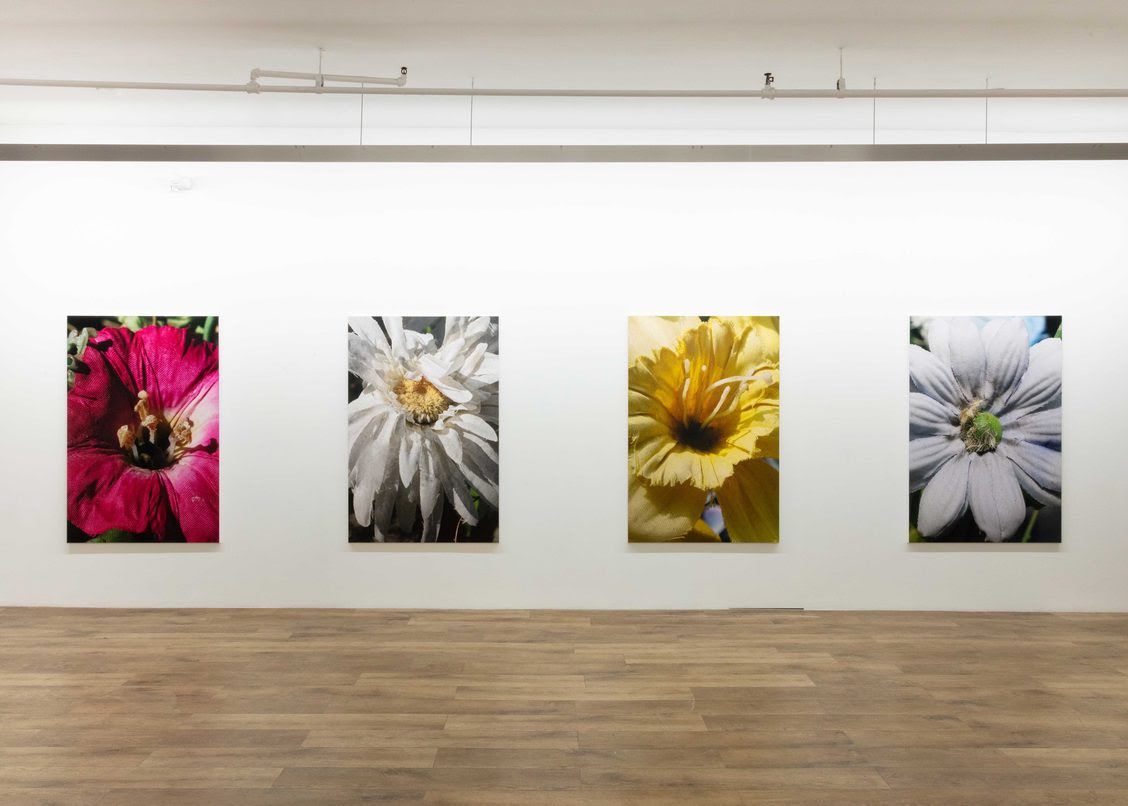
Installation views
At the gallery
Lomex
Chinatown · 86 Walker St, 3rd Floor