Lomex
Chinatown, Downtown, NY
86 Walker St, 3rd Floor
Sign in to save this gallery, log a visit, or add a show to a shared list.
Exhibitions
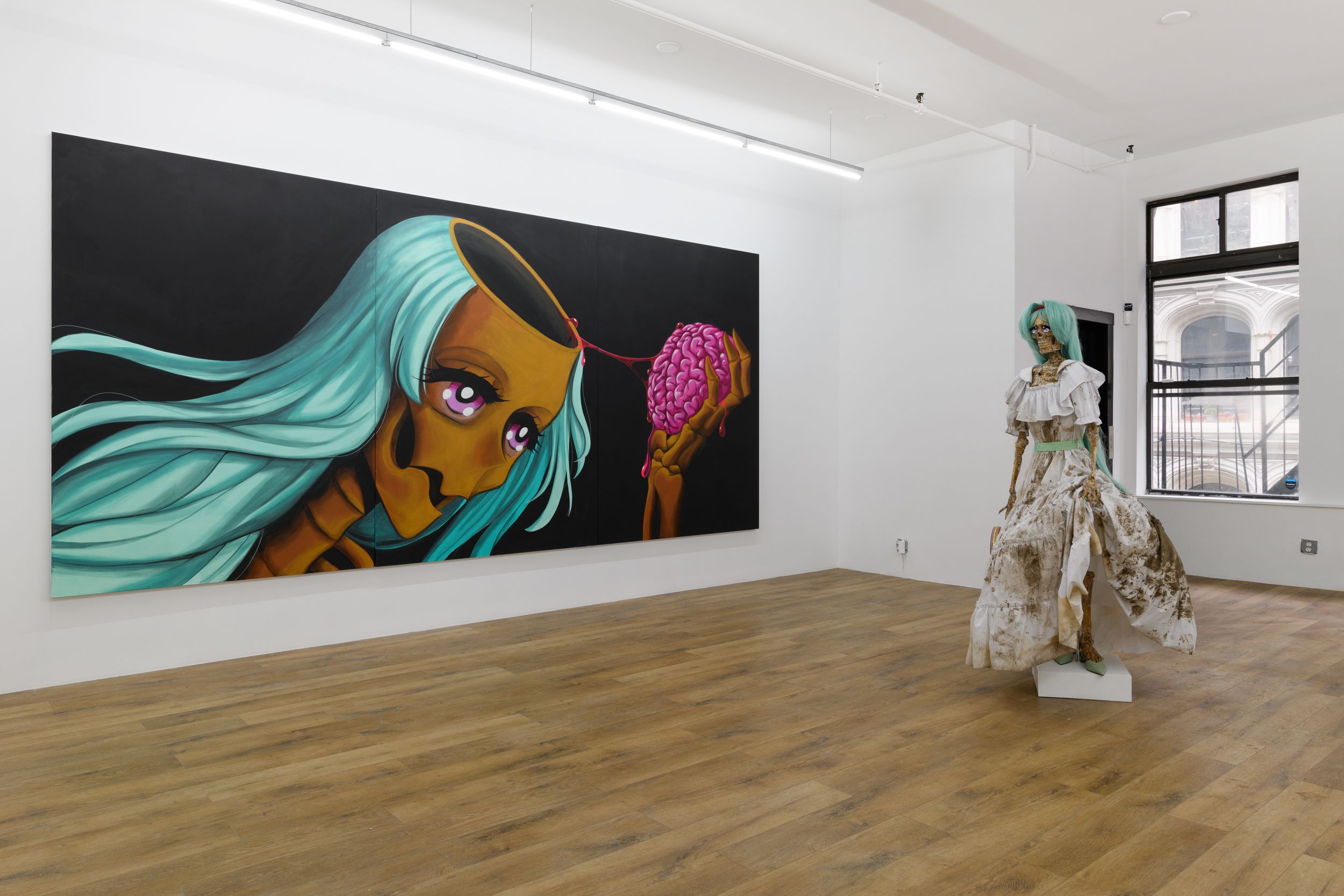
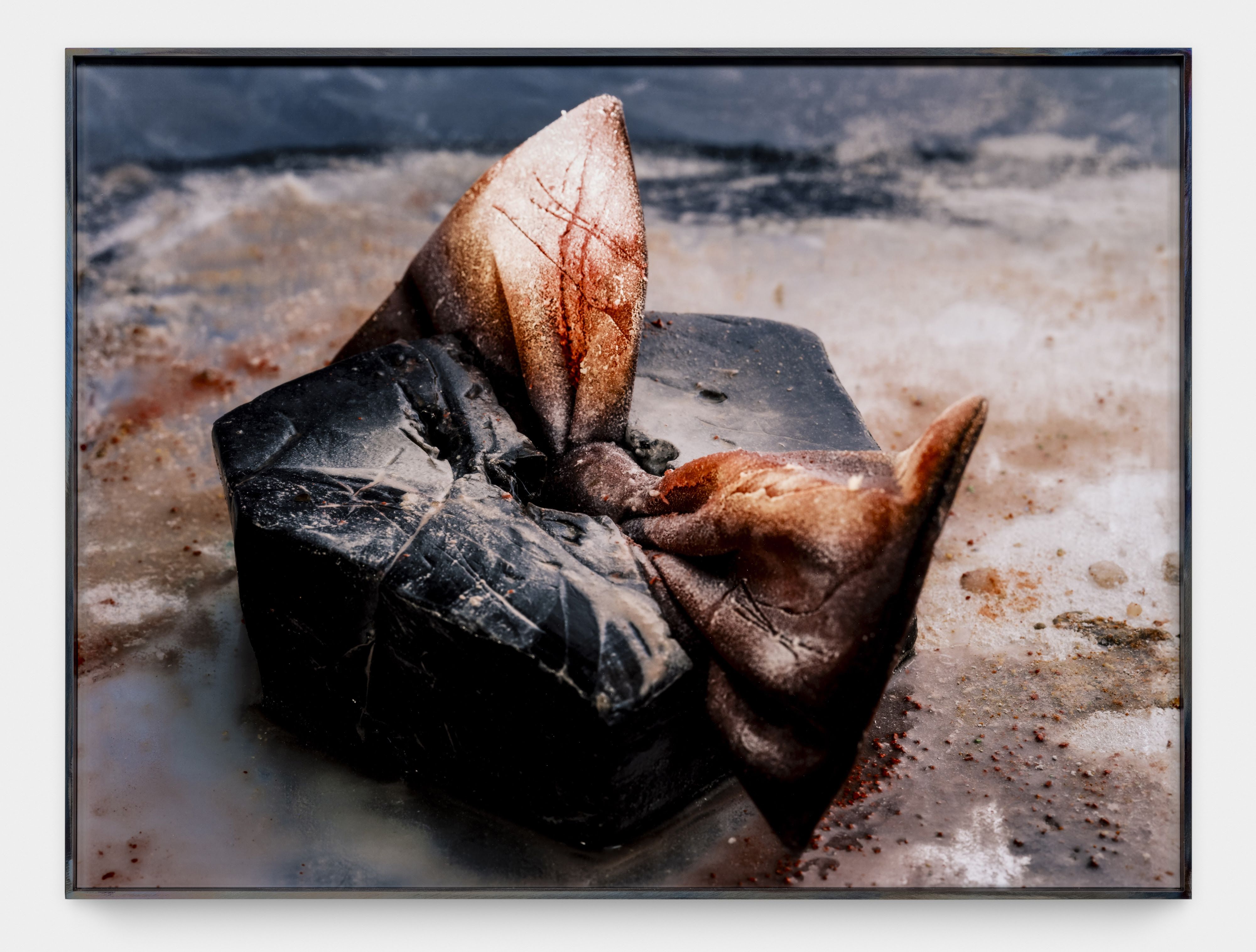
- Reupholstered and Undressed
Jun 12 – Jul 18
Danica Barboza, Kelsey Isaacs, Enzo Iwase, Greer Lankton, Diane Severin Nguyen, Heji Shin
 PastTime and Light
Yoshitaka Amano
Apr 24 – May 24
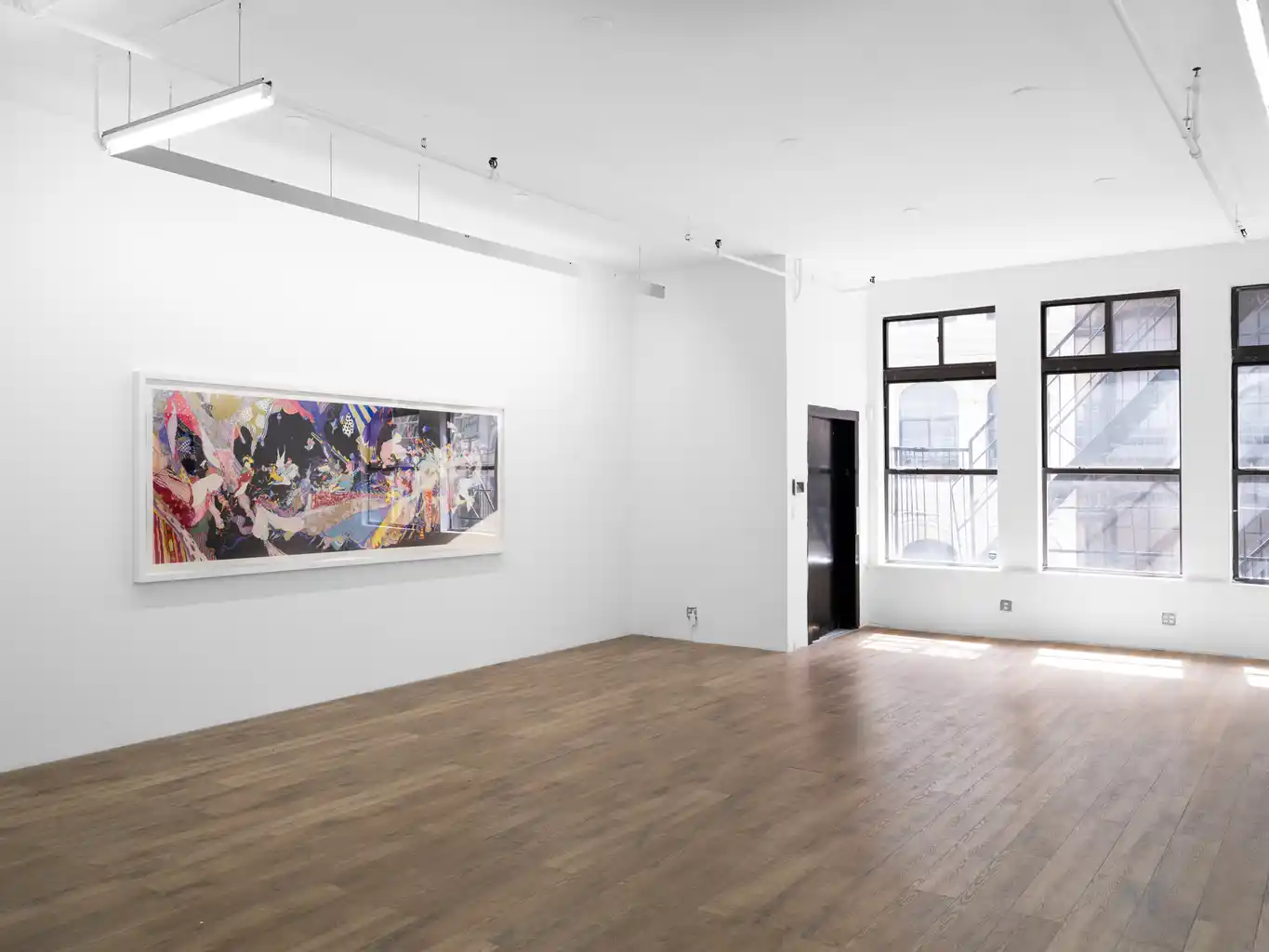
Lomex is proud to present a series of large scale works on panel by Yoshitaka Amano, alongside a selection of important lithographs. This exhibition coincides with a multi-month retrospective at The Warehouse Dallas Art Foundation.
Past
The Bed Sitting RoomJan 10 – Feb 15
Rebecca Ackroyd, Okiki Akinfe, Charlie Engelman, Zayd Menk, Alexandra Metcalf, Phoebe Nesgos, Hamish Pearch, Tom Schneider, Jaime Welsh, Kiki Xuebing Wang "Twenty survivors of the apocalypse go about their business amidst the rubble, despite mutations that gradually change them into furniture or bargain housing." Lomex is pleased to present The Bed Sitting Room, an exhibition organized by Ginny on Frederick. Borrowing its title from Richard Lester’s 1969 absurdist comedy, The Bed Sitting Room imagines a landscape of polite catastrophe, where adaptation becomes both a necessity and a performance. It brings together artists whose works inhabit this uneasy aftermath: figures, images, and objects persist through societal collapse, and rearrange themselves with a stubborn propriety. Scenes and surfaces maintain their manners even as the systems around them fall into decay. Gestures loop, postures harden, and fragments arrange themselves into a makeshift order. The mood is not tragic but faintly ridiculous—a kind of post-catastrophic decorum. The Bed Sitting Room continues Lomex’s commitment to highlighting the work of its peer galleries and their programmes.
Past
Heaven Beneath You as an AbyssNate Boyce
Sep 25 – Nov 16
“The image escapes me, and this tortures me, only when my mind clears completely do I feel happy again…clouds raced over the moon; now total darkness, now the elusive foggy landscape reappears in the moonshine…” —Georg Büchner, excerpt from Lenz Georg Büchner’s 1836 novella Lenz describes the wanderings of the writer Jakob Michael Reinhold Lenz through the bucolic mountains of Alsace. Experiencing the onset of acute schizophrenia, Lenz’ perception of his natural environment seems to fluctuate and alter in accord with the intensity of his own psychological state. Nate Boyce’s second exhibition at Lomex, Heaven Beneath You as an Abyss, consists of a video installation and a suite of new paintings. Boyce’s video work, Rapid Countenance, features a series of characters that have been procedurally generated from images drawn from 1980s cartoons and from historic literary texts like Büchner’s. Often appearing in the throes of some sort of psychic episode, these characters are cast into a refracted video taken in the gallery itself. The characters flash in and out of view alongside repeating gestural marks that trace across the screen like fragments of abstract paintings. The footage varies in its structure at the whims of a computer program devised by Boyce, and the images evolve and recur for an infinite duration. The work exists both as a generated record of the interaction between Boyce’s program and the gallery, as well as an adaptive installation which can incorporate a live feed of any physical space into its algorithm. Rapid Countenance is accompanied by a new series of paintings done on raw aluminum. Made in oil and inscribed with a die grinder, they are made through repetitive mark making that mirrors the movements of the rotoscoped characters in Boyce’s video work. The images are smeared to reiterate their unstable temporal nature. Their surfaces have been etched into in a manner that indexes their own velocity. Rapid Countenance furthers Boyce’s exploration of the aesthetic passage from Romantic idealism to procedural nihilism. Boyce radicalizes this through repetitive gestures that push his figures into abstraction.
Past
Void Beside a Desire MachineDanica Barboza
May 9 – Jun 29
Note to my Former Self as well as my favorite philosophical Jesuits, Michel de Certeau, composing L'iovention du quotidien. Vol. 1 [aka The Practice of Everyday Life] : In the future (say 2024/2025) grown women, the descent of the decadent of the 1960 sexual revolution will eventually make mainstream sound-emphasized videos, displaying their affluence to the world while demonstrating their skill at cracking open drink cans while wearing careful decorated nails and pouring the mixed cream, caramel and sugared mass produced substances into mass manufactured pastel canisters of plastic (resembling the size and shape of multi-strapped and lattices scuba-gear) - the act ultimately climaxed with sounds of plops and fizz of ice - or the clinked rattling of broad metal straw. They will do this in the name of trends such as: ASMR, and 'self-care', and OCD Moder-Plastic- Mom-ism... And neither they nor much of anyone will be able to un-numb themselves to the endless bombardment of over-stimulus long enough to deliberate over the connotations of their actions and priorities, to observe whether they are backward to individualized liberation - And they will do such in the name of tolerance, acceptance, live-and-let-live attitude that condones superficiality via prioritizes concepts such-as 'fluidity in all things', and a mildly concussed version of supposed modern feminism the was breast-fed by (sadly or un-sadly) on a late 1990s to early 2000s commercial branding of 'girl power' presented to the minds youths (who had never know the earthier dualities of the 1960 and the 1970s), via the franchises of the 'Spice Girls' and later 'Power Puff Girls'. Dear de Certeau, alternative use of mass produced objects has flourished by necessity, but sadly SO has mass mindlessness. Why does the above matter: Because some specific form of "human-wholeness" that existed in the upheavals of the the 1960s (and lesser and lesser so in west during the 1970s into the 80s...) will be forgotten and usurped by generations who live in solipsism of "bobble-cultures" [as also noted by Chris Headges] altemative/middle to mass franchises exercise of repetitive culture. No one will remember, because their parents (for some-reason) did not teach them to care about anything that took place before their own presumed more progressive awareness. Note to Laurie Anderson Using the word Petrochemicals - in 'Oh Superman' in 1981: Dear Laurie, Eventually there will come a day then no one will use this term any more [Petrochemicals], and your own past use of it will ring as something 'exotic' in our contemporary ears. So much of everything Americans are surrounded by will be plastic that use of such a word will feel redundant to reality- and your own use of it will seem *charming, and nostalgic to look back-upon, like a love song to some remonstrate of a slightly faded and doused out sanity ... that no one in the common era ... much remembers anymore. It was in interesting word though — "Petrochemicals..." (so thank you) ______ And you along with everyone else, will continue to be asked to remain 'tolerant' of mass confusion and mass ineptitude, mass senseless acts of nations 'taking the piss' at the sake of human lives, and the collective 'flock' of human semi-non-consciousnesses will nudge toward rebellion.... but retract... and detract and huddle back to the Orwellian dwellings, their mass huddled technologically advanced versions of Orwell's the 'Road to Wigan Pier. [Cut to yourself - on a anonymous beach], (and yes', we know, you somewhat hate the beach ... But this moment is placed here because you associate the Anonymous Beach with [[Blacked out text]] ...whom you have recently learned is 6ft 3in much like … [[Blacked out text]] ... so now you will associate 'the anonymous beach' with him - You will pay for his presence/existence in your life for at least a year, because his voice initially reminded you [[text Omitted because - text double omitted.]] And NO, former self you are not That intrigued by [[Text omitted]] You are just a highly devoted person, Moreover in 2016, dear former self, you will accurately identify the sourced from which the 'void' will exactly expand from And you will proclaim its potential expansion to anyone you can pay to be earful and advising ... And in the end no matter what you tell them it will do no good it will come to full visibility and expansion, and it will devour anything it can for its own fulfillment and the 28 people you paid to listen and advise - will no longer be on payroll, so once again there will be no one who cares. lets go back - Cut to you - on a beach... Curled up in nothingness--- like vapor, ... like air. And all the while you will be thinking of -- things that are lovely, that 'were' lovely, wondering, [[Blacked out text]]? Is tomorrow [[Blacked out text]]? And also [[long Blacked out text]] Specially designated for breaking [[Blacked out text]]? And also the thoughts concerning: the beloved, IS or WAS or IS (again) - quite lovely Until, in the end... [[Blacked out text]] hurt.
Past
Shadow Work for PeoniesDavid Flaugher
Mar 29 – May 4
This show is a series of landscape paintings that progressively increase in scale throughout the gallery. Atop broken horizons, tornadoes contort and swirl in various stages of deconstruction and preformation to elicit fleeting images of dried flowers, herniated discs, and torpedoes of fire. Contrary to other series, there are no real cast shadows in any of these paintings. I like that this reinforces their overcast feeling and helps nudge the works towards a more conceptual place. These works were all produced from metaphysical premises, generated purely from my own sketches–a formal practice and an attempt to not produce overly sincere, wispy paintings. Eliciting and taming the movement of each painting became my focus. Erasure remains a critical part of my process, and that is especially true with these works where redaction becomes generative throughout the series. I was constructing images based on physics and then breaking down that stability. In this show, as in the last, scale is significant. I found a handling of a subject that works at nearly any scale. Each painting has a type of mark making and surface treatment that reaches a qualitative finish. With regards to their imagery, of flowers and landscapes, it's nice that they range from intimate to fully engrossing. In Jungian psychoanalysis, “shadow work” refers to the practice of encountering and integrating repressed and unconscious aspects of the self. In the context of these paintings, in their “shadow work” there is a balance of attraction and repulsion. I wanted to imply that objects of conventional beauty, like a flower, could propose multiple truths at once. —David Flaugher David Flaugher (b. 1986, Detroit, MI) lives and works in Berlin, Germany and New York, NY. Flaugher has had two solo exhibitions with the gallery (2022 and 2020), alongside recent solo exhibitions at Bernheim, Zurich, Switzerland (2024); James Cope Gallery, Dallas, TX (2022, 2020, 2018); and the Eli and Edythe Broad Museum (MSU Broad), East Lansing, MI (2021). He received his MFA from New York University, New York, NY (2013) and a BFA from the College for Creative Studies in Detroit, MI (2008).
Past
ApocalypseYoshitaka Amano
Jan 31 – Mar 16
"The world situation has changed dramatically since I painted these works. The world is constantly moving, and I feel as if some mysterious disaster is watching us from an unseen place. Are we really heading towards the end? No, we are certainly here now. Here in New York. I hope that through these works you can feel the deep love, quiet sadness, and hope. I painted these works in one go about 10 years ago. Now, in 2025, it may no longer be a world that I can paint. But these works will continue to be painted now and into the future. Perhaps that is why the true meaning of these works is now being questioned. In any case, these works are paintings of salvation. To be honest, I don't remember the details because I painted them in one go, but these works are the result of researching various documents and tapestries. And these works are one of my answers." —Yoshitaka Amano on the Apocalypse series, 2025 The gallery is pleased to present its second exhibition with Yoshitaka Amano, Apocalypse | 黙示録. Spanning the gallery two locations, the show consists of a selection of over forty works on paper from Amano's 2013 Apocalypse series, alongside the display of Amano's monumental 2002 work "Universe". The work of Yoshitaka Amano (b. 1952) has had a far-reaching influence on the history of Japanese art and on Japanese and American popular culture. First coming to prominence in the 1960s working for the Japanese animation company Tatsunoko Productions, Amano's character designs for franchises such as "G-Force" brought him early widespread acclaim and led to a storied career crafting the aesthetics of numerous anime shows, video games, and comic books. Amano left Tatsunoko Productions in 1982 and embarked on a career as a fine artist and freelance illustrator. His iconic work on entertainment properties like "Final Fantasy" and "Vampire Hunter D" has garnered him a massive international fan-base. Amano's exhibition will be accompanied by the publication of a new catalogue, featuring the works on view, inaugurating the gallery's new press. Selected works and ephemera are offered in conjunction with the online art sales framework Platform.
Past
HereinKye Christensen-Knowles
Nov 9 – Jan 19
Saturday [February 1916] My dear Russell, I didn't like your letter. What's the good of living as you do, anyway. I don't believe your lectures are good. They are nearly over, aren't they? What's the good of sticking in the damned ship and haranguing the merchant-pilgrims in their own language. Why don't you drop overboard? Why don't you clear out of the whole show? One must be an outlaw these days, not a teacher or preacher. One must retire out of the herd & then fire bombs into it. You said in your lecture on education that you didn't set much count by the unconscious. That is sheer perversity. The whole of the consciousness and the conscious content is old hat-the millstone round your neck. Do cut it-cut your will and leave your old self behind. Even your mathematics are only dead truth: and no matter how fine you grind the dead meat, you'll not bring it to life again. Do stop working & writing altogether and become a creature instead of a mechanical instrument. Do clear out of the whole social ship. Do for your very pride's sake become a mere nothing, a mole, a creature that feels its way & doesn't think. Do for heavens sake be a baby, & not a savant any more. Don't do anything any more-but for heavens sake begin to be-start at the very beginning and be a perfect baby: in the name of courage. Oh, and I want to ask you, when you make your will, do leave me enough to live on. I want you to live forever. But I want you to make me in some part your heir. We have got to clear out of this house in a week's time. We are looking for another house. You had better come & live near us : but not if you are going to be a thinker and a worker, only if you are going to be a creature, an infant ... My love to you. Stop working and being an ego, & have the courage to be a creature. Yours, D. H. Lawrence Letter from D.H. Lawrence to Bertrand Russell, 1916
Past
Vase WaterKathryn Kerr
Sep 14 – Oct 27
Vase Water is a diaristic show–a collection of experiences, techniques, and visions describing a perceived world. Sometimes, it is an amalgam of fiction and reality–a bat transforms into an orange glow in Wig Wag. Or it is often an ode to an artist like Manet–his last flower paintings, or Max Ernst–his collages. Indeed, it is a way to translate an inner world into color and form. I use divergent ways of making to create harmonious sets of paintings unified by hue, recurrent shapes, and themes. What emerges is an exploration of wanderings and associations to record a subjective experience and imagination, to make that felt, and to play with a painting’s potential. These paintings were made primarily in Bovina, New York, and the outside–the birds, the trees, and the friends I made there–entered the paintings and influenced their forms. Blissful Countryside is a kitchen sink painting: the remnants and colors of the other pieces in Vase Water migrated into its frame, becoming the map or key to this set of works. The cedar waxwing’s feathered breast, a gentle gradient of sienna to sea gray, built the arc in Cranberry Sauce. Broken remnants of an eastern tiger swallowtail transformed into Xiidra. An apocryphal story from the local car mechanic: John Lennon lay on a hill in the nearby town and declared, “A man could die here,” seeped in and transmuted into an underlying rhythm within the suite of paintings. And a dense forestscape in the distance drifted into the pointillist windows of Happy Valley. These observations and idiosyncrasies, along with the joyful scrutiny of painting’s possibilities, brought forth the materialization of Vase Water. —Kathryn Kerr Kathryn Kerr (b. 1984, Los Angeles, CA) lives and works in New York, NY. Vase Water is her second solo exhibition with Lomex, New York, NY following her first solo exhibition with the gallery in Spring 2023. A recent solo exhibition has been held at Andnow, Dallas, TX (2023). Selected group exhibitions include Phosphor, Project Native Informant, London, United Kingdom (2024); Drop Scene, Chapter NY, New York, NY (2024); Exhibition with Ben Horns and Leslie Martinez, Andnow, Dallas, TX (2023); And Now at Night, Night Gallery, Los Angeles, CA (2022). Kerr received her MFA from the Yale School of Art, New Haven, CT.
Past
House of RatsRasoul Ashtary
May 2 – Jun 23
Jean Laplanche, among the most astute interpreters of Freud, posited that human subjectivity emerges from the infant’s desperate attempt to make sense of a world of symbols, phrases, and gestures within which it finds itself suddenly, and traumatically, inundated. To be new in the world is to be overwhelmed by both its novelty and by the task of decoding its ciphers. What Laplanche calls “enigmatic messages” are those moments of frustration which are not, and cannot be, resolved: messages incomprehensible to the infant and, more often than not, unintelligible to the transmitter themselves as a primal, instructive scene. They are an “alien inside me, and even one put inside me by an alien.” With House of Rats, Rasoul Ashtary offers form to the enigmatic we each carry with us from infancy. A skeletal tree repeats, inverted, against a backdrop of shapes almost bodily in their fleshy bulbousness (are our bodies not the first and most enduring alien objects we must try and fail to decode?). A skull, that eternal signifier of death, is relegated to the realm of images through the screen of a camcorder. Alongside a tangle of near-machinic apparati—a series of forms and voids tantalizingly close to being intelligible as a system—an egg holds the promise of the symbolic and the horror of obscurity in the balance. In Laplanche’s formulation, the alien—the unknown that remains unknown—has more to teach us about the world than any meaning we may ultimately decipher. We lodge these enigmatic moments in our unconscious, and their mystery shapes our being, our ability to inquire and deduce as well as our apprehension of that which we cannot work out. Therein lies our capacity for longing, suspicion, superstition, magic. —Holly Bushman Rasoul Ashtary (b. 1991, Tehran, Iran) lives and works in Berlin, Germany. House of Rats is his first major solo exhibition with Lomex and his first exhibition in the United States. Ashtary graduated from Städelschule in Frankfurt in 2022 where he studied with artist Willem de Rooij. His paintings and sculptures experiment with differing forms of visual mediation, distortion, and altered modes of perception.
Past
Like a Cluster of Dust Charged With an Activity That Decomposes ItValerie Keane
Nov 4 – Jan 14
Lomex is proud to present like a cluster of dust charged with an activity that decomposes it, an exhibition of new sculptures by Valerie Keane. It is Keane’s third exhibition with the gallery. Assembled from strata of stainless steel, aluminum, acrylic, and fiberboard, Keane's sculptures variably appear like human proxies, formal abstractions, totems, and the products of automatic writing. She has been working with many of the same constraints for nearly a decade, and her newest pieces reference and reiterate elements and gestures drawn from her practice as a sculptor and draftsperson. In feedback with previous pieces, the five sculptures on view restate inherited motifs alongside new passages, in a manner not unlike the elaboration of a piece of music. The works are made in scale to, and limited in scope by, the artist’s body. Comprised of materials that accumulate evolving technologies of industrial production, they hover between organic and inorganic. Calling to mind medical prosthetics, biomorphic machines, and even sigils, their forms are in a constant state of flux. Taken together, they are like fragments of an obscured whole. Keane’s sculptures are produced slowly, often built from elements from older abandoned pieces and the remainders from the production of other works. Their components are bound with metal and rubber–incorporating a tension that evokes both a delicate femininity and a close-guarded evocation of their aggressive fragility, not purely as objects but as images. Suspended from single points, Keane’s sculptures shift with the evolving natural light and fracture the space as the viewer passes between them. Previously intended to violently disrupt their environments, Keane’s newest pieces are presented in varying states of disclosure and concealment. Their palettes are more nuanced and they are more attuned to their own reliefs. Moving between the works, and considering the emptiness manifest in their construction and in their framing of environment, the dynamics of the space changes, and one feels transported to an interstitial space–one marked by contrast.
Past
The Birth of MythYoshitaka Amano
Sep 9 – Oct 29
Lomex is pleased to presents new and historical works by Yoshitaka Amano. Spanning two venues, the show is one of the largest gallery presentations of his career.
Past
This OdorOto Gillen
Jun 8 – Jul 29
Over the past four months, I have been photographing plastic flowers that appeared across the city in the last couple of years. Set dressing for a dusty curbside, these are subjects I previously photographed from a distance but now scrutinize from a few nose-lengths away. The economic concerns of street-facing businesses seems to have warranted the installation of these cheaper, low-maintenance facsimiles of floral arrangements and plantings that, if they were real, would require thoughtful attention and regular watering. These false flowers act as lures, beckoning the pedestrian to compulsively pull out their pocket camera and collect souvenirs from the sidewalk. They might even be compelled to touch the petals to confirm whether or not they are cool to the touch. We have grown accustomed to commonplace photographs of botanical specimens. These are taken either by professional photographers, weekend amateurs in an urban park, or by friends sincerely sharing spring’s display online. Although I have always been seduced by nature’s annual display, I also feel photography isn’t well suited to convey the brilliance and emotion of color that real flowers exhibit. It occurred to me earlier this year that I had never contemplated how artificial flowers appear up close. The frayed and often sun bleached polyester petals reveal their unit of construction; woven fibers from an industrial loom. These are low-resolution objects in comparison to their biological source material. As a subject, I feel these fake flowers are absorbent enough for the anxieties of the present moment to saturate these images. Formally, I also sought to imbue these inanimate objects with a presence or sentience of their own. In printing these images, which depict a space no larger than my hand, over five feet tall, I wanted to alter the perceived scale of these woven petals so that they approached a human scale. From afar, the photographs could appear to be vernacular images, but as the viewer approaches, the hairiness of their texture and the individual personalities of these blooms comes into sharp relief. The prints are dye-sublimation on aluminum sheet, cut, scored, and drilled by a CNC router following a pattern of my own design and engineering. I carefully folded and assembled the panels with stainless steel hardware on the back. This series is the first to arise directly out of the process of designing these displays over the last two years. My goal was to produce photographs whose content possessed a texture incongruous with the smoothness of the aluminum substrate they are printed on. The lighting in the gallery has been altered to create conditions best suited to looking at these recent images. I have placed strips of aluminum and attached them by magnets to the fixtures in the room so that they cast light only on the walls and artworks. The installation is clustered towards the front of the gallery such that during the day, sunlight can supplement the space’s lighting system. The title of this installation, this odor, came to me in April on walk down Prince Street. It was a beautiful and crisp early spring day. Across the street, I noticed the brilliant hue of some potted hyacinths I assumed were fake. As I approached, the undeniable fragrance enveloped me before I pinched the delicate purple petals which confirmed I had been fooled by nature. —Oto Gillen
Past
Country AirKathryn Kerr
Apr 29 – Jun 4
In the Beach Boys' song Country Air, the refrain “Get a breath of that country air, breathe the beauty of it everywhere” repeats three times. By repetition, the sense of that place could be conjured: its freshness, its expanse of space, its dappled light. Pulsating back and forth, a vaporous incantation becomes a site within reach. More distant as the song continues, it is entangled with effervescent misremembering, making way for the charm and limitations of personal fantasy. These paintings are an excursion–highlights from a journey of an itinerant dreamer. Each work in the series is a marker of an undisclosed and obscure location, connected by recurrent color, signals, fluid and rigid forms. Created with layers of acrylic watercolor and finished with oil, each piece is compressed and saturated with divergent thematic propositions. Much like the discursive trajectory of a song, the combination of deliberate shapes and colors vibrate alongside chance encounters accumulating in the painting’s itinerary. The traveler is the subject of the series. Mapping and tracing form a trail that bonds the works together. The traveler contends with the paradox of an interior voyage and a conflicting connection with the real world. Wandering along, this pilgrim sings the refrain of Country Air to supplicate the random forces and to document a journey that is simultaneously near-at-hand and ungraspable. The paintings offer a footnote to the great and familiar idea of longing for an elsewhere, judged by its power to connect, illuminate, and make new and fruitful places for reflection. —Kathryn Kerr
Past
Short Cuts IIIKye Christensen-Knowles
Mar 17 – Apr 23
From February 10th to April 22nd, Lomex is exhibiting a series of presentations eschewing the traditional format of a group show. Three single bodies of work, each by a different artist, is on view one at a time in the gallery rotating approximately every two weeks. Short Cuts I: Andrea Fourchy: February 10 - 18, 2023 Short Cuts II: Rasoul Ashtary: February 23 - March 11, 2023
Past
Short Cuts IIRasoul Ashtary
Feb 23 – Mar 12
From February 10th to March 18th, Lomex will exhibit a series of presentations eschewing the traditional format of a group show. Three single bodies of work, each by a different artist, will be on view one at a time in the gallery rotating approximately every two weeks. For its second iteration, the gallery presents a suite of paintings by Berlin-based artist Rasoul Ashtary made across the last three years. Born in 1991 in Tehran, Ashtary attended the Städelschule from 2016-2022. In 2022 he had a solo exhibition at Diez Gallery in Amsterdam, and will exhibit at Liste with Diez this summer.
Past
Short Cuts IAndrea Fourchy
Feb 10 – Feb 19
From February 10th to March 18th, Lomex will exhibit a series of presentations eschewing the traditional format of a group show. Three single bodies of work, each by a different artist, will be on view one at a time in the gallery rotating approximately every two weeks. Initially, the gallery will exhibit a single large scale painting by Andrea Fourchy, Alcove so great outdoors. It is presented alongside drawings used in its construction. Paintings continuing this series are now on display as of this week at Felix Gaudlitz, Vienna.
Past
Passport Control: An Expat ChristmasDec 20 – Jan 23
Samuel Acevedo Mykki Blanco Jamian Juliano-Villani An immersive installation, exhibition, and party with a live performance in the gallery around 9pm on December 20th by Expat (Mykki Blanco and Samuel Acevedo) Paintings by Samuel Acevedo, sculptural installation by Mykki Blanco, and a collaborative work by Mykki Blanco and Jamian Juliano-Villani A limited number of drinks provided - Mykki Blanco’s De-Colonized Cock Tales available first come first served Expat are masters of the Evangelical mosh pit. Expat is a performance in which a combination of theatrical poetry stemming from the Black Queer diaspora is combined with the goth and heavy metal musical traditions of Latin America. Bloodbath of the colonizer, reclaiming the tradition of experimental noise for the Black/Brown wo/man and hardcore queer baptisms as a rite of passage into the void. Expat is punk theatre for the masses.
Past
Yard with LunaticsDavid Flaugher
Nov 12 – Dec 18
Lomex is pleased to present its second solo exhibition with New York based artist David Flaugher. On view in the space is a suite of paintings by Flaugher all produced in 2022, alongside a series of new sculptures made in concord. Flaugher’s still-lives are rendered without any real world sources. Conceptual works which reference the paintings of artists as varied as Hammershøi, Morandi, Cezanne and Courbet, they incorporate brushwork characteristic of Color Field painters like Clifford Still. Like historical vanitas paintings, their compositions are simultaneously static and transient. Situated in nonspecific windowless interiors, Flaugher’s pieces employ the same motifs and methods in variation. Uncommon to the genre, in scale they are larger than life. On the floor are a series of wax stars inset with LED lights, and in one corner, a turtle with an overturned star on its back (perhaps a reference to the unfortunate pet of Huysmans’ Des Esseintes). Like Flaugher’s earlier works, they call to mind the anxious atmosphere of middle-American households around the holidays. All cast by hand, the lights in the pieces will last for a number of years, but will eventually burn out, unable to be replaced.
Past
A Mistaken Style of LifeAustė
Sep 24 – Nov 6
Lomex is pleased to present a survey of works by the artist Austė (b. 1950), many of which are shown for the very first time. A Mistaken Style of Life is an overview of the artist’s cross-disciplinary practice spanning nearly forty years. It traces Austė’s unique aesthetic that fuses elements of Lithuanian folkloric art, Punk, No Wave, and European Surrealism, while charting her history as a stalwart presence in the East Village and Downtown art scenes. Born in Detroit, the child of Lithuanian refugees, Austė’s memories of her childhood fairy tales informed her work as a performer (under the header Cococello Club), her variegated literary productions, and her wildly expressive paintings and works on paper. Upon moving to New York from Chicago in 1979, Austė’s images cascaded across the landscape of the city. Initially exhibiting with the Hamilton Gallery, she performed in spaces as varied as 8 BC, Palladium, and Pyramid Club. She went on to show in numerous venues, including Ronald Feldman Gallery, PS1, Artists Space, 56 Bleecker, and more recently with Mitchell Algus Gallery (2009), and Greenspon (2016). Her work expanded outside the confines of these spaces: in 1986 she was invited by Simon Doonan to create a suite of massive tableaux occupying the windows at Barneys New York; and in 1988 designed sets for the theatrical production Champagne, Glamor, Glory, & Gold directed by Taylor Mead. Austė’s visual output speaks to the overlooked roots of Punk and New Wave aesthetics in divergent strains of European modernism, in Expressionist painting, and in Surrealist landscape. Representing decades of artistic production, the works today appear fiercely new.
Past
Under the Volcano IIJul 29 – Sep 18
Austė, Danica Barboza, Henry Belden, Miguel Bendaña, Patia Borja, Kye Christensen-Knowles, Elizabeth Englander, Dese Escobar, Rachel Fäth, David Flaugher, Andrea Fourchy, Covey Gong, Hardy Hill, Alexandra Metcalf, Sean Mullins, Phoebe Nesgos, Esther Sibiude, Michelle Uckotter, Coco Young
Past
Venous SystemPhoebe Nesgos
Apr 9 – May 22
Lomex is pleased to present Venous System; Phoebe Nesgos’ debut solo exhibition with the gallery and her first major New York presentation. Phoebe Nesgos’ paintings set a series of nude female figures in uncanny terrains that phase in and out of focus. All titled Venous System, in reference to the vascular network that carries deoxygenated blood to the heart, the works present a sequence of bodies that reference their own constructions as well as the physical relationships between the canvases and between the painter and her models. Drawing from both classical and modern traditions, they bring to mind the anatomic attention of the works of Hyman Bloom, the extreme performances of Ron Athey, the early work of Susan Rothenberg, and the lush romantic femininity of the landscapes of Arthur Davies. Made through a cumulative process of mark making and erasure, by the repeated sanding down of the canvas and the subsequent building up of many layers of paint, the works present their figures with no hierarchy between their bodies and surroundings. A space both simultaneously psychological and fantastic, the pictures struggle with their own material and slip in and out of obscurity. Phoebe Nesgos (b. 1993, New York, NY) lives and works in New York, NY. Recent exhibitions include Bianca D’Alessandro, Copenhagen, Denmark; Lomex, New York, NY; Neue Alte Brücke, Frankfurt, Germany; Ed. Varie, New York, NY; and a solo exhibition at Barrister’s Gallery, New Orleans, LA.
Past
HRGNYCH.R. Giger
Jan 29 – Apr 3
Lomex is pleased to present a survey of the works by H.R. Giger. The largest exhibition of Giger’s work in New York in nearly three decades, HRGNYC draws from the breadth of his entire career and displays his manifold talents in a vast array of media. Hans Ruedi Giger (1940 - 2014) was a Swiss Surrealist artist whose work had an indelible effect on the popular imagination of the last half century. Resonating far beyond even his iconic work for Ridley’s Scott film Alien, for which he won an Academy Award in 1979, his work had incredible influence on now-historical projections of the future in cinema, video games, animation, popular music and television, as well as across the landscape of contemporary art. His strange surrealist vistas, where bodies and machines meet in violent erotic communion, delineated an existence dominated by nightmarish technology–a vision which continues to exert its dark power on the aesthetics of the new throughout contemporary culture. Long fascinated with New York as both as an idea and as a place of exhibition, Giger made many visits to New York and the city's landscape was a continuous source of inspiration to him throughout his career. Evident in his work even from the age of 18, New York’s skyline became the basis for a terrifying mythological world of technical and occult majesty, a negative utopia that expressed itself as a philosophical inverse of the sublime. His iconic “New York City” series, displayed at the Hansen galleries on 57th street in 1980, intermingled figures drawn from his own occult mythos with a claustrophobic futurist steel skyline. The NY paintings, made in airbrush without preparatory sketches, in their extraordinary precision appear at times almost as otherworldly photographs, and are landmarks of technical innovation with a method completely of Giger’s own devising. This body of work was the subject of an artist book published in 1981 by Ugly Publishing Zurich—Giger’s own pseudonymous publishing house—with a preface by Timothy Leary, which is now being republished by Kaleidoscope on the occasion of this exhibition. Even from Switzerland, Giger was an artist continually engaged in the counter-cultural fabric of New York and a major force in shaping the scope of Downtown. In 1980, he met Chris Stein, Blondie’s co-founder, guitarist and Debbie Harry’s life-long creative partner, and collaborated with Harry on the iconic KooKoo album cover, and its accompanying music videos. On view in the gallery are a selection of photographs taken by Chris Stein on the sets of this collaboration, a series that conveys the full array of the scope of Giger’s creative vision. Giger continued to collaborate with numerous musicians and had far-reaching influence in punk rock, metal, techno, gothic, and industrial subcultures. In 1998, he designed the VIP room of Peter Gatien’s landmark hells-kitchen club The Limelight. Housed in a deconsecrated church on 20th street, the collaboration established him as a cultural icon of NYC Nightlife. The Limelight VIP room’s otherworldly landscape, infamous haunt of the Club Kids and apogee of New York cool, only closed its doors upon the destruction of the club in 2002. Giger’s Harkonnen Chair, original designed for the film Dune, on view in the gallery, was a centerpiece of that installation. The demise of Gatien’s club, as a result of wilful persecution by Giuliani’s vice squad, led to a change in the fabric of Downtown which continues to this day. Despite Giger’s cult-like status amongst leading contemporary artists and his far-reaching influence on popular culture, he has been absent in many ways from the main narrative discourse of contemporary art history. This exhibition, part of an international effort to redress this curious situation, hopes to begin to situate Giger as one of the most impactful and provocative artists of the latter half of the twentieth century, a key figure in the cultural history of New York, and as an artist of extraordinary relevance to our current fraught political and ecological moment. —Alexander Shulan Special thanks to Cristina Travaglini and Marco Witzig
Past
Wax GourdOto Gillen
Jun 17 – Aug 2
Wax Gourd, Oto Gillen’s first solo exhibition in New York since 2016, consists of eight photographs taken throughout New York over the past five years. Perhaps the record of a walk through the street over one very long day, or a collection of moments torn from an archive of anonymous memories, Gillen’s images slip in and out of their timelines. Projecting both forwards and backwards, they present an account of the city in all of its triumph and trauma. It is a history contrasted with its often pitiful particulars—a pile of roast peanuts constructed into an ersatz edifice, a bin full of fish gasping for air on a street corner, a melon for sale on Mott Street that appears like an anachronistic vanitas. These objects all speak to frustrated yearnings, or small acts of bittersweet defiance, up against an insistent and inevitable skyline. All of the works are presented in a mode of Gillen’s own devising: dye sublimation prints in aluminum folded to be supported without a frame. The images are presented without ornament or distraction: in this way they are conversant with projection, a medium of import to Gillen. Rather than a collection of imaginary mementos, Gillen’s images have an ambiguity that leads to their constant reinterpretation. A mass of bodies, under a crimson sky, gathered on the onramp to the Brooklyn Bridge, appears variably as an image of foreboding, or of celebration.
Past
Low BatteryKye Christensen-Knowles
May 13 – Jun 14
“Watch out. The gap in the door... it's a separate reality. I can hear them calling to me from hell.” —P.T. (video game) Low Battery, Kye Christensen-Knowles’ second solo exhibition with the gallery, features a series of heterogeneous paintings that fuse genres and draw from the margins of differing avant-gardes. Experimenting with images from sources as varied as found footage horror, modernist grand portraiture, the writings of Pierre Guyotat and Marcel Schwob, the works of Balthus, and images of American Pop, it proposes its own degenerative history as it looks towards a manic future. On display are a series of surreal, unjust worlds seen through an array of perspectives; on the beat-up tape of an old vhs left in an attic, through the cracked door to a childhood bedroom, and from across the floor of a senate chamber in classical Utica. Simultaneously baroque, humorous, and pathetic, they reflect an uncertain present in the service of something ecstatic and alien. Kye Christensen-Knowles (b. 1993) lives and works in New York. He graduated from RISD in 2015. This is his second solo exhibition at Lomex. He has participated in group exhibitions at Gladstone, New York; Neue Alte Brücke, Frankfurt; Nicolai Wallner, Copenhagen, among others, and had a solo exhibition in Stockholm at Rehnsgatan 3 (2019).
Past
GirlfriendsAndrea Fourchy
Mar 13 – May 9
The gallery is excited to inaugurate its new Tribeca location with Andrea Fourchy’s second solo exhibition, Girlfriends. Over the course of a series of canvases cascaded throughout the gallery, a constellation of easily identifiable figures repeats and recurs in series. Portraits of Charlotte Rampling, Isabelle Hupert, Divine, Charlotte Gainsbourg, and Anjelica Huston array throughout space with the cadence of a film strip or a music video. In conversation with one another and with a host of familiar art-historical motifs, the figures appear with the naive airs of teenage band posters, and experiment with the shifting register of drag. The use of these figures as a leitmotif questions the way the painter presents and re-presents herself through painting. Both drawing from and ironizing the bravado presentations of Pop, while historically liberated from the confines of that specific style, the works present an a-historical, playful, and defiant identity. Andrea Fourchy (B. 1990) lives and works in New York. She graduated from UC Davis in 2012. This is her second solo exhibition at Lomex. She has participated in group exhibitions at Doyers Street, New York; Greene Naftali, New York; Maria Bernheim, Zurich; Svetlana, New York, Gaudel de Stampa, Paris, among others, and had a two person exhibition with Sergej Jensen at Avlskarl, Copenhagen (2016).