
Early Works
Cynthia Carlson
Feb 23 – Mar 12 · Tribeca
Cynthia Carlson was born in Chicago where she ultimately graduated From the Art Institute in the mid sixties. There she met a number of the artists that later formed a group often referred to as the Chicago Imagists. It is in New York however where the artist moved for graduate studies in 1970 that she begun a series of works that form the basis of our survey exhibition at Duane Thomas Gallery. Characteristic of the surreal aesthetics of the Chicago painters of the period the works followed a path entirely their own. In a film made at the time titled “Cynthia’s Ceremony” the artists reflects: “I am a painter, a college art instructor, a woman, and a human being who has a life in New York City. I don’t think these different facets amount to a shattering whole, and I sometimes wonder if I should worry about it or not, practically speaking it is difficult being a woman and a serious painter at the same time because people who know me in one of the role refuse to take me seriously in the other.” In these works, surrealism may be an afterthought, maybe in response to the diktat of minimalism that overtook much of the art world at the time. Carlson begun to delve in her interest in vernacular architecture and her life long interest in patterns searching for contradictory spaces with no defined focal points. A semblance of figures might emerge, sometimes referred to in the titles or subject, “Leg,” “Dress,” Mattress” “Foam,” but only serve as a premise for the development of a different kind of space: non-linear, non-narrative, and yet familiar. Lucy Lippard then touring studios for her seminal exhibition at the Aldrich in 1971 recognized in Carlson a feminist master, and included most of these works in the exhibition “26 Contemporary Women Artist,” which may be the first instance in America of a women-only show. The art critic Grace Glueck of the New York Times was struck by one of the works “Untitled (Inscape) 1” and wrote: “there are unmistakable gynecological references, for example, in Cynthia Carlson’s biomorphic abstractions.” Further noting about the muted reactions surrounding the original show and allusions made to this work Alexis Clement write in a recent review of the reboot of Lippard’s show at the Aldrich: “Cynthia Carlson’s “Untitled Inscape #1” (1970), even without using literal representations of the body, strongly conjures the constant experience of women’s bodies being examined, explored, and pulled apart.” For the artist however, feminism while of concern, in particular at a time when women only composed %4 of the selection of the Whitney Biennal that year; a sense of disjunction closer to the French New Wave and the emancipating spirit of the late sixties strikes closer to the original intent. A small work in the exhibition titled “First in Line” is nearly entirely abstract, and there the pattern becomes a whole rhythm on its own, akin to Experimental Jazz in that period in its capacity to create mood through repetition.
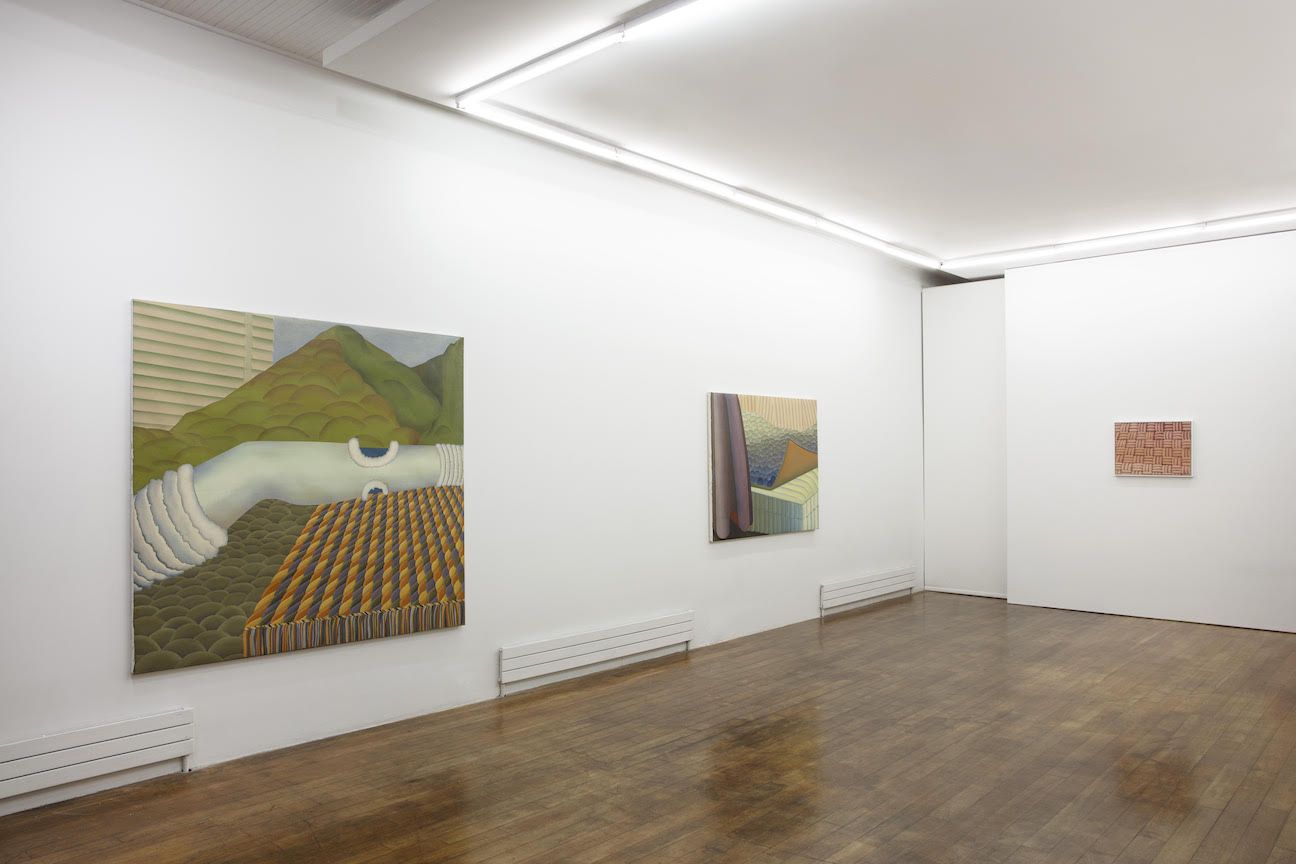
Installation views
At the gallery
Duane Thomas Gallery
Tribeca · 137 W Broadway, 3rd Floor