
Duane Thomas Gallery
Tribeca, Downtown, NY
137 W Broadway, 3rd Floor
Sign in to save this gallery, log a visit, or add a show to a shared list.
Exhibitions
- On viewEunice Golden & Shirley Pettibone
Eunice Golden & Shirley Pettibone
May 15 – Jun 16
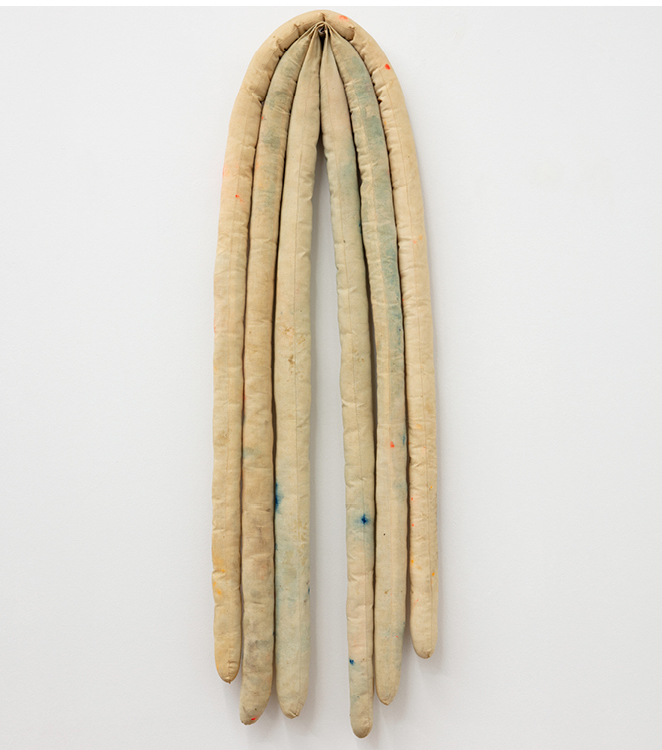
To make an appointment, please write to hello@duanethomasgallery.com Duane Thomas Gallery is pleased to present two concurrent exhibitions: Eunice Golden: Drawings 1968–1973 and Shirley Pettibone: Cloth Objects 1968–1973. Installed as distinct but dialoguing presentations, these exhibitions bring together two artists who, working independently during the late 1960s and early 1970s, developed deeply personal and materially innovative approaches to the body, abstraction, and feminist expression. Eunice Golden: Drawings 1968–1973 focuses on a selection of works produced during a pivotal moment in the artist’s early career. Executed in graphite and other dry media, these drawings, often charcoal on canvas, explore fragmented, eroticized, and often monumentalized representations of the male body. Golden’s works resist both classical figuration and purely abstract form, instead occupying a charged space between the two. Limbs, torsos, and suggestive anatomical forms emerge and dissolve across the surface, destabilizing conventional hierarchies of looking and desire. At a time when depictions of the male nude by women artists were rare, Golden’s drawings assert a reversal of the traditional gaze. The works are at once intimate and confrontational, combining a meticulous attention to surface with an unapologetic engagement with sexuality. Rather than presenting the body as fixed or idealized, Golden renders it unstable—cropped, enlarged, and psychologically loaded—anticipating later developments in feminist art while remaining largely unrecognized within its dominant narratives. Shirley Pettibone: Cloth Objects 1968–1973 presents a focused selection of the artist’s soft sculptural works, developed through her experimentation with stained, cut, and sewn fabric. These “Cloth Objects,” formed from painted muslin and stuffed with batting, occupy a space between painting and sculpture. Neither fully flat nor fully dimensional, they translate painterly gesture into bodily form. As described in Pettibone’s own reflections, these works emerged from a desire to move beyond the limitations of traditional painting, incorporating physical substance while retaining a sense of ambiguity and poetic suggestion. The resulting forms—tubular, knotted, or suspended—evoke bodily associations without resolving into explicit representation. They suggest skin, organs, or organic growths, while also maintaining a formal rigor aligned with the conceptual concerns of the period. Pettibone’s use of sewing and fabric introduces a material language historically coded as feminine, transforming it into a structural and conceptual device. The works engage with contemporaneous movements such as “Eccentric Abstraction” and “Soft Sculpture,” yet remain distinct in their synthesis of intimacy, process, and restraint. Despite their innovation, these works were created within a context in which women artists were often marginalized, their contributions overlooked in favor of their male counterparts. Presented together, these two exhibitions highlight parallel investigations into the body and materiality by women artists working during a period of significant cultural and political transformation. Both Golden and Pettibone challenge dominant artistic conventions of their time—Golden through her radical reconfiguration of the drawn figure, and Pettibone through her redefinition of sculptural form. While their practices differ in medium and approach, both artists articulate a subtle but powerful resistance to the constraints placed on women within the art world of the 1960s and 1970s. These exhibitions invite viewers to reconsider their contributions within a broader historical framework and to recognize the continued relevance of their work today.
Past
LiederBenedikt Gahl
Jan 15 – Feb 4
Duane Thomas Gallery is pleased to present Lieder, a solo exhibition of new paintings by Munich-based artist Benedikt Gahl (b. 1977, Germany). This exhibition—Gahl's first major presentation with the gallery—introduces a distilled body of work imbued with psychological immediacy and symbolic clarity. Trained at the Kunstakademie München under Markus Oehlen, Gahl's work stands in contrast to German neo expressionism and the Neue Wilde. In his paintings Gahl turns toward reduction, atmosphere, and the quiet force of archetypal imagery. His pared-down iconography—houses, trees, faces, boxes and flames—operates in a psychological and dreamlike register, at times closer in spirit to David Lynch's use of subconscious cues. These motifs do not narrate; they surface like recollections or premonitions, hovering between the primordial and the immediate. Central to this new body of work is Gahl's evolving palette: a restrained yet sensual constellation of ochres, greys, olive greens, and washed pinks. His colors oscillate between the seductive and the sober—warm without sentimentality, muted without retreat. The palette lends the paintings a psychological temperature, a quiet intensity that anchors the symbolic forms and brings them closer to the emotional register of memory. Each canvas feels measured, deliberate, and strangely intimate, as if the colors themselves were chosen for their capacity to hold experience without theatrics. Gahl's recent works also evoke the late clarity of Georges Braque, whose pared-down shapes approached a kind of sculptural stillness, as well as the Etruscan sensibility that informed Braque's thinking: the belief that an outline, when fully inhabited, can carry the weight of an entire worldview. In Gahl's hands, the contour becomes the carrier of essence—a structure into which emotion, recollection, and instinct are quietly poured. This attention to what is essential aligns with Alberto Giacometti's famous assertion that, in a fire, he would save a cat before a work of art. Giacometti's preference for the living spark over the art object parallels Gahl's own orientation: his paintings seek not to preserve an image but to capture its life. They operate in the zone where form becomes urgent—where a symbol retains the immediacy of a real encounter.
Past
Works from the 1960’sEunice Golden
Apr 11 – May 3
Duane Thomas Gallery is honored to present a solo exhibition of works by American artist Eunice Golden. This focused presentation showcases a pivotal body of work created between 1968 and 1973, including Golden's powerful and provocative series of drawings titled Rape. Eunice Golden, who very sadly passed away at the age of 98, is known for her visceral exploration of sexuality, power, and the human body. A key figure in the feminist art movement of the 1970s, Golden's work challenged conventional depictions of the male and female form, using abstraction and expressionism to confront the complexities of desire, vulnerability, and aggression. The centerpiece of the exhibition, the Rape series, offers an unflinching examination of sexual violence, exploring the psychological and physical dimensions of trauma through raw, gestural mark-making. These drawings, created during a politically charged era of feminist awakening, remain strikingly relevant today, engaging viewers in a dialogue about consent, agency, and the body as a site of both pleasure and violation. In addition to the Rape series, the exhibition features a selection of large-scale canvases that reflect Golden's signature approach to figuration, abstraction, and expressive use of color and form. The exhibition offers a rare opportunity to experience the emotional intensity and technical mastery that define Golden's practice. Eunice Golden's work from this period confronts the complexities of gender and power with remarkable courage and clarity. Her exploration of the body—both as a source of strength and vulnerability—continues to resonate deeply with contemporary audiences. Eunice Golden (b. 1927) is an American artist whose work addresses sexuality, the body, and feminist themes through abstraction and figuration. Golden emerged as a leading figure in the feminist art movement of the 1970s, with her work exhibited at institutions such as the Whitney Museum of American Art, the Brooklyn Museum, and the Museum of Modern Art.
Past
Moving Targets: A Tribute to Lucy LippardFeb 28 – Apr 29
Cynthia Carlson, Sue Coe, Eunice Golden, Nancy Graves, Brenda Miller, Adrian Piper, Mimi Smith, May Stevens, Barbara Zucker Duane Thomas Gallery is pleased to present Moving Targets, an exhibition that draws from Lucy Lippard’s newly published compilation of Feminist Essays (Seidelman and Co 2024) titled Moving Targets. This dynamic exhibition expands on the concept introduced in Lippard’s collection of essays by incorporating pivotal feminist artwortks that have shaped the trajectory of feminist art history. Central to the exhibition is the re-examination of three of Lippard’s most influential books: From the Center: Feminist Essays on Women’s Art (1976), The Pink Glass Swan: Selected Feminist Essays on Art (1995), and Get the Message? A Decade of Art for Social Change (1984). These texts are woven together to form a conceptual framework that underscores the ongoing relevance of feminist thought in contemporary art.
Past
MidsectionJenny Kemp
Nov 22 – Dec 19
Duane Thomas Gallery is excited to present its inaugural collaboration with American artist Jenny Kemp, featuring the solo exhibition titled Midsection, which will showcase her recent paintings. Jenny Kemp’s Midsection offers an in-depth exploration of her innovative approach to abstraction. With a highly personal and intuitive style, Kemp's compositions evoke a distinctly feminine and fluid space. Often starting from a grid of pathways that form the backdrop of her work, she skillfully blurs the boundaries between figurative and geometric abstraction. Kemp draws inspiration from early modernism and the Chicago Imagists. Her paintings feature shapes that can be interpreted as tubes, paths, or organs. She embraces a distinctly American tradition championed by women artists since Georgia O’Keeffe, illuminating the spiritual dimensions of a woman's body and mind. Jenny Kemp holds a BS in Art from the University of Wisconsin-Madison and an MFA in Painting from the University at Albany. Her work has been exhibited nationally and internationally, with recent solo exhibitions at KennaXu Gallery in Shenzhen, China (in collaboration with Chambers Fine Art), Gold/Montclair in Montclair, NJ, and two-person exhibitions at Turley Gallery in Hudson and Transmitter in New York City. Recent group shows include exhibitions at JDJ, McKenzie Fine Art, 5-50 Gallery, and Kenise Barnes Gallery. Her work has been featured in notable publications, including 100 Painters of Tomorrow (Thames and Hudson), New American Paintings, The Huffington Post, Seattle’s City Arts, and Chronogram. She is also a recipient of the 2015 NYFA Fellowship in painting.
Past
Edges InsideoutCynthia Carlson
Oct 18 – Nov 19
Duane Thomas Gallery is thrilled to present Edges Insideout, a solo exhibition featuring abstract works by Cynthia Carlson from the past decade. Edges Insideout offers a deep dive into Carlson's dynamic and innovative artistic approach. With a career spanning over sixty years, Carlson is celebrated for her pioneering contributions to the Pattern and Decoration movement of the 1970s and 80s. Her distinctive style, characterized by bold uses of color and form, has left a lasting impact on the New York art scene and continues to captivate a new generation of curators and art enthusiasts. The exhibition features Carlson's exploration of color, shape, and space through works created between 2016 and 2022. These pieces include irregularly shaped panels with abstract forms that evoke symbols or metaphors. Edges Insideout embodies Carlson's belief in the essential role of play in art-making. Her optimistic approach, combined with her unique blend of humor and curiosity, reflects her commitment to pushing artistic boundaries. This exhibition not only highlights her vibrant work but also celebrates her enduring spirit and enthusiasm. Born in Chicago and now based in New York, Cynthia Carlson has exhibited extensively in prestigious galleries and museums across the United States, including the Metropolitan Museum of Art and the Museum of Modern Art. A celebrated figure in the art community, she is also a Professor Emerita at Queens College, CUNY.
Past
A SurveyEunice Golden
May 17 – Jun 18
Duane Thomas Gallery is delighted to present its upcoming survey exhibition of Eunice Golden this spring in Tribeca. The artist, who recently celebrated her 97th birthday, is exhibiting for the first time with the gallery. The survey focuses on works created between 1968 and 1980, a period during which Golden concentrated on male nude imagery. In an essay titled "The Male Nude in Women’s Art," Golden expressed, "For centuries, men have been obsessed with women as objects: objects of necessity, of status, of desire. Men have invested themselves intellectually and emotionally in exploring and clarifying their own problems through the vehicle of the female body. More than that, they have, through the language of art, saturated our culture with female images based on the concept of male supremacy and female submission, of male power and female vulnerability - in short, on ways of seeing rooted in male experience, male institutions, and male values." Navigating her career in the 1960s, amidst a sexual revolution once perceived as liberation for women, Golden was astonished to encounter resistance to her subject matter. In depicting male friends, often fellow artists, she found that "art that celebrates as well as explores women’s sexuality through the use of the male image is so revolutionary and carries such a powerful threat that it has provoked considerable suppression from the male establishment." Golden became a member of the Ad Hoc Committee for Women Artists and Women in the Arts in the early 1970s. Lucy Lippard championed her work and featured full-page reproductions of her paintings in several essay collections, notably "From The Center: Feminist Essays on Women’s Art." While acknowledging the argument of "central core" imagery aimed at reclaiming a purely feminine stance and space, Golden aimed to push boundaries further, using the male body to "attack the powerful historical bias against the male nude as a vehicle for women artists." As a result, Golden may have been among the first female artists in America, alongside figures like Alice Neel, Joan Semmel, and Sylvia Sleigh, to depict the male body erotically. In our exhibition, early works from the 1960s, such as "Cronus" (1969), demonstrate the artist’s bold and masterful exploration of complex imagery: a headless male adopts a typical macho stance, holding his genitals and exposing what may also be perceived as vulnerability. "Metamorphosis #12" from 1973 presents a totemic representation of a human body, combining hair and various anatomical parts, reminiscent of Louise Bourgeois's work as a composite of male and female body parts. Another focal point of our presentation is a series of works created between 1979 and 1980, which the artist titles "Landscapes." These large-scale works, painted with acrylic in vibrant and rich hues, depict reclining male nudes. Color areas are defined with hard edges, resembling a map's configuration. The male figure is present but serves merely as a motif; even the genitals are abstracted, reminiscent of floral shapes. The viewer is both "jolted and lured into participating in the seduction." Golden encapsulated the complexities of her project when she wrote, "I see that I am the product of a male- oriented culture. This is a double bind for me because I also have erotic fantasies and needs. My male landscape reflects this dichotomy of power and vulnerability." Eunice Golden (b. 1927 in New York) studied art at SUNY Empire State College in NYC and Brooklyn College. Since the 1960s, Golden has participated in numerous solo and group exhibitions, including at the Guild Hall Museum/East Hampton, Brooklyn Museum, Whitney Museum of American Art, and the Museum of Modern Art, New York.
Past
Dale LewisDale Lewis
Apr 5 – May 16
Duane Thomas Gallery is delighted to present its exhibition featuring artist Dale Lewis. Dale Lewis (b. 1980, Essex, UK) grew up and continues to reside in Essex, near London. Over the past seven years, he has cultivated a distinctive style centered on monumental-sized paintings that draw inspiration from various sources, including Italian and Northern Renaissance art, his travel experiences, and the working-class environment of North East London. The artist aptly describes his practice as Social Painting, reflecting both the political consciousness embedded in his compositions and the relational aspect of his work, which captures life one story at a time. While Lewis addresses specific and deeply personal themes such as gay life or addiction, he refuses to confine himself, deliberately selecting subjects to empower the medium. A consummate technician, Lewis is wholly dedicated to the craft of painting, utilizing oil straight from the tube to create rich, tactile surfaces. His palette is vibrant, transforming the ordinary or gritty facets of contemporary life into subjects celebrated through paint. A scene of casual encounters in a local park evokes Cranach’s Three Graces, while a memory of intoxicated individuals during lockdown is rendered as an epic composition reminiscent of Rubens, charged with horror and animus. Dale Lewis does not merely observe life; he endeavors to transmute it into the language of paint itself. For this exhibition, Lewis spent six intense weeks creating a monumental piece measuring 2 by 9 meters, commemorating a trip to South Florida characterized by revelry and chaos. The work serves as a testament to his first solo show in the United States, encapsulating his exploration of crowd dynamics and dense group compositions influenced by Bruegel. Chaos, states of intense disequilibrium, and a meticulous attention to detail permeate the work, as Lewis fills the canvas with human figures, sometimes seemingly trampling one another. Amidst the tumultuous scenes, a cosmic undercurrent suggests the quest for order within chaos. For Lewis, painting is a form of resistance against despair, akin to American beat poetry, notably the works of Bukowski. Each epic painting stands as a defiance against the prevailing modern malaise of the 21st century. Dale Lewis (b. 1980) earned a BA in Fine Art from London Guildhall in 2002, an MFA from Brighton in 2006, and completed the Turps Studio Programme in 2015. Recent solo exhibitions include “No Place Like Home” at Block 336, London, UK (2021); “The Great Day” at Edel Assanti, London, UK (2020); “Free Range” at Nino Mier Gallery, Los Angeles, USA (2019); and “Fat, Sugar, Salt” at Edel Assanti, London, UK (2018). Recent group exhibitions include “The Day I Saw You” at Museo de Arte Contemporáneo Querétaro MACQ, Santiago de Querétaro, Mexico (2023) and “Friends and Friends of Friends” at Schlossmuseum, Linz, Austria (2020). In 2021, Lewis unveiled a permanent 8-meter-high mural at Picture-house’s newest central London cinema. He was awarded the Jerwood Painting Fellowship in 2016. His work is held in international collections, including The Arsenal, Montreal, Canada; By Art Matters, Hangzhou, China; David Roberts Art Foundation, London, UK; Fundacion AMMA, Mexico; Government Art Collection, London, UK; Hort Foundation, New York, USA; and Zabludowicz Collection, London, UK. Dale Lewis currently resides and works in London.
Past
Early WorksCynthia Carlson
Feb 23 – Mar 12
Cynthia Carlson was born in Chicago where she ultimately graduated From the Art Institute in the mid sixties. There she met a number of the artists that later formed a group often referred to as the Chicago Imagists. It is in New York however where the artist moved for graduate studies in 1970 that she begun a series of works that form the basis of our survey exhibition at Duane Thomas Gallery. Characteristic of the surreal aesthetics of the Chicago painters of the period the works followed a path entirely their own. In a film made at the time titled “Cynthia’s Ceremony” the artists reflects: “I am a painter, a college art instructor, a woman, and a human being who has a life in New York City. I don’t think these different facets amount to a shattering whole, and I sometimes wonder if I should worry about it or not, practically speaking it is difficult being a woman and a serious painter at the same time because people who know me in one of the role refuse to take me seriously in the other.” In these works, surrealism may be an afterthought, maybe in response to the diktat of minimalism that overtook much of the art world at the time. Carlson begun to delve in her interest in vernacular architecture and her life long interest in patterns searching for contradictory spaces with no defined focal points. A semblance of figures might emerge, sometimes referred to in the titles or subject, “Leg,” “Dress,” Mattress” “Foam,” but only serve as a premise for the development of a different kind of space: non-linear, non-narrative, and yet familiar. Lucy Lippard then touring studios for her seminal exhibition at the Aldrich in 1971 recognized in Carlson a feminist master, and included most of these works in the exhibition “26 Contemporary Women Artist,” which may be the first instance in America of a women-only show. The art critic Grace Glueck of the New York Times was struck by one of the works “Untitled (Inscape) 1” and wrote: “there are unmistakable gynecological references, for example, in Cynthia Carlson’s biomorphic abstractions.” Further noting about the muted reactions surrounding the original show and allusions made to this work Alexis Clement write in a recent review of the reboot of Lippard’s show at the Aldrich: “Cynthia Carlson’s “Untitled Inscape #1” (1970), even without using literal representations of the body, strongly conjures the constant experience of women’s bodies being examined, explored, and pulled apart.” For the artist however, feminism while of concern, in particular at a time when women only composed %4 of the selection of the Whitney Biennal that year; a sense of disjunction closer to the French New Wave and the emancipating spirit of the late sixties strikes closer to the original intent. A small work in the exhibition titled “First in Line” is nearly entirely abstract, and there the pattern becomes a whole rhythm on its own, akin to Experimental Jazz in that period in its capacity to create mood through repetition.
Past
From the CenterNov 30 – Jan 26
Cynthia Carlson, Judy Chicago, Nancy Graves, Rita Myers, Shirley Pettibone, Adrian Piper, Reeva Potoff, Nancy Spero, Barbara Zucker Duane Thomas Gallery is delighted to present an exhibition that pays homage to Lucy Lippard’s groundbreaking publication, From the Center: Feminist Essays on Women’s Art, originally published in 1976. This seminal collection of essays has played a pivotal role in shaping the discourse surrounding women’s art and has been a source of inspiration for generations of artists and scholars. The exhibition, aptly titled From the Center, seeks to activate Lippard’s influential ideas by showcasing a selection of artworks that echo the themes explored in her groundbreaking book. Highlights of the exhibition include Cynthia Carlson’s “Untitled (Inscape) #1,” from 1970, a prominent painting from that era recently featured in Lippard’s recreation of “26 Contemporary Women Artists” at the Aldrich Museum, CT. Barbara Zucker’s “Advancing Forms” (1974), a dynamic sculpture made from repetitive organic shapes that might recall stunted fingers and reminiscent of other works of the period such as “Dark Huts” (1973) and “Mix, Stir, Pour” (1972). Nancy Graves’s film “Reflections on the Moon” (1974) a meditative and cinematic scroll through two hundred stills of the lunar surface, while Reeva Potoff ’s “Mica Schist ‘’ (1971), reconstructs both sides of an outcropping in Central Park through 57 individual still photographs. It invites viewers to contemplate each individual photograph as an abstract entity, complete unto itself, as well as its contribution to the image as a whole. Rita Myers’s video “Slow Squeeze” (1973) subverts the role of the artist by engaging in an 11-minute imperceptible zoom-in, adjusting her body to remain within the confines of the frame. A scroll from Nancy Spero’s 1971 introspective take on Artaud’s writings (Codex Artaud XXXI) and Judy Chicago’s “Peeling Back,” a print originated from a “Female Rejection Drawing” (1974) acts as a political manifesto for the full recognition of women’s enduring genius and participation in art history despite rejection and systemic oppression. The exhibition not only celebrates the artistic achievements of these trailblazing women but also reflects on the lasting impact of Lucy Lippard’s critical perspectives on women’s art by providing access to publications and archives, particularly Lippard’s most celebrated books and issues of “Heresies” magazine. From the Center invites viewers to engage with the rich history of feminist art and consider its continued relevance in contemporary conversations about gender, identity, and artistic expression. The gallery would like to acknowledge and thank the following for their help and collaboration in the making of this exhibition: Accola Griefen Gallery, New York (Barbara Zucker), The Adrian Piper Research Archive Foundation, Berlin, Jessica Silverman, San Francisco (Judy Chicago), Galerie Lelong & Co, New York (the estate of Nancy Spero), Mitchell-Innes and Nash Gallery (the estate of Nancy Graves) for their kind participation and help in making this exhibition possible.
Past
One Thing About Which Fish Know Exactly Nothing Is WaterCarver Audain
Apr 13 – May 14
Duane Thomas Gallery is proud to present One Thing About Which Fish Know Exactly Nothing Is Water, the gallery’s first solo exhibition of the work of Brooklyn based artist Carver Audain. Carver Audain is a multimedia artist born in 1981 in Buffalo, New York. His work spans across various mediums including sound, video, installation, and assemblage. His work has been exhibited in galleries and museums around the world, including the Neuer Berliner Kunstverein in Berlin, Germany, and the Museum im Bellpark Kriens, Switzerland. His multimedia work has been featured in numerous group exhibitions, including “Lost In America” curated by John Miller at NBK Berlin in 2021, “Burn It Clean” curated by Blake Rayne at 1301PE Gallery in Los Angeles, CA and 9 Evenings + 50 curated by Julie Martin & Regine Basha at Fridman Gallery New York NY in 2016.
Past
Survey of the Conceptual WorksShirley Pettibone
Mar 2 – Apr 4
Duane Thomas Gallery is proud to present its upcoming exhibition Shirley Pettibone Survey of the Conceptual Works 1961-1973. This exhibition is planned and made possible thanks to a collaboration with the estate of the artist. Shirley Pettibone (1936-2011) was born in Bakersfield, CA, to a community of farmers who were bewildered when she expressed interest in becoming an artist. Her parents encouraged her to pursue a practical career, and she obtained a teaching degree from Principia College. Soon thereafter, she applied to the Otis Art Institute and attended the school starting in 1958. For this survey, Duane Thomas Gallery presents some of Pettibone’s early works, including drawings with a distinct feminist sensibility and assemblage pieces made from cloth and polyester resin, while also focusing on her main and most mature conceptual body of works: “The Cloth Objects.” These works, made between 1968 and 1973, were mostly started after she and her then-husband, Richard Pettibone, moved from California to Brooklyn. Made from muslin that the artist dyed with thinned acrylics on the floor of her studio, they were sometimes sewn and turned onto themselves to become sculptures that she filled with pillow stuffing. The pieces were both revolutionary and highly synthetic in their approach to painting and sculpture. Neither truly one nor the other, they articulate, with a high degree of clarity, the elements of the crafts, decompose them, and reorganize them into an object that feels highly familiar and yet definitely foreign. The years between 1968 and 1970 seemed particularly important and prevalent in the making of works for both women artists worldwide and for Pettibone, who saw the political revolution taking place as an opportunity to make her most refined and mature work to date. The Cloth Objects were presented in three major venues in the course of three years: Ivan Karp’s first gallery “100 Acres” in 1972, Lucy Lippard’s seminal exhibition at the Aldrich “26 Contemporary Women Artists” in 1971, and a smaller yet notable presentation of the works at a newly opened artist space in Los Angeles, Orlando Gallery, in 1973. While Eva Hesse forged a path to stardom in the short years she was active, many women working in a conceptual vein during this period were finding it difficult to show their work. Nonetheless, many persisted despite the bias, and a new generation of women, including Pettibone, were heralding a new wave of deconstruction: Mary Heilmann, Howardena Pindell, Louise Parks, Dona Nelson, Mary Miss, Sylvia Mangold, Barbara Zucker, and many others are only today getting the recognition they deserve. In the years following these groundbreaking innovations, Pettibone shifted her interest to photo realist painting. It may be that the deconstruction project, which took much of her practice in the 1960s, had found an ultimate expression and was over. One such “flag piece” presented in our exhibition is composed of 51 strands of stained fabric, with twenty lines of sewing running across, bringing the piece together as one; the work is both united and torn. The simplicity of the work and the depth of its symbolism is undoubtedly the work of a master. In an artist statement she wrote for an exhibition of these paintings she stated: “I am a realist, but some of the symbolism of my early work still lies beneath the surface. I have never liked obvious statements but have chosen ambiguous symbolism and suggestion in order to give the viewer choices. My love and concern for nature and the environment are important elements in my art, and I hope my work conveys a life-affirming spirit to others.”
Past
UndertonesJessica Russ
Jan 19 – Feb 23
Duane Thomas Gallery is honored to present a solo exhibition of artist Jessica Russ. Jessica Russ (b. 1988) lives and works in Lausanne where she has for the last few years inaugurated a process of making abstract pictures that is both familiar and entirely personal. Intensely drawn to space, line and color, the artist tackles the problem of composition by first creating repertoires of images that serve as inspiration. She is quick to dismiss the narrative content of these source images as their sole premise is to provide shapes that she likes to transform into “mental landscapes,” whose form can evoke the curves of a body, anonymous organic objects, and other forms that she intently likes to keep ambiguous. After making a digital sketch, the artist finds an unexpected field of improvisation in the use of lines (freely penciled to the canvas) and in her palette which follows a cycle using the fortuitous remains of the mixtures prepared for previous paintings. The space where chance intervenes thus becomes a way of “involving movement in compositions that evoke the exploration of unknown terrains, where a colored cartography restores a balance between flat and saturated tints to creates a slight wobble.” For Russ the interweaving of these abstract shapes is tied to music and to the search of a “sound,” Whatever the collision of shapes may imply she prefers that the figurative aspects of the work remain difficult to name or describe; she cites as lasting influences Marcia Hafif and Georgia O’Keefe. As she notes in her statement about her process: “Shapes become blocks of sharp colors and precise, to the point that no concession is conceivable, acrylic does not allow any repentance. The perspective is lost, the planes merge.” As unforgiving as the technique seems, almost a cruel flattening of perspective so familiar to modernism, Russ’s works reside inside multiple and disparate temporalities that she summons to co-exist in harmony on the surface of the painted canvas.