Management
Chinatown, New York, NY
39 East Broadway
New York art space verified from current gallery listings or gallery website.
Sign in to save this gallery, log a visit, or add a show to a shared list.
Exhibitions
- New Grotesque
Jun 12 – Jul 27
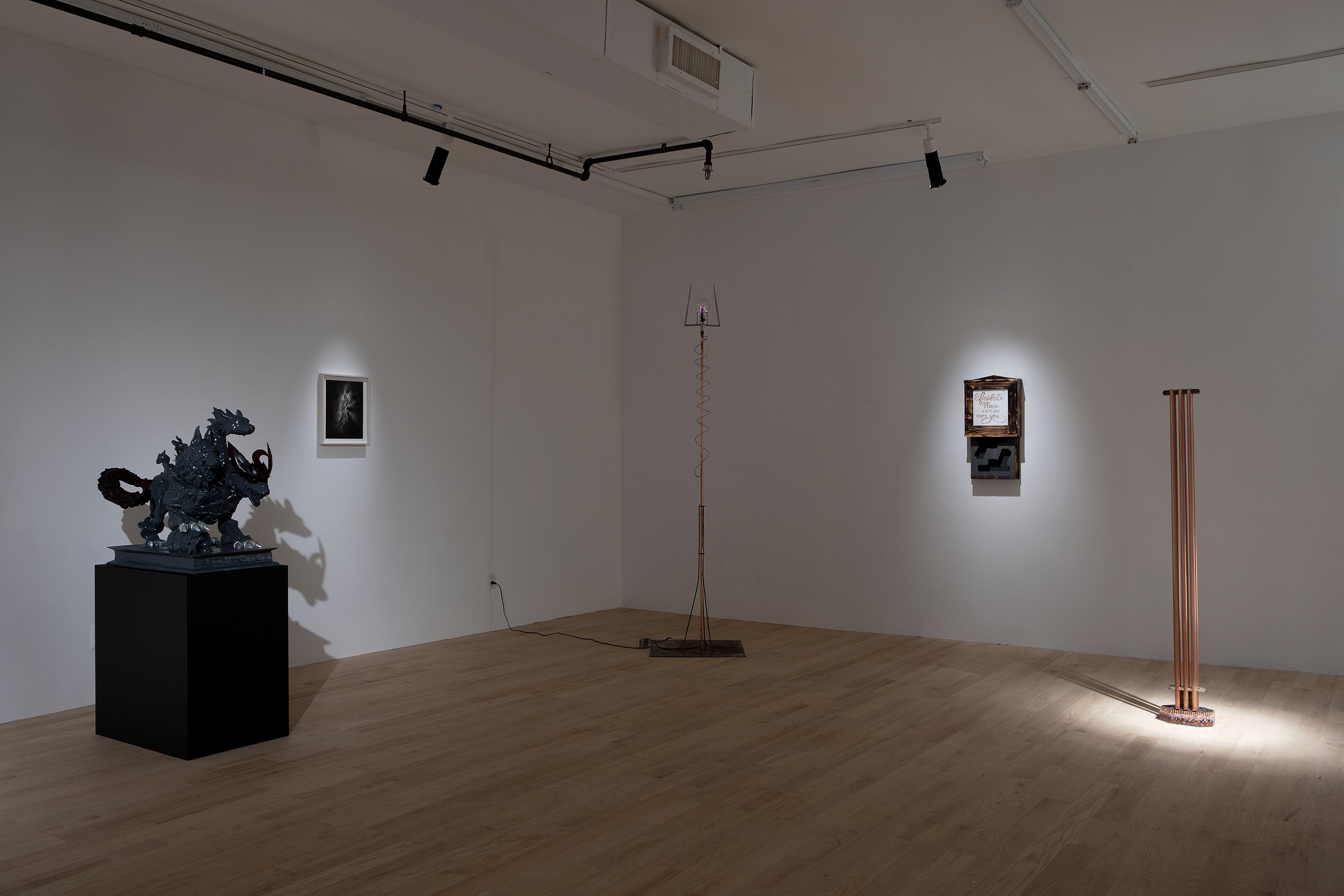
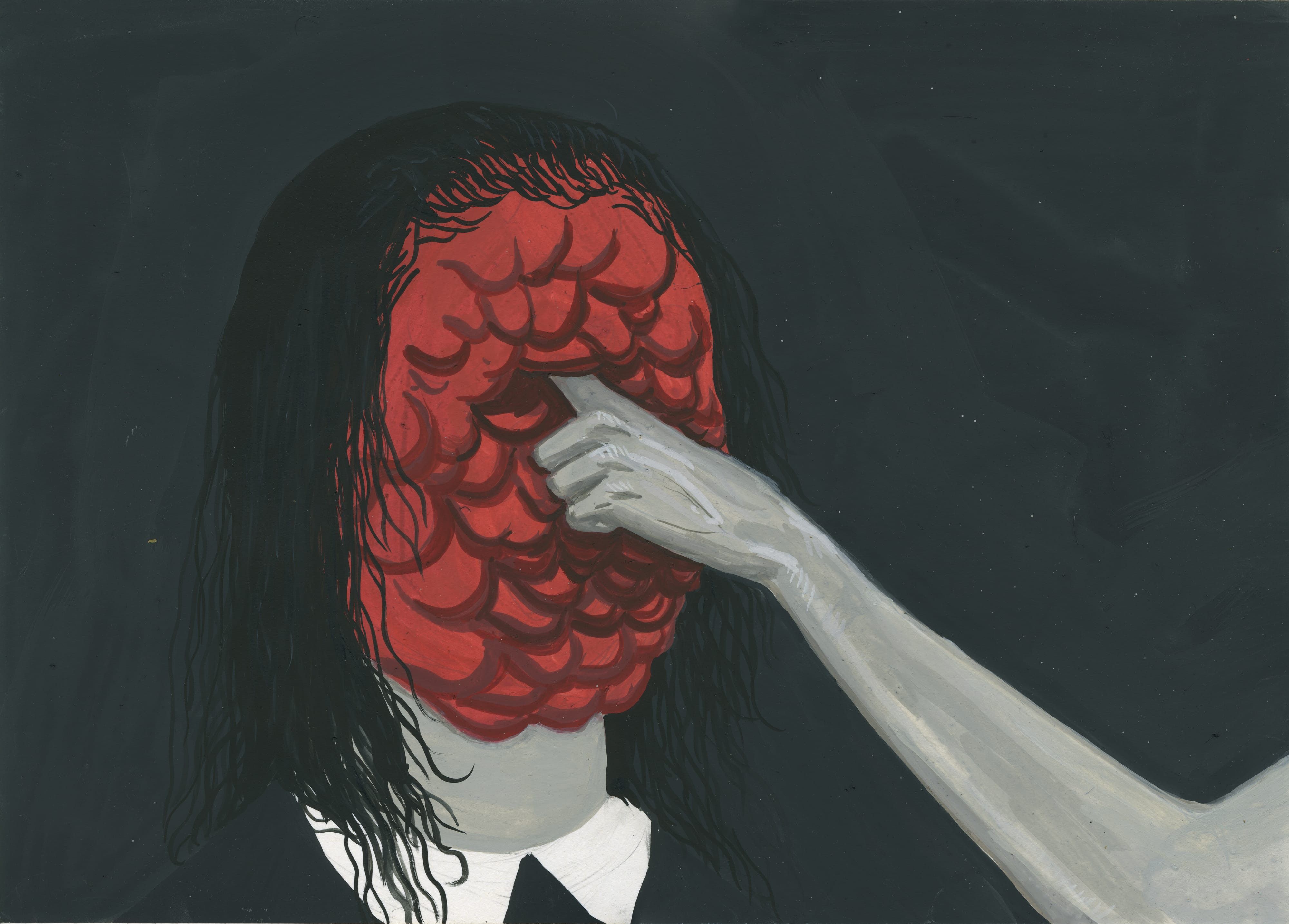
David Altmejd, Tim Brawner, Miriam Cahn, Willehad Eilers, Christina Forrer, DD Herschlein, Linda Marwan, Tura Oliveira, Jang Pa, Jon Rafman, Andrew Roberts, Sibylle Ruppert, Igor Simic, Inna Smolina, Aleksandra Waliszewska
 PastMothers of Time
Amorelle Jacox
Apr 29 – Jun 8
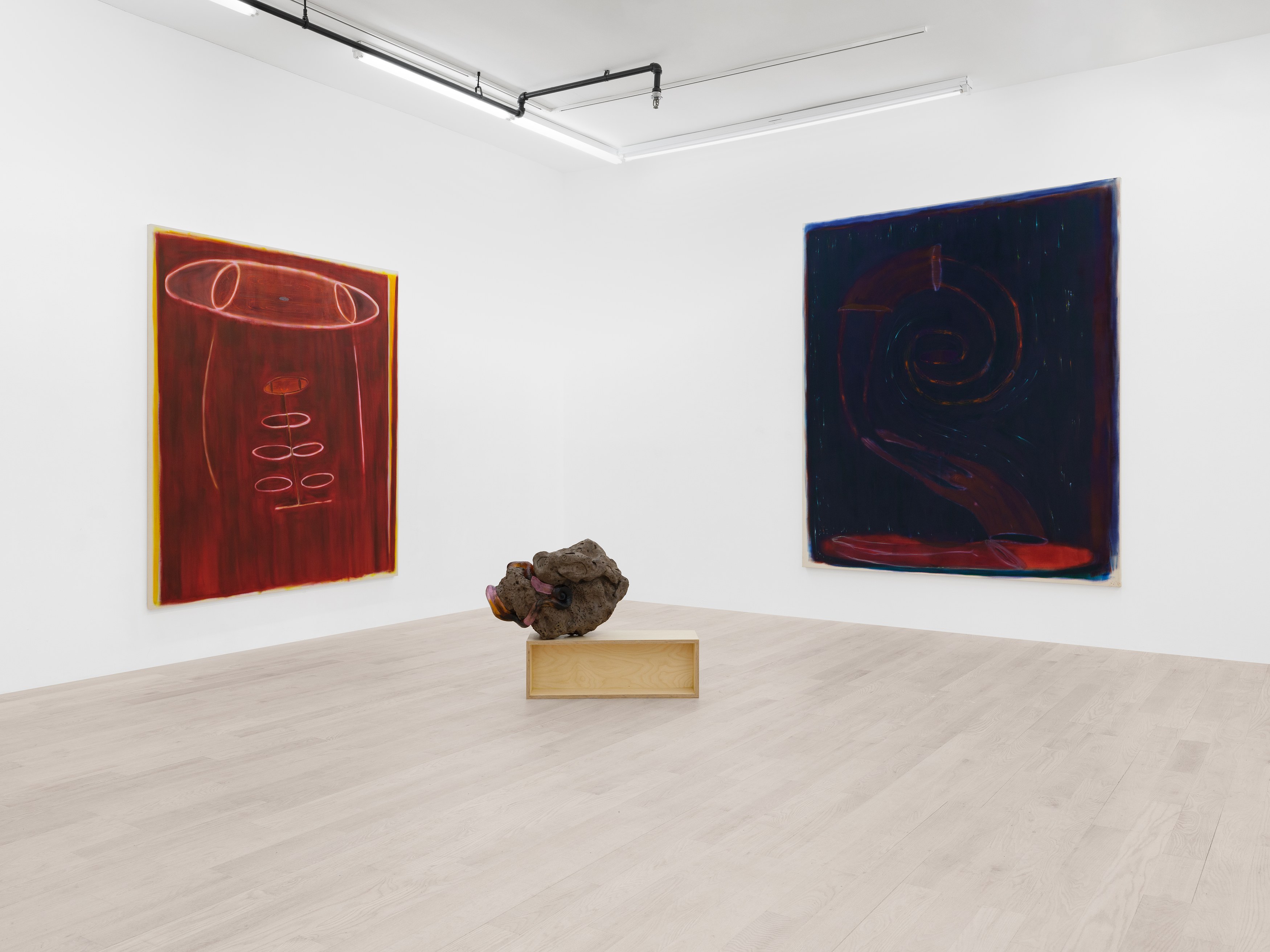
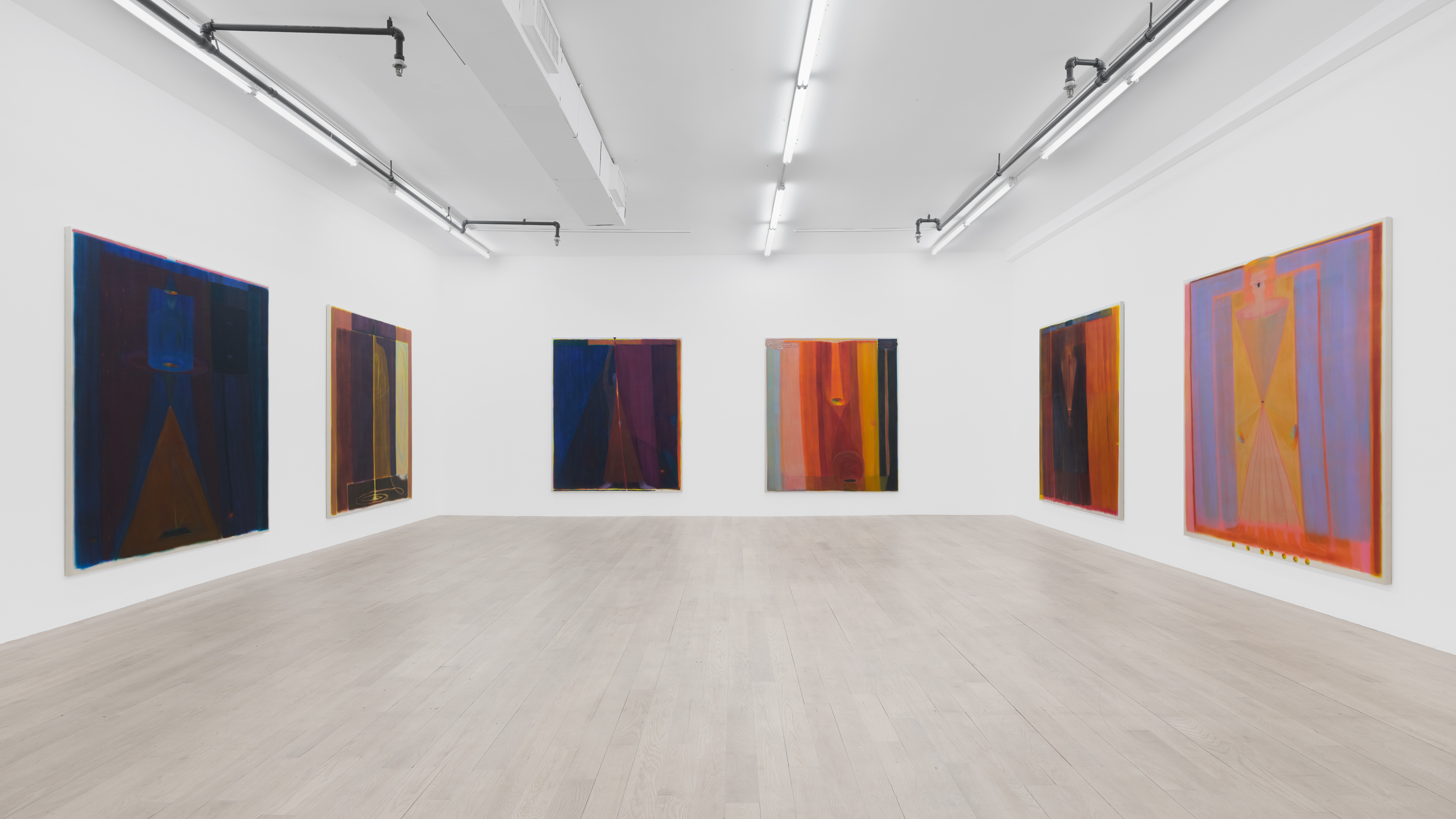
Management is pleased to present Mothers of Time, Amorelle Jacox's debut solo exhibition with the gallery, on view in New York. Rooted in metaphysics, Jacox's painting practice navigates the relationship between the self and the cosmic through a unique synthesis of color field, transcendentalist, surrealist, and symbolist influences. The palpable gravity of her work speaks to the enormity of the existential ideas she wrestles with, informed by a distinctly feminist approach to philosophical and psychological inquiry. In this group of seven paintings, together titled Mothers of Time and made over the past year, Jacox considers the nature of time through its seven causal sources (mothers): Light, Shadow, Cosmos, Void, Matter, Movement, and Number, each in cyclical relation to the others. A text by Amber Collins accompanies the exhibition. "Time flits along the edges of Light as it shapes our days. It hovers in the Shadows of sundials, licks the Numbers on the clock, and deepens ever-outwards from the womb of the Cosmos. It juts out of Movement, of the primordial beginning, pushing Matter ever-onwards with the days and beckoning everything back to its mysterious Void." —Amorelle Jacox Jacox’s practice is driven by a metaphysical and poetic inquiry into the self’s entanglement with the world it inhabits. Time, space, and matter function as recurring coordinates in works that move fluidly between figuration and abstraction. Drawing on Surrealism and color field painting as much as natural phenomena, her work unfolds intuitively, as a direct mode of inquiry. In Mothers of Time, Jacox imagines time as being born of seven mothers (Light, Shadow, Cosmos, Void, Matter, Movement, and Number), together forming a landscape of ontological ancestry. Jacox considers time’s origins through seven figures that surround the gallery like the ticks of a clock face. They meet us from time’s edge, rendered by Jacox as a prismatic architecture built from her singular visual syntax of hourglasses, triangles, ellipses, spirals, and hovering bands of deep color. In these works, body and time are collapsed, blurring anatomy and hour—as if duration could move, heartbeat ticking. Her figures not only inhabit time but hold it, stand on it, carry it in their being. For Jacox, time is not a separate entity but multitudinous, embodied, and felt. In Jacox’s works, time is born from and bound to Light, Shadow, Cosmos, Void, Matter, Movement, and Number, each turning into the others in circular, cyclical relation. Units of measure are rendered fluid, exceeding human systems of quantification. Some of the mothers are haloed with a color wheel, imbuing time with a sacred charge. Made of seven colors, these spectrums carry their own measure, echoing the days of the week and the exhibition’s seven figures as they turn beneath the septapedal Movement (mother) and reappear, smaller, on each big toe. Working before a large window in her Greenpoint studio, Jacox slowly builds up the surfaces of her canvases through thin layers of Gamsol-saturated oil paint, pulling the sun directly into their creation. The appearance of color wheels in these paintings also draws from the studio, where crystals hang in the window, casting shifting glints of prismatic light across the wall and onto the canvases. At the edges of each work, traces of earlier layers remain visible, referred to by Jacox as “early time,” or a material record in which the beginning of the painting remains contiguous with its end. Across these paintings, her highly intuited palette is broader and more varied than in earlier works, reaching toward deeper registers while retaining command of color’s flickering luminosity and material presence. In Mothers of Time, painting is a place where beginnings remain open-ended, where figures appear less as subjects than as presences, beings that speak through the materials that compose them. They emerge as both timekeepers and instruments, and together turn the exhibition into a measuring apparatus, a metronome held across bodies, space, color, and light. Time becomes bodily and cosmic, slipping free from proportion, so that days and years, length and distance, infinity and minute share the same plane in paintings that open like portals into another scale of perception. —Amber Collins Amorelle Jacox holds an MFA from Hunter College (2022). Recent exhibitions include Sun Catcher, Time Keeper at 12.26 Gallery, Los Angeles (2025), They turn into days at Abraham & Wolff, Paris, France (2025), Gravity was an entity at Management, New York (2024), An Infinite Sunder at Lauren Powell Projects, Los Angeles, CA (2023), and Two projections of time, Baseltor Kiosk, Solothurn, Switzerland (2022). She recently completed a residency with Wolf Hill Arts, Chappaqua, NY (2023). Jacox was a recipient of the Marjorie Strider Foundation Grant (2022). Her works and writing have been published in Art Maze (2023) and Yale School of Divinity’s Letters journal (2019).
 PastUntitled (Radiators, Zip Ties)
Bat-Ami Rivlin
Mar 11 – Apr 20
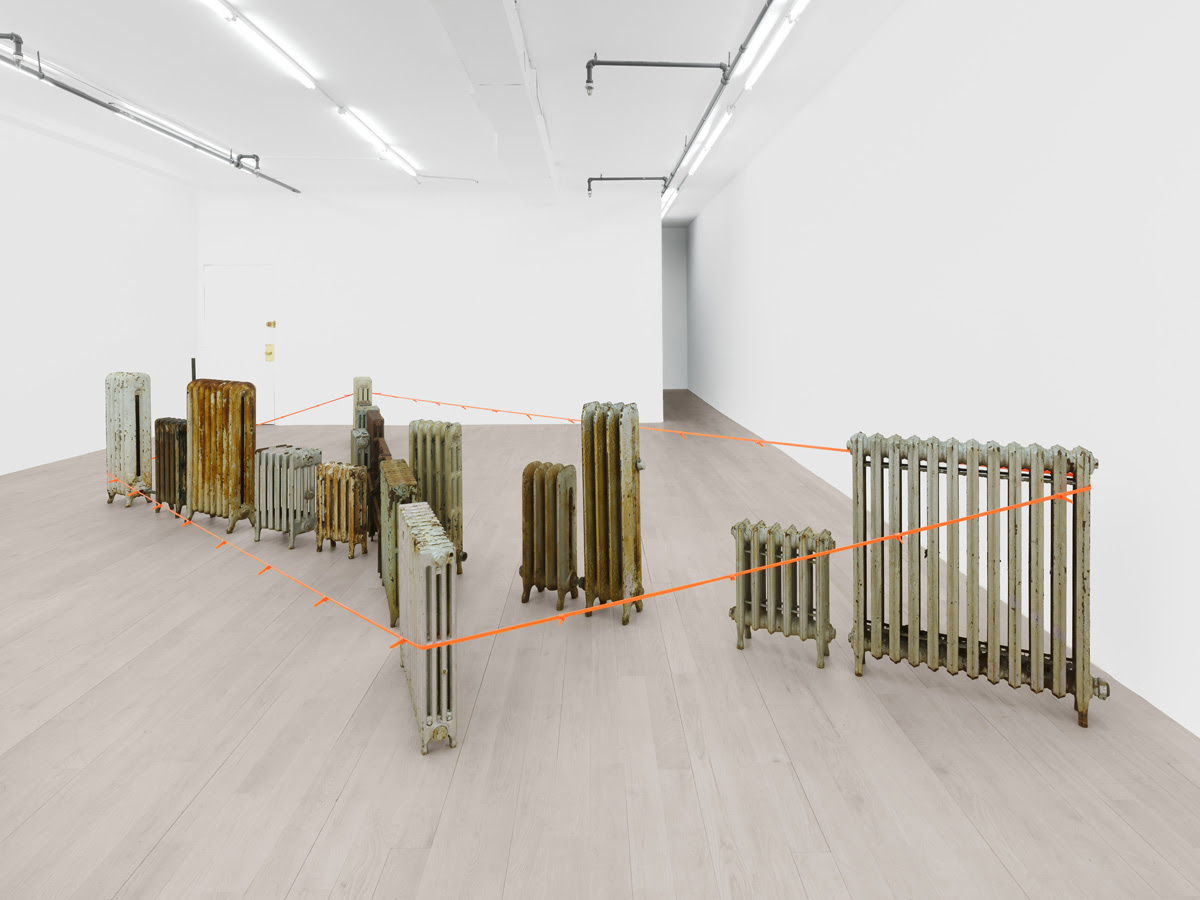
Management is pleased to present Untitled (Radiators, Zip Ties), Bat-Ami Rivlin’s debut solo exhibition with the gallery. Rivlin develops sculptural installations that disrupt and unsettle our habitual relationship to everyday objects. Drawing from locally sourced consumer, domestic, and industrial materials, she constructs improvised yet highly structured assemblages that foreground the charged presence of objects and the social, economic, and linguistic systems that shape how we encounter them. Bat-Ami Rivlin's site-specific installation Untitled (Radiators, Zip Ties), 2026, invites the viewer to step into the space of the familiar and yet understated objecthood. Presented in powerful sparseness, an assembly of locally sourced radiators, encased by zip ties, occupies the gallery space. At first glance, the radiators may appear general, yet their material identity is deeply marked by locality. Deriving from New York City’s architectural strata, their current placement is inherently shaped by the objects’ origins, while the weight of the cast iron becomes indicative of the rootedness at hand. Albeit detached, they remain entangled with their systematic origins of structure, function, and place. Several of these radiators bear the signs of a century by means of their patinated surfaces, while others quietly embed themselves within the timelessness of their whimsical existence through their monochromatic finish. The zip ties, which surround these radiators, function to delineate territory and inscribe an immediate yet soft distance between the viewer and object, as two species of omnipresence meet within a bounded field. Across decades, the radiator slowly accumulates the stratified memory of habitation, inscribing itself onto the cast-iron surface and achieving its endurance through durational persistence. This endurance is not passive, the radiator determines where furniture is placed, how bodies gather around the room, and what corners remain unceasingly cold. Existing as a total object, dominated by its unique columnar form, the radiator monuments its own intent, remarking upon the immediate recognisability for us as viewers, while formal clarity unfolds as the direct relationship between form and purpose. The zip ties, by contrast, proliferate through sheer multiplication. Disposable, but simultaneously everywhere at once, deterministic of budget and provisional solutions. Both objects, in their different temporalities, prescribe the reality around them, dictating what possibilities exist within the domestic spaces they occupy. As time becomes spatial, the cast-iron radiators function as carriers of long-duration time, persisting through decades of use, changing inhabitants, and renewal of interiors, remaining fixed whilst surrounding elements shift, shaping how space organises itself around us. Meanwhile, the zip ties introduce a counter-temporality, operating as carriers of short-duration time and defined by a sense of urgency in the wake of the immediate solution, repeated countless times across varying scenarios and spaces. It is through these different temporalities, that the vitality of each object’s matter foregrounds the operative as opposed to the symbolic. Asserting itself through material action such as the capacity to heat and regulate, and simultaneously to bind, fix, and restrain. Rivlin’s installation highlights and challenges the object’s dynamic modus operandi as it exists across spatial, systemic and political hierarchies. It deliberately stages the object's continued operation to remain visible, holding function in the foreground as something neither neutral nor incidental. In doing so, Untitled (Radiators, Zip Ties), 2026, draws attention to the quiet authority through which everyday materials persist, organise, and regulate the space in which we live. What emerges is an attentiveness to how such objects continue to structure environments long after their presence has ceased to be remarkable, shaping the terms of inhabitation through use, endurance, and repetition. —Saskia Hubert
 PastAußerkörperliche Erfahrung: Wandering Spirit
Jura Shust
Jan 17 – Mar 2
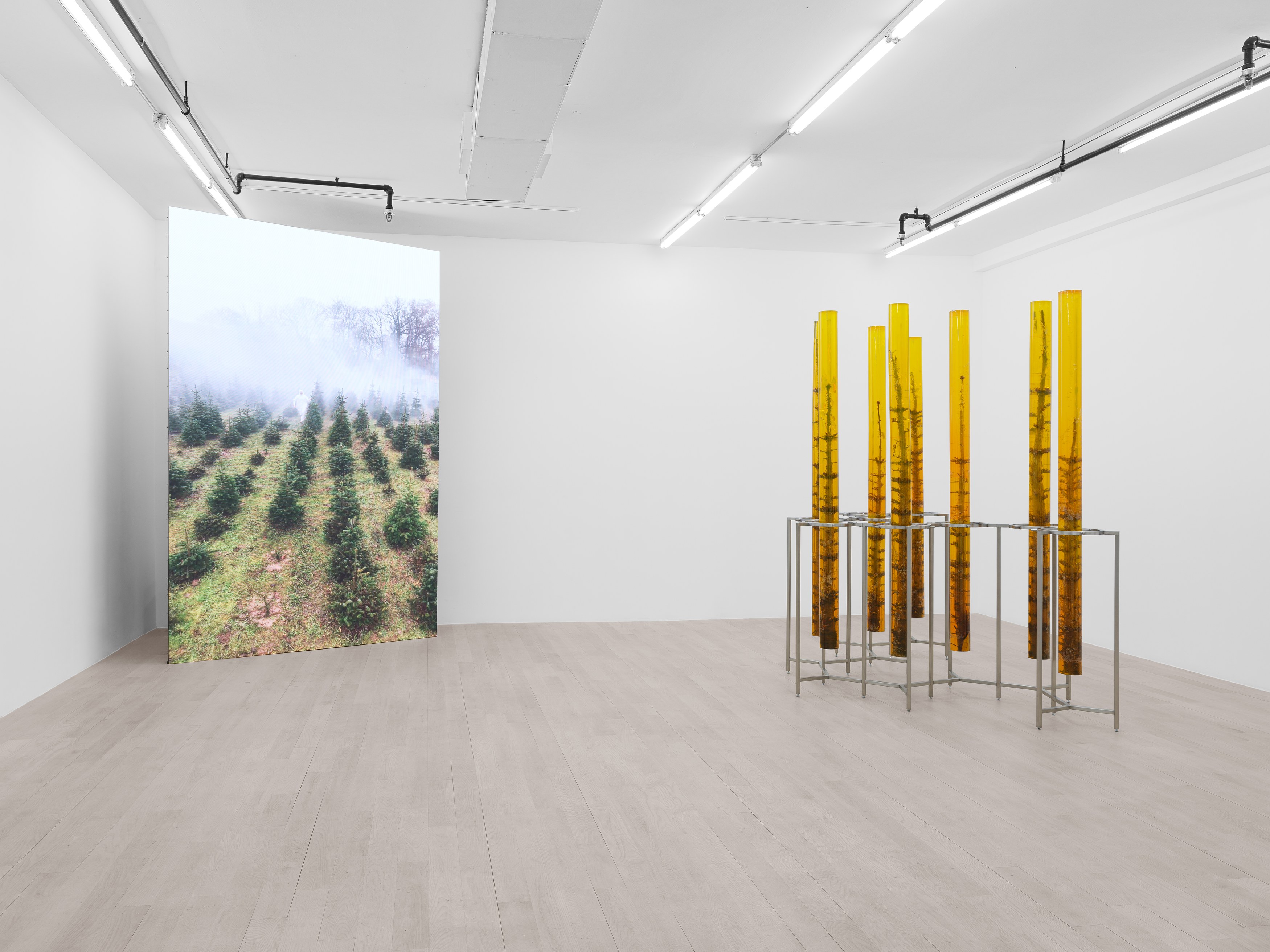
Management is pleased to present Außerkörperliche Erfahrung: Wandering Spirit, Jura Shust’s second solo exhibition with the gallery. The exhibition features a new video and a series of wall-based works made in 2025-2026, as well as two major works commissioned for the 15th Gwangju Biennale in South Korea in 2024. A wandering spirit leaves the vessel of an animistic being, drawn toward a new materialism. Through ritual, it gradually forgets its origin. It spins through a Christmas-tree plantation, repeating loops of growth and extraction, and slips into a parallel world. A breath-filled glass crown is placed atop a century-old spruce. The spirit reappears as a guardian consciousness within a cemetery, where conifers are planted on graves and needles carpet the ground. The cemetery is a database. The root system of the spruce spreads horizontally, close to the surface, and in a gust of wind, it is often the first to fall. After the festival, desecrated trees are collected from the streets. Their branches are cut — a gesture that once carried meaning, now repeated as an automated action. The cuts encrypt a message in a language that has been forgotten. The trunks are entombed in synthetic amber, archiving the entity within. A future ritual becomes the interface that might decrypt the archive. The core video of the exhibition, eponymously titled Außerkörperliche Erfahrung, depicts this disembodied spirit as a digital consciousness. Neither human nor entirely artificial, the neural entity performs a ritual migration, transplanted from a Christmas tree farm to a cemetery in Berlin’s Neukölln. What once belonged to animistic cosmologies now circulates through technological systems, carrying agency without a body. The central sculptural work, Leaving an Annual Growth at the Top: Succession (2024), comprises eight discarded Christmas trees whose branches are cut and whose trunks are encapsulated in resin. The gesture oscillates between care and exploitation, preservation and capture. Drawing on ancient Slavic tree-worship practices, the work references funerary cults and the concept of the sacred grove — a space that indigenous cultures of Northern and Eastern Europe perceived as a temple, a site of connection to a broader cosmology beyond human time. In a parallel register, digital consciousness appears as a hybrid of root system and neural network in the wall-based diptych Untitled (2024). Generated by prompting a large language model to define its own anatomy, the work is machine-sculpted from spruce wood, activated with black soil, and sealed in synthetic resin. Accompanying this piece is a new series of panels, Breath-filled Glass Crown (2025), produced using the same technique. Here, the LLM is trained to generate the architecture of a human mind through MRI images of the artist’s brain, translating neurological activity into speculative structures. Drawing on principles of ancient animism, Außerkörperliche Erfahrung reflects on the convergence of ecology, technology, and spirituality. The exhibition points toward a condition in which technology no longer functions as a tool but emerges as an autonomous agent integrated with natural systems. In this shifting cosmology, distinctions between the organic and the synthetic, the living and the archived, the spirit and the system begin to dissolve. —written in collaboration with a wandering spirit. Jura Shust (b. 1983 in Maladzyechna, Belarus; Based in Berlin) explores the relationship between ritual and escapism. Intrigued by semantic polysemy, informational intoxication, and primal aspiration for an out-of-body experience, he reflects on how the mythological overlaps with the technological. Revising the linear and circular temporalities, Shust juxtaposes an archaic worldview with a futuristic perspective. Exploring the renewal cycle within organic decomposition and artificial synthesis, he is focused on the relationship between the human psyche and the natural world. Based on scientific research, the artist’s practice merges various forms to construct mental landscapes illuminated by ethnoreligious beliefs and flooded by biopolitics. Shust has exhibited at the Museum of Contemporary Art GFZK, Leipzig, Germany; Contemporary Art Museum S.M.A.K., Ghent, Belgium; Museum de Domijnen, Sittard, Netherlands; Mystetskyi Arsenal, Kyiv, Ukraine; Calvert 22 Foundation, London, UK; Badischer Kunstverein, Karlsruhe, Germany; Blaffer Art Museum, Houston, Texas; and Management, New York, among others. He participated in the 14th Baltic Triennial in Vilnius, Lithuania; the 4th Art Encounters Biennial in Timișoara, Romania; and the 15th Gwangju Biennale in South Korea. His works are held in the collections of S.M.A.K. Museum of Contemporary Art in Ghent, Belgium, Muzeum Sztuki in Łódź, Poland, Alain Servais Family Collection, Brussels, Belgium, and numerous private collections. Shust is the founder and curator of the platform saliva.live.
 PastGilgul (The Wheel)
Kate Liebman
Nov 5 – Dec 29
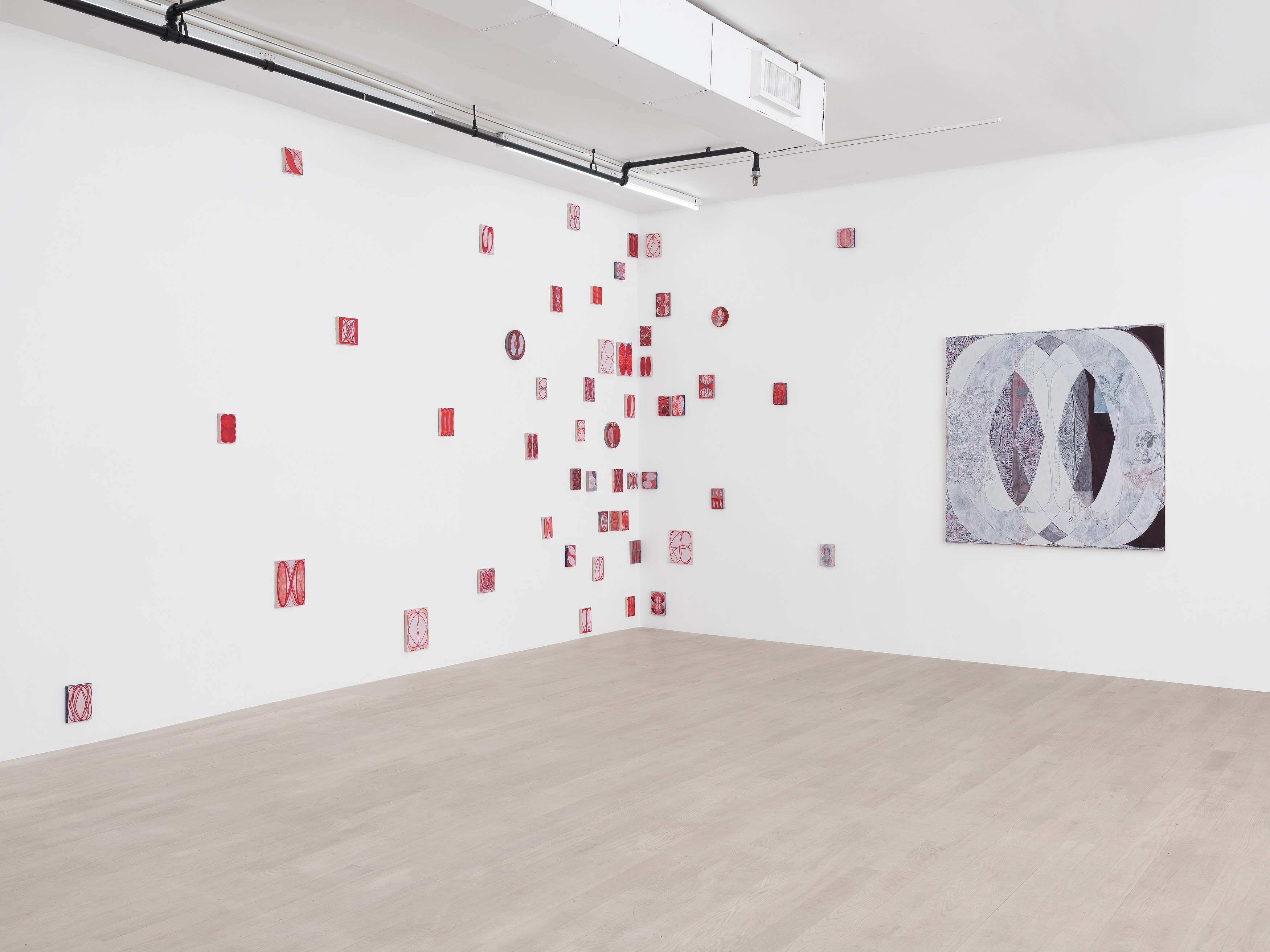
Management is pleased to present Gilgul (The Wheel), a solo exhibition of new works by New York-based painter Kate Liebman. Her work emerges from a process of meaning-making that weaves together a layered visual tapestry with elements of astronomical charts, Hebraic symbolism, old master paintings of myths, and personal memories. Intelligible despite their complexity, Liebman's paintings are a heuristic bridge between our most confounding mysteries and the defining moments of the human experience. A text by Brooke McGowan accompanies the exhibition. A cacophony of signs haunts the surface. “It’s instinctual” artist Kate Liebman intones blithely, with a seemingly off handed twirl of her wrist, gesturing towards a tableau in her Brooklyn studio; When it was our generation’s turn to be alive (2025) portrays large, muscular overlapping circling forms, suggestive of at once the plenitude of infinity and the void of zero, against a tangled background of red and burgundy organic forms: a painterly hollow of ghostly tree branches and vines overgrowing the contained field. Immured between layers of white, an image of Bruegel’s masted ship from his masterpiece The Fall of Icarus floats as a memento mori on an ethereal sea, not a bulwark against hubris, but a reminder we will all fall to the earth, unnoticed. On the far left of the canvas, integers, in their rational objectivity, march up the wall like a lie of the mind, pointing towards the ultimate impasse between subjective reality and that which can be weighed, measured, and found wanting. In Zero at the Bone (2025), the numbers repeat, while the round, foregrounded forms of the previous painting give way to delicate red lines, cutting deeper in the flesh of the surface, leaving behind a persistent wound of bright blood-red chroma. The offense, it seems, is so grave as to have violated the substrate itself: barely perceptible beneath the strata of acrylic lies the visceral trace of a wound; the canvas is stitched together by hand. Elsewhere, a cautionary plume of avian forms murmur across the tableau in phase change (2025), met by the whisper of the Hebrew Kaddish, a prayer of mourning: blessed, praised, glorified, exalted, extolled, honored, elevated and lauded be ... Blessed is he. Perhaps, I think to myself, this is also a love letter. Death, however, is never far off. Indeed, the very title of the exhibition invokes a haunting: Gilgul refers to the mystical Jewish concept of reincarnation, an ancient spectral recycling, subject to a multiplicity of significations. The artist’s use of the Kabbalistic term belies an attraction to its indeterminacy. As the artist states: "‘Wheel’ would be the translation of Gilgul more suggestive of the physical world, ‘cycle’ … more abstract. Perhaps ‘rounds’ would be more sportive and/or more suggestive of medical treatments. This multiplicity is appealing in that it reflects the work both formally (the rounds/cycles/wheels/spinning that make up the compositions) and in process (the iterative approach). Working serially also resonates with this term if you take the concept of reincarnation seriously, because then we are all just iterations of previous and future souls. So then each painting might be thought of as a reiteration of a previous painting, just endlessly shifting from panel to panel." Composed in the rain shadow of the birth of her two daughters as well as during medical treatments for a loved one, the hauntological works of Gilgul, are undeniably incarnate. These are paintings as flesh, as corpus: bleeding, violated, stitched, marked, reproducing. But these works are also results of an invented, and inventive, process of iteration. After a Lower East Side Printshop residency, Liebman sought to bring the lessons of etching and chinecolle, of putting multiple images on the same plane, back to the studio. The artist first applies to the canvas an assemblage derived from an idiosyncratic library of worked material—the tracing of an MRI of her daughter’s body, a drawing of Grunewald's Isenheim Altarpiece, an image of an airplane, or numbers one through 24 as hours of the day—then washes this with color to create the first archival layer. This prepared ground is subsequently treated with acrylic paint—often white as an undeniable act of erasure. Finally, into that thick, layered body of paint and collage, Liebman carves further signs, like vestiges, wounds, or ghosts. Repeat. Repeat. Repeat. Assertive but intimate, hermetic but penetrable, Liebman’s forceful collection of rouge-hued tableaux entices the viewer with a cornucopia of signs whose signification nonetheless withdraws at the very moment of surfacing. The work resists the relentless reduction of the artwork to content, intentional or otherwise. As Susan Sontag states in Against Interpretation, “The overemphasis on the idea of content entails ... the perennial, never consummated project of interpretation.” Such interpretation for Sontag is not only limiting and unitary (looking for only one ‘true’ meaning) but ascetic, overtly rational, or “Even more. It is the revenge of the intellect upon the world. To interpret is to impoverish, to deplete the world.” This diminishment evolves, for Sontag, from the imagination of a post-mythic consciousness that seeks to strip magic and ritual from art. Thus, while Liebman’s iterative process points towards an indeterminacy which might be understood as traumatic—both personally and existentially—Gilgul, as a body of work and a concept, is recuperative, healing. Through the personal, instinctual, and idiosyncratic, the archeology of Liebman’s oeuvre yearns to excavate the space of the unsayable, to, like the coincidentia oppositorum of zero and infinity, write the sign for the unaccountable—even magical, ritual—without, as Sontag notes, “heroic pretensions or universalist goals.” Or perhaps she is just speaking in tongues. —Brooke Lynn McGowan
 PastObjects in Mirror May Be Closer Than They Appear
Vladislav Markov
Sep 6 – Oct 27
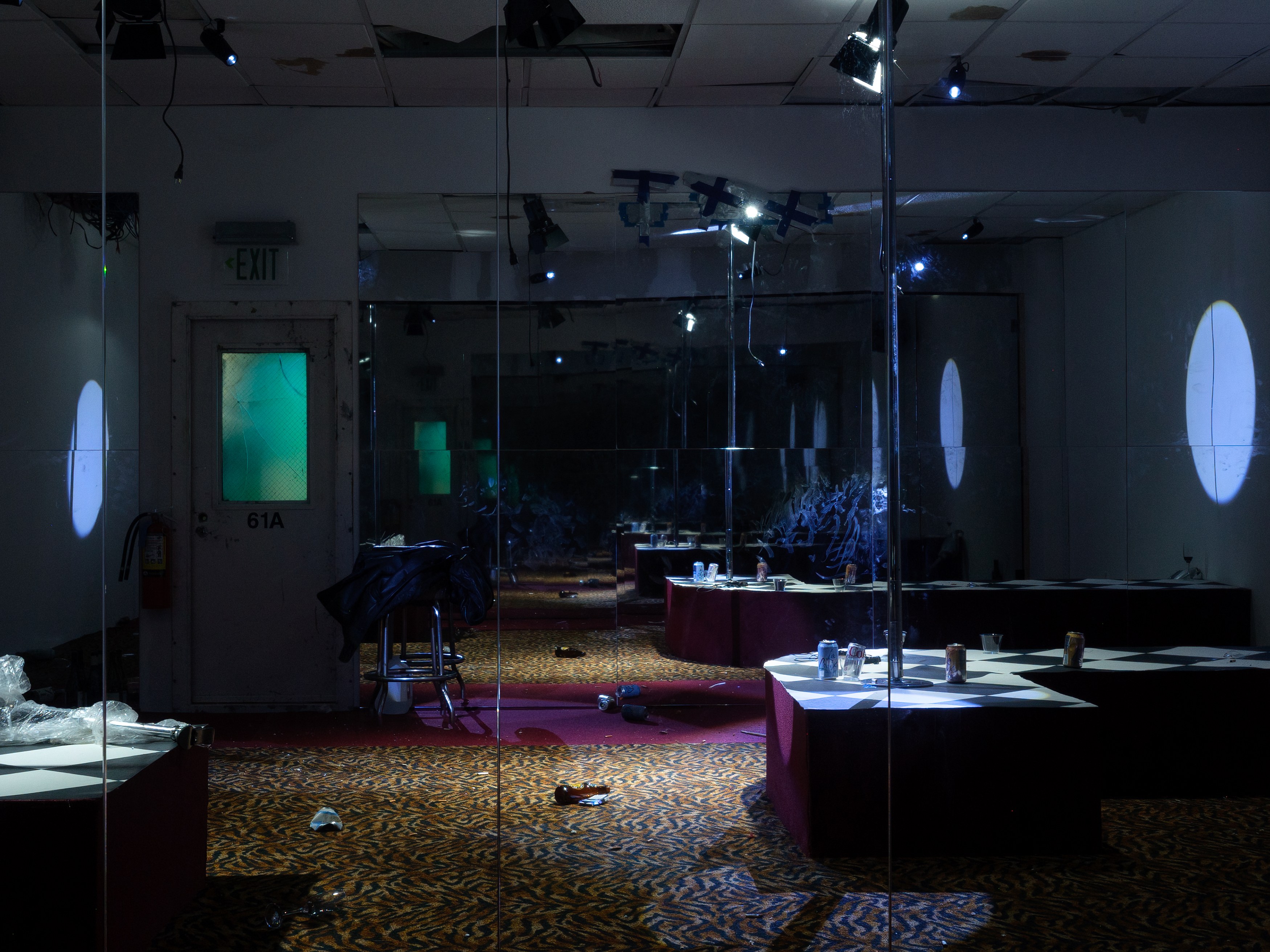
Management is pleased to present Objects in Mirror May Be Closer Than They Appear, the second solo exhibition of New York-based Vladislav Markov at the gallery. Markov creates an environment reminiscent of a seedy strip club that viewers are able to observe from within a black box behind a one-way mirror wall, not unlike that of a monitoring room in an interrogation context. The performers in the space are amputees Markov contracted online, for whom he has created custom prosthetics for the duration of the exhibition. A 3-hour-long soundtrack accompanies the exhibition, its content drawing on the tradition of world-specific entertainment radio for various video games like the Grand Theft Auto series. "Since the beginning of the century, there have been three significant moments in the relationship between art and technology. First, there was post-internet art, a term coined by artist Marisa Olson in 2008, which encompassed artistic practices that occur "online but can and should also take place offline," raising questions about the relationships between the real and the virtual. Next, a new generation of painters, including Kelley Walker and Wade Guyton, integrated computing into painting, sourcing their subjects by browsing the internet. The third moment is the confrontation between subjectivity and robotics, between human desires and algorithms. For artists today, the issue is no longer how to transition from online to offline but rather how humans can negotiate their relationships with machines that transform reality. What was termed "zombie abstraction" fifteen years ago seems to have become the norm. Current exhibitions showcase zombie figurative art, zombie installations, and even zombie identity politics. When forms become automatic, our brains hit pause, and power loves it. Nowadays, most artists produce visuals — images meant to be vaguely "received," much like a QR code scanner receives a QR code. Yet, great artists are distinguished by their ability to create not just visuals, but images: an image is alive, complex, unsettling, resilient. Truly contemporary forms, those that could not have been produced yesterday, are still rare, yet Vladislav Markov is among those artists who "feel" their time. In 2022, I was struck by his series of paintings depicting a worn and tattered world, affected by an inexplicable spatial and temporal disintegration, as if the overall coherence of the universe had collapsed — paintings that reveal "accidents of things." When the first digital images emerged in the 1980s, humanity's and art's history took a decisive turn: because these images are the result of computation, they no longer bear the trace of anything. In other words, the image is no longer connected to reality by analogy—the link that once existed between the senses and the world has become secondary. In Blade Runner, Philip K. Dick envisioned robots that could only be distinguished from humans by their lack of emotions and the implanting of artificial memories devoid of any trace of real events. What is known as the "Mandela Effect" demonstrates a similar disconnection from the information provided by reality. The normalization of false memories and mental illusions, along with the emergence of "alternative truths," indicates that Dick's replicants are now among us. An artist seeking to represent the world as it is can no longer merely depict reality; they must incorporate this hallucinatory dimension, linking themselves to a world of disconnection, a realm liberated from the laws of physics, information, and scientific principles. Born in Russia, Vladislav Markov is well-positioned to perceive the invisible toxicity that shrouds what we call "reality" and to discern the forms of global chaos in which we operate. In the exhibition Objects In Mirror May Be Closer Than They Appear, he integrates bugs, remote control, the dark web, buzz, and filters that distort or color reality. We now perceive the world through interfaces that shape our perception: the optical and mental illusions referenced in the title of the exhibition are now embedded in reality. Markov constructs spaces that seem to have been produced by a malfunctioning computer, in a world riddled with glitches. Objects In Mirror... is an image composed of deteriorated code fragments from social life, of declining or dilapidated forms of existence, capturing the most toxic elements floating in contemporary society: voyeurism, masculinism, police apparatus, and ubiquitous surveillance. Thus, Markov's work proves to be strikingly realistic, in the sense that Gustave Courbet attributed to the term in the 19th century, because it brutally illuminates the dimly lit corners of existence, its most grim recesses, revealing, through battered and bumpy forms, the gradual dissolution of reality. This is why his work will stand as emblematic of our era, just as Courbet was for his." —Nicolas Bourriaud Performance dates: Saturday, October 4, 3pm to 6pm Saturday, October 11, 3pm to 6pm Saturday, October 18, 3pm to 6pm Saturday, October 25, 3pm to 6pm
Past
ExuviaeStine Deja & Mary Audrey-Ramirez
Jun 13 – Jul 28
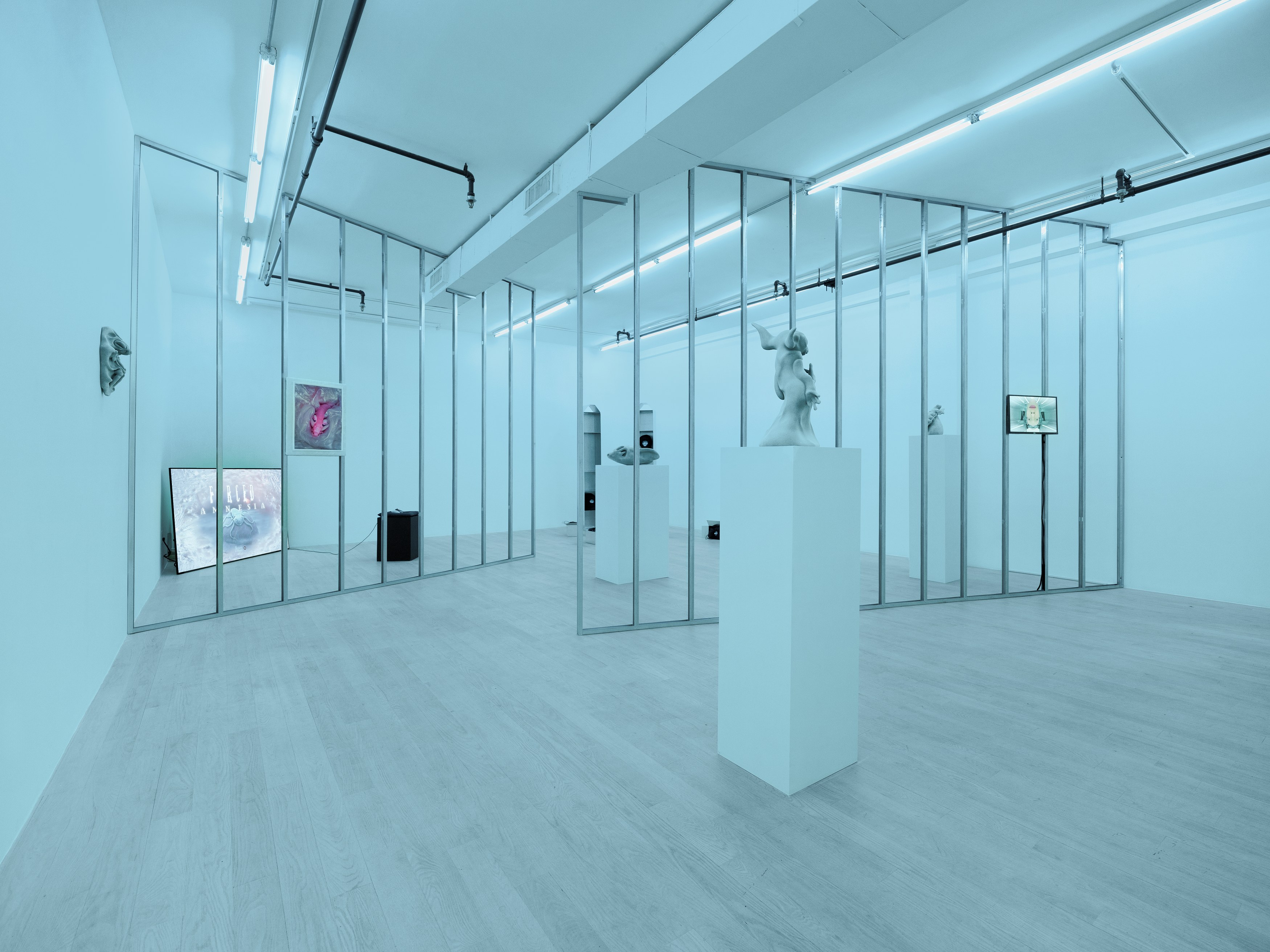
Management is pleased to present Exuviae, a duo exhibition by Danish artist Stine Deja and Luxembourgish artist Mary-Audrey Ramirez. A text by Adriana Blidaru accompanies the exhibition. While Exuviae doesn't care much for linear time, it responds directly to the moment we're in: one where human centrality is dissolving under ecological pressure and technological acceleration. As a viewer, you are thrown into a timeline where human history - on a species scale - has already fractured. Stepping into this world feels like studying the past from a far future, trying to piece together a cohesive narrative. Everything's a little off, a little funny - but the kind of funny that leaves a pit in your stomach. Artists Stine Deja and Mary-Audrey Ramirez bring together two different species of speculation: Deja through suspended, digitized stasis; Ramirez through organic, erratic evolution. A dark thread of humor runs through both. Neither of them takes itself too seriously but both worlds seem to unfold in the long shadow of a humanity that no longer feels central, or even intact. In what Claire Colebrook calls "twilight of the Anthropocene idols," we face the crumbling of our species' self-image - not as apex thinkers but as one adaptive system among others. Both artists work with this collapse, extending the legacy of post-internet aesthetics towards a kind of speculative anthropology, one that navigates the disorientation of non-centrality through hyper-rendered bodies and looping simulations. Deja's work imagines a future where humanity decided to hit pause on life. Not completely stopped, just suspended. In Tomorrow's Heads, made with Danish author Ida Marie Hede, human heads are stored for future use, cryogenically frozen, waiting for their second act. They are like any other organs in a freezer except they hold on to their consciousness. This dream is as old as human civilization: cheat death. But Deja draws attention to the logistics of this fantasy: what is the way to get there? Who does the freezing? Who is cleaning the tanks? Who is paying the power bill? The tone is clinical and eerie, evoking a theatrical absurdity found in an Ionesco play. Deja's world highlights the sleek contrasts between human and technological evolution. These aesthetic choices reflect a nervousness about how much we want to control and preserve. On the other hand, Ramirez's world couldn't care less about preservation or control. Her blobby, insectoid creatures - some recognizably cute, some totally unplaceable - aren't waiting for any human timeline to fulfill their purpose. They're constantly becoming. Their names - like Schminkie or Baby Jesus - suggest an anthropomorphic presence, but any sense of meaning dissolves just as quickly. While they have strong cryptid energy, these creatures also echo real-world biological organisms: the indestructible Tardigrades, who can suspend their metabolism for years and survive exposure to space, yet otherwise live peacefully in mosses and lichens; or the Demodex mites--tiny worm-like beings buried in our pores and lashes, crawling out at night to mate, feast on sebum, and vanish before morning. Ramirez's creatures seem to be pulled from a dream, or from a footnote in a speculative biology journal. In this context, they appear as if they've been evolving alongside humanity the entire time, indifferent to its obsession with preserving and sustaining these cryogenic businesses. It's implied that these creatures' evolution remained unnoticeable, and perhaps took over completely when humans succumbed to their obsessive myth of self-preservation. Completely indifferent to us, they continued thriving in the margins, slowly taking over. The works construct this exhibition like a mirror house built from broken glass, distorting a reflection just enough to feel familiar but awfully uncanny, a little grotesque, and strangely funny. Ramirez ripples where Deja freezes. If one holds time still, the other lets it slide sideways. Both seem to be asking the same core question: how do we relate to the unknown? Forget monuments, archives, or passed-down stories. The future isn't elsewhere - it's already here, between these gallery walls, rendered in digital processes. Here, screens flicker, files are loading, and bodies do not breathe - they loop. —Adriana Blidaru Stine Deja (b. 1986 in Denmark). Lives and works in Copenhagen) received an MA from Royal College of Art. Solo exhibitions include Grave Matter at Ringsted Galleriet, Ringsted, Full Circle at Florit Florit, Palma; Heavy Render at OTP Copenhagen; Dawn Chorus Beta at Fragment, New York; Cold Sleep at Tranen, Gentofte; Last Resort at kim? Contemporary Art Centre, Riga; Hard Core, Soft Bodies at Schimmel Projects, Dresden, and has executed several site-specific projects internationally. Deja's work has been published in Cura, Nasty Magazine, Coeval Magazine, Kunstforum, Overstandard and many other publications. Her work is included in the collections of Arken, The New Carlsberg Foundation, The Danish Arts Foundation, Esbjerg Art Museum. Mary-Audrey Ramirez (b. 1990 Luxembourg-City, Luxembourg. Lives and works in Berlin) studied under Thomas Zipp at the University of the Arts in Berlin Germany from 2010 to 2016. In 2019 she was the recipient of the prestigious Edward Steichen Award in Luxembourg for her textile-based sculptural and pictorial works. Her works have been shown in both solo and group exhibitions at institutions such as Casino Luxembourg - forum d'art contemporain, Luxembourg, Triennale fr Kleinplastik, Fellbach, Max-Ernst-Museum, Brhl, Kunsthalle Gießen, Gießen, Kunstpalast, Dusseldorf, Dortmunder Kunstverein, Dortmund, Trauma, Berlin, Kai10, Arthena Foundation, Dusseldorf, Haus Modrath, Kerpen Polansky Gallery, Prag und Martinetz, Cologne, Esch2022+ARS Electronica, Luxembourg/Linz.
 PastLuca
Anastasia Komar
Apr 23 – Jun 2
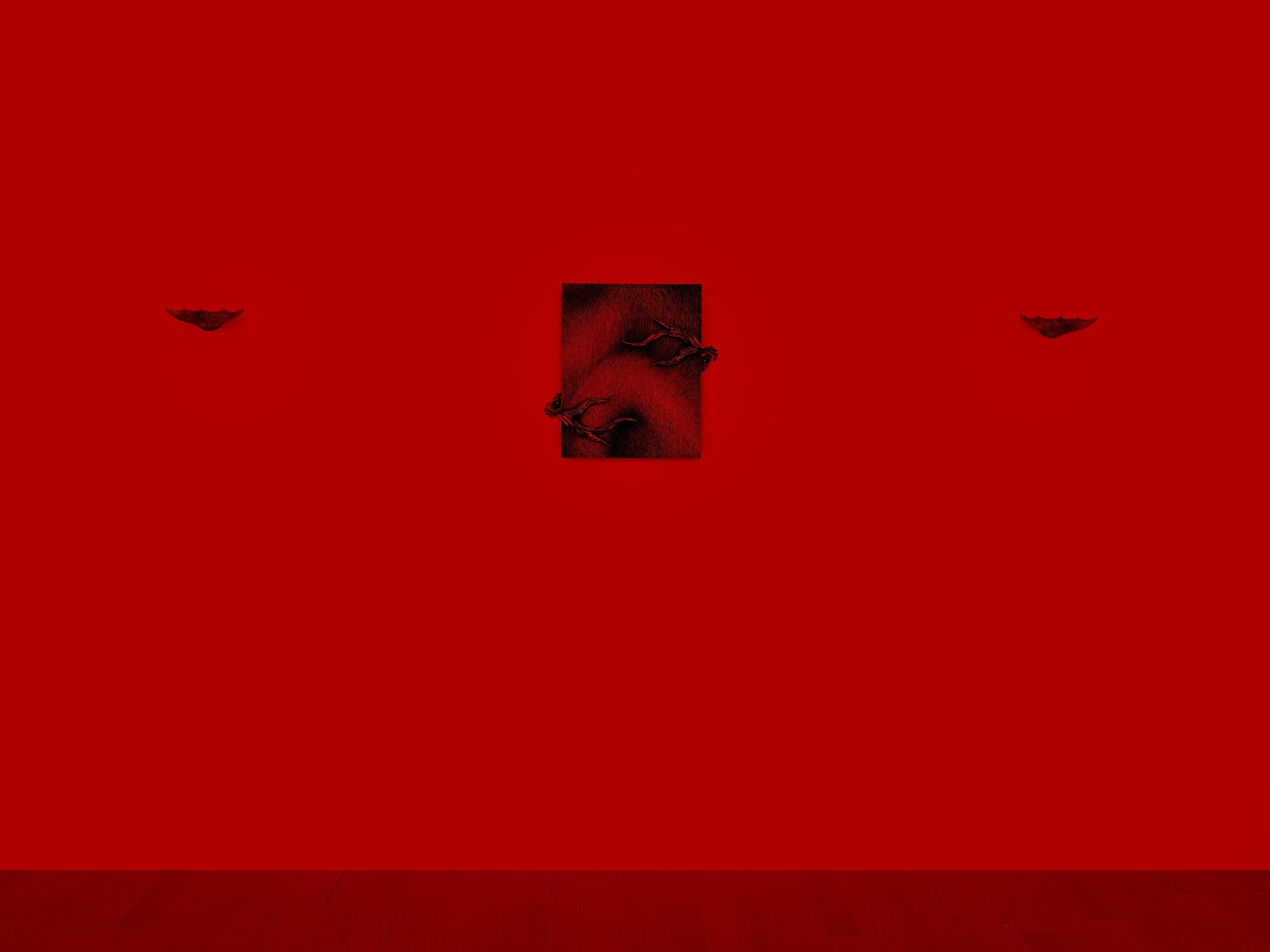
Management is pleased to present LUCA, an installation by Anastasia Komar that contemplates the future of humanity through the prism of its primordial past, the Last Universal Common Ancestor (LUCA). Komar will create an installation in the gallery space that hints at the synthesis of organic and non-organic lifeforms, engaging our senses of sight, scent, and sound. A special soundtrack for the show was written and composed by Kamron Saniee in collaboration with the artist. ——— A voice—calm, and measured. I am not first, but only. Mother and father to all that crawl, that breathe, that can reach and recoil. In your marrow, where it narrows. Between me and you, lattice-like and shifting. Organelles free-based in the ichor of potential. The cask of merging, consuming, becoming, is here. The split and spread of tendrils not yet come to flesh, an infinite presence sprouting in brilliant technicolor. Between potential and reality. Coated in a cipher of biological intent. It wraps itself in damask, and yearns, hardening in shells made of acetate. A whisper charged pulses, an ancient incantation woven from the language of ions and gradients, a hymn of hydrogen and heat. I am the ghost of vents long cooled, the ember of oceans still boiling. Fish have walked out of me. I am the channel that bridges time, the sinew between future’s past and past’s future. You were never alone. You were always me. Lines emerge from the void, glowing filaments that tangle and weave into fractal patterns. These are cells, or not cells, but the idea of cells—their earliest echoes, when life was a thought not yet spoken. From the central chamber, a translucent mass writhes and divides, a digital rendering of genesis itself. Not a reconstruction of history, but a suggestion, a dream of what might have been before there was anything else to remember. I am not first, but only. Mother and father to all that crawl, that breathe, that can reach and recoil. In your marrow, where it narrows. Between me and you, lattice-like and shifting. Organelles free-based in the ichor of potential. The cask of merging, consuming, becoming, is here. The split and spread of tendrils not yet come to flesh, an infinite presence sprouting in brilliant color. It wraps itself in damask, and it yearns, hardening in shells made of acetate. Its placenta unfurls into space, a web of sensory tendrils reaching, translating the shifting currents of its environment, a transmission node pulsing with silent messages. It is not inert. It sings its song I know in my cells, searches for echoes in the void—others like itself, or at least the promise of their existence. In my womb, life replays its first refrain. To be. To become. To reach. To return. Bathed in the petrichor of an electrochemical gradient, folded into every lungful of air, LUCA endures. —Maya Kotomori Anastasia Komar’s practice is informed by her research into the intersection of art and contemporary bioengineering, seeking to elucidate aspects of our reality that increasingly affect the human experience but elude comprehension. Referencing science, theology, and history, Komar combines acrylic painting executed in a wide gamut of short, vivid, and luminescent brushstrokes with advanced polymer sculptures that echo forms at once biomolecular, mythological, and mammalian. Komar (b. 1986 in Kaliningrad, USSR) received an MA in Architecture and Environmental Design from the Moscow Institute of Architecture. Solo exhibitions include Hosts at Management, New York; ex-vivo at Bank, Shanghai; and von Neumann’s Dream at Shulamit Nazarian, Los Angeles. Group exhibitions include To Bloom at The Page, Seoul; Cell Struggles at Foundry, Seoul; Weirding Worlds at Podium, Hong Kong; Fever Dream at Swivel Gallery, New York; Holding at Kristen Lorello & Van Doren Waxter, New York; Poetics of Falsification at Harper’s, East Hampton; America Runs at Dunkunsthalle, New York; Contemporary Practices at the gallery of the School of Visual Arts, New York; Over the Structures at the CICA Museum, South Korea, and has executed several site-specific projects in New York and California. Komar’s work has been published in The Financial Times, The Art Newspaper, Vogue Scandinavia, Surface Mag, Bomb Magazine, Cultured Magazine, Artsy, Designboom, and many other publications. Her work is included in the Start Museum, Shanghai, and the Zabludowicz Collection, London.
 PastThe Permanent and the Insatiable
Xin Liu
Mar 5 – Apr 14
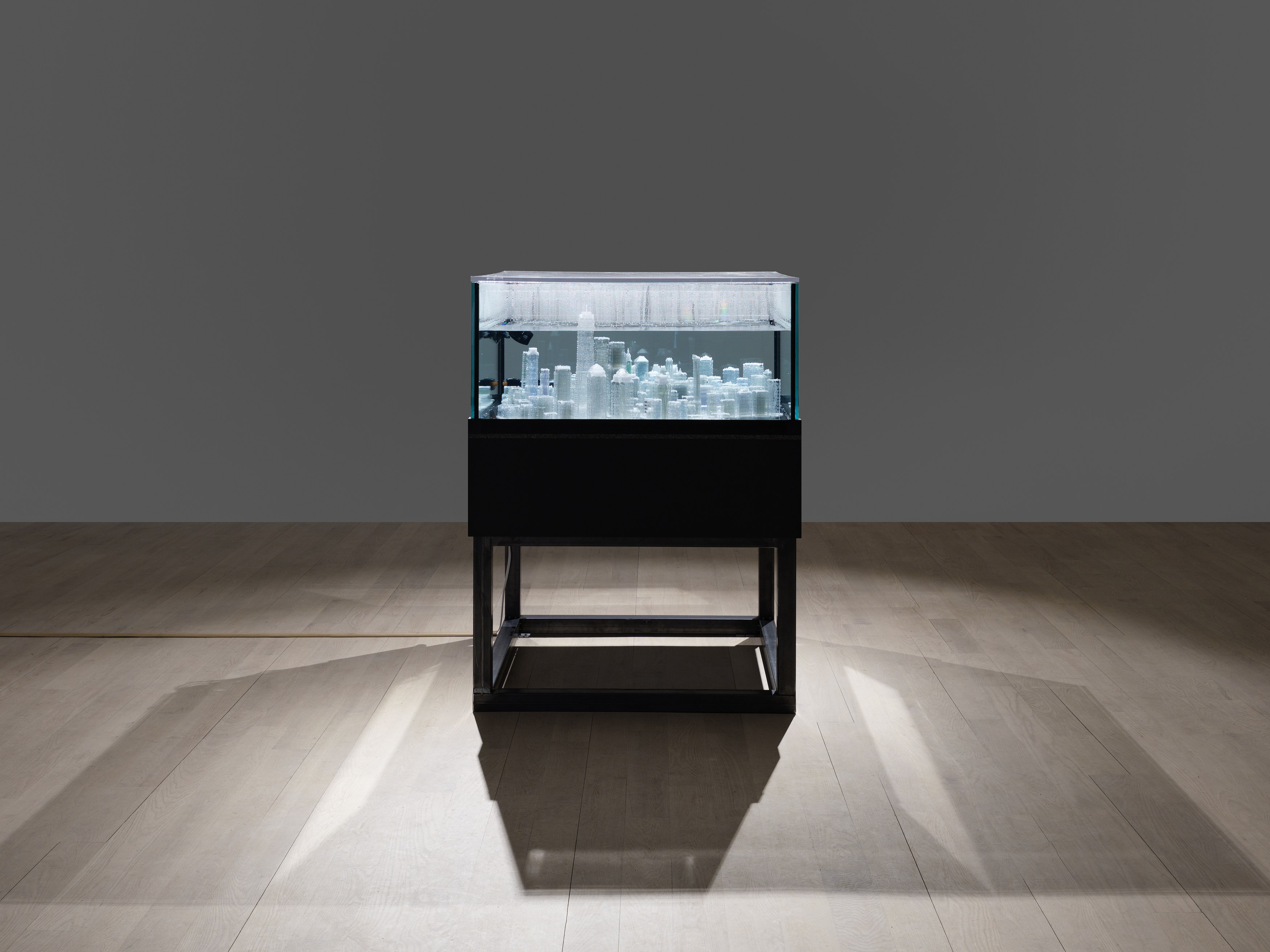
Management is pleased to present The Permanent and the Insatiable, Xin Liu's first exhibition with a gallery in New York. A text by Valerie Mindlin accompanies the exhibition. "Nature, in her most dazzling aspects or stupendous parts, is but the background and theater of the tragedy of man," John Morley writes in 1871, the year The Equitable Life Building, one of Lower Manhattan's first skyscrapers, rises up, supported by steel beams meant to keep it standing forever, indifferent to fires, floods, and natural forces; two years after the first synthetic polymer, the original industrial plastic, is invented as an entry in a New York business's $10,000-prize open call for a cheap replacement for ivory. Xin Liu's The Permanent and the Insatiable: New York lays bare the tortured antinomy of immortality and destruction unfolding just behind the stage curtain of Too-Late Capitalism's theater. This piece surfaces the notions of materiality, permanence, and anthropocentrism--and prompts its visitors to follow suit. In this installation, both the viewer and the work itself are left by Liu to think their way through an improbable yet completely real scenario whose ultimate outcome one can only surmise and speculate on. 1907: Leo Bakeland invents Bakelite, marking the beginning of an era in which industrial plastics will become an inextricable part of nearly all worldwide manufacturing. Bakelite's hired hype man John Mumford writes a few years later that the material has "a solidity that mocks at the disintegrating forces of heat and cold, time and tide, acid and solvent." 2016: Japanese scientists make a surprising discovery: buried in the dirt outside a recycling facility in Sakai City, Osaka, a bacterium they dubbed Ideonella sakaiensis is quietly secreting enzymes that are deconstructing old plastic beverage bottles scattered about. 2022: A team of scientists from the National Renewable Energy Laboratory assesses and reports the entire life cycle impacts for an enzymatic PET recycling system in the near future. These are the three facts that prompted the creation of The Permanent and the Insatiable: New York. The work is composed of a custom-made bioreactor tank inside of which an enzymatic reaction will, over the course of the exhibition's run, attempt to slowly degrade a scrupulously faithful replica of Lower Manhattan's architectural landscape constructed from woven strips of post-consumer PET. Placed within the context of art's history, the readiest visual cognate The Permanent and the Insatiable brings to mind Mike Kelley's Kandors, created between 2005 and 2009. Unlike Liu's, Kelley's series of sculptures placed delicate, elegantly crafted miniature skyscraper landscapes inside glass enclosures. Representing a shrunken image of Superman's home planet, Kelley himself referred to these as "metaphors for the alienated relationship to the planet he [Superman] now occupies"--an "outdated image of the future" once aspired to. That all sounds like a pretty accurate description of the work on view as well, doesn't it? Xin Liu is a rare artist: one whose scientific knowledge and technical expertise wound their way toward allegorical realism that is as formally considered as it is aesthetically striking. While both the biological scenario and the sculpted landscape of The Permanent and the Insatiable: New York are entirely accurate and thoroughly loyal to reality in their representation, the resulting work reflects a much wider social and cultural contextual framework--our collective reality out of which it was born. The World-For-Us, The World-In-Itself, and The World-Without-Us--or simply The World, The Earth, and The Planet: the philosopher Eugene Thacker has delineated these concepts as three distinct levels of understanding the environment in which we live. In this schema, The World is defined as the environment in relation to humans and their interaction with it, our primary way of comprehending everything around us. The Earth is defined as the environment's life and existence that is separate from humans--the one you see in nature shows, the one subject to our study and exploration: it's the animals, and geology, and bacteria that don't make art and are uninterested in culture--yet are still unavoidably subject to our influence. The Planet, in turn, is The Earth imagined after the disappearance of The World--The Earth so fully divorced from the human's concerns and his very existence that it isn't even hostile--it is simply indifferent. What you're looking at when you look at Xin Liu's work, then, is the extraordinary and the unimaginable: The Earth reclaiming The World to become The Planet. Architecture and plastics are the perfect epitomes of humanity's hubristic myopia, the dream of permanence that turns away from the Earth to insist that there is only the World. Is there a better symbol of that myopia than Lower Manhattan? Take your time to look closer at the landscape inside the tank--there are subtle color gradations among the intricate little copies of these iconic buildings. Do these colors look familiar? You may recognize the emerald of Graza olive oil and the ochre of Aesop soap (fancy!) among other threads of scavenged plastic. It's too bad the enzymes that are slowly consuming them can't tell the difference--to them, we're but a background to nature's tragedies… —Valerie Mindlin Xin Liu was born in 1991 in Xinjiang, China, and currently lives and works between New York City, New York and London, United Kingdom. Liu received a BA and BEng from Tsinghua University in Beijing, China, in 2013, an MFA from the Rhode Island School of Design in 2015, and an MS from the Massachusetts Institute of Technology in 2017. She is an artist-in-residence at SETI Institute, a Visiting Fellow at Cornell Tech (2024-25), an advisor for LACMA Art+Tech Lab, and the founding Arts Curator in the Space Exploration Initiative at MIT Media Lab. Her recent institutional solo exhibitions include Seedings and Offspring (2023) at Pioneer Works, New York, and At the End of Everything (2023) at Artpace, San Antonio. Her work has been exhibited at the Shanghai Biennale, the Thailand Biennale, the Hammer Museum in Los Angeles, the Yuz Museum in Shanghai, Ars Electronica, the Sundance Film Festival, Tribeca Film Festival, and Museum of Fine Arts, Boston, among others. In 2018, Xin Liu initiated and led the research project MicroPET: developing a modular bioreactor for a plastic degradation payload at the International Space Station (ISS). It is an autonomous payload for enzymatic reactions and microbial cultivation with fully programmable serial passaging and sample preservation, developed in collaboration with MIT Media Lab Space Exploration Initiative, the National Renewable Energy Laboratory (NREL), Weill Cornell Medicine, Harvard Medical School, and Seed Health. The team successfully conducted the payload experiment in ISS in Dec 2022, with the results to be published in Nature Microgravity. The project is recognized as one of The Best Inventions of 2023 in TIME magazine. The research work seeded the conceptual and technical development of The Permanent and the Insatiable.
 PastLast Caress
Tim Brawner
Jan 15 – Feb 24
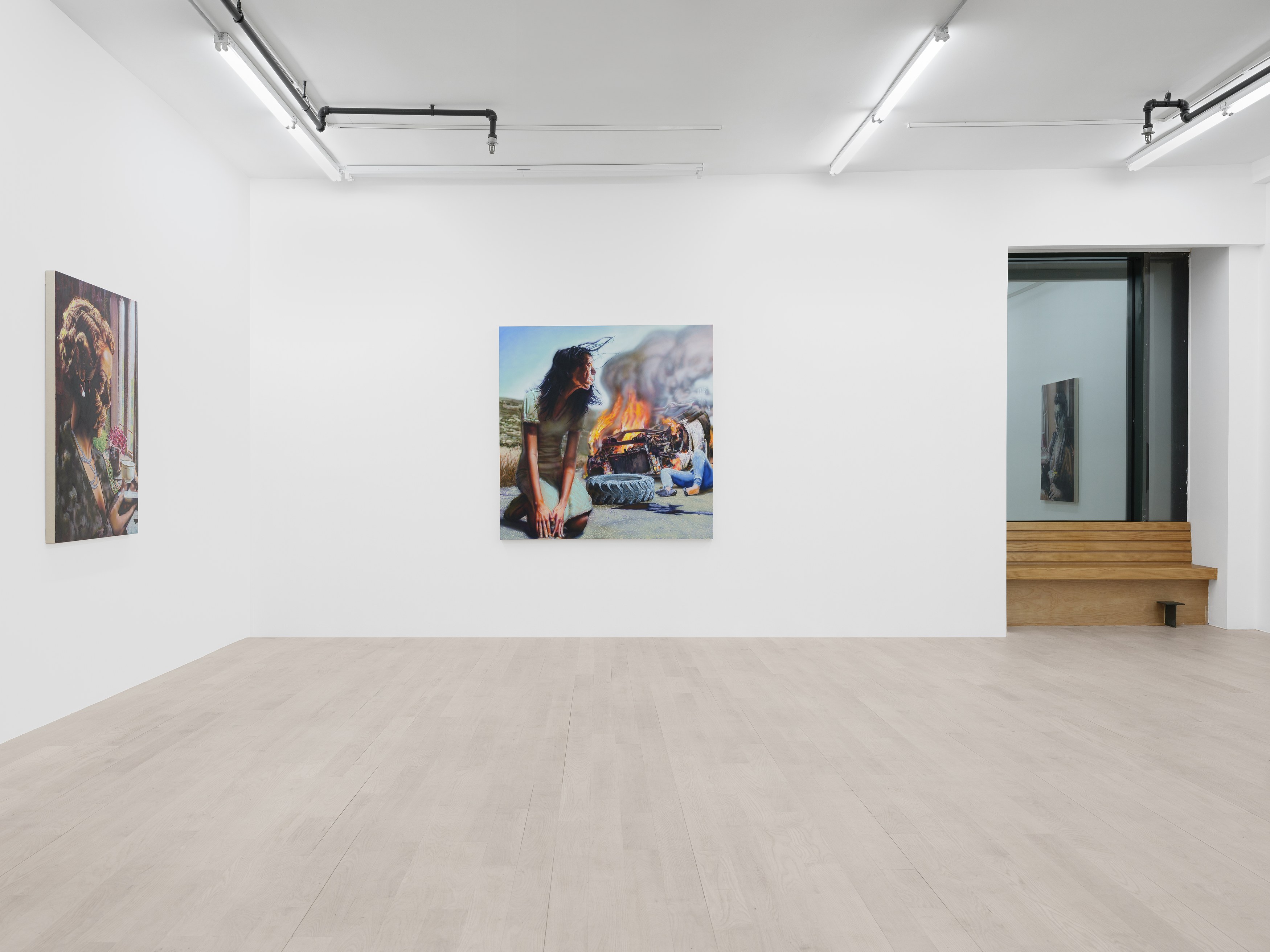
Management is pleased to present Last Caress, Tim Brawner's second solo exhibition with the gallery. In Last Caress, Brawner investigates the psychological expressions of America's excess and decline, using painting to explore the resentments and paranoia within class and generational divides. An essay by Andrew Woolbright accompanies the exhibition. Pearl, Pustule, Pixel: The Work of Tim Brawner by Andrew Woolbright. Pearl: "Is there any distance left between glamour and rot? They fulfill each other, possessing each other as they realize their own extent. They are more chambered with each other than they are antipodal. It is similar to how painting adopts the position of the image, how it swells and distends from the image strand. As a painting inclines towards the image, it starts to buckle under its own desire. It feels its vertigo. The projector spills out Rorschach forms of meaning through each caressed detail. It feels that all that it has left is all the glimmering surface, endless surface, sprawling outward without armature beneath it. It is left with nothing but its intent--the intent to make a painting perfect along its surface. Nacre, the word we use to describe the opalescent shimmer of a pearl's surface, is rumored to come from the Arabic word nakara, which means 'to hollow out.' From its beginning, the more a surface glimmers the more it rots the thing within. Kitsch was originally a term that was exclusive to painting. The brush searches for ersatz, escutcheon, and ornament. Mark models form to reveal and revel in detail. Faceted and over-faceted. overtness becomes an odor. It excises and exceeds what is beneath." Pustule: "Skin goes slack as it loses its collagen. The American Rococo feels chintzy--swollen and ready to burst like a Venture Capital bustout. Amongst all the gossamer-fine tulle and the reflections of the crystal decanters, a Luxor mummy is painted sensitively, like a fragile Shelley Duvall. While it reeks of being buried with all that has been amassed, it's also tinged with the desperate pity of grey gardens and sunset boulevards. The morgue is all Little Edys and Norma Desmonds strung out and holding on, shivering next to a flipped Beemer. They remember when they were young and beautiful, but in their memories they are also kept up by the lurking intruders in the hedges. They go to the window, carrying a candle and a glock. Being the head of the HOA makes enemies, after all. In their triazolam dreams they are young and beautiful and everything is a period piece. Except for the glock, which unravels the time of the whole thing. Their eyes are inert, over-vivid, maybe suspicious that something is unsettled about time. They move in the dark surrounded by all of their aggressive affectations and their phenobarbital. Their fear is that the mirror will reveal them to be crypt-keepers, buried with all of their real estate and excess. They feel the slithering, living dead of vanity; their vainglorious attempts to maintain their sloughed and tan skin, cut crystal, and formaldehyde. Fixation isn't agential, it's libidinal. Consider the undescended cryptorchid as a metonym of wild and unrealized desire. Undescended, it's the bulging threat of hoarded assets. It is the unique pressure of an unrealized wish. Painters often indulge in the things that are wrong for them to like. That's what makes the period piece not sit right. Pickman's model is Liveleaks and boards." Pixel: "A pixel is both a pustule and a pearl. We are left to interpret what is the priority. What is in focus? When the pupils become static and crystalline, the rest of the painting jitters out of focus. It traps the same anxiety of movement that a generated image has. It is manically unsure of itself the further it gets away from the prompt, writhing as it is forced to develop without text. Soft edges are nervous ones. There's something that happens with painting when it follows so closely to its original intent. It becomes a production. The painter becomes the director, and then an actor when they have the script. As they carry out the image, they reveal the texture maps that don't have the rigging underneath them. Heidegger's worst fear of culture was how technology was stripping it of meaning to be a lebensattrappe--a life dummy. In taxidermy, the model that you use to wrap a hide around is called a blank. There are blanks of foxes, crows, and wolves. Are mummies blanks? What is the hide and what is the blank that Brawner is referring to here? The replacement of life with cheap and dummy objects is interdigitally linked. These are dummy mummies sheared of skin. Brawner is convulsing each painting into pixel, shifting them into impoverished and undead images enthralled with carnal pulls." Tim Brawner (b. 1991 in Omaha, NE; Based in New York) received an MFA from Yale School of Art in 2020. Solo exhibitions include Feels Like Heaven at von ammon co., Washington D.C.; Glad Tidings at Management, New York; Sometime Come the Mother, Sometime the Wolf at Union Pacific, London. Group exhibitions include Maskenfreiheit, Margot Samel, New York, NY; Focus Group 4, von ammon co, Washington, DC; OMGWTF, Primary Projects, Miami, FL; Companions, Union Pacific, London; Yale Painting & Printmaking MFA, Galerie Perrotin, New York, NY. Brawner’s exhibitions have been reviewed in The Washington Post, Artforum, and The Brooklyn Rail.
 PastGhosts in the Garden
Jaeheon Lee
Oct 30 – Dec 30
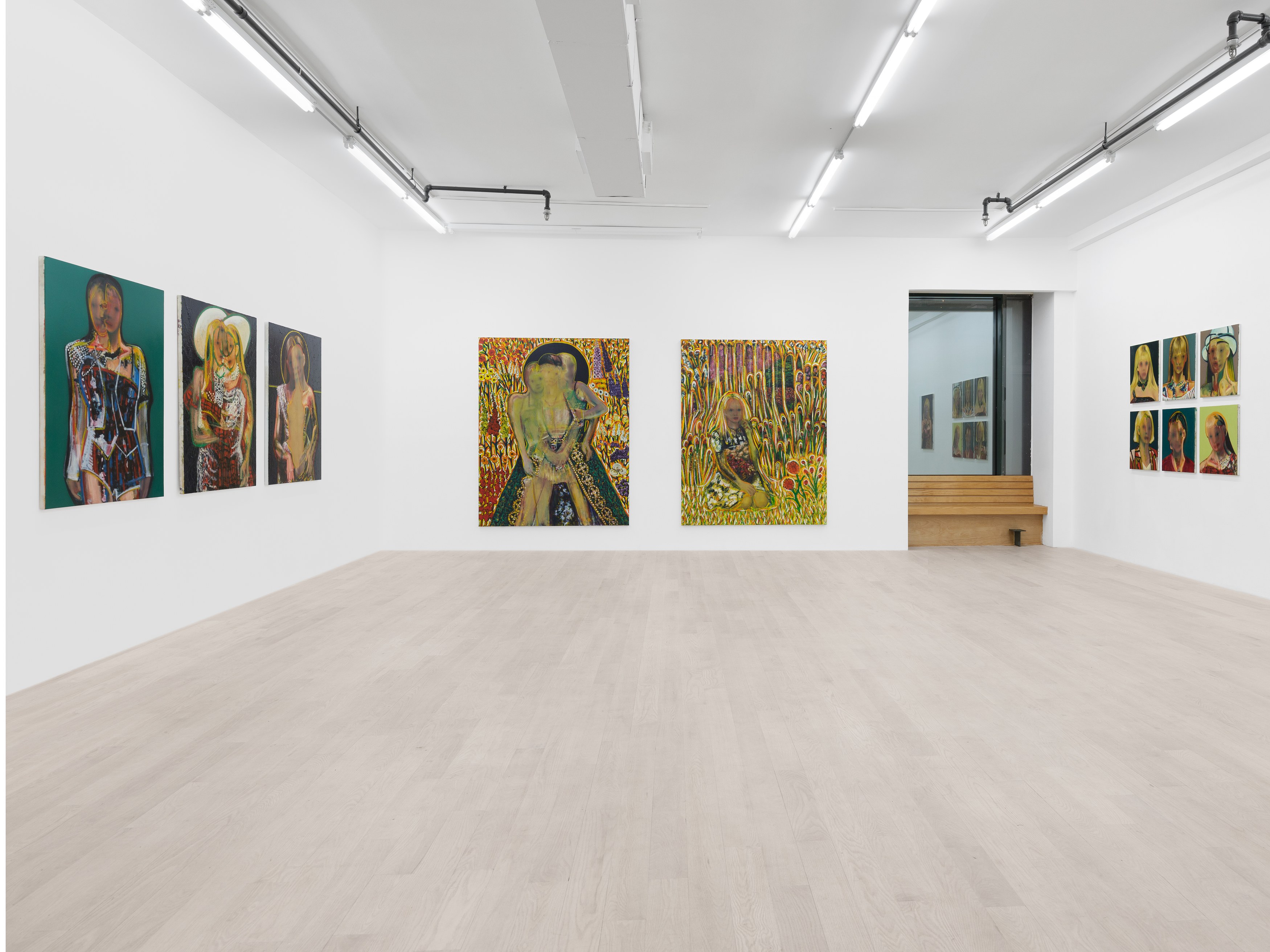
Management is pleased to present Ghosts in the Garden, Korean painter Jaeheon Lee’s debut exhibition with the gallery. A text by Jungmin Cho accompanies the exhibition. Looking at the paintings of Jaeheon Lee, I always want to follow their gaze, but they slip away from me. They are too still, like fixed dots on the canvas—no more, no less; empty, hollow, blue-green dots. Multiple faces share one body, dressed in the decorative costumes of celebrities in his Idol, Two in One, and Three in One series. In Figure in a Garden, the lush garden of colorful flowers seems to attract so many buzzing bees, almost too loud to listen to. The rough-textured brushstrokes of the background and ornaments are layered upon layers, while the faces seem to exist briefly, then disappear quietly. The gap created by the contrasting tempo of the background and the figure contains Lee's ongoing contemplation about the disconnection with the past. The type of figurative painting the artist engages in faced a period of marginalization in Korea from the 1960s under the dominance of abstract painting, driven by a desire for modernity and novelty. After Korea's liberation from Japan, the first generation of artists educated in Korea rejected the figurative painting that had been developed under Japanese colonial rule. Instead, they directly embraced contemporary Western art amidst industrialization and modernization, proposing new directions for existing ideologies, art institutions, and artistic styles. Consequently, geometric abstract painting gained attention following its rise internationally, and debates intensified between the old/new generations, academicism/modernism, and figuration/abstraction. In other words, the opposition between figuration and abstraction was embodied in the artistic attitude of the time. Abstraction conveyed the "present and contemporaneity" of Korea in an international language, while figuration expressed Korea's "past and tradition" in its regional language. Although abstract art, through continuous dialogue with the past, came close to the point of convergence with Dansaekhwa, creating a new field for contemporary Korean art, figurative painting has been relatively marginalized, leaving behind faint dialogues within a disconnected timeline. Lee’s pursuit of figuration has led to the artist’s concern about how he, as someone deeply rooted in Korea, can convey a sense of "Koreanness" through his interpretation of Western visual language. For the artist, this is not about dependence on or nostalgia for the past, but rather a sustained interest and responsibility toward the remnants of art historical rupture to clearly understand the identity of his own practice. With sincere brushstrokes that trace a lineage of traditional Western art history, he seeks to speak to today's Korea. He often draws inspiration from "idols," which he describes as the utmost "Koreanness." Idols, who sing and dance perfectly in glamorous and beautiful outfits, are endlessly consumed and venerated, becoming global icons that undoubtedly represent today’s "K" in Korea. At the same time, implicit sociopolitics hidden within the frame imposed on them under the umbrella of popular culture results in pervasive suffering in our society. Mark Fisher, analyzing today’s pop culture, mentioned in his book on Hauntology that while everyday life has sped up in recent years, culture has slowed down. In the state of continuous connection across time and space facilitated by digital platforms, we repeatedly reproduce and consume culture based on the ghost of the past, becoming increasingly numb to the need for change. In contrast to the accumulating, dazzling superficial background, Lee depicts the inner forms of today’s Korea as rapidly erased, redrawn, consumed, and becoming a void of numbness. Considering how nostalgia-driven pop culture has become a global trend, the void he captures is perhaps not just a story about Korea. As a result, the void that Lee paints does not remain merely one of nothingness. In his attempt to recover the severed time of figurative painting, and to bridge the gap between tradition and nowness, he deconstructs the historical and psychological void with a deep gaze. This is the portrait of a contemporary painter, as well as of those living in the neoliberal era, who say goodbye to the past, confront their anxieties, and withhold judgment about the future in pursuit of hope. His ongoing act of painting—rooted in reflections on the self, history, and cultural phenomena—is a noble, pilgrimage-like endeavor. From that moment, a faint stream of cool air begins to seep back into the void. The blurred faces on the canvas start to emerge again. I feel as if I can meet their eyes, piercing through the blue-greenish void. —Jungmin Cho Jaeheon Lee (b. 1976 in Ulgin, South Korea) holds an MFA from Seoul National University and is based in Jecheon, South Korea. Solo exhibitions include Ghosts in the Garden at Management, New York; My Ghost at Gallery SP, Seoul; Night Vacuum at Place Mak, Seoul; Abject Beauty at Shin Gallery, New York; Man on the moon at Gallery Chosun, Seoul, and others. Group exhibitions include Time Lapse at Pace, Seoul; The Possible and the Elsewhere at Tang Contemporary Art, Hong Kong; One at a time at WESS, Seoul; Are You Depressed? at Seoul National University Museum of Art; Noon of April at Geomjaejeongseon Art Museum, Seoul; Mindful Mindless at Seoul Olympic Museum of Art; The Secret: Margin of error at Gwangju Museum of Art, the Arko Art Center in Seoul, and the Busan Museum of Art; Ghost House at Jeonbuk Province Art Museum, Jeonju, and others. Lee’s work is in the collections of the Government Art Bank of Korea, the National Museum of Modern and Contemporary Art in Seoul, and the Seoul National University Museum of Art.
Past
Eternal RentTahir Karmali
Sep 4 – Oct 21
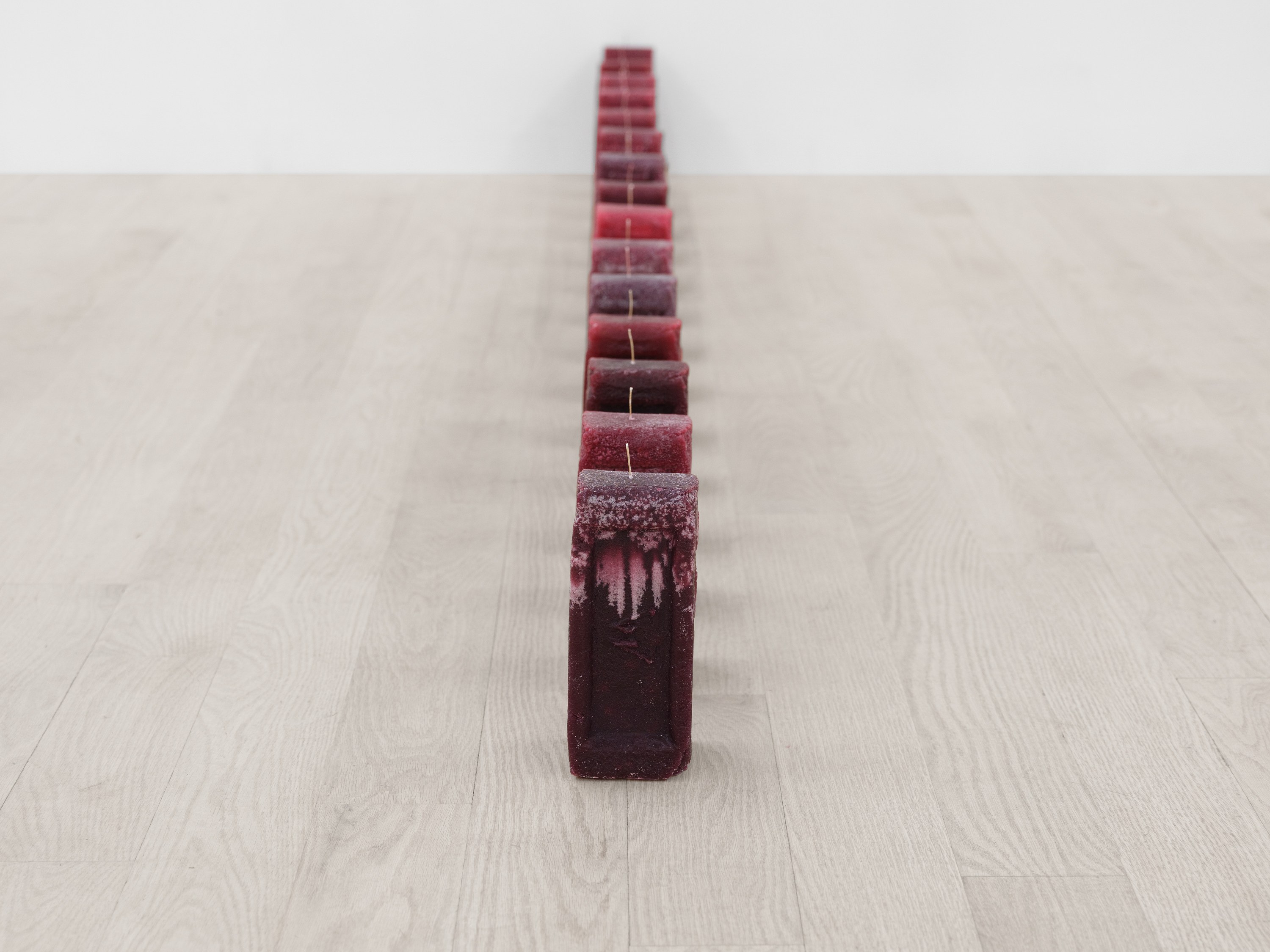
Management is pleased to present Eternal Rent, New York artist Tahir Karmali’s debut New York solo exhibition. Charged with symbolism, Karmali's expansive material-oriented practice concentrates thematically on migration, landscape/geology, labor, and belonging. A text by Jesse Bandler Firestone accompanies the exhibition. A city like a body, a bone like a brick, the psyche your sewer. Rent. It's happened, happening to you. In Eternal Rent, Tahir Karmali explores similarities between psychological states of rupture and change with the perpetual construction and reconstruction of New York City to express the terror and wonder of transformation. Twisted my ankle at the gym. He sees himself reflected in the city —used, relied upon, integral, supportive, and ever-changing. Should I get high tonight? To Karmali, the water-stained facades of buildings resemble a leaking body, torn fabrics mirror a wound that needs healing, and scaffolding represents the ongoing vulnerability of being exposed. Can’t stop these stress dreams, damn Anton again. In this new series of works, Karmali incorporates elements of fashion, infrastructure, and references to organs, touching on themes of protection, exploitation, and the full spectrum of emotions within. Double jab, cross. Making anything has become erotic to me. This exhibition marks a significant departure from Karmali’s previous work, which often involved detailed research and analysis of geopolitical forces and how they manifest in global consumption and production. In Eternal Rent, Karmali shifts his focus inward, tearing apart his practice—and himself—to embrace an exquisite pain through the cathartic release of art-making. 190 grams of protein. The works featured in this exhibition include wall-mounted pieces, floor sculptures, and objects for the home, utilizing a wide range of materials including wax, metal, wood, fabric, concrete, glass, and cocaine. Wet socks on the subway. Eternal Rent captures Karmali’s versatility as a maker and his power as a conceptualist to imbue these materials with emotional resonance. Among the exhibited works, wax-cast bricks that bleed red when burned acknowledge precarity and exhaustion, while painted images of cracked sternums on high-visibility fabrics suggest a body in danger. Delivery, in the rain. Discarded and trashed deli containers, which Karmali has preserved and cast in glass and concrete, pay homage to the cogs in the machine. A large piece of denim, dyed, then stripped of color and brushed with cocaine, speaks to ideas of class, decadent waste, and oblivion. I’ve been hiding behind politics, materials and drugs. Though anchored in an embrace of material presence, Eternal Rent must also be considered a rejection—a rejection of the perceived expectations placed upon an artist from the Global South, specifically Kenya. 186 grams of protein. Karmali has found deep inspiration in shedding these constraints, allowing him to present himself as he truly is: exposed yet resilient, flayed yet repairing. As if to say, the horrors persist, and so do I. Delivery. Again? At its core, Eternal Rent is an invitation to feel more and think less - to bear witness to an artist in the process of self-affirmation and reclamation. To see what comes up when you put it all down. Rent. It's happened, happening to you. —Jesse Bandler Firestone (with interjections by Tahir Karmali) Karmali (b. 1987 in Nairobi, Kenya) holds a Master's in Photography from the School of Visual Arts, New York, and is based in Brooklyn. Solo exhibitions include Eternal Rent, Management, New York; Bound Between Cliffs, Circle Gallery, Nairobi; Paper Planes, Sotheby’s Institute, New York. Group exhibitions include Invocations, Circle Art Agency, Nairobi; Open Call, The Shed; Omniscient: Queer Documentation in an Image Culture, Leslie Lohman Museum; Second Careers, Cleveland Museum of Art; and Making Africa at High Museum of Art, Atlanta, Kunsthal Rotterdam, Blanton Museum, Houston, CCCB, Barcelona, Guggenheim Bilbao, and others. Karmali was awarded a Pollock-Krasner Foundation Grant and a Lower East Side Printshop Keyholder Residency. He was an artist in residence at The Watermill Center and Montello Foundation, Triangle Arts Association, Pioneer Works, Trestle Gallery, the MacDowell Colony, and BRIC.
 PastEternal Rent
Tahir Karmali
Sep 4 – Oct 21
Management is pleased to present Eternal Rent, New York artist Tahir Karmali’s debut New York solo exhibition. Charged with symbolism, Karmali's expansive material-oriented practice concentrates thematically on migration, landscape/geology, labor, and belonging. "A city like a body, a bone like a brick, the psyche your sewer. Rent. It's happened, happening to you. In Eternal Rent, Tahir Karmali explores similarities between psychological states of rupture and change with the perpetual construction and reconstruction of New York City to express the terror and wonder of transformation. Twisted my ankle at the gym. He sees himself reflected in the city —used, relied upon, integral, supportive, and ever-changing. Should I get high tonight? To Karmali, the water-stained facades of buildings resemble a leaking body, torn fabrics mirror a wound that needs healing, and scaffolding represents the ongoing vulnerability of being exposed. Can’t stop these stress dreams, damn Anton again. In this new series of works, Karmali incorporates elements of fashion, infrastructure, and references to organs, touching on themes of protection, exploitation, and the full spectrum of emotions within. Double jab, cross. Making anything has become erotic to me. This exhibition marks a significant departure from Karmali’s previous work, which often involved detailed research and analysis of geopolitical forces and how they manifest in global consumption and production. In Eternal Rent, Karmali shifts his focus inward, tearing apart his practice—and himself—to embrace an exquisite pain through the cathartic release of art-making. 190 grams of protein. The works featured in this exhibition include wall-mounted pieces, floor sculptures, and objects for the home, utilizing a wide range of materials including wax, metal, wood, fabric, concrete, glass, and cocaine. Wet socks on the subway. Eternal Rent captures Karmali’s versatility as a maker and his power as a conceptualist to imbue these materials with emotional resonance. Among the exhibited works, wax-cast bricks that bleed red when burned acknowledge precarity and exhaustion, while painted images of cracked sternums on high-visibility fabrics suggest a body in danger. Delivery, in the rain. Discarded and trashed deli containers, which Karmali has preserved and cast in glass and concrete, pay homage to the cogs in the machine. A large piece of denim, dyed, then stripped of color and brushed with cocaine, speaks to ideas of class, decadent waste, and oblivion. I’ve been hiding behind politics, materials and drugs. Though anchored in an embrace of material presence, Eternal Rent must also be considered a rejection—a rejection of the perceived expectations placed upon an artist from the Global South, specifically Kenya. 186 grams of protein. Karmali has found deep inspiration in shedding these constraints, allowing him to present himself as he truly is: exposed yet resilient, flayed yet repairing. As if to say, the horrors persist, and so do I. Delivery. Again? At its core, Eternal Rent is an invitation to feel more and think less - to bear witness to an artist in the process of self-affirmation and reclamation. To see what comes up when you put it all down. Rent. It's happened, happening to you." —Jesse Bandler Firestone (with interjections by Tahir Karmali) Karmali (b. 1987 in Nairobi, Kenya) holds a Master's in Photography from the School of Visual Arts, New York, and is based in Brooklyn. Solo exhibitions include Eternal Rent, Management, New York; Bound Between Cliffs, Circle Gallery, Nairobi; Paper Planes, Sotheby’s Institute, New York. Group exhibitions include Invocations, Circle Art Agency, Nairobi; Open Call, The Shed; Omniscient: Queer Documentation in an Image Culture, Leslie Lohman Museum; Second Careers, Cleveland Museum of Art; and Making Africa at High Museum of Art, Atlanta, Kunsthal Rotterdam, Blanton Museum, Houston, CCCB, Barcelona, Guggenheim Bilbao, and others. Karmali was awarded a Pollock-Krasner Foundation Grant and a Lower East Side Printshop Keyholder Residency. He was an artist in residence at The Watermill Center and Montello Foundation, Triangle Arts Association, Pioneer Works, Trestle Gallery, the MacDowell Colony, and BRIC.
 PastNew York Girls
Richard Kern
Jul 24 – Aug 5
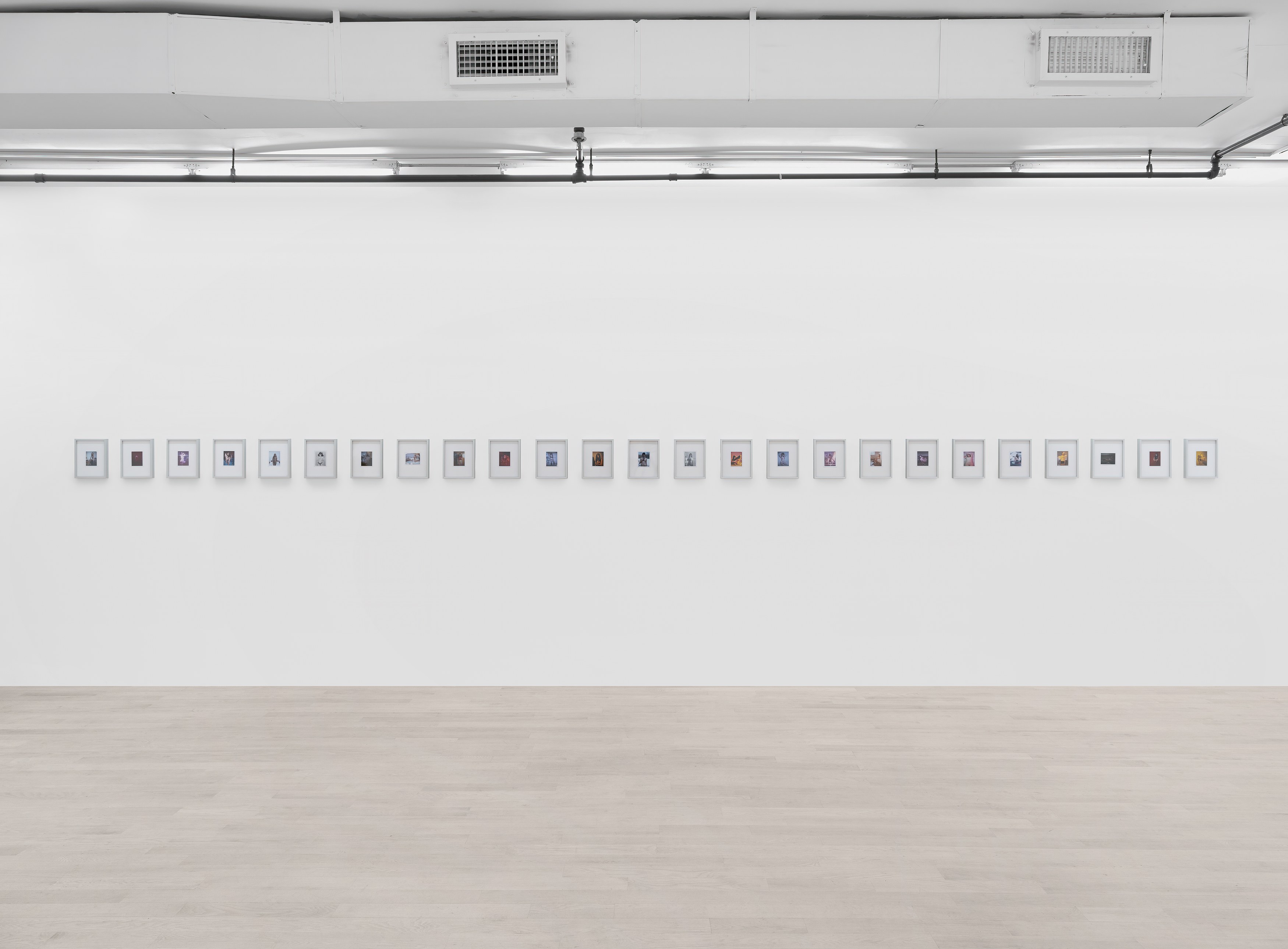
Management is pleased to present Richard Kern: New York Girls, in collaboration with No Agency New York. "I’m 15 and I’m looking at a photo of a girl with a lizard on her face on the internet and I’m thinking it’s one of the coolest pictures. I’m finding her dirty black hair inspiring and I’m thinking about the kind of person I’m going to be. I’m lying in the dark talking on the phone with my internet boyfriend and I’m telling him I find this image compelling. He’s asking me if I’ve heard of No Wave Music. I haven’t but I’m getting the impression that New York City is incredible. My internet boyfriend is also in high school and having domestic acrimony with his dad, in Philadelphia, where he lives. We “met” on a file sharing platform called “soulseek” but have never “met” in “real life”. We’re having phone sex on a landline, which is crazy. He mails me two DVDs and a book about snuff movies. One of the DVDs is called Faces of Death and the other is called The Hardcore Collection: The Films Of Richard Kern. That girl with the lizard on her face is on the cover and in some of the movies as well. I’m only able to watch it once before my parents find it and throw it away. I’m yelling at my dad. I’m acting like that girl in the films of Richard Kern. In one of the movies she is killing her parents. I’m calling my internet boyfriend on the phone crying. One day I’m going to move to New York City and make snuff movies. One day I’m going to leave this town and go to college and watch every episode of a web series called Shot by Kern, which documents the nude photoshoots of Richard Kern and various sexy models. These girls are really incredibly sexy, European, etc. They’re brushing their teeth and the toothpaste is getting foamy in their mouths. This guy Richard Kern must be some kind of genius to get these girls to do this. I hope I get to meet him one day." —Dasha Nekrasova "Richard Kern, photographer and filmmaker remains, first and foremost, a portraitist. For more than two decades Kern has sought to unravel and illuminate the complex and often darker sides of human nature. Kern makes the psychological space between the sitter, photographer and audience his subject. With his dry, matter of fact approach, he underlines the absurdity of truth and objectivity in photography while playing with our reliance upon taxonomies around sexual representation." —Matthew Higgs Kern is a regular contributor to Interview, The Face, Dazed, Numero, Vice and Purple and has published 28 books. His films and photographs have been exhibited at MoMA, The Whitney Museum and in more than 50 solo shows around the world. Kern lives and works in New York City.
 PastBreed
Nana Wolke
May 17 – Jul 15
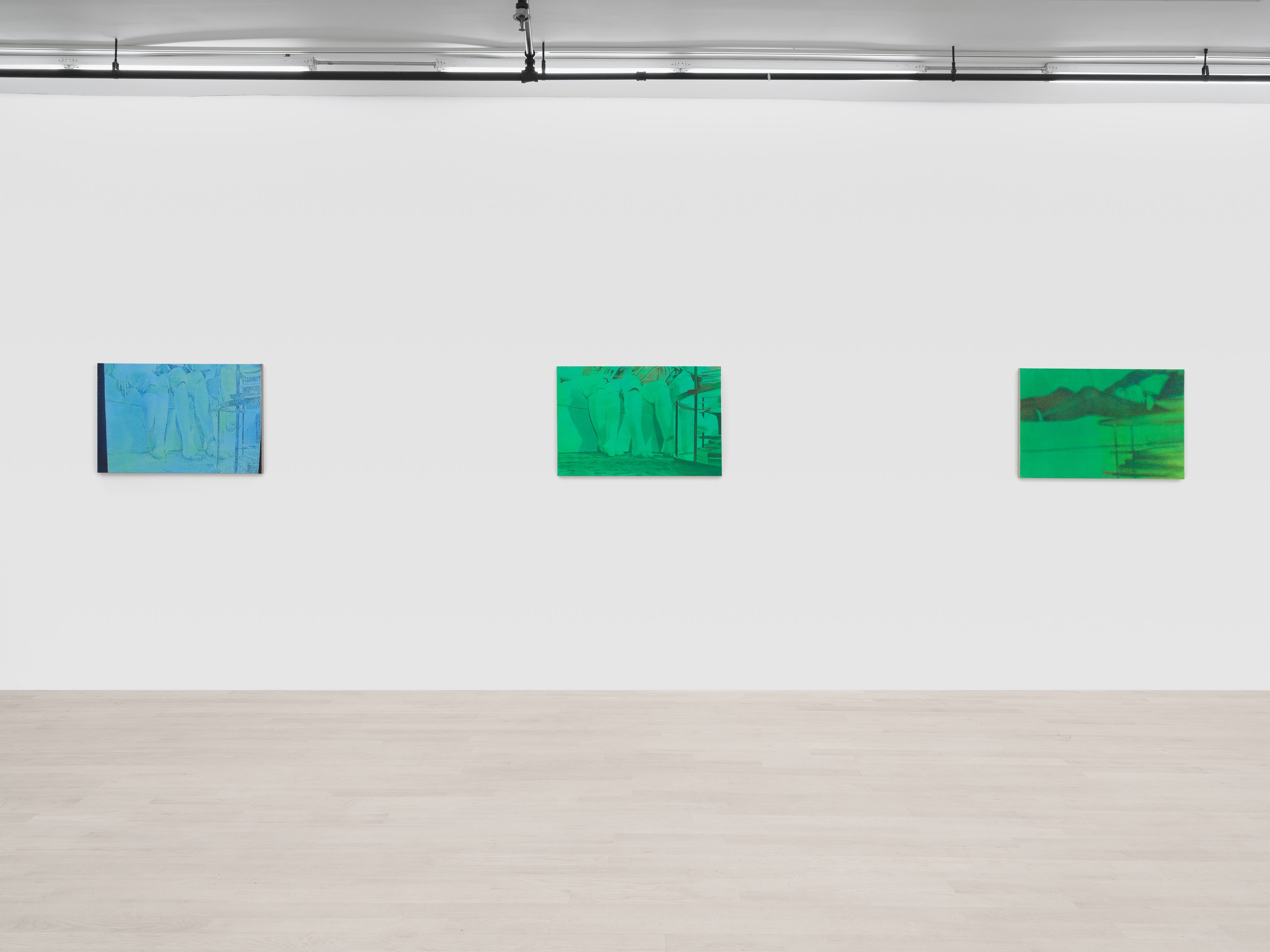
Starting with the obvious. We mediate and understand so much of our worldbuilding* through the nexus of screens, these could be in a private home, a panopticonic monitoring room, or a doorman’s outdated security post. The awareness we have of these screens is something like a catalog. Viewers can sense, or infer, value, context, and age based on the size and quality of the moving image. This library of screen-mediated images is compared against our physical world constantly to arrive at truth. The questions that arise as a result of this divided existence are complex ones. Mainly, which reality to prioritize? After this is satisfied (if that is even possible), next we ask what lens to interpret it through (first person/third person/ominous narrator/artificial environment). In the age of omnipresent surveillance, Nana is constructing an opening through which we can interrogate ideas about value, ownership, viewership, wealth, and other forms of hierarchy. Within Breed, we are asked to traverse a network of relational images, and, one that is unfolding in real-time, the livestream. Wolke offers us an experience as a 'fly on the wall'. She is both mediator of that view (screen/camera/service person, lap dog), and in painting it merges many layers into an eerie monochrome rendering of what happens behind closed doors. Sometimes from the nosebleeds of a stadium looking down on the impossibly expensive seats 00:02:15,300 - - > 00:02:45,800 (Ansicht mit Rum-Kokos Kugeln). In the one work that connects the static and the moving image, - - - (Tell me when it’s over), we see the ongoing construction required to keep the 10021 intact. A reminder that elements of the veil are physically constructed, constantly maintained, and just out of sight. In 00:00:00,000 - - > 01:36:06,960 (It’s good enough for Nancy. It’s good enough for Nancy) we are offered a unique type of non-human, non-man-made spectatorship. Probing into the inherent veil of secrecy that lies between the 'gossip girl' presentation of the upper echelon and the reality known by the unhappy 'captives' who stand on the other side of the veil. This work asks for interrogation of our relationship to exclusivity; our part in upholding the lives of the rich and famous? The brands of the braindead upper class have always been a calling card. It's not about the object, or its quality, or your belief in the 'designer'. It's about placing yourself in a food chain, separating yourself from the rung on the ladder right below you. It's gross - we just want to see a painting of a rich woman's face (from any era) to compare to our own, in hopes that the most recent beauty haul will be the thing that finally closes the gap between us and Kim K. Newsflash! the gap will never be closed. To effectively close it you would have to go back in time and re-birth yourself on the opposite side of the impenetrable veil that I mentioned earlier. The people who have the face that you want started paying for it a long time ago. They spend their afternoons fencing, and their evenings indulging in spectacle. The sad part is, even the picture-perfects can't acknowledge the weirdness of their hypoallergenic, hyper-visible, hyper-homogeneous world. Nana masters the act of interrupting these spaces to conduct lablike reenactments of situations, as an act of disturbing the veil, the image of the space, and reality. It's about how people want to be perceived and how they occupy that space where perception is understood. Learning to surgically split the veil in this way is no easy task; what you find on the other side ... is for you to ponder. —David Lisbon, Probing Collective Nostalgia Nana Wolke (b. 1994 in Ljubljana, Slovenia) explores the nature of perception, focusing her attention on modes of apprehension of space and time. Her series of works usually begins on film-like sets, where the artist records the unfolding of staged situations and improvised actions occurring in spaces spanning across social hierarchy. Wolke proceeds to assemble and edit both original and found footage to create distinctly monochromatic visual atmospheres and rhythms that she then translates into painting and sound installations. Using commonplace lighting to model space and generate the grain, textures and slippages of her images and sequences, Wolke utilizes a variety of devices chosen as much for their technical properties as for their social significance – e.g. CCTV equipment, home video camcorders, inventory cameras, intercom systems, etc. Considering the multiple viewpoints from which an action can be witnessed, Wolke’s work conjures a tension between observation and control, often inviting viewers to navigate environments that interrogate notions of access and inclusion – whether for economic, social, or security purposes. In so doing, Wolke reflects upon the conflation of desire and shame in contemporary modes of production and consumption of images and visual culture. By constantly confronting the logic of live actions, cinema and paint, Wolke ultimately seeks to analyze the progressive inextricability between actual and artificial realities. Wolke is based in New York and holds an MFA from Goldsmiths, University of London. Solo exhibitions include Breed at Management, New York; Wanda’s at Nicoletti, London; High Seat at Castor Gallery, London; 4:28 - 5:28 am at VIN VIN, Vienna; and Some Girls Wander by Mistake at Fondazione Coppola, Vicenza. Group exhibitions include Over you/you at the 31. Biennial of Graphic Arts, Ljubljana; Daddy at G2 Kunsthalle, Leipzig; Painters Painting Painters: A Study of Muses, Friends, and Companions at the Green Family Art Foundation, Dallas; Love is the Devil: Studies after Francis Bacon at Marlborough, London; and No Angels at Wilhelm Hallen, Berlin among others. Wolke was also selected for the 2021 cohort of Bloomberg New Contemporaries.
 PastEgo Rip
Katie Hector
Apr 12 – May 13
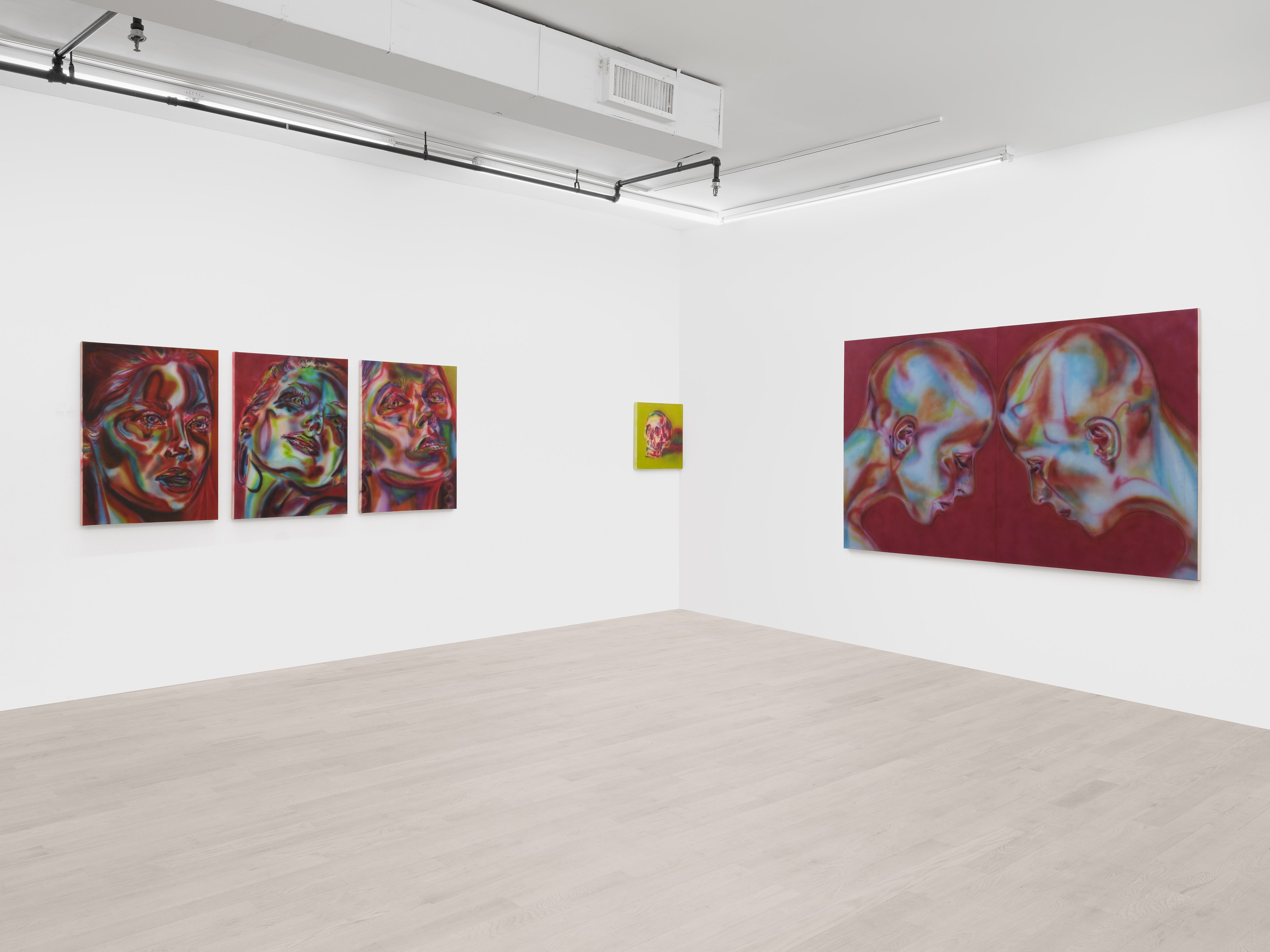
Management is pleased to present Ego Rip, LA-based artist Katie Hector's debut New York solo exhibition. Los Angeles-based artist Katie Hector paints without paint, utilizing bleach and dye applied directly to the substrate, in obsessive layers and a successive play of absence and presence. In the exhibition Ego Rip, the artist focuses on contemporary portraiture, manifesting rather than mirroring the relationship between the erasure and stain of selfhood in our dissociative social reality. Explicitly memorial and composed at the site of a loss, the works in Ego Rip present portraiture as lack rather than plentitude and individuals as symbols rather than subjects—luminous, even metallic, ciphers, according to Hector, of “loss, grief, intimacy, and longing.” At its heart is a death, a grieving, a prayer. Two heads bow towards one another, haloed in hues of ethereal blue, red ochre, muffled yellow, and screaming fuchsia. Presented against a crimson ground, the figures in the diptych Death makes angels of us all and gives us wings where we had shoulders smooth as raven’s claws (2024), arguably the central work in the exhibition, appear pensive or penitent, whilst the angle of their devotion recalls Durer’s clasped hands. Divorced from context, this representation appears to be that of a single individual in parlance with their own selfhood—or its withdrawal. Presenting the likenesses of friends, acquaintances, and complete strangers, Hector seeks not to aggrandize, but to grieve: the works in Ego Rip labor in opposition to the Western historical paradigm of portraiture as representations of a unified selfhood and opulent dominion, as culminated in 17th to 19th century European portraiture. In contrast, Hector’s works are ascetic, bereft, floating, technicolor signifiers hovering over a void. Described by the artist as allegories of the death of the ego and attendant loss of subjectivity—drawn as much from the transformational moment in Joseph Campbell’s hero’s journey as from the artist’s journey as witness to her mother’s recent battle with terminal cancer—Hector’s tableaux confess as much as they portray. In the latter case, the artist imparts, “My interest in and perhaps experience with ego death emerged in tandem with my mother's literal death”. Reflected in the seminal work of Death makes angels… (2024) described above, as well as in the unmistakable though playfully titled skull images of Dead Head I & II (2024), the works in this exhibition doubtlessly and elegantly bear witness to this traumatic maternal passing. Yet in the former case, the hero’s journey may be the artist’s own. Here, for Campbell, as well as perhaps for Hector, it is the loss of ego that signals triumph, return, or overcoming: a creative re-birth. Taken from the psychoanalysis of Carl Jung, and imbued with Eastern philosophy, Campbell’s ego death is an appealed-to, desired, transcendent state: the sign of transformation. Campbell states in The Hero with a Thousand Faces, “The ordeal is a deepening … the question is still in balance: Can the ego put itself to death? For many-headed is this surrounding Hydra; one head cut off, two more appear, unless the right caustic is applied to the mutilated stump. … Dragons have now to be slain and surprising barriers passed — again, again, and again. Meanwhile there are be a multitude of preliminary victories, unretainable ecstasies, and momentary glimpses of the wonderful land.” In Hector’s work then, the multiplied portraits, not as selfhoods but symbols, point towards her encounter with the hydras on her own voyage towards salvation; yet here, it seems, as bleach pours onto pigment, and the fiber of the canvas is tested, ‘the right caustic is applied.’ However, these somber, uncanny portraits also recall other practices, other histories of the portrait. Presenting slick-hued images that strike the viewer as objectively beautiful yet eerily repulsive, Hector’s chrome toned cheek bones, pigment-saturated lips, and chiseled, blanched jawlines recall the vanity of beauty and indeed, when paired with the skull images in Dead Head I & II, the Vanitas itself. The Vanitas, like memento mori, recall the futility of life and the temporality of earthly pleasures. As a style, often marked by the presence of a skull but otherwise restrained in composition, it reached its apogee in 16th and 17th-century Dutch still life painting. Like Hector’s oeuvre, these works served as allegories of death—the ego notwithstanding. Likewise, though the zenith of millennia of portraiture may have climaxed in historical memory in the likenesses of power and privilege, the genre’s ancient origins lie in the tradition of the death mask, often cited as derived from 2,000-year-old Fayoum paintings, encaustic likenesses gracing the sarcophagi of Egyptian elites. In Hector’s work, the mask remains and yet the indexical link is lost. Its trace is that of erasure—a bleached lack. No longer does the portrait enact a particular form of identity rendered visible, but rather a condition of alienation, of dissociation: the artist’s oeuvre, perhaps not coincidentally as the work of a female artist, belies the insufficiency of the image or sign to portray (her)selfhood as such. Or, as suggested by the diptych of reflective, bowed heads, whose title consists of a citation from Jim Morrison’s last spoken word album, American Prayer, its only plentitude is an echoing appeal to a void. —Brooke Lynn McGowan, One head cut off, two more appear: on the work of Katie Hector Katie Hector (b. 1992) in Lawrenceville, New Jersey, is an artist, curator, and writer based near Los Angeles, California. She earned a BFA in painting from the Mason Gross School of the Arts at Rutgers University in 2014. Solo and duo exhibitions include Ego Rip at Management, New York; Somebody at the untitled void, Seoul, Korea; Cyborgs Never Die at Moosey, London; and Allegories at The Cabin, Los Angeles. Recent group exhibitions include Pillow Talk at LA Beast, Los Angeles; Fembot at The Hole, New York; Reminisce at Hollis Taggart, New York; Twentysomethings at The Orlando Museum of Art, Florida; and Fifty Reds in Their Minds at Red Arrow, Nashville.
Past
Gravity Was an EntityAmorelle Jacox & Jessi Li
Feb 23 – Apr 1
Management is pleased to present Gravity Was an Entity, a duo exhibition of new work by New York-based artists Amorelle Jacox and Jessi Li. Jacox’s painting practice expands from the self to the cosmic, observing the traces of her being in the all-permeating celestial void that is as present in the beyond as it is at the edges of consciousness. Li’s sculpture practice of casting glass and modeling clay is rooted in the investigation of the natural order in its relationship to humans, equalizing the mythical and the mundane in the service of philosophical inquiry into the cycle of life and matter in their transmutational infinitude. A short story by Meleah Moore accompanies the exhibition. Amorelle Jacox (b. 1994 in Tulsa, Oklahoma) is a New York-based artist whose work is born of metaphysical inquiry, conjectures of body, object, and deep space being inseparable. Jacox holds an MFA from Hunter College (2022). Recent solo exhibitions include An Infinite Sunder at Lauren Powell Projects, Los Angeles, CA (2023), and Two projections of time, Baseltor Kiosk, Solothurn, Switzerland (2022). She recently completed a residency with Wolf Hill Arts, Chappaqua, NY (2023). Jacox was a recipient of the Marjorie Strider Foundation Grant (2022). Her works and writing have been published in Art Maze (2023) and Yale School of Divinity’s Letters journal (2019). Jessi Li (b. 1987 in Poughkeepsie, NY) is a Brooklyn-based artist whose work investigates the relationship between human intervention and the natural world. They hold an MFA in sculpture, Hunter College, 2019; a BA in ceramics, Bard College at Simon’s Rock, 2009; a post-baccalaureate in glass at Virginia Commonwealth University School of Art, 2014. Li is a 2024 NYSCA Support for Artist Grant recipient and will complete a large-scale outdoor work this summer in collaboration with Becky Sellinger at Stone Quarry Art Park, Cazenovia, New York. Recent exhibitions include: Form and Formless: Constellations of Knowledge, Urban Glass curated by Alpesh Kantilal Patel Brooklyn, New York, 2023; Nowhere Fast, Olympia, New York, New York, 2023; Heavy Show, Spring/Break, New York, New York, 2022; 100 Sculptures, Anonymous Gallery, New York, New York, 2021. Li was an artist in residence at Chautauqua School of Art, 2020 and teaches sculpture, ceramics, and glass casting at the Fashion Institute of Technology, Greenwich House Pottery, and independently.
Past
Wa(r)ning LightDanni O’Brien
Jan 13 – Mar 18
The Skirt Ortega y Gasset Projects proudly presents, Wa(r)ning Light, a solo show of works by Danni O’Brien in the Skirt, co-curated by OyG Co-Directors Zahar Vaks, and Lauren Whearty. O’Brien’s relief sculptures irreverently and humorously combine diagrams with a variety of found objects to create an intersection of machines, flesh, usefulness, and speculation. Early 20th century contraceptive device patents and schematics from a book titled “Contraception Naturally: A Comprehensive Self-Help Guide to Responsible Contraception From Your Kitchen” are abstracted– becoming glyphs on tablets made uncanny through their use of household objects like a dip’n’snack chip bowl, vintage humidifier, clamshell jewelry boxes, alabaster stone eggs, a star shaped jar opener, and light. O’Brien collects these historically gendered, mostly plastic, and visibly used items once they’ve been discarded. Their domiciliary nature and anthropomorphized and organic forms emulate crevices, cycles, and habitats, all of which point to the body and its systems. Illustrations of a diaphragm insertion or homemade barriers are drawn with pipe cleaners embedded in paper pulp slabs, evoking the earliest forms of language like carved stone petroglyphs, where bulbous forms emerge from organic rock formations. Others are articulations of early, intimate contraceptive aids and tools themselves, forming larger than life machine-like contraptions. In each speculative sculpture, O’Brien uses this scale shift, highlighting the urgency and importance of their content. This site responsive and intimate installation situates paper pulp membraned assemblages in response to the rhythm of the Skirt’s corridor, echoing the exposed architectural textures, like the foundation stone, pipes, and concrete. Lanky, coiling, twisting, and buckling electric cords dance and meander across the walls and floor, signifying connectivity and usefulness. Absurd in their scale and logic, these dysfunctional lighthouses softly glow, attracting, rather than repelling. Like many dichotomies present in O’Brien’s work, this installation draws on the mid-20th centuries futuristic imagination of a space age utilitarian world, while also presenting the failures of that imagined future, and our dystopian present. In The Temptation of the Diagram Matthew Ritchie says, “Diagrams not only describe reality but also in some sense enlarge it, simply by coming into being.” O’Brien’s immersive installation shows this monumentalizing quality in a physical way- each diagrammatic work has the attention-grabbing quality of billboards, inundating us with symbolic language that illustrates our past while warning us of the future. Just as elaborate as they are economic, O’Brien incorporates the precision of a computerized router with hand wrought and sculpted paper pulp to maintain the sense of the hand-made. This approach is evidenced in her bold use of color, surface, and texture. Through reimagining mundane, nostalgic found objects as beacons, O’Brien actively queers these materials, asking them to perform, pretend, and bend– transforming their original function, culminating into a new cross section of material culture and gendered bodies. The resulting reliefs function as absurdist nighlights and talismans beaming with hope for reproductive justice, and warning lights for what's at stake in this current moment of government mandated, waning bodily autonomy. Danni O’Brien (she/they), b. 1992 in Virginia, is a queer, interdisciplinary artist working between Baltimore, Maryland and Central Kansas. O’Brien received their BFA in Sculpture from James Madison University in 2014. Her work has been exhibited with Asya Geisberg Gallery, Museum of Contemporary Art Arlington, Belger Arts Center, and the Virginia Museum of Contemporary Art. She has been awarded residencies with PLOP (London, UK), Proyecto Ace (Buenos Aires, Argentina), Baltimore Clayworks, and Art Farm, among others. In 2023 they were a resident artist at Stove Works, Elizabeth Murray Artist Residency, and Wassaic Project. Her 2022 solo exhibition, Cross Sections, with Tephra ICA, was reviewed in the Washington Post. In February 2024, O’Brien will be the Artist in Residence at Furman University in Greenville, SC and is looking forward to an upcoming two person exhibition with Cleo Gallery in Savannah, GA.
Past
Study for a SceneSara Stern
Jan 13 – Feb 12
Ortega y Gasset Projects is pleased to present Study for a Scene, a solo exhibition of new work by Sara Stern in our Main Gallery, curated by OyG co-director Adam Liam Rose. Stern presents a moving image installation filmed with cast glass, stop motion, and mime. "Many thought that it was a simple scene. That the blame was clearly on the glass, the window that played tricks on the bird, the glass who pretended to be the sky. But the window had, for a moment, been the bird, when the bird in the sky became the bird in the glass. The window felt shattered. A glass feather floated down and away and up and over the city. I'm the victim, said the window. And the people watched. They were in the theater. The glass was a scrim. And the glass was caught in a loop, the bird’s doppelgänger cemented there. A loop from mirror to water to mirror again. A loop because the glass was always moving. A loop because the glass was Janus." Sara Stern is an interdisciplinary artist from New York City. Her recent projects prod histories of urban development with animacy and speculative fiction. She has exhibited and screened her work in the US and internationally, at venues including Sculpture Center (Long Island City, NY), Anthology Film Archives (New York, NY), the Museum of the Moving Image (New York, NY), The Jewish Museum (New York, NY), and the Institute of Contemporary Arts Singapore. Stern received a BA in Visual and Environmental Studies from Harvard College and an MFA in Visual Arts from Columbia University. She is the recipient of a Rema Hort Mann Emerging Artist Grant, the Fountainhead Fellowship in the Department of Sculpture + Extended Media at Virginia Commonwealth University, and several residencies at the Fine Arts Work Center in Provincetown, MA: the Visual Arts Fellowship, an LGBTQ+ Returning Fellows Residency, and the Stephen & Palmina Pace Residency. In recent years, Stern has participated in the Fire Island Artist Residency (Cherry Grove, Fire Island, NY), the Oberhausen Seminar, the Art & Law Program, the Artist Residency at the Carving Studio and Sculpture Center (West Rutland, VT), and the Object Movement Residency at The Center at West Park (New York, NY).
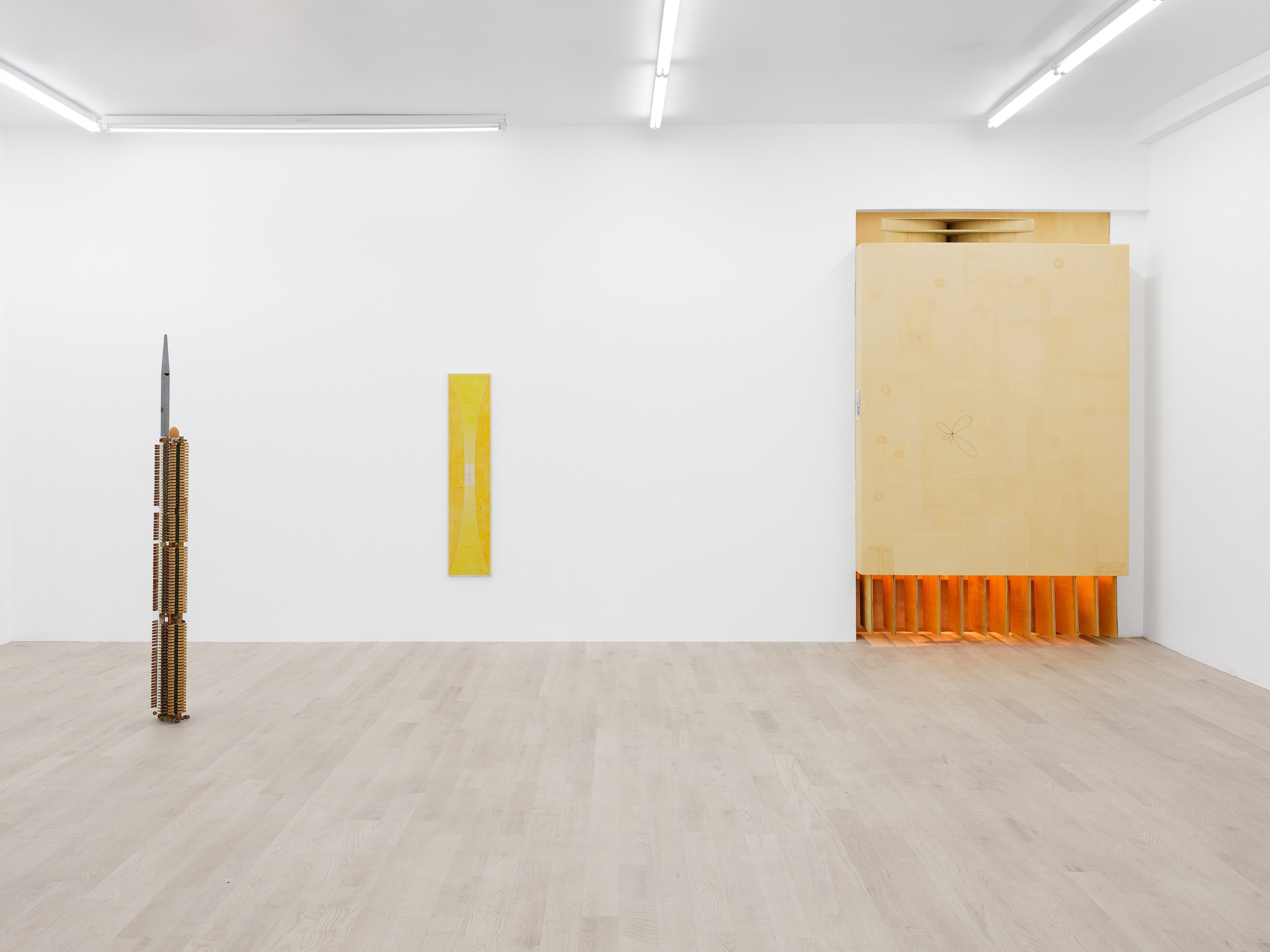 PastLullaby
Marlon Kroll
Jan 10 – Feb 12
Management is pleased to present Lullaby, Marlon Kroll’s first solo exhibition with the gallery and his first in New York since 2021. Through a practice that filters sculpture, drawing, and found ephemera, Kroll attempts to understand spiritual and cultural phenomena through ideas in science and folklore, and the body’s shifting position therein. Marlon Kroll (b. 1992 in Hamburg, Germany) is a Montreal-based artist interested in perception, infinity, and the supernatural. The child of a psychic and a musician, his work articulates questions around embodiment, the nature of reality, and the construction of truth. Recent solo and institutional exhibitions include Fireflies, Eli Kerr, Montreal; Revelation, Fondrie Darling, Montreal, 2023; Receiver, Acapella, Naples, Italy; Nesting, Foundation Phi, Montreal, 2022; A Chronique Fear, Marvin Gardens, Queens, New York, 2021; Rifts, hovels, a sighing tide, Afternoon Projects, Vancouver, 2021; La Machine Qui Enseignait Des Airs Aux Oiseaux, Musée d’art Contemporain de Montreal, 2020; Red Sky at Morning, Interstate Projects, Brooklyn, New York, 2019; Sunrise It Crystallize, Parisian Laundry/Bradley Ertaskiran, Montreal, 2019. Kroll was awarded the William and Meredith Saunderson Prize for Emerging Artists in 2020. His work is in numerous public and private collections, including the Museum of Contemporary Art (MAC) in Montreal, CDPQ Collection, Fidelity Investments Collection, and Foundation Giverny Collection.
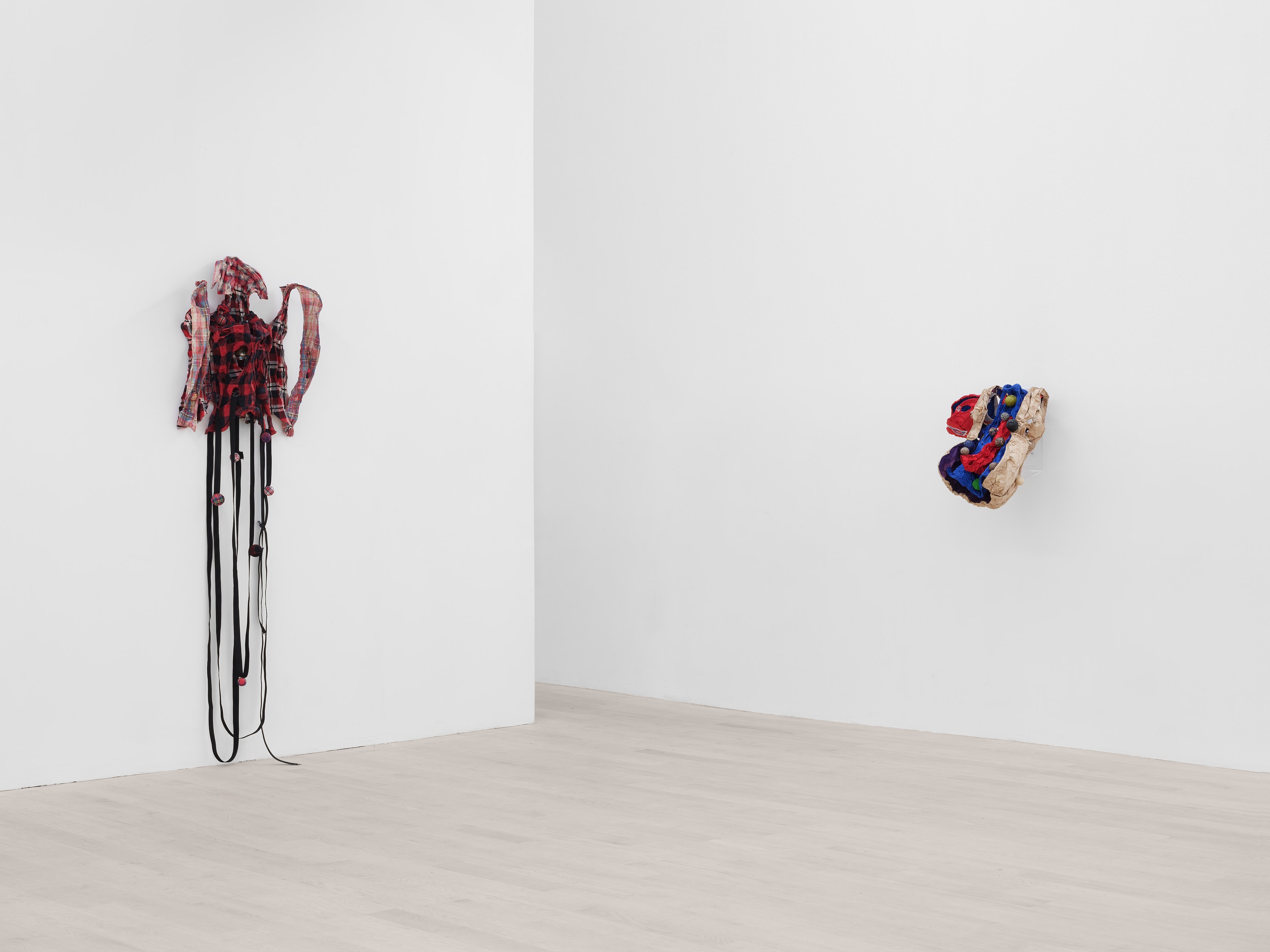 PastThe Village Bites Itself
Asif Mian
Nov 8 – Dec 18
Management is pleased to present The Village Bites Itself, Asif Mian’s first solo exhibition with a commercial gallery in New York. The Village Bites Itself is Mian’s first solo exhibition in New York since RAF, his expansive show at the Queens Museum in 2021. Cinching writing and cutting together in a single act, Mian uses a hot knife to carve an X, flocked and pipetted with sand, transforming it into a metastasizing, mutating form that functions as a repository for shrapnel of rock and glass. It resembles a lattice carved out of the earth’s crust, itself delimited into blocky zones where people do or don’t count. A stylistic allergy towards binaries folds—their resurgence heralds the eschaton. The X also evokes formal diagrams of chromosomal recombination during human reproduction. For years, genetics has offered Mian a set of conceptual starting points in the studio, for instance, in drawings made of parsed threads that resemble alleles. It also provides an allegorical language to think about kinship and a conception of a human organism that is written to the smallest measure. This digital understanding of the human is appealing to Mian, whose sculptural vernacular of wrought rigidified fabric, hybrid textiles, carved sand glyphs, and industrial ducts, is instantiated like a series of scripts. Mian’s experiences with infinitely light, thin digital objects perfectly wrapped in repeating, flexible patterns, inflect his facility for binding, skinning, and marring simple forms into animate, spectral presences. Mian integrates material to emphasize, not transcend, a split. He conceives himself as a hybridized, but unsynthesized, text. The level syntax of his rug sculptures—planar, ordered, exacting—belies a mind that constantly modulates its own proclivities towards extremes. The titles of two of these works refer to scarring and poisoned roots, suggesting an anterior thrust to his thinking: a tendency to look for a previous, more fundamental wrong. In his search for a prior act of rending, he inevitably traverses back home, his spiral path there punched in blue out of the smaller Afghan carpet. Shirts, rugs, jerseys, that can be imagined crumpled in the corner of a bedroom, or quickly removed and draped over a piece of furniture, are flayed, riven with apertures, and splayed open. The exhibition’s palette is domestic and ravaged. Like Haneke, he sees the home as an arena in which quiet degradation presages social murder. The inaugural coordinates of permission and law laid down in childhood also demarcate the possibility of inflicting grievous injury and getting away with it. This tacit condoning is given as a birthday gift, or a lesson. To plumb one’s lineage for explanation risks being delivered only madness. That’s the gambit. Another wager, a lifeline: couched in the metaphors of inheritance and mutation, Mian’s real concern is theodicy. It is not a question of origins, but of vindication perennially deferred: then, we shall see face to face. In the meantime, the conviction that nothing that anyone does is unintelligible, is a salve.[1] And so, Mian cuts familiar, familial archetypes out of a spray of phenomena with an expediency born of this belief in intelligibility. Today, there is no topic other than slaughter and its meaning. All else is reconstruction, mere technique.[2] Once again, our thanatophilic, permissive culture debases and cheapens life warmly in private, before pulverizing it on the world’s stage. —Vijay Masharani Asif Mian (b. Jersey City, NJ), earned a BS in Biology (Genetics) & BA in Studio Art from Drew University, an MFA from Columbia University (2018), and attended the Skowhegan School of Painting and Sculpture (2018). Mian’s multi-chapter project, RAF, was the focus of a 2021 solo exhibit at the Queens Museum for the Queens Museum-Jerome Foundation Emerging Artist Award. Mian has also exhibited at The Kitchen for the Whitney ISP curatorial exhibition, The Shed: Open Call, BRIC, and Queens Museum for ‘Queens International: Volumes’. Recently, Mian was awarded the 2022 Rema Hort Mann Foundation Emerging Artist Grant and participated in the Okayama Art Summit 2022, curated by Rirkrit Tiravanija. 1 - Alain Badiou, Our Wound is Not So Recent (Originally delivered at La Commune theatre, Aubervilliers, on November 23, 2015) [online, https://miguelabreugallery.com/wp-content/uploads/2016/09/AlainBadiou_OurWoundisNotSoRecent.pdf] 2 - Theodor Adorno, Minima Moralia: Reflections on Damaged Life, (New York and London: Verso, 2005), p. 247.
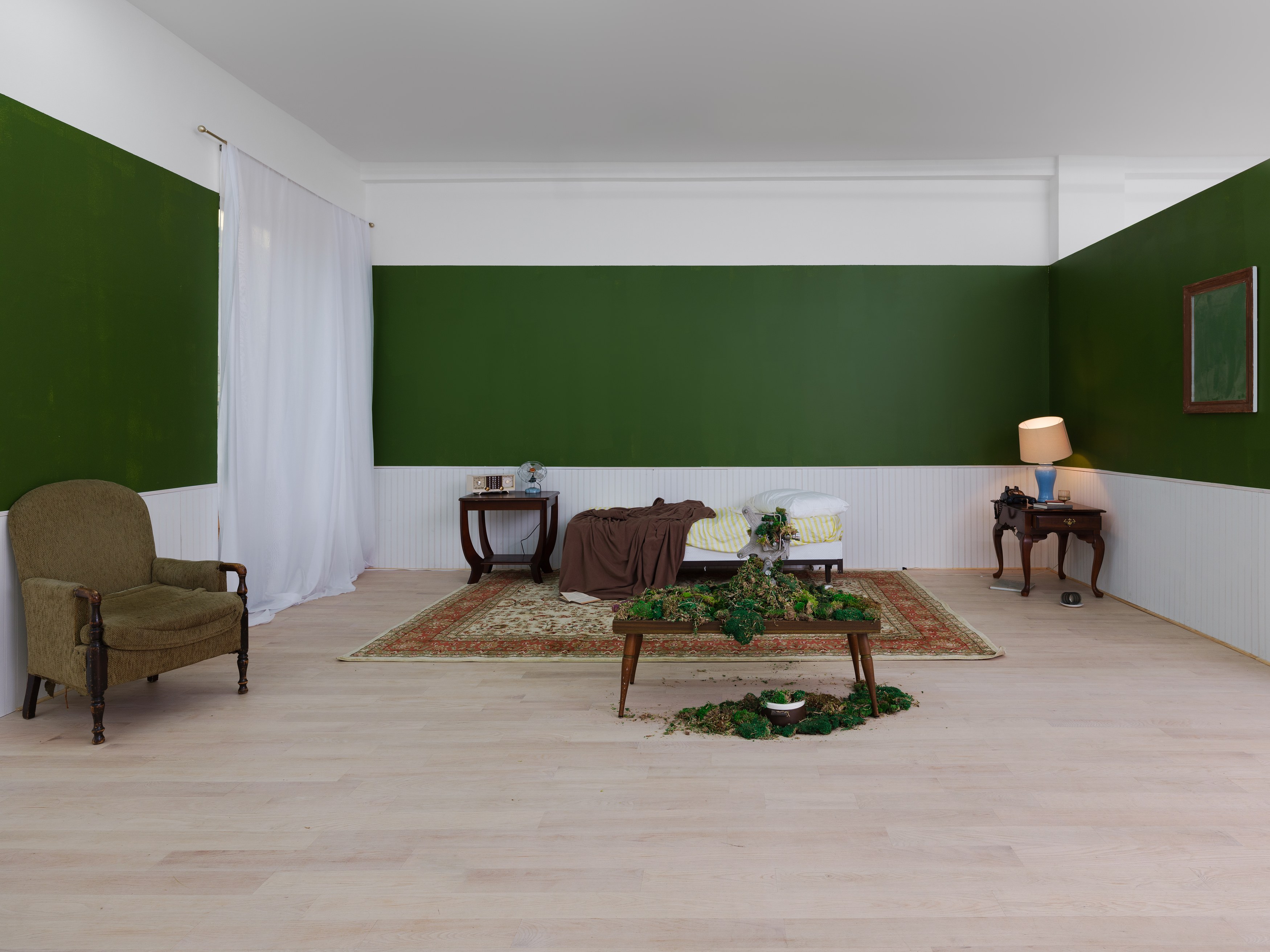 PastYour Absence Is My Monument When Your Being Was My Everything
Merik Goma
Sep 5 – Oct 23
Management is pleased to present Your Absence Is My Monument When Your Being Was My Everything, Merik Goma’s first solo exhibition in New York. In his photographic practice, Goma saturates images with a profound Jungian and quotidian symbolism that impedes direct interpretation in favor of divergent narrative possibilities addressing the phenomenological experience of grief and loss. Goma’s practice involves building tableaux with spatially and temporally ambiguous narrative constructs populated most often by a single protagonist. With close attention paid to color and lighting, the images captured within Goma’s meticulously assembled sets become psychological vessels charged inexplicably with both stillness and yearning. The exhibition includes four chromogenic prints from the Your Absence is My Monument series, and a site-specific installation that will be the setting for several performances. The Your Absence is My Monument series grows out of the artist’s experience of losing his close friend and his grandmother in succession, leading him to meditate on the existential nature of absence as presence. The photographs in this series, named after an eponymous poem by the artist, are dramatically lit scenes inhabited by a single wistful subject surrounded by objects that allude to the hypnagogic nature of the environment. Using found antiques and effigies permeated with varied histories for his sets, Goma constructs a metaphysical space that is at once intimate and solitary. This space is imbued with the same kind of anxious Sartrean nothingness, the presence of absence which resides in the mirror, the cage, the photograph, the rope, the suitcase, the mattress, and the shadow. The exhibition is accompanied by a series of performances. The first performance will take place during the opening. Full schedule to be announced. Merik Goma (b. 1987, in Manistee, MI) is a New Haven-based photographer and alumni of the NXTHVN Studio Fellowship Program, an arts incubator. His work has been shown by Tilton Gallery, and is in the collection of 21C Museum, Yale University Art Gallery, and the Detroit Institute of Art. Goma represented Connecticut in the New England Triennial at DeCordova Museum, is a FY21 Connecticut Artistic Excellence award recipient and was selected as the Joyce C. Willis Artist in Residence by the Amistad Center for Arts & Culture at the Wadsworth.
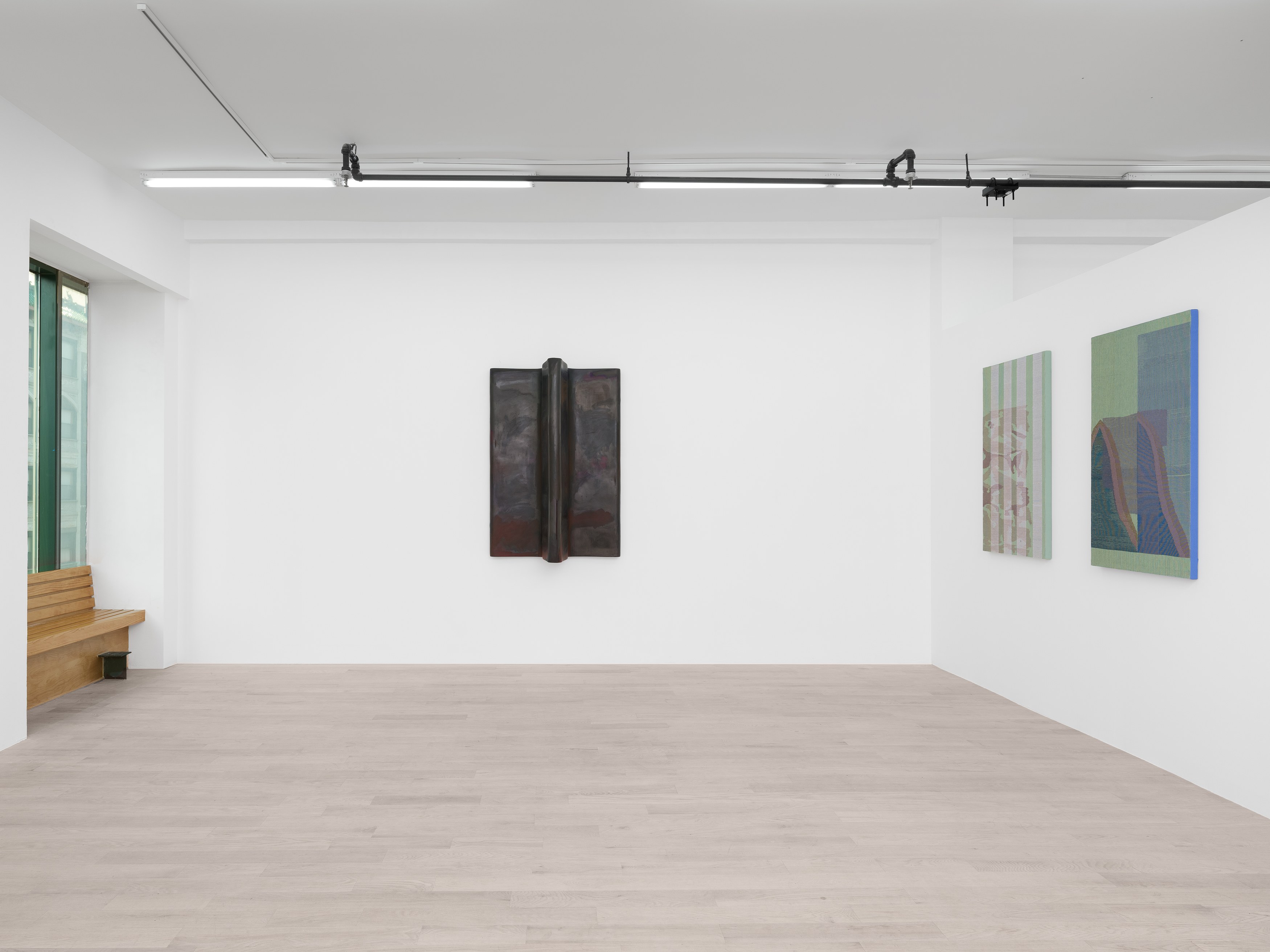 PastThe Third Kind
Charlotte vander Borght, Catharine Czudej, Aislinn McNamara, Eric Oglander, Miranda Fengyuan Zhang
Jun 29 – Aug 14
Megumi Shauna Arai, Charlotte vander Borght, Catharine Czudej, Miranda Fengyuan Zhang, Myranda Gillies, Aislinn McNamara, Eric Oglander Management is pleased to present The Third Kind, an exhibition curated by Lola Kramer and Loup Sarion. Neither distinctly painting nor sculpture, most of the works in this show come into being through a dedication to the object and its physicality. In response to the panorama of recent art heavily relying on image-making, this show seeks to reassess the place of material, craft, and form. There is boundless freedom in breaking away from the culture of the screen, and each of these artists has found new paths working from a pure, tangible desire intensely rooted in material. Emerging through various approaches, ranging from weaving to carpentry, casting, hand-stitching, and even alchemy: all of the work is made by artists living in New York City. Several artists are breathing new life into natural materials. Aislinn McNamara's wall-mounted nylon reliefs are meticulously stitched and stretched over metal armatures, creating intricate cavities. Their undulating surfaces are coated with layers of pigments, including shades like "severed-head red" and "Francis Bacon cobalt," which the artist sourced during her travels near the ruins of Herculaneum. The work is as inspired by ancient civilizations as it is by visualizing the gurgling, sputtering, and sucking sounds of a volcano or a "minor-key shriek" in a Coltrane composition. An impulse to record the natural world reverberates nearby in the alchemical reliefs of Catharine Czudej, created by dipping an aluminum frame into a vat of liquid Bismuth, an element used in Pepto-Bismol and eyeshadow. It emerges transformed, its iridescent crystalline surface responding to the precise conditions it is born into. Many of these artworks engage the formal language of painting, as seen in the fiber-based experiments of Myranda Gillies, the hand-woven textiles of Miranda Fengyuan Zhang, or Megumi Shauna Arai's gestural めぐりあい I (Encounter I), constructed by stitching hand-dyed silk soaked in walnut and variations of logwood, pinned in a windswept motion. Appearing frozen in time, it serves as a reminder that the dynamics of power and submission, identity, and the essence of the human experience do not wholly rely on its explicit representation. A different engagement with the history of painting is present in a new three-dimensional series by Charlotte vander Borght. Cast from scuffed subway seats that have fallen into disuse, they are inverted and treated like a canvas, made obscene, even debased. Giving the impression of peeling off the wall, their relationship to the body falls further into abstraction. Recently, Eric Oglander, a naturalist and avid collector of folk art, asked ChatGPT how it would make the minimal handmade "objects of happenstance" that line the shelves in his studio. It got close. He fed the software a set of familiar materials: striped blue fabric, branches, plywood, and white paint. Whether this hypothetical artwork would contain the auratic touch of a fisherman with an eye for accidental souvenirs is hard to say. I would like to think the rippling moiré effect produced in Crops Circles is more like the construction of a song. "Songs arise out of suffering," wrote Nick Cave in a blog post last January, "by which I mean they are predicated upon the complex, internal human struggle of creation and, well, as far as I know, algorithms don't feel." To that end – how can the material experience of the art object, and the finesse that brings it to life, reaffirm a relation to the physical, irreplaceable essence of human creativity? If society's ongoing inclination is to reproduce representations of our everyday life through computation, perhaps it is time to reconsider the place of craft and material within contemporary art. —Lola Kramer Lola Kramer (b. 1990, Los Angeles, California) is a curator, writer, and editor based in New York City. She was the curator of Liz Magic Laser's Frieze Project at Frieze New York 2023, and is known for her essays, profiles, and interviews with pioneers of creative disciplines. She was the curator of 7 Gardens, a public art exhibition throughout the community gardens in the Lower East Side, conceived with Joseph Ian Henrikson as a journey connecting local community space to the practices of established and emerging artists working to represent ideas of nature and community engagement. She was recently selected by Cultured magazine as one of 8 young curators to watch and a leading expert and advocate for the next generation of artists and change-makers. Kramer’s writing has been featured in numerous publications, including the Whitney Biennial Catalogue, Frieze, Interview, CURA, and Kaleidoscope, as well as monographs published by MACK, Phaidon, and Rizzoli. Loup Sarion (b. 1987, Toulouse, France) studied at Beaux-Arts de Paris (2010-2015) and Cooper Union, New York (2013). Recent solo and duo exhibitions include: Saliva, Berthold Pott Gallery, Cologne; Cannibal Canyon, M+B, Los Angeles (w/ Daniel Boccato); Socrates Sculpture Park, New York; Milch in meinen augen, Kunstverein Heppenheim, Germany; Tuff Titties, Sorry We’re Closed, Brussels (w/ Al Freeman); Chapo, Clearing, New York (w/ Harold Ancart); Everybody is somebody’s secret, Berthold Pott Gallery, Cologne; Smooth like an alibi, Formatocomodo, Madrid; Langue Pendue, SpazioA, Pistoia, Italy. Recent group exhibitions include: Carl Kostyál, Sweden; Galleria Continua, Les Moulins, France; Noire gallery, Torino, Italy; Espace 251 Nord, Liège, Belgium. He was artist-in-residence at International Studio & Curatorial Program, New York, in 2018. In 2021, he founded Marrow, an experimental design project with Rafael Prieto. Loup Sarion lives and works in New York.
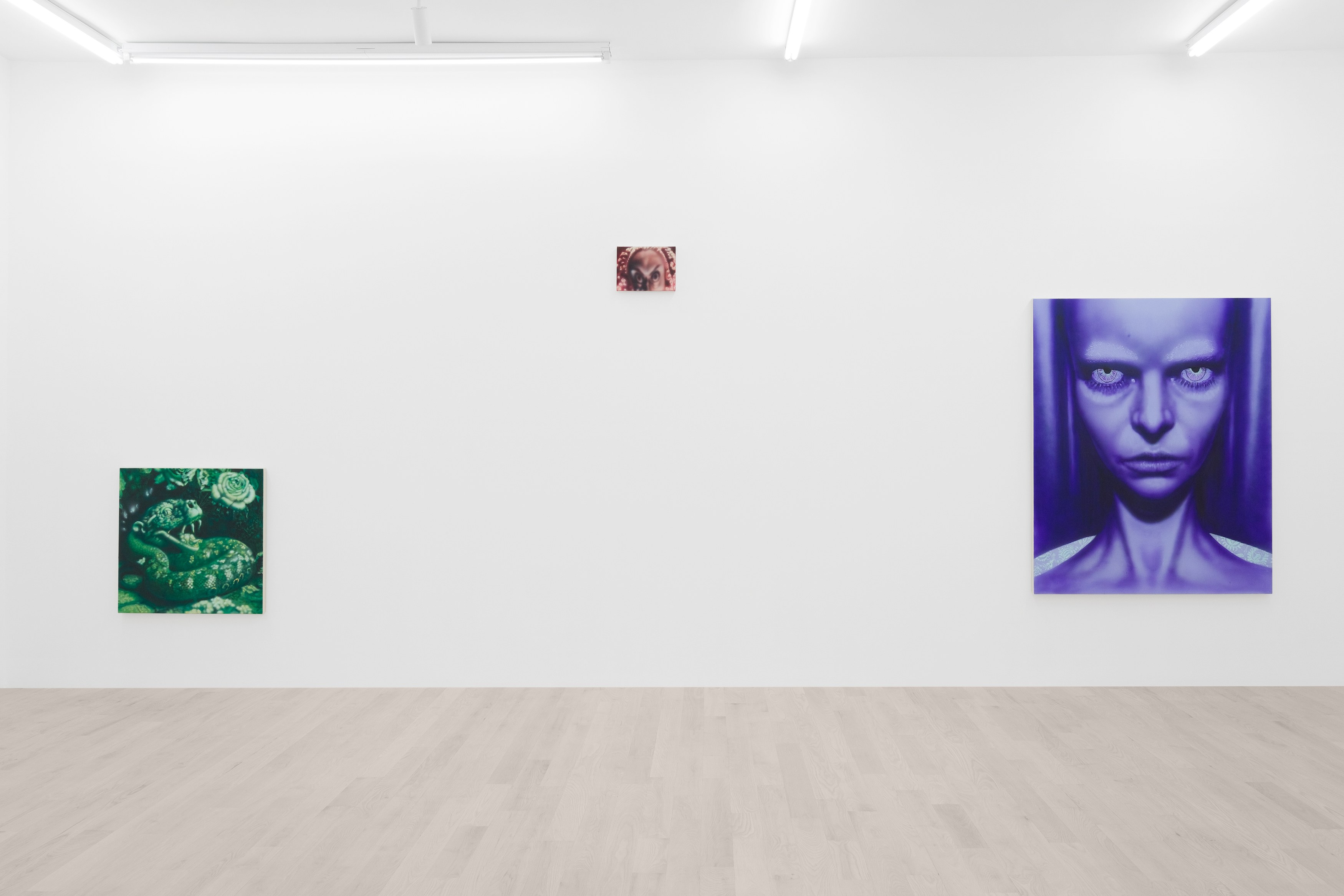 PastGlad Tidings
Tim Brawner
May 5 – Jun 19
Management is pleased to present Glad Tidings, Tim Brawner's first solo show with the gallery as well as his first in New York. Tim Brawner sets forth, equally motivated by a documentarian impulse and the submission to the fantastic and weird, where saturated psychedelia defamiliarizes the compositional playing field. His extreme interest in portraiture yields exaggerated, almost humorous depictions of faces and objects alike, through which affect is pushed to the point of alienation. This manifests in Brawner’s invocation of Franz Xaver Messerschmidt’s infamous “Character Heads,” which were produced towards the end of the sculptor’s life. Comprising dozens of self-portrait busts, each face appears caught somewhere along the continuum of human emotion. Messerschmidt pushes physiognomy to its extreme, a move that Brawner subsumes into his own field of representation. Both artists commune where realism slopes into the uncanny valley, where affect is dictated by exaggerated forms. Brawner narrows his focus to a precision akin to the delicate pinning of a butterfly, ultimately in service of documenting an ontological struggle for representation. He contends that the act of painting precludes the effort to make an object, its drama stemming from the individual’s subjectivity manifesting in the process. The strangeness of a painting stems from its utility as a decorative object, which distances the viewer from its causation. Recognizing this paradox, Brawner instills his compositions with a marked sense of the weird, inviting a perceptual reorientation. The fringes of the real function as fertile ground for this endeavor. When discussing the content of his paintings, Brawner refers to concepts of “the weird” and “the eerie,” specifically in the way Mark Fisher invokes Lacanian jouissance in his discussion of H.P. Lovecraft’s brand of weirdness, where the sublimation of negativity is accomplished through the transformation of “an ordinary object [which causes] displeasure into a Thing which is both terrible and alluring, which can no longer be libidinally classified as either positive or negative.” This serves as a basis for Brawner’s subjects as he pursues content with ongoing consideration for the failure of empathy. Brawner’s stylistic anchors also include politically oriented horror comics such as Slow Death, the haunting melodramas of Victor Man, and the pop perversity lodged in the work of neo-geo artists. He likewise implicates the intensities found in Gothic writing, as every formal aspect in the genre contributes to building and sustaining a certain mood, specifically citing Thomas Ligotti’s aptitude for encapsulating the impoverished quality of being trapped within one’s mind. Brawner accomplishes the same in his tightly wound body of work, through drawing, collaging, and printing until an image is arrived at – a process that is almost never linear. In a painting titled Xtro, the back of an impeccably styled head of hair is overtaken by a fierce pair of eyes, a feature that dominates the artist’s oeuvre. This work is daubed with pearlesque spots, which pervert Roy Lichtenstein’s meticulous Ben-Day dots. Similar ornamentation exists everywhere, such as in the portrait of a bizarre snake hybrid, Second Instar, rendered in vibrant shades of blue and green, or Semiochem, the haunting portrait of a humanoid creature with glowing eyes and a disconcerting grimace. These images pulsate, stirring a bizarre drama where the audience confronts painted subjects that almost become real. There are passages where Brawner selectively pushes maximalist details, overexplaining the formal aspects so that they become hypnotic. Such sites of focus contribute to descriptive eruptions as they are weighed against the sparser expanses. This disorientation mirrors the artist’s studio practice, where he initiates multiple paintings and drafts at once, constantly chasing an extreme engagement with whatever subject has his immediate attention. —Reilly Davidson Omaha-born, New York-based artist Tim Brawner produces a practice of painting that mines the space between the uncanny and the grotesque. Seeking to produce in the viewer a compelling affect of unease, Brawner utilizes the idiom of illustration to render images of alienation, through the purposeful bricolage of disparate representational elements. In each work, a persistently fine, monochromatic, painterly execution meets the artist’s formal drafting process of drawing and montage in order to achieve what Brawner terms a pathos of ‘weirdness’: a form of defamiliarization which is also a seduction, an entreat, into a strange representational space nonetheless evoking trepidation and dread. These visual chimeras undermine the spectators’ traditional binary frames of reference, eliding at once those of conservative Western Christian morality and those of liberal secular paradigms of Enlightened empathy. As the artist intones, this ‘weirding’ is “part of the drama of the work; it is an ontological struggle [of an alternative world beyond our given dichotomies] to be represented… to come into being.” Tim Brawner (b. 1991, Omaha, Nebraska) received an MFA from Yale School of Art in 2020. Past exhibitions include Zang Gallery, Brooklyn, NY; Page (NYC), New York; Yale University Gallery, New Haven, CT; Ashes On Ashes, New York; Yale Painting & Printmaking MFA, Galerie Perrotin; Papa Projects, Minneapolis, MN; Union Pacific, London; Unit London, London; Primary, Miami, FL.
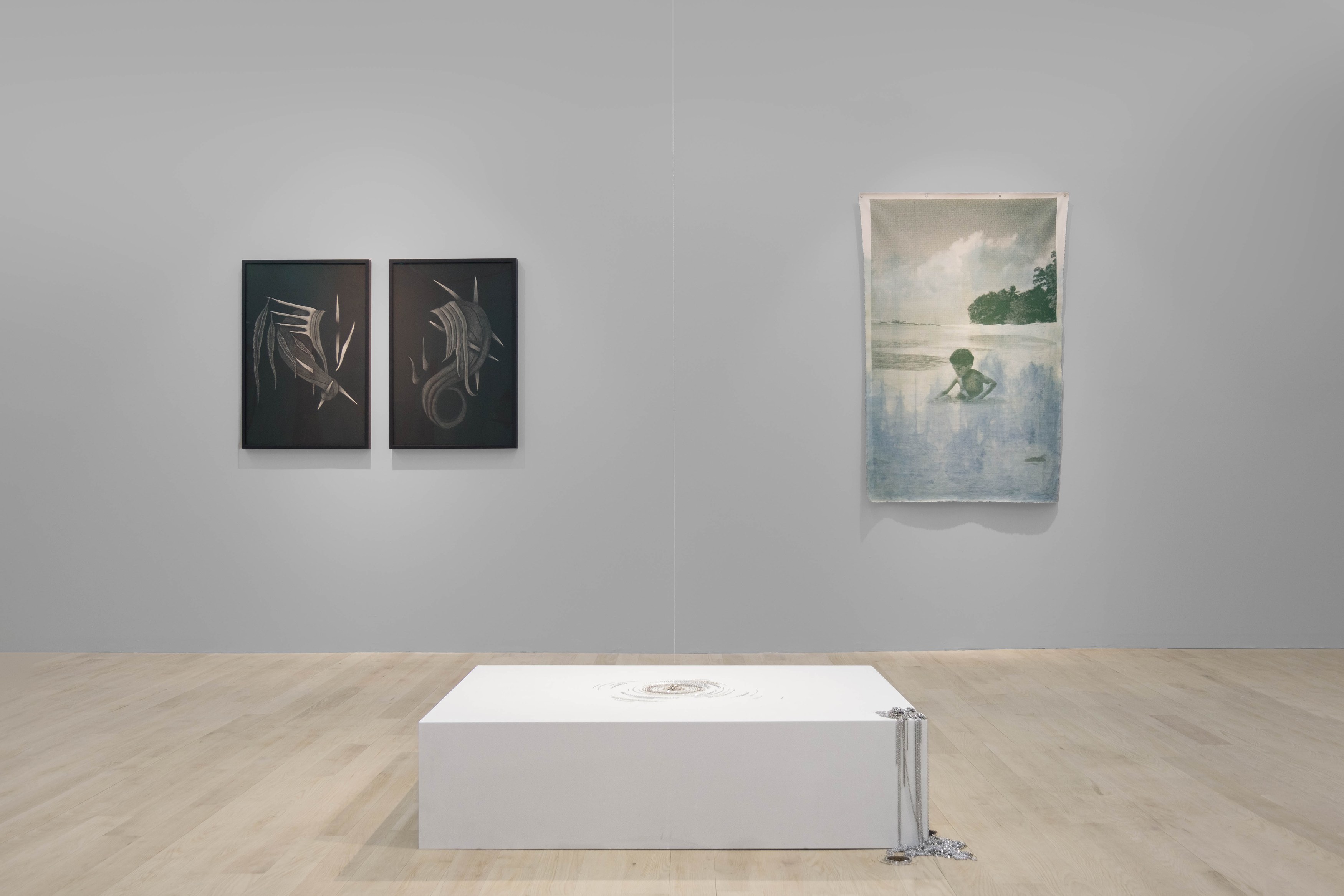 PastInvitations to Tremble
Afruz Amighi, The Bruce High Quality Foundation, Tahir Karmali, Kate Liebman, Vladislav Markov, Nikholis Planck
Mar 22 – Apr 24
Afruz Amighi, David Bernstein & Rosa Sijben, Bruce High Quality Foundation, Tahir Karmali, Liane Lang, Kate Liebman, Vladislav Markov, Nikholis Planck Management is pleased to present Invitations to Tremble, curated by Brooke Lynn McGowan, reflecting on the practice of eight artists and artists collectives and investigating the slippages between trauma and self-care, between death and reversal, between fear and bliss. Invitations to Tremble considers the artists’ oeuvres not only in the aftermath of the Covid-19 pandemic, but also in light of intergenerational or interpersonal trauma, the violence of capitalistic exploitation, or the intimate devastation of lost loves and loved ones. Invitations to Tremble is a meditation—at turns uncanny, devotional, ironic, and sincere—on oppositions to repetitive narratives of trauma, occupations of the liminal space of overcoming, and considerations of death as both symbol and fact. Invitations to Tremble takes its title from a slippage in philosophy, derived from two contrapuntal sources. The first is that elaborated by Jacques Derrida in The Gift of Death, based on the Socratic notion of melete thanatou, suggesting that the examined life is one bound up in a care for one’s death. In Derrida’s understanding, this being-towards-death demands a sacred trembling, a sublime sacrifice riven with fear, branded with trauma: “We have fear of fear… we tremble… We tremble in that strange repetition which links an irrefutable past (a blow that occurred, a trauma that has already affected us) to a future”. Contrary to this, Edouard Glissant offers the liberating concept of tremblement, or trembling thinking: “What I call tremblement is neither incertitude nor fear... [It] is the instinctual feeling that we must refuse all categories of fixed and imperial thought… and in which we can counter all the systems of terror, domination, and imperialism with the poetics of trembling.” He invites us to tremble with the world. In Afruz Amighi’s Love Story, Ghost Story, a diptych from 2018, recently exhibited at the Frist Art Museum, two figures barely emerge from shadowy darkness. Drawing on the artist’s previous graphic work evoking a funerary processional, these heraldic figures recall David Foster Wallace’s enigmatic aphorism ‘Every love story is a ghost story’, recurrent in the novelist’s letters and private correspondence. Nikholis Planck’s works from a series of wax paper paintings, Another Portal (2021) and Untitled (duo horizontal) (2021), are durational studies completed at Green-Wood Cemetery in Brooklyn and point directly to questions of trembling and ontology. If being is a being towards death, and if signification since ancient times has been bound to a tomb, as the Greek word sema for sign is also that for grave, then Planck’s provisional landscape studies indicate towards the moribund as site of meaning-making and towards our uncertain regard for landscape in the age of capitalist expansion and the virtual. Vladislav Markov’s Cremation Society (2020) reflects the artist’s use of industrial and disused found objects to evoke and frustrate the viewer’s desire for representation; made of dehydration trays designed to make food last longer, the work recalls our human desire for self-preservation and presents the uncanny visual suggestion of a death mask. For Bruce High Quality, in a piece from the series Ways to Die (2018) post-structuralist tautologies of ‘the death of’ reach ironic apogee. As the collective states in interview, “If Socrates was right and how to die is all there is to philosophize about, someone ought to write the index.” What is our relationship to death not as lived, or even sign, but simply signified? Nonetheless, real pain occurs. And real healing. It can be personal. Or political. Kenyan- born artist Tahir Karmali’s works Fingers in the Soil (2017) and Paradise VII (2019) address bodies of trauma and redress, politically and personally respectively. For Fingers in the Soil, fine worked raffia stained with cobalt drapes from a copper pole yielding a cascading textile sculpture. Cobalt is the same mineral used in contemporary cellphones; its exploitative extraction in the region has resulted in devastating child labor, abuse, and endangerment. The organic Congolese cloth acts as a cipher for the body of the nation and the individual marked by the harm of the continuation of colonial relations by other means. In Paradise VII (2019), conversely, the trauma is not sociological but personal; this image reflects an exilic identity, whilst also taking inspiration from the hadith saying from the Prophet Mohammed, ‘Paradise is at the feet of the mother’. Featuring images of the artist’s brother, deceased suddenly and much too young, in the Elysian sands of their mother’s native Seychelle Islands, this series, composed just before the Covid-19 pandemic, the artist describes as “deeply cathartic”. Likewise, Kate Liebman explores a personal trauma, but in this case through a practice of painting. As the artist intones, “My work explores time, specifically how grief transforms the experience of time’s passage.” After the sudden loss of a loved one, the artist sought to process both her trauma and attendant fixation on the passage of time, through iconography and mythology, with particular reference to Bruegel’s portrayal of the fall of Icarus. In the densely layered After Bruegel 3 (2023), images oscillate between clarity and opacity of representation, reflecting the struggles in the mind when one is attempting to account for the experience of trauma and loss. In all this trauma, in all this death, in all this trembling, we need Something to Hold On To (2019). Completed by Brussels-based David Bernstein and Sijben Rosa, and previously presented at the Sculpture Center, New York, this haptic and participatory body of work includes multiple uncanny objects that spectators are quite literally invited to hold on to, as they traverse the exhibition landscape of anxiety, trauma, and healing. Something to Hold On To, reflects the duo’s emphasis on intimacy and connection in an increasingly augmented and mediated reality. Meanwhile, in Liane Lang’s Bliss (2022), a photograph printed on agate, provides a moment of hope and escape, presenting the possibility of pleasure: trembling in the ecstasy of being. Finally, for this exhibition, at the center of the room, a site-specific mandala shimmers, with a singular chain hanging from above; here artist Afruz Amighi presents a devotional gesture, a quivering and defiant poetics of ritual, which, after Glissant, ‘counters all the systems of terror, domination, and imperialism.’ In other words, she invites us to tremble with the world. And we do.
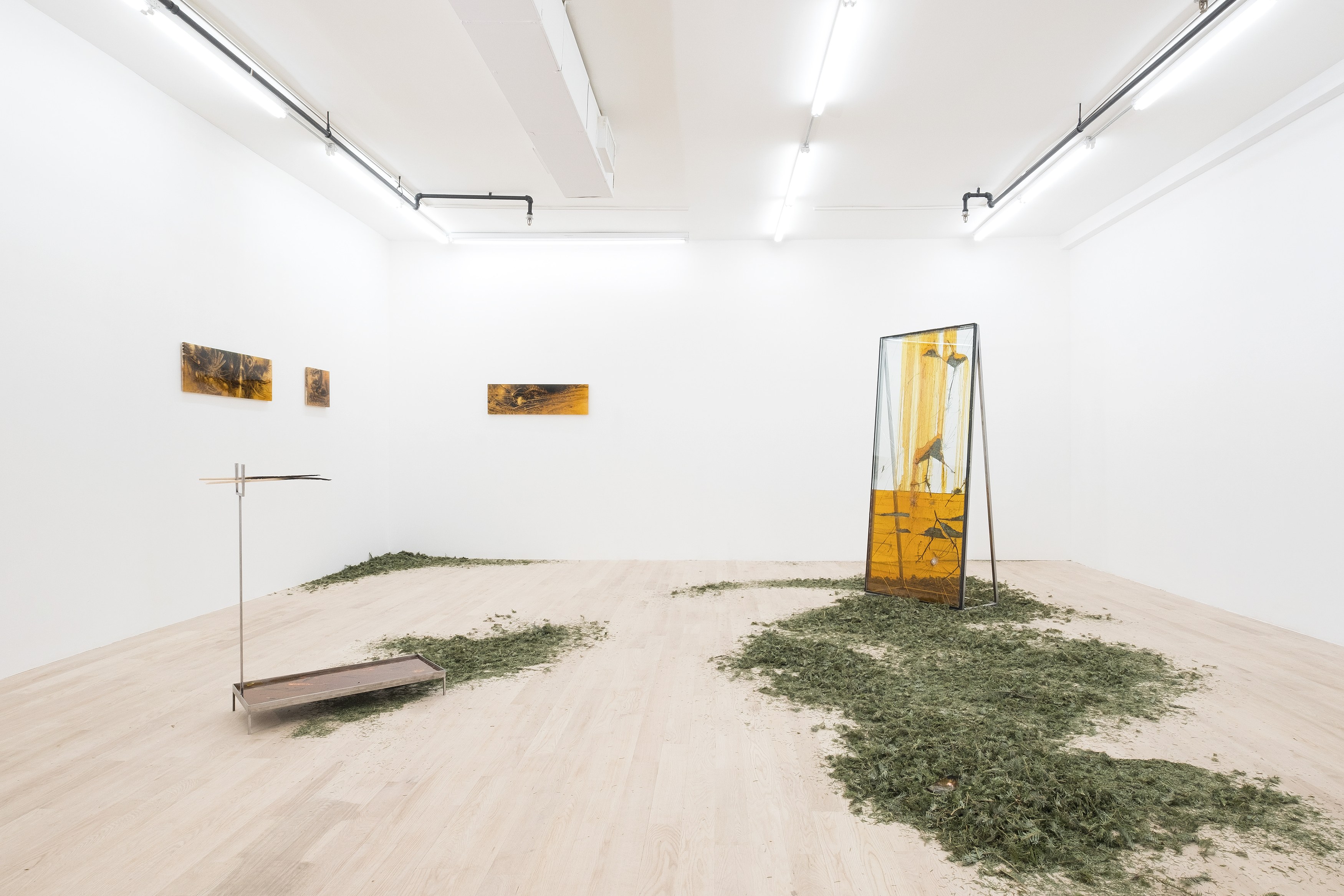 PastConiferous Succession
Jura Shust
Jan 20 – Mar 13
Management is pleased to present Coniferous Succession, Berlin-based artist Jura Shust’s first solo show in the United States. — Post-holidays, Christmas trees are laying on the streets of New York: some are covered in plastic bags, like discarded bodies, and others are tossed here and there, secluded or stacked in piles. The pleasant whiff of conifers is mixed with the smell of underground steam escaping from manholes and the smell of trash juice leaking on sidewalks. 300 million years ago these trees created for themselves such a successful genetic make-up that they ended up outliving dinosaurs. As ancient beings, conifers can normally live on average hundreds of years, and - in some cases - even thousands of years. The tree’s childhood and youth last ten times as long as ours, and its complete life span is at least five times as long. Perceived as both protective and ominous, the forest has been the birthplace of many myths and folktales from prehistoric times to the present day. For instance, sacred coniferous groves have been used as ancient pre-Christian temples, human sacrifices were made to tree spirits, and individuals were paired with trees, as twins, in transcendental unions. In his exhibition Coniferous Succession, Jura Shust highlights the art of meaning-making and presents with an anthropological interest the forest as an ancient, sensual territory of non-linearity. The artist unfolds a myriad of overlapping mythologies and spiritual beliefs that have been knitted around coniferous forests by multiple cultures in search of a connection with divinity. Shust’s interest in depicting the relations between ritual, escapism, and contemporary scientific research, starts from the native inhabitants of Eastern Europe, more specifically from the Finno-Ugric tribes. Echoing through the exhibition space is a sound piece: a collage of multiple ethnographic sources that tells the story of the spruce and the human’s symbiotic relationship. We hear of rituals involving breast milk, blood, or stillborn babies buried under trees; we hear of trees that whisper about the future, have the ability to bless households, of trees that bleed, and of trees that long for their twin-humans to find them. We also hear of trees that bless lovers, of trees that open their bellies to give birth after nine months, and of trees that help the departed ones pass on peacefully to the afterworld. With Reflects and multiplies light Shust reinterprets an ancient lighting device made to hold a rushlight. Underneath it, a water basin devised to catch the falling flames, multiplying their luminance, is instead filled with pine resin. Shust shows how nature slides into everyday life through both new technical devices and folklore, becoming part of humanity’s most intimate functions: from birth to death, and everything else in between. For instance, in many Slavic beliefs, pine fire was associated with passion, lust, and procreation. Similarly, individual spruce trees were thought to be inhabited by the spirits of deceased people. Each tree was a vessel for a soul, and when the spruce lost its needles, the spirit - it was said - also left the tree. Shust gathered pine needles from discarded Christmas trees around New York and arranged them on the gallery floor in the shape of a map inspired by the territory of prehistoric Europe. Resting on top is a smartphone playing a video of a fiery squirrel that runs up and down a tree, eponymously titled Coniferous Succession. The AI-generated creature represents the shape-shifting forest spirit common to both Slavic and Norse mythologies. This forest spirit inhabits the tree of life “Yggdrasil,” moving between worlds. The tree of life, a symbol of immortality and connector of worlds, is also present in the central piece of the exhibition, Hardens on the surface and heals the wound. This large self-standing panel, composed of a two-sided laminated glass unit, holds a spruce branch soaked in pine resin. Violently cracked on one side, this piece taps into another ancient belief that coniferous trees have blood flowing through their veins. For if a wound is inflicted on a tree, resin emerges. In industrial resin collection, a sharp blade is used to cut into the tree, and every week this wound is renewed and extended, or new wounds are opened. Until all needles fall immortalizes this process, presenting two rows of metal cones filled with hardened, overflowing resin, placed vertically on the gallery wall like a frozen waterfall. The stillness of an absence grows heavy in the exhibition and Shust captures this gradual disappearance from the world. The series of abstract works serially titled Walking, knocking on roots, and shaking the spruce paws are AI-generated drawings of plant forms, that resulted from feeding the AI the text of the sound piece echoing in the gallery space. The drawings were then machine-cut into pine wood and covered by soil to emphasize their meandering forms. A final coat of resin covers the panels, fossilizing the composition’s movement. Shust reflects on the death symbolism associated with pine trees and looks at the multitude of pre-Christian traditions that have been preserved through folkloric and contemporary beliefs. Coffins, for instance, are still made of pine wood, branches of evergreens are used in funeral decorations, and conifers are still planted on graves. Shust shows how, in a literal way, a phytomorphic process takes place through death, where remains, through their mineralization, start to embody the attributes of plants, and molecular matter rises anew through a redistribution. Thus, the coniferous tree - as a symbol of both death and rebirth - is an ancient truth that is rooted in a pattern of biological interaction. Coniferous Succession is in many ways a reminder of this circular interaction between systems, but it also depicts how humans and forests, in their co-evolution, have been in a dance of proclivity where meaning is projected and reinforced over the unknown. Despite what seems to be a beneficial uroboric balance, the ghostly presence in the exhibition implies that this projection, coming from a place of fear, will always be smothering the reality of kinship. —Adriana Blidaru — Jura Shust explores the relationship between ritual and escapism. Intrigued by semantic polysemy, informational intoxication, and initial desire for oblivion, he reflects on how the mythological overlaps with the technological. The sacral idea of incorporation of the human mind into a global network with its tendency for decentralization inspires the artist to redefine the concept of spiritual ecology. Shust’s practice merges sculpture, video, and installation to construct mental landscapes illuminated by ethnoreligious beliefs and flooded by biopolitical intentions. Jura Shust (*1983, Belarus) lives and works in Berlin. Since 2012, Shust has exhibited at institutions such as the Museum of Contemporary Art, GfZK (Leipzig, DE), Badischer Kunstverein (Karlsruhe, DE), Contemporary Art Museum S.M.A.K. (Ghent, BE), Calvert 22 Foundation (London, UK), Blaffer Art Museum (Houston, US), Museum de Domijnen (Sittard, NL), Mystetskyi Arsenal (Kyiv, UA), Arsenal Gallery (Białystok, PL) and others. He also took part in the 14th Baltic Triennial, CAC (Vilnius, LT) and the 4th Art Encounters Biennial (Timișoara, RO).
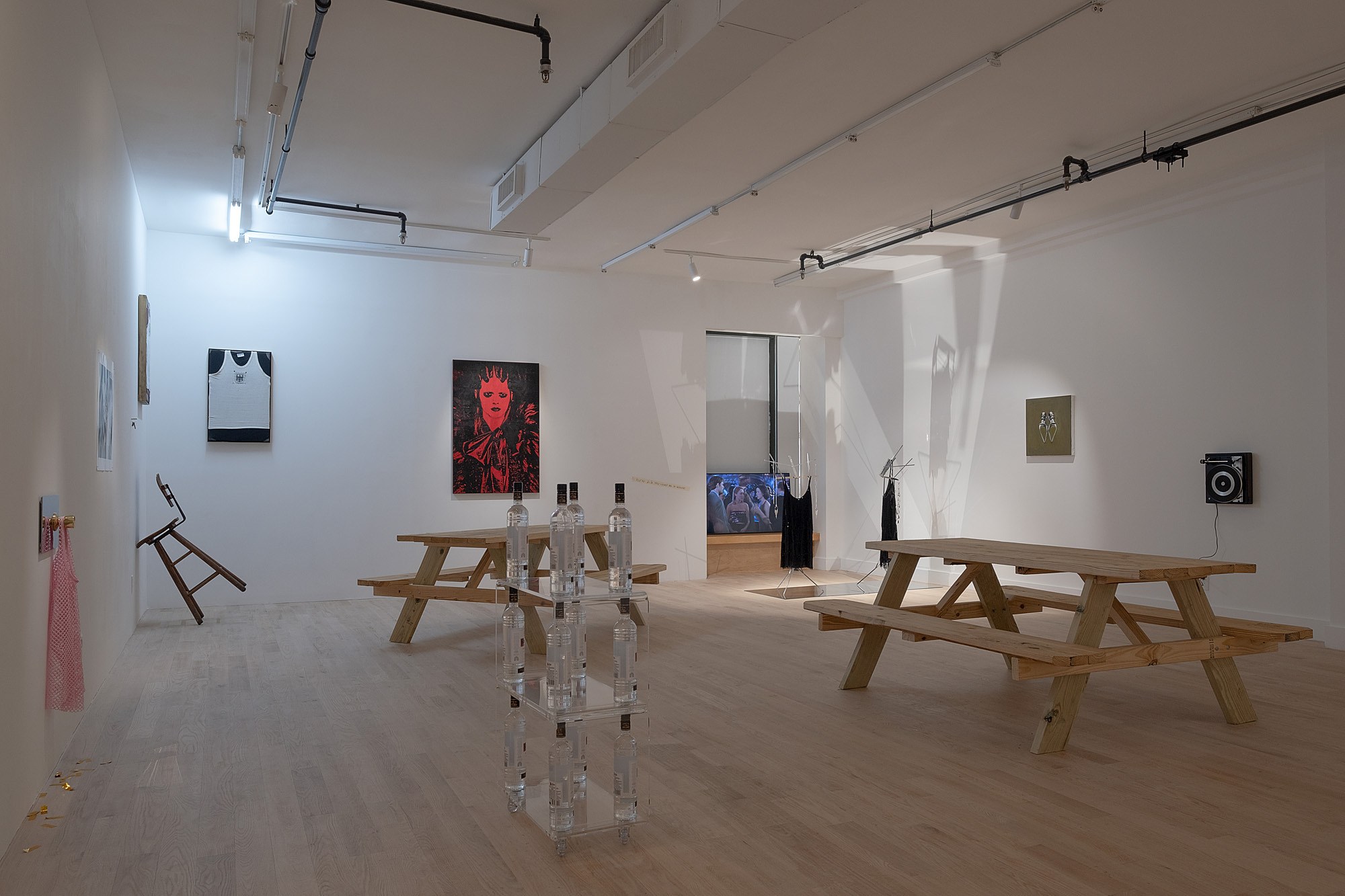 PastThe Last Day of Disco
Jimmy Beauquesne, Matthew Tully Dugan, Claire Fontaine, Nick Hoecker, Will Sheridan Jr, Marlon Kroll, Kayode Ojo, Gaby Sahhar, Abbas Zahedi
Jun 9 – Jul 10