Matthew Brown
Chinatown, New York, NY
390 Broadway
Founded in 2019 by then-23-year-old Matthew Brown with an inaugural exhibition by Kenturah Davis, the gallery has grown to represent 23 artists from around the world across locations in Los Angeles and New York's TriBeCa neighborhood, presenting ambitious exhibitions by emerging and mid-career artists without boundaries related to medium or generation.
Sign in to save this gallery, log a visit, or add a show to a shared list.
Exhibitions
- On viewThe Revenants of Our Founding Furies
Sedrick Chisom
May 15 – Jun 16
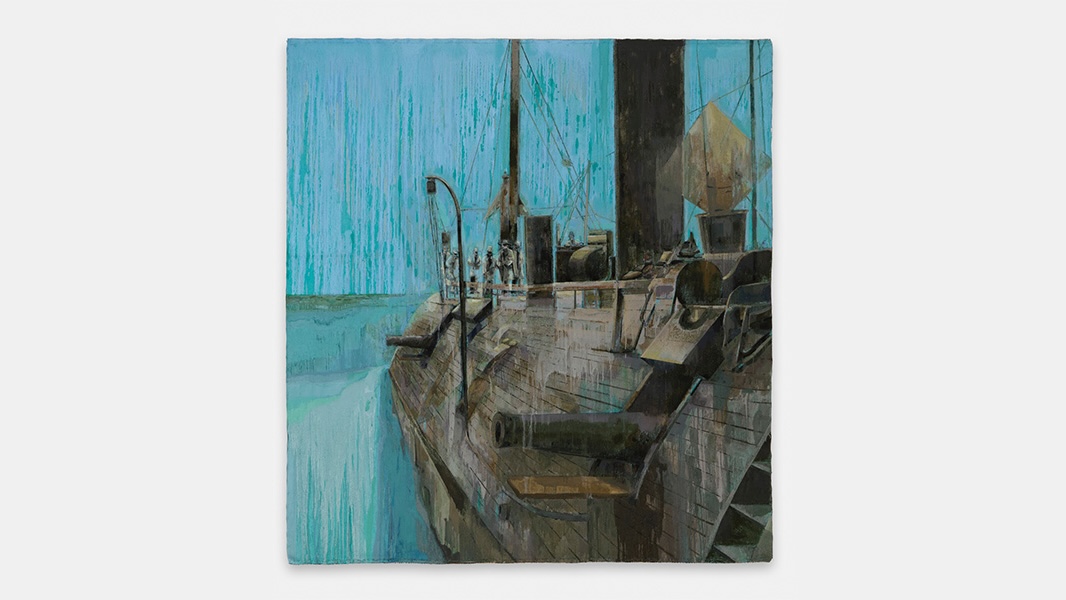
In these new paintings of Sedrick Chisom’s, his figures are more grounded than before. Their bodies have more weight and volume, a more solid outline—but many other parts of this world are merging. Imagined sights, hallucinations, representations of representations, events that took place but have since been forgotten, strings of letters – many different versions and interpretations of reality are compounded together. Sedrick’s studio chair appears in front of a bay, a scene of Virginia during the Civil War. Figures from different time periods share the same plane. We arrive in a speculative future in which several hundred years of American history keep on repeating and acting upon one another. The American Revolution, the Civil War, the Open Range times never ended. Time has been metabolized. Time does not move in any one direction. These are paintings of nonlinear time: all times looping, overlapping, happening simultaneously, just as they are now, in the present day. Solidity and flow are pitched against each other: wet paint running like ocean spray versus the solid form of an ironclad. Multiple paintings collide. A stone wall is intruded upon by floating embers pulled in from another painting: the Capitol Citadel burning in liquid fire far away in Monument Valley. This canonical event, at the center of this ongoing epic, shifts the world. Cataclysm happens out of frame, offstage, like in the theater. The land of the living crashes into the land of the dead. There is a figure laid flat on his back with his hat atop his coffin. He is dead. But is he going to the afterlife? Are those horsemen his comrades, enemies, maybe spirits he is joining? Perhaps he is among them already, looking down at his body from the vantagepoint of the setting sky. In an interpretation of a detail from a 19th-century archival photograph, there are prisoners lined up in barrels. We don’t know what they are being punished for. The crime has been lost. One barrel-man is stuck with a piece of paper on which are printed four letters. They are a mystery. It is no longer possible – for the artist, for anyone consulting the original photograph or the painting – to know what the letters say. Real and imagined events and spaces are collapsing into one another. The world and the stage are pushed together. Two figures face each other on a stage, before a painted backdrop. The real and the mythological stand face to face in theatrical, directed light. One has a tail and pointy ears. Figures like these emerge from the old found images the artist scours, and from his imagination too. He does not know exactly who they are. They are revealing themselves to him and to us. The Devil comes down to meet you on a stage in America, in-between different shifting layers of reality. Is all of America a stage? Is all of history looping? Napoleon, the World Spirit, appears with some of his soldiers on the artist’s balcony at 2:00AM in London, after ten hours of painting while listening to podcasts on Hegel. The World Spirit Reappeared During Miasmic Ass-Crack Hours. French and American histories colliding in England again. Back in the painted mythology, the European powers are sponsoring Transatlantic companies. The mytho-historical space imagined by the artist, and the artist’s mythologizing of his own life, are beginning to blend together. —Dean Kissick Sedrick Chisom (b. 1989, Philadelphia) lives and works in Brooklyn, NY. He received a full scholarship to study at Cooper Union, where he completed his BFA in 2016 and was awarded the Jacques and Natasha Gelman Foundation Award for Exceptional Ability. In 2018, he received his MFA from the Mason Gross School of the Arts at Rutgers University. Select solo and two-person exhibitions have been held at Pilar Corrias, London (2024, 2021, 2020); Matthew Brown, Los Angeles (2022, 2019); Clearing, New York (2024); Rutgers University, New Brunswick, NJ (2019); ADA Gallery, Richmond, VA (2019); and Cooper Union, New York (2018). In 2022, Chisom was included in In the Black Fantastic at the Hayward Gallery (2022), curated by Ekow Eshun. Read the Guardian’s five-star review. Chisom has participated in select group exhibitions at Matthew Brown, New York (2024) and Los Angeles (2023); Adler Beatty, New York (2024, 2022); Gratin, New York (2024); Max Werner, New York, (2023); Amanita, New York (2023);Nahmad Contemporary, New York (2023);Hayward Gallery, London (2022); Clearing, Beverly Hills, CA (2022) and New York (2022); Kasmin, New York (2022); Montpellier Contemporain, France (2021); Institute of Contemporary Art, Richmond, VA (2020); Ceysson & Bénétière, New York (2019); and JTT Gallery, New York (2018). He was awarded the 2018–2019 VCU Fountainhead Fellowship in Painting and Drawing at the Macedonia Institute and was a 2019 resident at the Skowhegan School of Painting and Sculpture. His work is included in the collections of the Studio Museum in Harlem, New York; Aïshti Foundation, Beirut, Lebanon; Perez Art Museum Miami, Florida; Institute of Contemporary Art, Miami; Musée d’Art Moderne de Paris, Paris; Stedelijk Museum, Amsterdam, Netherlands; The Hessel Collection, Bard College, Annandale-on-Hudson, New York; Rachofsky Collection, Dallas; Yuz Museum, Shanghai, China; and The George Economou Collection, Greece.
 PastAct of God
Fin Simonetti
May 6 – May 9
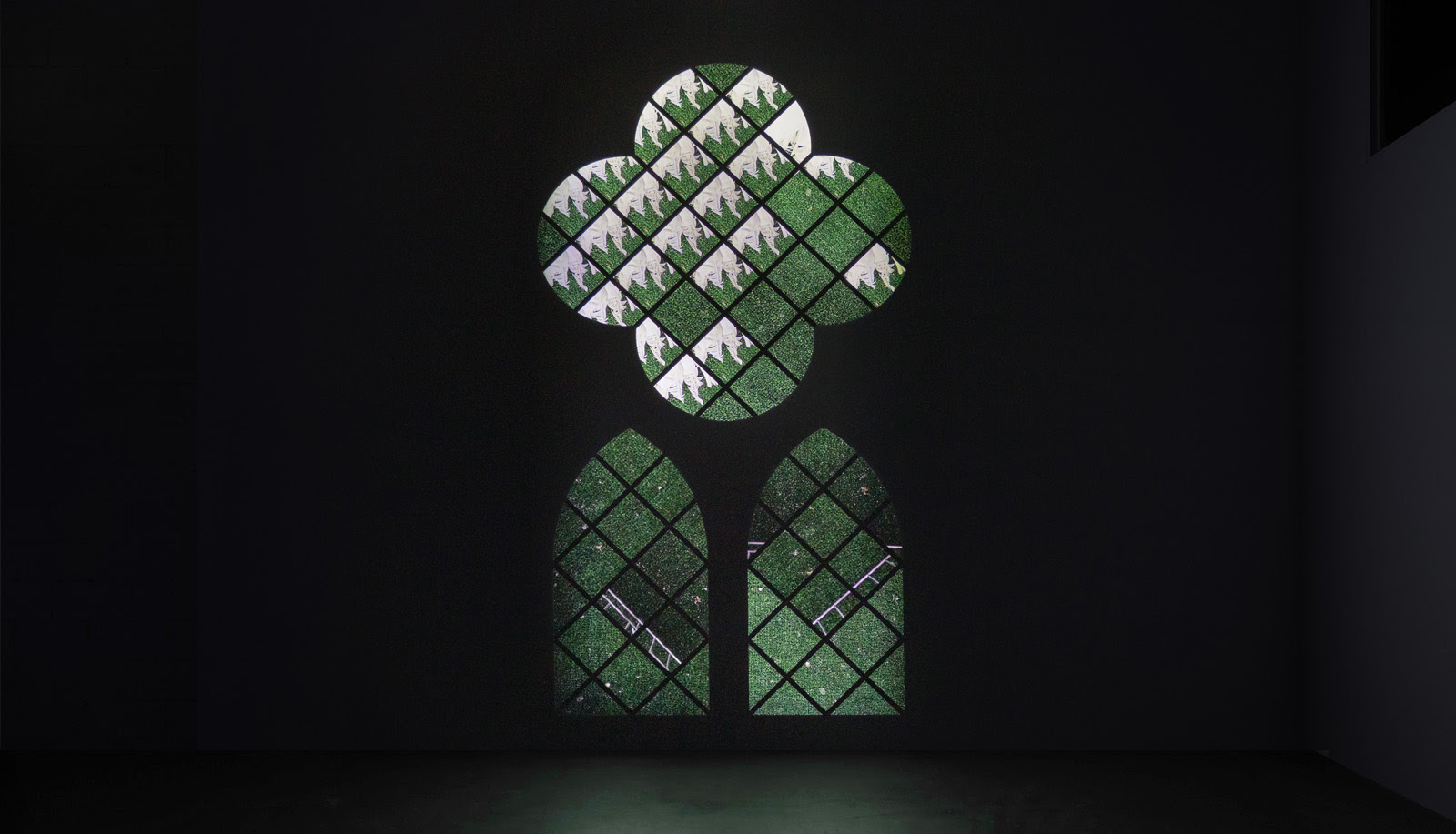
Act of God (1), a two-channel video by Fin Simonetti, is on view at Matthew Brown New York Wednesday May 6 through Friday May 8 with a closing reception Friday, May 8 from 6-8pm. Act of God (1) by Fin Simonetti explores devotion, cruelty, and hierarchies of consciousness in an immersive two channel video installation. One channel depicts a monumental stained-glass cathedral window, the other simulates light filtering through it, slowly migrating across the room to suggest the passage of the sun. Within the panes of glass is footage the artist filmed at exotic pigeon shows across the US. In Act of God (1), we see men’s hands handling birds in gestures that oscillate between tenderness and barbarism. In the varied ways the men touch the pigeons, they enact both anthropomorphizing and objectifying gestures. Viewed simultaneously, these two lenses negate each other while pointing to the absence at the centre: the actual animal. While pigeons are usually assigned low status, in the exotic pigeon community they are fetishized, selectively bred for extreme genetic mutations. Sculpted over centuries, their bodies have become increasingly abstracted, beautified for the human eye. Through editing and collage, Simonetti continues this process of distortion/beautification, producing imagery that is increasingly unrecognizable from its source. In some scenes, kaleidoscopic wheels of feathers mirror biblical descriptions of angels. While the format of the cathedral window connects this piece to the artist’s work in stained glass, it also serves as an entry point into thinking about sentience hierarchies. If animals are below, God is above. Simonetti invokes our relationship to God as a context in which humans don’t position themselves at the apex of consciousness. Spaces of worship are designed to induce awe, producing a visceral sensation of our scale within a hierarchy. The title suggests both a sublime force beyond our control and humanity’s impulse to dominate nature (such as “playing God” by breeding flight out of a bird). Fin Simonetti (b. 1985, Vancouver) is a Canadian artist and musician based in New York. Simonetti received her BFA from the Ontario College of Art and Design in 2009. Solo exhibitions include Albion Jeune, London (forthcoming); Canada Goose, Cooper Cole, Toronto (2026), Hardening, Matthew Brown, Los Angeles (2023); Our Denomination, Cooper Cole, Toronto, Canada (2022); My Volition, Matthew Brown, Los Angeles (2021); Fin Simonetti: An Appeal to Heaven, alongside Louise Bourgeois and Chris Curreri, Esker Foundation, Calgary, Canada (2021); Head Gusset, Cooper Cole, Toronto (2019); Pledge, Company Gallery, New York (2019); Pastoral Emergency, SIGNAL, New York (2018); LIFEMORTS, Interstate Projects, New York (2017); and IS PATH WARM?, Good Weather, Little Rock, AK (2017). Group exhibitions include Prosthesis, Haynes Art Projects, Chicago (2023); Drawings by Sculptors, Helena Anrather, New York (2023); Second Best Scenario, Francesca Minini, Milan (2022); Summer Nights, curated by Kahil Irving, Canada, New York (2022); Summer Days, curated by Kahil Irving, Klaus von Nichtssagend, New York (2022); Concrete Spiritual, Morán Morán, Los Angeles (2022); Recent Sculpture, Matthew Brown, Los Angeles (2022); Realism of the Game, Tranzit, Bucharest, Romania (2021); Material Conditions, Matthew Brown, Los Angeles (2020); To dream a man, Clima, Milan (2020); Harvest, curated by Bob Linder, Slash Art, San Francisco (2020); Dog Days, Clearing, New York (2019); New Moon, Hotel Art Pavilion, New York (2019); Cerrajeria, Lock Up International, Mexico City (2018); Eye to Eye, Arsenal Contemporary, New York (2018); Altered, Company Gallery, New York (2018); At the End of the Game, Alyssa Davis Gallery, New York (2018); Pleasure Over Matter, The Space Company, San Francisco (2018); Fear Faire, Marinaro, New York (2018); The Belly & the Members, MX Gallery, New York (2018); Paperweights, Fisher Parrish, New York (2017); and Industry Woman, MoMA PS1, New York (2016), among others.
 PastSpite House
DD Herschlein
Mar 13 – Apr 26
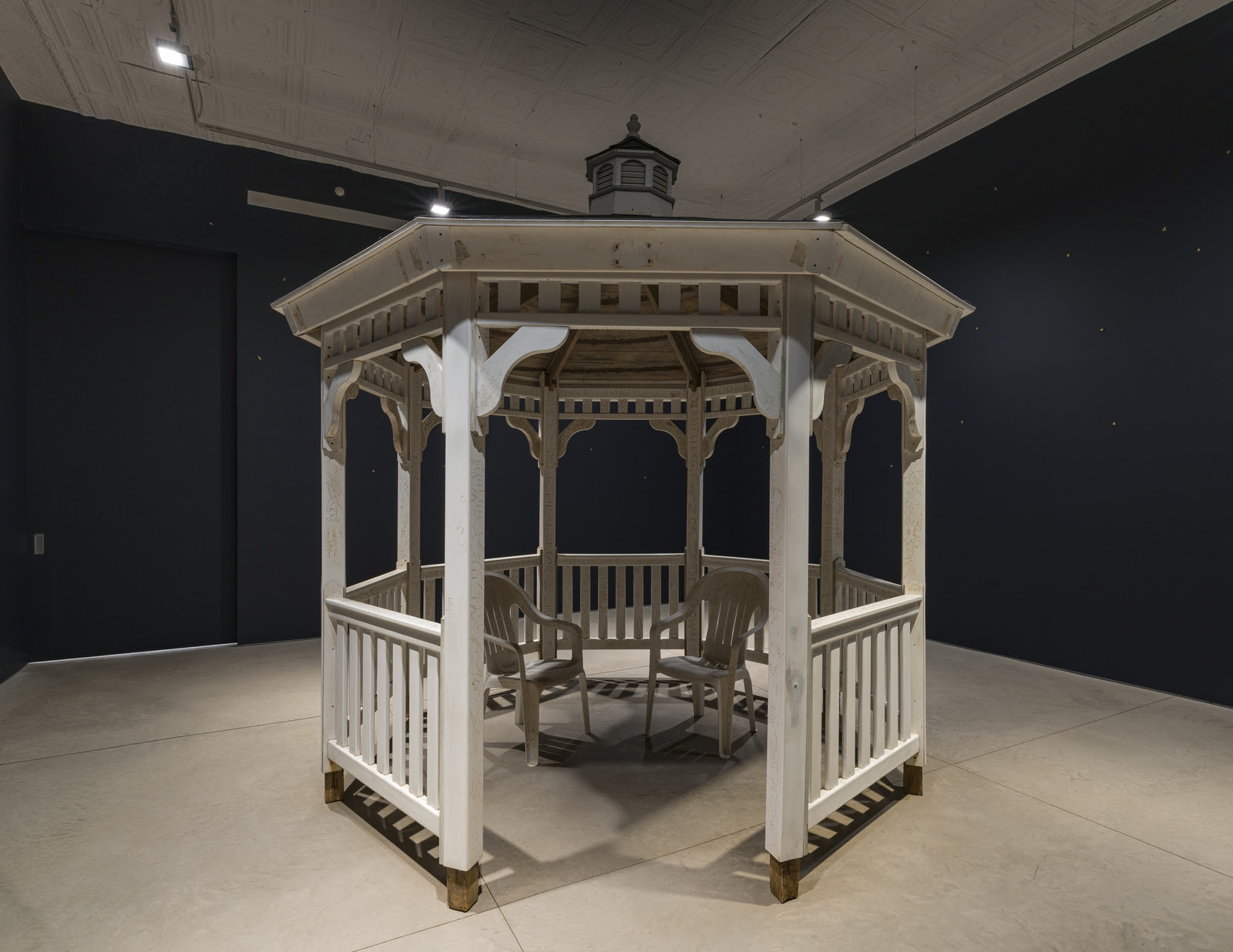
“A fire in tha master’s house is set"[1] —Rage Against the Machine At the center of DD Herschlein’s Spite House is a photograph: Burning the Universal Facade. Against a pictureseque, partly sunny sky sits a mansion. Its windows, licked by flames, have started to char. The building is, in reality, an incombustible set, a bygone stop on a Universal Studios tour. But in Herschlein’s hands, its image is a mirror and a manifesto. The artist asks us to consider spite—to reassess its reputation and recognize it as a righteous rebellion, a tool for seizing dignity. For the disempowered, spite can alchemize stagnation into energy. U.S. empire, bloated by bloodthirsty self-superiority, is a brute oppressor. To undermine its power, the subjugated must try and try again to assail the facade, to wear it down—much like this false home, reinforced against attack, is nonetheless battered by fire, again and again. These efforts may appear inconsequential; spite is a balm, nonetheless. Philosophers Patrick Forber and Rory Smead define spite as a “social behaviour that inflicts harm with no direct benefit to the actor and often at some cost.”[2] In this vein are the “spite houses” that pepper the country: structures erected to settle a score, with the intent to annoy rather than reside. From this tradition, DD Herschlein’s Spite House at Matthew Brown Gallery takes its name. The artist renders spite as structure—an apparatus to behold and to revere. Across Herschlein’s sculptures and paintings, suburbia operates as a bizarre zone where harm lurks around the bend. Here, they have constructed “framing devices”: a gazebo, a fence, a birdhouse. These apparatuses, typically demarcators of suburban tranquility and isolation, are presented as mechanisms to propagandize and reinforce ideas of “ownership, dominance, and manipulation” to “create the boundaries of the dominator culture,” the artist explains. Leading us into the exhibition are black-and-white drawings. They are urgent depictions of evacuation—frantic rabbits, their eyes beaming like headlights; cracking eggs being gathered in haste; cars bolting down roads. Inside, concealing some of the painted reliefs on view is Living Is Easy With Eyes Closed (Spite Fence), constructed from fencing salvaged and rearranged from their partner’s home in Altadena, after the community was devastated by the LA Fires of 2025. (This wood is utilized throughout the exhibition.) Two holes drilled in its facade tempt us to engage as voyeurs, to see the paintings behind the barrier, like nosy children peeking into the neighbor’s yard. Between the fence’s sharp points are miniature, sculpted homes—a society shrunk down to pocket-size and put on display. On the opposite side of the barricade is a painted silhouette: a tantalizing savior figure with arms outstretched, their hollow eyes where ours had just been. In our looking, we have been implicated. Their arms were outstretched not to comfort, but to control—a parallel of unseen, omnipresent state surveillance. The Apology also offers and entices: stacked hands gesture toward us, cupping a birdhouse perforated by two holes. Behind the fence are several paintings. Herschlein returns to a familiar motif from their oeuvre in The Collision, a painted relief in which a vehicle navigates a dark and mountainous road. In I Will Take You Apart, a torso stands in the middle of a concentric forest. Their soft, gloved hands palm nails and screws; we cannot see their face, hidden behind leaves. A dress hangs delicately from their frame, and light pools around their body. In I Have a Big and Beautiful Body, a moth is split open, a redwood carved into its innards. Like nesting dolls, the ecosystem of Herschlein’s artworks never seems to cease. Each layer lures us closer, and we are tempted to descend further and further into their rabbitholes, in search of continued surprise. A gazebo, Spite House, sits at the center of a gallery, peppered with scratchitti doodles bearing messages of dissent and cheeky observations. A fabricated, spiraling wasp’s nest clings to its ceiling. Intentionally degrading the site and our expectations, the artist questions the perceived pristine dominance of hegemonic infrastructure. Herschlein’s suburbia is one in decline. Above head, adhered to the darkly painted walls are bulbous, golden pins that appear like stars or lightning bugs. (They will be available for $50 each and mailed to the buyer at random—an introduction of a new, more egalitarian mode of engagement and accessibility in the gallery space.) These miniatures, the artist has dubbed “Morning Stars.” As we drink in this facsimile of a nighttime scene, a pair of scuffed plastic chairs offers respite, where we can sit and ruminate on the status quo that Herschlein critiques and dream up new ways to spite it. Knocked from its pedestal, we can pick at its bones. “Spite is for everyone to use, to punch up, to trend towards fairness and assert dignity,” says Herschlein. —Jasmine Weber DD Herschlein (b. 1989, Bayville, NY) lives and works in Los Angeles. They received their BFA from New York University in 2010. Solo exhibitions include Deadman, Kings Leap, New York (2024); The Long-Fingered Hand, Matthew Brown, Los Angeles (2023); Crickets in the City of Spare Parts, Matthew Brown, Los Angeles (2021); Dweller, JTT, New York (2020); Plot Hole, Matthew Brown, Los Angeles (2019); Night Pictures, JTT, New York (2019); The Architect, New Museum, New York (2018); Safe As Houses, JTT, New York (2017); The Stillness of Eddies, 56 Henry, New York (2016); Worm, AALA, Los Angeles (2016). Selected group exhibitions include Friends in Both Places, Nicelle Beauchene Gallery (2025); Progam, Matthew Brown, New York (2024); Manic Pixie Nightmare Drawings, Adler Beatty, New York, (2024); Flesh & Flowers: Made in America, No Name, Paris (2023); Made in LA 2023: Acts of Living, Hammer Museum, Los Angeles (2023); Papertrail, Matthew Brown, Los Angeles (2023); Evening Shadow, Make Room, Los Angeles (2023); River Styx, Sea View, Los Angeles (2023); The Tale Their Terror Tells, Lyle & King, New York (2022); Recent Sculpture, Matthew Brown, Los Angeles (2022); Theorem X, Rachel Uffner Gallery, New York (2021); I Want To Feel Alive Again, Lyles & King, New York (2020); It Seems So Long Ago, Matthew Brown, Los Angeles (2020); Ecce Puer, Pact, Paris (2020); Horology, Jack Hanley, New York (2019); A Detached Hand, Magenta Plains, New York (2019); Housewarming, Nicelle Beauchene, New York (2018); The Pain of Others, François Ghebaly, Los Angeles (2018); NVV_2018, Museum of Modern Art, Dubrovnik, Croatia (2018); Pine Barrens, Tanya Bonakdar Gallery, New York (2018); Dinner that night, Bureau, New York (2018); A Scream Runs Through the House, Helena Anrather, New York (2017); By The Shade That Wanders, Signal, New York (2015); The Lateness of the Hour, Evening Hours, New York (2015); and Me and Everyone that is With Me, Recess, New York (2012). Herschlein's work is included in the permanent collection of the Los Angeles County Museum of Art. 1 - Rage Against the Machine. "New Millenium Homes." Track 10 on The Battle of Los Angeles. Epic Records, 1999, CD. 2 - Forber, Patrick, and Rory Smead. “The Evolution of Fairness through Spite.” Proceedings of the Royal Society B: Biological Sciences 281, no. 1780 (April 7, 2014): 20132439.
 PastLost Object
Jan 23 – Mar 1
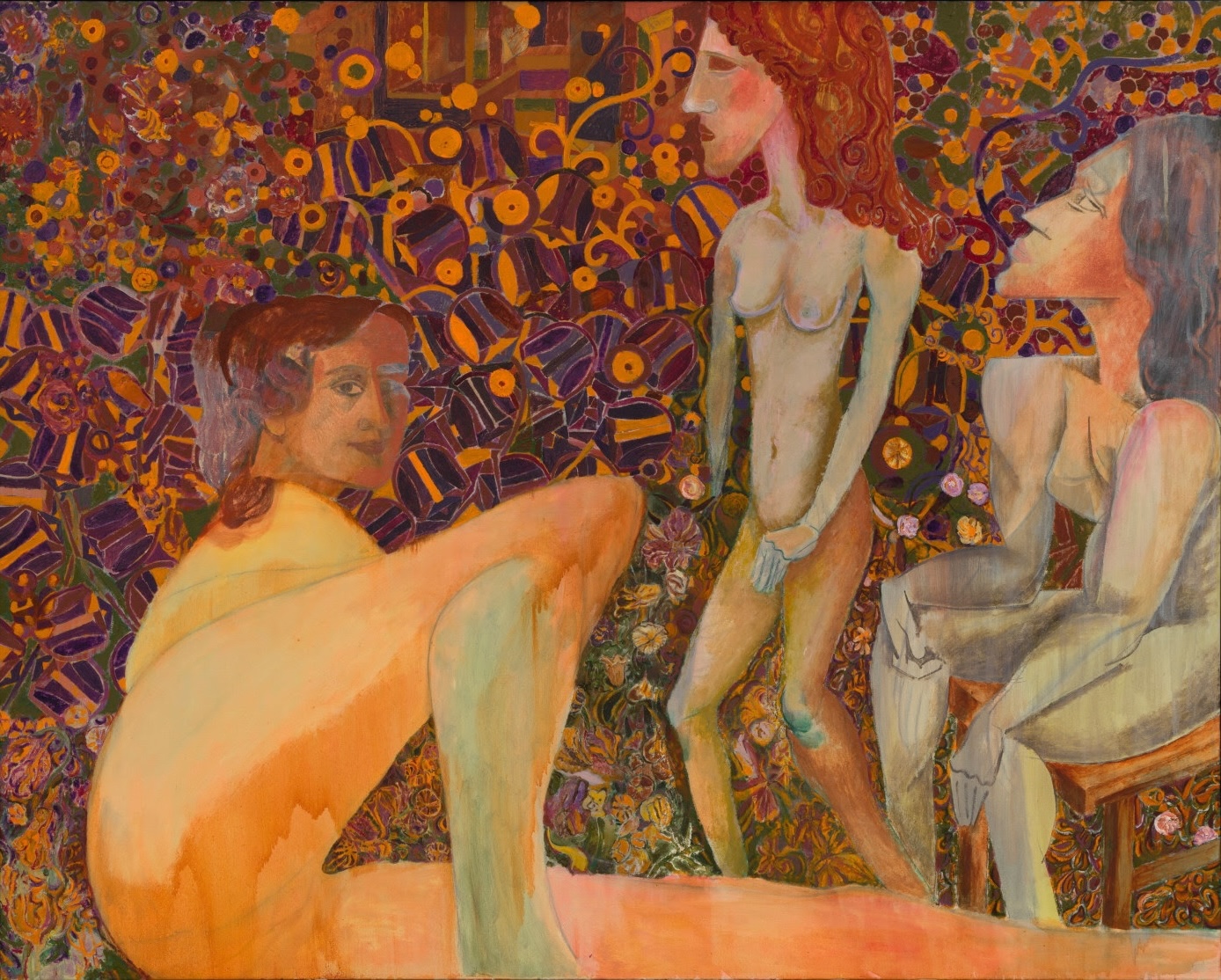
Jean-Marie Appriou, Uri Aran, Dike Blair, Sedrick Chisom, Nat Faulkner, Lenz Geerk, Beaux Mendes, Diane Severin Nguyen, Rose Salane, Tarwuk, Cathy Wilkes Matthew Brown is pleased to present Lost Object, a group exhibition. Lost Object examines how human longing is shaped by absence—by that which feels missing, even when it was never entirely possessed. Drawing on Freud’s notion of the “lost object,” the exhibition considers how absence structures desire, memory, and imagination, persisting not as something to be recovered, but as a generative force. In this framework, loss is not a conclusion but a condition through which perception, recollection, and yearning are formed. Throughout the exhibition, the lost object functions as a site of projection and melancholia. Culturally, it may surface as nostalgia; politically, as the sense that a shared meaning or collective identity has disintegrated. Formally, the lost object appears through artworks that resist resolution or certainty. Images held in suspension, marked by vulnerability, and forms that hover between recognition and ambiguity. Rather than offering closure, the works remain open-ended, allowing absence to remain active. Even when loss proves illusory, the drive to replace what is missing endures. Lost Object frames absence not as an end point, but as an inexorable force.
 PastYouth
Darren Bader
Nov 7 – Jan 11
Matthew Brown Gallery: I like to start with formal analysis. Can you share a description of the contents of the exhibition that you know of thus far? Darren Bader: Words and objects and images. A whole mess of them, some striving for cogency and limpidity, and others attempting to be somewhat fearless in the face of being too legible. MBG: Are any of the artworks part of existing series or have they been exhibited before in different contexts? DB: Many are extracted from previous bodies’ contexts and themes. Others are unapologetic (concomitantly embarrassing) continuations of existing series. Some are mutations that may fail to improve (or improve to fail!) on the original “species”. Others are attempts at meaningfully distinct novelty. MBG: Are there any connections between the works selected for the show? How do they fit together? DB: Habits, which must be something like metabolized attempts-at and demands-of rigor. In short the aforementioned word object image (in any order). Also the brutal human comedy. Also, what is this thing we (can) consider art? The answers (perhaps absent here) prove less apparent every day. MBG: How does this exhibition respond to the gallery space physically? DB: The two have to do what they need to do together. MBG: Will the exhibition change over time? DB: Due to the exigencies of parenting + requirement(s) of a day job, not as much as I’d hoped. But change will be change. MBG: I think of a lot of your work as these sentences or absurd proposals. Would any given artwork in the exhibition be one of those proposals, just manifested for a viewer experience? Or are these separate things? Am I even making sense? DB: It’s the tension between the verbal and the material and/or visual that’s at the crux of this work and so many others. MBG: This is really important! When you come up with proposals do you have a visual in mind of how it might be manifested? DB: Sometimes, but it’s usually far from the reality that presents itself when dealing with non-verbal materials. MBG: I use “proposals”, but is there another term you use for these types of works? I heard someone else say “sentences” which I thought was an oblique and funny and apt descriptor. DB: If that someone meant “sentences” in the legal sense it might be more appropriate than the grammatical sense. Sententious could be appropriate too. MBG: Anything else you can say about this tension between the verbal (words) and the material (visual)? DB: “It is what it is.” MBG: The title of the show is “Youth”. I like it. Do you want to share where that came from? DB: Both on and off record, I’d prefer not to. Darren Bader (b. 1978, Bridgeport, CT) lives and works in New York City. He participated in the 58th International Art Exhibition, Venice Biennale, Venice (2019); 13th Lyon Biennale (2015); and 2014 Whitney Biennial, Whitney Museum of American Art, New York (2014). Institutional solo and two-person exhibitions of his work have been presented at: By Art Matters, Huangzhou (2023); Whitney Museum of American Art, New York (2020); Museo Madre, Naples (2017-18); Kölnischer Kunstverein (2015); and MoMA PS1, New York (2012). Select solo gallery exhibitions have been held at: Sadie Coles HQ, London; Galleria Franco Noero, Turin; Andrew Kreps, New York; Blum & Poe, Los Angeles; Société, Berlin; Alex Zachary, New York, among others. In 2023, the artist attempted—and failed—to sell his art practice. Youth is his first solo exhibition since. Bader’s work is included in the collections of Whitney Museum of American Art, New York; Centre Pompidou, Paris; Dallas Museum of Art, Dallas; Walker Art Center, Minneapolis; Marciano Art Foundation, Los Angeles; Zabludowicz Collection, London; K11 Art Foundation, Hong Kong; Fondazione Prada, Milan; and Chicago Booth School of Business Art Collection, Chicago.
Past
Bastard RhymeOlivia van Kuiken
Sep 5 – Oct 19
Circular and unfolding movements repeat across these new canvases, as Olivia van Kuiken rails against stasis. Her investment in-and subsequent representation of-mobility is attached to Eadweard Muybridge's motion studies and Giacomo Balla's revelatory oil painting Dinamismo di un cane al guinzaglio ("Dynamism of a Dog on a Leash"), which was accomplished in 1912. The latter's focus on repetition and form is especially relevant, as it reflects the dynamic sensationism articulated by a group led by Umberto Boccioni (and including Balla) in the 1910 "Technical Manifesto of Futurist Painting." The collective proclaims, "on account of the persistency of an image upon the retina, moving objects constantly multiply themselves; their form changes like rapid vibrations, in their mad career. Thus a running horse has not four legs, but twenty, and their movements are triangular." In van Kuiken's Multiply, for instance, one can sense Futurist conceptions of momentum laid bare and reconfigured for the twenty-first century. According to van Kuiken, these aren't specific people with subjectivities (per Alice Neel or Lucian Freud), but truly emptied-out bodies. She draws from figure reference books, then totally wings it in terms of new structural configurations. The resulting forms are manipulated and foreshortened, subtly Frankensteined together through shuffling and collaging. Extremities are multiplied: four arms here, an extra leg there. One such example, titled Splayed legs, disrupts neat figuration accordingly while also subtly referring to Frank Stella's hard-edge painting. Futurism and Geometric Abstraction are just a few sources from which van Kuiken pulls energetic and formal qualities. Baroque emerges as another core muse underpinning the artist's latest body of work. Here, the movement characterized by drama and excess is reframed within a contemporary landscape. In the current epoch of hyperinformation and impossible narrative strings, there exists no universality nor a stable meaning-making apparatus. Van Kuiken also cites the nature of opacity as one that drives her own imaginal investments. She also expresses a confrontational attitude toward her pool of citations. By referring at once to the thing, and then engaging its opposite, one participates in the arena of dialectics, from which systems like language are born. A maelstrom of impressions thus collapses into the same sphere of investigation, leaving van Kuiken to navigate conflicting methods. When pathworked together, however, these networks bounce between each other, hurdling forward and gaining momentum. Previous references to Japanese landscape gave way to meditations on a positional relationship between viewer and free-standing painting. The resulting work is less imagistic and more experiential; Van Kuiken places a particular onus on the viewer-in-space, referring back to the tenets of minimalism and nonobjectivism. Further yet, eight paintings are staged upright, spreading out across the gallery floor. This situationalization communicates a felt presence beyond the image alone, offering architectural and bodily aspects simultaneously. On the reverse sides of these maximalist figures, one meets a suite of monochromes that comprise an alternative colorfield exhibition. The exhibition's title, "Bastard Rhyme," is related to a slant rhyme, which is built from similar but not exact sounds (for example: kind/time or tame/rain). This bolsters van Kuiken's appraisal of linguistic flexibility, speaking directly to the infighting and thwarting of expectations in terms of painterly signification. The phrase is also present in all caps on a particular composition, whose central figure dons the word "BASTARD" like a halo or crown around the head. At the painting's lower edge, "RHYME" is scrawled in the same font, though rendered in light pink. Shadows and glitches punctuate the scene, swarming the central head with dimensionality. In keeping with the rest of the works on view, van Kuiken effectively cites then distorts the conventions of formalism in a move against painterly logic. —Reilly Davidson Olivia van Kuiken (b. 1997 in Chicago, Illinois) is a New York based artist. She received a BFA, Studio Art, Cooper Union, New York. Solo Exhibitions include Losing looking leaving, Caprii, Dusseldorf (2024); Beil Lieb, Chateau Shatto, Los Angeles (2024); Make me Mulch!, Chapter NY, New York (2023); She clock, me clock, we clock, King's Leap, New York (2022). Select group exhibitions include What are you looking for?, curated by Brandy Carstens, Societe, Berlin (2025); the Lord will spit out the lukewarm, Bortolami Gallery, New York (2025); Meet me by the lake, Clearing, New York (2024); Mad Monk, Micki Meng, New York (2024); A Modern Disease, curated by Cooper Brovenick, New York (2024); Manic Pixie Nightmare Drawings, Adler Beatty, New York (2024); Anything can pass before the eyes of a person, Derosia, New York (2023); Inaugural Exhibition, Bodenrader, Chicago (2023); Works on Paper: 100 Years, Amanita, New York (2023); Supper Club, As it Stands, Los Angeles (2023); Oceans of Time, Chateau Shatto, Los Angeles (2022); Elective Affinities, Chapter NY, New York (2022); Bright lights, big city, no fun, Shoot the Lobster, New York (2022); La Saison Creuse, Hoffman Maler Wallenburg, Nice (2022).
Past
CompressionJun 24 – Aug 2
Uri Aran, Nat Faulkner, Kenji Ide, Mark Manders, Yu Nishimura, Julia Yerger, Huma Bhabha Uri Aran (b. 1977, Jerusalem) lives and works in New York. He received a Bachelor of Design from Bezalel Academy, Jerusalem in 2004, studied at Cooper Union and graduated with an MFA in Visual Arts from Columbia University, New York in 2007. Aran participated in the 2014 Whitney Biennial, Whitney Museum of American Art, New York (2014); A Needle Walks into a Haystack, Liverpool Biennial 2014, Liverpool (2014); and The Encyclopedic Palace, 55th International Art Exhibition, Venice Biennale, Venice (2013). Select solo exhibitions have been held at Matthew Brown, Los Angeles (2025); Sadie Coles HQ, London (2024, 2021, 2019, 2016); Andrew Kreps, New York (2023, 2021); The Douglas Hyde Gallery, Dublin (2023); The Club, Tokyo (2021); Gavin Brown’s enterprise, New York (2020); Kölnischer Kunstverein, Cologne (2016); Sant’Andrea de Scaphis, Rome (2015); Peep Hole, Milan (2014); Disjecta Contemporary Art Center, Portland, OR (2014); South London Gallery, London (2013); and Kunsthalle Zürich, Zurich (2013). Aran’s work is included in the public collections of the Los Angeles County Museum of Art, Los Angeles; Walker Art Center, Minneapolis; ICA Miami, Miami; Dallas Museum of Art, Dallas; Fundació Es Baluard Museu d’Art Modern i Contemporani de Palma, Palma de Mallorca, Spain; Israel Museum, Jerusalem; Kadist, Paris and San Francisco; American University, Washington DC; and RISD Museum, Providence, RI. Aran has a forthcoming solo exhibition at the Madre Museo d’arte contemporanea Donnaregina, Naples. Huma Bhabha (b. 1962, Karachi, Pakistan) lives and works in Poughkeepsie, New York. She moved from Karachi to the United States in 1981 to pursue her studies at the Rhode Island School of Design in 1985, and then Columbia University, where she completed her MFA in 1989. Bhabha currently has a solo exhibition at David Zwirner, Paris; and she is featured in Encounters: Giacometti with Alberto Giacometti at the Barbican Centre, London through May 2026. Select institutional exhibitions include Brooklyn Bridge Park, Public Art Fund (2024); M Leuven (2023); Baltic Centre for Contemporary Art, Gateshead, England (2020); Sydney Biennale (2020); ICA Boston (2019); The Metropolitan Museum of Art (2018); 56th Venice Biennale (2015); MoMA PS1 (2012); Whitney Biennial , New York (2010); and the Gwangju Biennial (2008). She has presented solo exhibitions with David Zwirner, Paris, New York (2025, 2024); David Kordansky Gallery, Los Angeles (2023, 2020); Xavier Hufkens, Brussels (2021); Salon 94, New York (2021, 2018, 2015, 2010, 2007); and Gagosian, Rome (2019); among others. Select public collections include Centre Georges Pompidou, Paris; Ekebergpark, Oslo; Hammer Museum, Los Angeles; Hirshhorn Museum and Sculpture Garden, Washington DC; Los Angeles County Museum of Art; The Metropolitan Museum of Art, New York; The Museum of Modern Art in New York; Museum of Fine Arts, Houston; Tate, London; and Whitney Museum of American Art, New York. Nat Faulkner (b. 1995, Chippenham, UK) lives and works in London. Recent exhibitions include Zero..., Milan (2025); Wschód, Warsaw (2025); Brunette Coleman, London (2024); Ginny on Frederick, London (2024); Final Hot Desert, London (2024); Roland Ross, Margate, UK (2024); and Mackintosh Lane, London (2023). He has an upcoming solo exhibition at Camden Art Centre, London. Kenji Ide (b. 1981, Yokosuka, Japan) lives and works in Tokyo. He received a master of fine arts from Tama Art University, Tokyo, Japan in 2006. Solo exhibitions include Matthew Brown, Los Angeles (2025); Art Basel Paris with Kayokoyuki (2024); organized by Wschód, Adam Mickiewicz Museum of Literature, Warsaw (2024); Adams and Ollman, Portland, OR (2024); Kayokoyuki, Tokyo (2023); curated by Matt Jay, Portland Japanese Garden, Portland, OR (2022); Goya Curtain, Tokyo (2021); Art Center Ongoing, Tokyo (2020); See Saw Gallery, Nagoya (2018); Art Center Ongoing, Tokyo (2018); Art Center Ongoing, Tokyo (2015); and Art Center Ongoing, Tokyo (2012). Mark Manders (b. 1968 Volkel, The Netherlands) currently lives and works in Ronse, Belgium. Manders represented the Netherlands at the Venice Biennale in 2013. Solo institutional exhibitions of his work have been presented at Fondazione Sandretto Re Rebaudengo, Turin (2024); Museum of Contemporary Art, Tokyo (2021); The Dallas Museum of Art, Dallas (2012); The Aspen Art Museum, Aspen (2011); The Walker Art Center, Minneapolis (2011); The Hammer Museum, Los Angeles (2010); Kunsthaus Zürich, Zürich (2009); S.M.A.K. Municipal Museum of Contemporary Art, Ghent (2008); The Art Institute of Chicago and The Renaissance Society, Chicago (2003); The Drawing Center, New York (2000); and more. Select solo exhibitions include Modern Art, London (2025); Xavier Hufkens, Brussels (2024); Gallery Koyanagi, Tokyo (2024, 2018, 2015); Tanya Bonakdar Gallery, New York and Los Angeles (2023, 2019, 2015, 2009, 2007); Zeno X, Antwerp (2022, 2016, 2012, 2010, 1997, 1994); among others. He was commissioned by the Public Art Fund to create a large public sculpture for the Doris C. Freedman Plaza in Central Park, New York in 2019. Other large-scale outdoor sculptural installations are on display at the Walker Art Center, Minneapolis and at the Rokin Square, Amsterdam. Public collections include The Art Institute of Chicago, Chicago; Carnegie Museum of Art, Pittsburgh; Kunsthaus Zürich, Zürich; Museum of Modern Art, New York; Museum of Contemporary Art, Los Angeles; Pinakothek der Moderne, Munich; San Francisco Museum of Modern Art, San Francisco; and the Walker Art Center, Minneapolis; among others. Yu Nishimura (b. 1982, Kangawa, Japan) lives and works in Kanagawa Prefecture. In 2004, he graduated from the Department of Fine Arts at Tama Art University, Tokyo. Solo and two-person exhibitions include David Zwirner, New York (2025); Castle, Los Angeles (2024); Sadie Coles HQ, London (2024); Arch, Athens (2024); Echigo-Tsumari Satoyama Museum of Contemporary Art (MonET), Niigata, Japan (2023); La Società delle Api, Monaco (2023); Crèvecœur, Paris (2022); Dawid Radziszewski Gallery, Warsaw (2021); King’s Leap, New York (2021); Crèvecœur, Paris (2020); KAYOKOYUKI, Tokyo (2020, 2017, 2016); 21st Century Museum of Contemporary Art, Kanazawa, Japan (2018); Tokyo Opera City Art Gallery (2015); Tokyo Wonder Site Hongo (2013); and Kiyosu City Haruhi Art Museum, Aichi, Japan (2010). Julia Yerger (b. 1993, Rockville, Maryland) lives and works in Los Angeles. She received a Bachelor of Fine Art from Maryland Institute College of Art, Baltimore. Select solo and two person exhibitions include Château Shatto, Los Angeles (2024); Kings Leap, New York (2024); Clearing, Brussels (2023); Paid, Seattle (2023); New Low, Los Angeles (2022); and Johannes Vogt, New York (2018). Select group exhibitions include Sebastian Gladstone, Los Angeles (2024); Bel Ami, Los Angeles (2023); The Wolford House, Los Angeles (2023); Paul Soto, Los Angeles (2023); Harawik, New York and Los Angeles(2021); and Apartment 13, Providence (2019).
Past
StationsNick Goss
May 6 – Jun 15
For his second exhibition at Matthew Brown and his first presentation in New York since 2016, British artist Nick Goss is showing Stations, a group of new paintings and works on paper inspired by a journey to the historical Belgian coastal resort of Ostend. "Little by little Ostend has become the unofficial rendezvous-location for the real and bogus aristocracy that one sees floatinglike a spume above the waves of capitals, everywhere encountering and recognizing itself, and for whom a home-town ismerely a station in transit from which they seek to reach the great international centers of pleasure." —Stefan Zweig, The Season in Ostend (1902) The idea of the journey, of stations and harbors encountered along the way and the crowds of people that passthrough them, has long been a fascination for artists. Goss travelled to Ostend by bus and ferry in the summer of 2024 to spend time in a place still marked by wartime trauma and the lingering traces of a once-glamorous, cosmopolitan age. He was drawn as much by its artistic past, and figures such as James Ensor and Léon Spilliaert who have informed the condition and vocabulary of his own painting. Goss made sketches while walking through its streets, past the beach, hotels, casinos, and the deserted racetrack, and inside some of the bars that line the seafront. While many of these places appear in the new paintings - from Sunday Morning in Leopold Park, Visitation and Hotel Pacific to Mariakerke Beach, whose composition is borrowed from a 19th century etching that Goss found at the Ensor house-museum - the works themselves are not documentary, but rather charged, psychological landscapes. Crowds of people are a recurring feature, surging masses with their own specific tidal rhythms that seem oftento dissolve into the architecture that should contain them. Faces and figures emerge from washes of color like visitors from a different time and place. Applied through silk screening, they were sourced from books and historical archives including the renowned collections of the Warburg Institute in London: a fragment of a medieval woodcut from a mid-15th century copy of the Book of Revelation; a statue of the goddess Aphrodite uncovered in Pompeii; a mask of a fox used in a French avant-garde theatre production of André Obey’s Noé, and so on. Bobbing up within the paintings like bits of collaged flotsam and jetsam, they float among motifs and subjects borrowed from the artist's own photographs and drawings in a layering of abstraction and figuration, of techniques and time registers, something that Aby Warburg himself referred to as ‘a subconscious memory of civilization’. In these new works Goss expands his visual language, pushing further into spatial ambiguity and vertiginous perspective, and using dye-like stains and silkscreen overlays to evoke both erosion and trace. He continues his ongoing interest in cultural sediment and the personal memories held within public space, and in doing so offers a profound meditation on how we remember, why we gather and what it means to feel, at once, connected and alone. Much like the city that he is depicting, whose famous sea wall is trapped in a perpetual cycle of rebuilding and crumbling, the paintings are themselves between states, in transit, hovering somewhere between solidity and disappearance. Nick Goss (b. 1981, Bristol) lives and works in London. He received his MA in Fine Art from the Royal Academy Schools in 2009 and his BA in Fine Art from the Slade School of Fine Art, University College London, in 2006. Solo exhibitions of Goss’s work have been held at Perrotin, Paris (2024); Ingleby, Edinburgh (2023); Matthew Brown, Los Angeles (2022); Thelma Hulbert Gallery, Honiton, UK (2022); Contemporary Fine Arts, Berlin (2021); Josh Lilley, London (2020); Pallant House Gallery, London (2019); Contemporary Fine Arts, Berlin (2018); Josh Lilley, London (2017); Simon Preston Gallery, New York (2016); Josh Lilley, London (2015). He has participated in group exhibitions at Ingleby, Edinburgh (2025); Matthew Brown, New York (2024); Contemporary Fine Arts, Basel (2024); Drawing Room, London (2024); Galleria Susanna Orlando, Pietrasanta, Italy (2023); de León Gallery, Bath, UK (2023); Grimm, Amsterdam (2023); Royal Academy of Arts, London (2023); Adams and Ollman, Portland (2021); Contemporary Fine Arts, Berlin (2020); Eccleston Project Space, London (2019); Josh Lilley, London (2019); Josh Lilley, London (2019); Berggruen Gallery, San Francisco (2017); Tannery Arts, London (2017); Lin & Lin Gallery, Taipei (2017); Josh Lilley, London (2017); Centre for Recent Drawing, London (2016); Palazzo Capris, Turin (2016); Josh Lilley, London (2016); Annet Gelink Gallery, Amsterdam (2016); 52 Whitbread Road, London (2016); Turps Gallery, London (2015). Goss’s work is included in the public collection of the Dallas Museum of Art, Dallas; The Metropolitan Museum of Art, New York; Museum of Contemporary Art Cleveland, Cleveland; the Pallant House Gallery; and the Zabludowicz Collection.
Past
Flame of VaporKent O'Connor
Mar 21 – Apr 27
Matthew Brown is pleased to present Flame of Vapor, a solo exhibition of new paintings by the Los Angeles-based artist Kent O'Connor. Kent O'Connor (b. 1987, Los Angeles) lives and works in Los Angeles. The artist earned his BFA from Maryland Institute of College of Art and his MFA from Yale University School of Art. Solo exhibitions include Everything All At Once, Mendes Wood DM, New York (2023); Close the Door Behind You, Matthew Brown, Los Angeles (2021); New Paintings, Diane Rosenstein, Los Angeles (2018); Flower Paintings, The Study, New Haven, CT (2017). Recent group exhibitions include Program, Matthew Brown, New York (2024); Arcadia and Elsewhere, James Cohan, New York (2024); Papertrail, Matthew Brown, Los Angeles (2023); Uncanny Interiors, Nicola Vassel, New York (2022); Art Basel Miami Beach, Josh Lilley, Miami (2022); Their Private Worlds Contained the Memory of a Painting that has Shapes as Reassuring as the Uncanny Footage of a Sonogram, curated by Sedrick Chisom, Matthew Brown, Los Angeles (2022); The Scenic Route, 1969 Gallery, New York (2021); It Seems So Long Ago, Matthew Brown, Los Angeles (2020); Open Air, Tong Art Advisory, East Hampton, NY (2020); Seven Year Itch, Diane Rosenstein, Los Angeles (2019); Way Out Now, Diane Rosenstein, Los Angeles (2018); Heads/Tails, Next to Nothing, New York (2018); and Oily Doily, BBQ LA, Los Angeles (2016). In 2017, O'Connor was awarded the Dumfries House Fellowship at the Royal Drawing School in Ayrshire, Scotland.
Past
Slow DefinitionJulie Beaufils
Feb 6 – Mar 16
Matthew Brown is pleased to present Slow Definition, a solo exhibition of new paintings by the Paris-based painter Julie Beaufils at the gallery's Tribeca location. This is the artist's second exhibition with the gallery and her first solo exhibition in New York. Julie Beaufils (b. 1987, Paris) lives and works in Paris. She studied at the Ecole Nationale Supérieure des Beaux-Arts in Paris and at University of Southern California's Roski School of Art in Los Angeles. Recent solo exhibitions include Inner Sources, presented by Matthew Brown and Balice Hertling, Unlimited at Art Basel, Basel, Switzerland (2024); Démo, Balice Hertling, Paris (2023); Diegesis, Matthew Brown, Los Angeles (2023); Art021, Shanghai, China (2020); La Plage, Balice Hertling, Paris (2018); True Myths, Mendes Wood DM, São Paulo, Brazil (2017); Cadors, Balice Hertling, Paris (2017); Le Meilleur des Mondes, La Kunsthalle, Mulhouse, France (2017); In Tongues, Overduin & Co., Los Angeles (2017). Recent group exhibitions include Thresholds, The Wolford House, Los Angeles (2024); Program, Matthew Brown, New York (2024); Studio of the South, Fondation Vincent van Gogh, Arles (2024); Inner Dims, Sifang Art Museum, Shanghai (curated by Julie Beaufils) (2022); Exposition 120, Balice Hertling, Paris (2022); En transit, All Stars x Signal L, Lausanne, Switzerland (2022); Palai, Palazzo Tamborino Cezzi, Lecce, Italy (2021); Amitiés (curated by Exo Exo), David Giroire, Paris (2019); Vol. 3: Nothing to hide (curated by Marie Madec), Sans Titre, Paris (2017); Your Memories are our Future (curated by Julien Fronsacq), Palais de Tokyo at ACRUSH, Zurich (2016). In 2020, Beaufils was the first artist-in-residence for Laura Owens's Studio of the South residency at LUMA Foundation in Arles, France.
Past
Misc. PippaPippa Garner
Nov 19 – Jan 26
“Artists are spectators with sticky fingers, messing around with creation and making some mistakes—and that’s how evolution occurs.” —Pippa Garner in conversation, October 2024 “I just want to make sure my body ends up where it belongs when I die: in the junkyard with the appliances I’ve made fun of throughout my career.” —Pippa Garner in conversation, October 2024 With Pippa Garner, things are always—at least—double. The present, for her, is a bridge between the past and the future. Humans are animals and machines. To gender hack is to re-engineer the male/female binary. Now, Stars and Matthew Brown have teamed up to present a double solo exhibition of the recently rediscovered, radical octogenarian artist’s work at their respective galleries in Los Angeles and New York. In Los Angeles at Stars, Misc. Pippa is intimate, tracing a genealogy from Garner’s first intentional work of art—Kar-mann, a half-human, half-car sculpture completed in 1969—to what many consider her ultimate artwork: her own body. In the mid-1980s, Garner began experimenting with hormones and surgery to alter her internal and external body just as she had once modified cars and appliances. By the early 1990s, the artist formerly known as Philip Garner—once a late night talk show regular and bestselling author celebrated for his satirical consumer inventions—had reinvented herself as Philippa Venus Garner, or Pippa for short. “I did it for art,” Garner wrote of her “sex-change” in 1995. “My body has gone from a temple to a Winnebago. I can identify with characters from mythology like centaurs and minotaurs. Duality becomes a daily convention […] Sex-change is a 20th century invention just as [sic] computers, electric can openers, polyester pants, 800 numbers and the rest of it.” She had taken her hero, Marcel Duchamp’s feminine alter-ego, Rrose Sélavy to the assembly line’s natural conclusion and become so multiple in the process, she had to invent a new honorific for herself. Not Mr. or Mrs., not Masc or Miss, but Misc. Misc. Pippa continues at Matthew Brown in New York where the selection of works on view reflects the artist’s hustle. The artist as inventor, as salesperson, as server. A countercultural figure obsessed with the mainstream, this Garner can’t stop making and making and making things. A radio bra. A chain grill. A Pubic’s Cube. A “trike” by Porsche and Harley-Davidson… Both shows consist of drawings, photographs, and sculptures, most of which were first conceived, if not produced, in the 1970s and 1980s. One notable exception is Garner’s 2021 sculpture The Bowels of the Mind on view in New York. Representing a brainstorm—where the artist’s ideas come from—Garner’s Bowels breathe, trapped in netting, much like her hand was once trapped in plastic and photographed against a wall of verdant leaves. There’s pleasure in the hustle, Garner seems to suggest, and it’s a trap. You need a third arm to wait tables. The TV has too many channels. Her “Life o’ the Party” lamp demands to be plugged in, forcing a party animal to become a wallflower. She’s made a chair from things that suck: vacuum cleaner hoses and toilet plungers. It’s a desk chair assembled from objects meant to discard human excrement. (Our production, our consumption, begets waste.) If Misc. Pippa in Los Angeles is a biography of sorts, or a personal ad—more feminine, sensual, and flirtatious—Misc. Pippa in New York is a business card; masculine, crass, and desperate. They are two sides of the same person, two sides of the same nation. Equally funny, equally sexy. —Fiona Alison Duncan, 2024 Garner would like to acknowledge Nick Rodrigues and Leah Dixon for their support with the fabrication. Misc. Pippa at Stars is presented in partnership with PST ART: Art & Science Collide. Pippa Garner (b. 1942, Evanston, Illinois) lives and works in Long Beach, CA. She studied Industrial and Product Design at the ArtCenter College of Design in 1970, and also took life drawing classes at the Cleveland Institute of Art. Select solo exhibitions include Act Like You Know Me, curated by Fiona Alison Duncan, White Columns, New York (2023); $ell Your $elf, Art Omi, curated by Sara O’Keeffe, Ghent, NY (2023); Immaculate Misconceptions, Verge Center for the Art, Sacramento (2022); The Bowels of the Mind, Jeffrey Stark, New York (2021); The Bowels of the Mind, STARS, Los Angeles (2021); A Shadow of My Future Self, curated by Scott Cameron Weaver, O-Town House, Los Angeles (2019); Autonomy N’ Stuff (Garnerrhea), Redling Fine Art, Los Angeles (2018); Tinker Tantrum, Redling Fine Art, Los Angeles (2017); and Vroom, Vroom!, Outlet, New York (2015). Select group exhibitions include Whitney Biennial 2024: Even Better Than the Real Thing, Whitney Museum of American Art, New York (2024); Post Human, Jeffrey Deitch, Los Angeles (2024) Post Scriptum. A museum forgotten by heart, curated by Luca Lo Pinto, Museum of Contemporary Art of Rome, Rome, Italy (2024); For Dear Life: Art, Medicine, and Disability, curated by Jill Dawsey and Isabel Caso, Museum of Contemporary Art San Diego, La Jolla (2024); Grow It, Show It!: A look at hair from Diane Arbus to TikTok, curated by Miriam Bettin and Thomas Seelig, Museum Folkwang, Essen, Germany (2024); No Prior Art: Illustrations of Invention, curated by Todd Lerew, Library Foundation Los Angeles and Los Angeles Public Library, Los Angeles (2024); Are You Joking?: Women & Humor, The Church, Sag Harbor, New York (2024); American Art Furniture: 1980-Present, Superhouse, New York (2024); Hollywood Dream Bubble: Ed Ruscha’s Influence in Los Angeles and Beyond, The Hole, Los Angeles (2024); 8th Yokohama Triennale, Wild Grass: Our Lives, curated by Liu Ding and Carol Yinghua Lu, Yokohama Museum of Art, Yokohama, Japan (2024); Made in L.A. 2023: Acts of Living, Hammer Museum, Los Angeles (2023); Public Structures, Kunsthal Charlottenborg Biennale, curated by Jeppe Ugelvig and Hans Ulrich Obrist, Kunsthal Charlottenborg, Copenhagen (2023); Origin Story, Gordon Robichaux, New York (2023); Works On Paper On Fridges, Harkawik, New York (2022); Comedy of Erros, organized by Fiona Alison Duncan, Stars, Los Angeles (2021), and Hello Again, curated by Susan Subtle, Oakland Museum, Oakland (1997).
Past
Garden of Infinite FoundationBlair Whiteford
Sep 13 – Oct 27
Matthew Brown is pleased to present Garden of Infinite Foundation, a solo exhibition of new paintings by Blair Whiteford. This marks Whiteford’s second solo exhibition with the gallery and his first major solo presentation in New York. His most diverse body of work to date, the 20 paintings span a vast range of scale and palette, fuse landscape, portraiture, and abstraction, and illustrate his ongoing engagement with the history of painting as a site of reflection and reinvention. Whiteford’s paintings begin with swaths of watercolor poured onto the canvas’s surface. This process—reminiscent of the New York Abstract Expressionists—creates a fluidity governed by gravity and the artist’s hand. Whiteford then builds layers of color using translucent glazes of oil paint in the tradition of Old Master painting. By marrying these methods drawn across time, the results are grounded in a technical discipline that balances improvisation and control. Thematically, the work navigates the complex territory between homage and innovation: through subtle allusions, Whiteford reinterprets the canon without being bound by it. Drawing inspiration from El Greco’s ethereal, mountainous landscapes, to Frankenthaler’s luminous and translucent fields of color, Whiteford creates a visual language of his own. In a monumental 13-foot canvas titled History of Transaction as it Relates to the Sea, reds, blues, browns, yellows and purples flow through densely poured layers of thinned-out paint and meticulous brushwork to merge figuration and landscape. While undulating gestures evoke a connection to agrarian growth—spanning earth, sea, and sky—the fluid composition imbues a primordial, elemental energy, echoing Whiteford's exploration of the links between physical and metaphysical concepts. Through the layering of art historical references and techniques, Whiteford places himself in conversation with modernity’s cyclical relationship to history: just as the modernists reacted to their historical moment, Whiteford responds to the current, embracing both tradition and innovation. His work offers a meditation on the ongoing evolution of painting, suggesting that modernity is not a fixed point in time but a continual process of reinterpretation, where the past is constantly resurfacing in the present. Blair Whiteford (b. 1990, New York) lives and works in New York. He received his MFA from Yale University in 2019 and BFA from Ringling College of Art and Design in 2013. Solo and two-person exhibitions include An Episode of Wind, Pond Society, Shanghai (2023); A Hand That Utters to the Foot of a God, Matthew Brown, Los Angeles (2022); Sowing a Seed in a Field Made of Ash, Jack Barrett, New York (2021); Flesh Beloved, Slipping Window, Union Pacific, London (2019); Hoodwinked, with Rory Rosenberg, Gern en Regalia, New York (2017); Leisure, with Blake Daniels, Fresh Exhibitions, Savannah, GA (2014); and The Nighttime Monument, So What Space, New York (2013). Recent group exhibitions include Program, Matthew Brown New York (2024); The Descendants, WOAW Gallery at K11 Musea, Hong Kong (2023); Made in the Dark, Clearing, New York (2023); Papertrail, Matthew Brown, Los Angeles (2023); One Hundred Eighty-Six Billion Steps To The Sun, Clearing, New York, NY (2022); Supermoon, Clearing, Beverly Hills, CA (2022); Complete Metamorphosis, Super Duchess Gallery, New York (2019); Fratirnete 188, Dwight st., New Haven, CT (2019); Again Always, Yale University, New Haven, CT (2019); You Can Get in and Not do Anything, Yale University, New Haven, CT (2018); Keeper of a Fever, No Place Gallery, Columbus, OH (2018); Group Show 1, Page Gallery, New York (2016); Flux Hustle, No Holds Barred, New York (2015); What We Saw Made Present, Crossley Gallery, Sarasota, FL (2013).
Past
ProgramJun 25 – Aug 10
Patricia Ayres, Uri Aran, Julie Beaufils, Sedrick Chisom, Kenturah Davis, Lila de Magalhaes, Omari Douglin, Alfonso Gonzalez Jr., Sasha Gordon, Nick Goss, Justin John Greene, Dan Herschlein, Andrew Kerr, Heidi Lau, Jack O'Brien, Kent O'Connor, Fin Simonetti, TARWUK, Hayley Tompkins, Vincent Valdez, Blair Whiteford Matthew Brown is delighted to present Program, a group exhibition celebrating the gallery’s recent expansion to New York. Featuring new sculpture, drawing, painting, and video from the twenty artists that comprise the gallery’s roster, the exhibition showcases the dynamic range of practices that make up the Matthew Brown program.
Past
Good Night, Ernst Toller!Tarwuk
Apr 29 – Jun 16
In war, markers of identity are often arbitrary, magnified into repeated divisions, doubling and fragmenting until individual identities dissolve. Having come of age during the dissolution of Yugoslavia, Bruno Pogacnik Tremow and Ivana Vukšic bore witness to such ethnic and national tensions–and the false distinctions and oppositions that ensued, resulting in devastating societal collapse. As Tarwuk, they reevaluate loss of selfhood as a potentially creative act rather than one of pure destruction. This is primarily enacted by their refusal to identify as a collaboration or duo, instead characterizing themselves as a “condition”, a state that surpasses any notion of two individuals brought together. This condition is circumstantial, but very much alive and dependent upon their artistic output–although their artwork only exists through the exploration of this same condition. Approaching theater as a means of social and self reorganization, Tarwuk considers ways of displacing and reconstructing the ego through the ascribed roles of actor and spectator. Within the space of a stage, physical or conceptual, decay becomes rebirth and fracturing of the psyche emerges as expansive potential. In Tarwuk’s theater, the threshold between the experienced and the enacted moves ever closer. Their sculptures forge this fragile terrain, emerging as progressive ruin and surrealist dystopia. A towering, imposing figure, appears like a hollowed totem: a shell emptied of personal legacy or a tribute to a lineage unrealized. Two small, costume-clad surrogates (stand-ins for Tarwuk, not Pogacnik Tremow and Vukšic themselves), allude to the performances conducted within the privacy of their own studio. Ritualistic, improvised explorations of self-abandonment, these happenings are nonetheless the manifestation of pure Gesamtkunstwerk; the costumes, sets, and makeup are meticulously crafted and planned. Aside from photographic self-documentation, these performances are not recorded or attended, occurring only in the immediate and only involving Tarwuk. Instead, the aftermath of these performances enters the public space as replicas and residue. Here one is recreated in miniature, like stop animation, in a diorama-like display. Displaced from the initial action, it reads less like a model and more as an artifact of a self already shed, now visible in phantom form. A series of large-scale paintings, evoking Byzantine patterns and Art Nouveau sensibilities, suggests a narrative of the wider action unfolding. Yet this is an illusion, a projected desire supported by familiar tropes and figures, rather than a discernible storyline. Languid figures and motifs of the natural world recall Symbolist metaphors, but here the language, signified and signifier, remains cryptic. Denied a passive position of observer, our role as spectator collapses. We are not the actors, nor are Tarwuk, though the artworks come close to holding this role within the exhibition space. In this sense, all the artworks–not only those with a physical resemblance to Tarwuk, serve as surrogates, alternative embodiments of their otherwise immaterial condition. —Sabrina Tamar Tarwuk is the artistic collaboration of Ivana Vuksic (b. 1981, Dubrovnik, Croatia) and Bruno Pogacnik Tremow (b. 1981, Zagreb). Vuksic received her MA from Faculty of Political Sciences, Zagreb and Bruno received dual MFAs from Columbia University and Academy of Fine Arts, Zagreb. Solo and two person exhibitions include Conceived for the Stage, White Cube, Paris (2023); Бољи живоt, Halle für Kunst Steiermark, Graz, Austria (2023); Posadila sam kost u zimskom vrtu, White Cube, London (2023); Ante mare et terras, Maramotti Collection, Emilia Romagna, Italy (2021); A Musical Score at the End of the World, Matthew Brown, Los Angeles, (2021); Bijeg u Noć, Martos Gallery, New York (2020); Pčele su prije bole češće. Nije li tako?Molim?,15 Orient, New York (2020); Vernacular River Holds 6 Bodies Down, Lauba, Zagreb (2020); Second Celebration of the Five, Evening Hours, New York (2019); Lent, Taito Ryokan, Tokyo (2019); Tarwuk with Gee Vaucher, Gauntlet, New York (2018); ’…Ti živiš već hiljadu godina.’ Team Gallery, New York (2018); Tužni Rudar,15 Orient, New York (2018); Host 2, Jaakko Pallasvuo and Anni Puolakka, GMK Gallery, Zagreb (2018); 0621_141332 (2), Museum of Fine Art, Osijek, Croatia (2017); Host, Jaakko Pallasvuo and Anni Puolakka, Showroom Mama, Rotterdam (2017); Tout est pret. Au premier signal que vous nous enverrez de Trieste, tous se leveront en masse pour l'independence de la Hongrie. Xrzah., Ethnographical Museum of Istria, Pazin, Croatia (2017); help you, help me, Essex Flowers, New York (2017); The Tyranny of White Teeth, Hannah Bonaguoro and Ryan Foerster, Museum of Fine Arts, Split, Croatia (2017); The rash of tommy Borgia, Hannah Bonaguoro and Ryan Foerster, Lazareti 1-5, Dubrovnik, Croatia (2017); j_KOPSA_LUCIS.32, Practice, New York (2016); M491A192()INKAROH, Museum of Modern and Contemporary Art, Rijeka, Croatia (2016); 4D/Dominant Doorman Doorstep Document, Pony Project Gallery, Vienna (2015); No New Followers, Lauba, Zagreb (2015); and Family Totems, Pony Project Gallery, Berlin (2014). Select group exhibitions include Papertrail, Matthew Brown, Los Angeles (2023); Door to the Atmosphere, Frye Art Museum, Seattle, WA (2022); I’m Not Your Mother, PPOW Gallery, New York (2022); Dissolving Realms, Kasmin Gallery, New York (2022); Strange Attractors. The Anthology of Interplanetary Folk Art. Vol. 3: Lost In Space, Apalazzogallery, Brescia, Italy (2022); Recent Sculpture, Matthew Brown, Los Angeles (2022); Exploratory Drawings, Maximillian William, London (2022); Studio Visit. Thoughts and Practices Surrounding Ten Artist’s Studios, Collezione Maramotti, Reggio Emilia, Italy (2021); Anarchy of the Imagination, Kerry Schuss, New York (2021); and Nesvrstani, Lauba, Zagreb, Croatia Drava Art Biennale, MLU, Osijek, Croatia (2020).