Gratin
Chinatown, Downtown, NY
291 Grand St, 2nd Floor
Sign in to save this gallery, log a visit, or add a show to a shared list.

Exhibitions
- PastDespite the Teacher’s Threats, and the Jeers of Child Prodigies
Elise Nguyen Quoc
Apr 29 – Jun 1
At first glance, my works seem to fulfill all the qualities expected of what is commonly called a “beautiful drawing,” a kind of technical virtuosity that mobilizes a wide range of historical drawing practices. But that is not what this is. My gestures do not arise from knowledge shaped by art or by art history—one does not learn to draw what one cannot name. They are an extension of everyday gestures, of the task to be carried out, the continuation of an ordinary human activity. My practice is grounded in chance and the everyday, not in ideas: doing, wandering, cooking, cleaning, discarding... It is from these ordinary acts of life that my work emerges. No exalted genius here—I invent nothing. The traces I reproduce were produced without any intention. What I photograph are infra-lives, residues, traces of my own activity or that of others, human or nonhuman—minute fragments inhabiting the margins of major subjects, escaping ordinary vision. Everything that bears the mark of an activity and that, to me, has the potential to become an inscription. Because we cannot place words upon what we see that would grant it a credible meaning, I stake everything on a form of transmission that exists beyond constructed and ordered language. When I begin the work of reproduction, I remain as close as possible to my image. I commit myself to treating each small fragment with the same degree of attention, without seeking to interpret the object of my fascination. The image organizes itself without hierarchy, in a space where each element can act without being assigned a dominant or subordinate position. To be with ‘the other’, is to work with and through the heterogeneity that differentiates ‘us’ from ‘them’. It means resisting the temptation to turn them into an object, to assign meaning, to interpret them. It means refusing domination and control, accepting the loss of power over the other. Paradoxically, to encounter ‘the other’, one must withdraw. It is in this place, where the fundamental withdrawal of our own desires truly allows an encounter with alterity. Maintaining this posture of the copyist requires adherence to a precise protocol, an ethics of making to which I submit myself. It is within this submission to the protocol that my work unsettles certain powerful equivalences inherited from modernity, where precision is equated with mastery, mastery with knowledge, and knowledge with learning. I am not there. My operations are mechanical, perceptual, and motor. Every technical gesture is a response to a question posed by the material; it is never just about its execution. If a relation of debt is established between the photograph and its reproduction (for which I am accountable — in the name of justice), it does not speak to what my work is about. Rather, the fidelity in my work is directed towards the reality that escapes me because it is caught in time, towards the conditions of the visible, rather than towards what I believe I know of it. From these images––now dead, almost divine––I come to restore their materiality by granting them the time they require. My works testify to the gap between living reality and its frozen image, where I surrender myself to my perceptual tools, to that sensitive and archaic instrument that is the body. Time in my practice is neither a means of producing value nor of improving the image. Time is the very condition of the work’s appearance, and is intrinsic to its existence. To transcribe an image is to change its mode of existence. It is to render perceptible the experience of making, where time is no longer capital but becomes the sign of a lived duration, of a persistence that has taken place and continues to act within the image, allowing the image not to erase the gesture that produced it. It is in this relationship to time and reproduction that a form of perception is replayed at the very bone of what we are. To track, to scent, to follow a footprint or flattened grass, belongs to a fundamental mode of attention in the formation of human gestures. The body anticipates, translates, and adapts; these operational chains, born from the demands of survival, persist in the way we enter into relation with the world. To reproduce a trace is to prolong this gesture, not by interpreting a sign, but by taking up a trajectory again, by inscribing one’s own body into the continuity of a previous movement, of what remains of it. And perhaps then, in turn, to make a sign—to become figuration itself. —Elise Nguyen Quoc
 PastFoc Foc
Brice Guilbert
Mar 20 – Apr 26
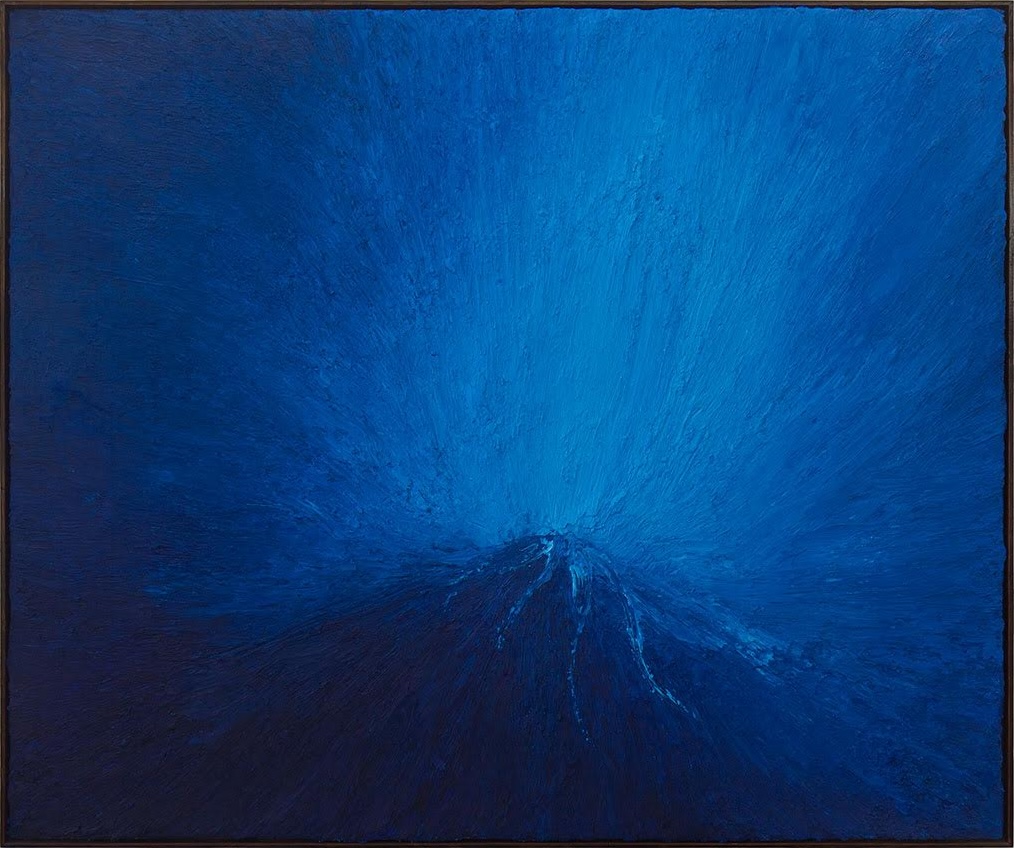
In Malcolm Lowry’s Under the Volcano, perhaps the greatest tale in the Brits-South-of-the-Border canon, our Mexico-based hero Geoffrey Firmin, the Consul, skulks in mezcalerias reading about the Nazis taking the Sudetenland, dealing with the booze-soaked dissolution of his marriage. Rarely mentioned, existing out of frame, are the titular craters: Popocatépetl and Iztaccíhuatl, one active and one dormant, a constant reminder that a mountain can explode at any moment. In Foc Foc, Brice Guilbert’s first solo show in New York, the subject is the volcano, in a quite visceral way. For the last decade, Guilbert has developed an ingenious conceptual practice, one that uses repetitions like Andy Warhol did with Shadows, the 102-panel investigation into the shape that shade takes when light moves. Guilbert grew up on Reunion Island, a French territory east of Madagascar, watching as the extremely active Piton de la Fournaise loomed in the background. In 2016, while working in Belgium, he started to daydream about the fire-geyser. It haunted him. It was a presence, or as he put it, “more of a mystical thing—this feeling that you’re near something”. Armed with self-cooked oilsticks, Guilbert started bringing the volcano to canvas, intent on channeling the lava of his childhood while living in the low countries. One show was all volcanoes, and then the next was, too. Soon it was all he painted. It was a religion. There was variation: Big volcanoes, small volcanoes, surreal volcanoes. They started off great—are you going to tell me you don’t like awesome paintings of a volcano exploding?—and as the years passed they transcended the subject, grew richer in texture via obsessive layering. These new ones, especially, quiver with the unholy—the sight of red-hot subterranean innards spewing out into the real world, violently, all at once, without warning. And then you go to the next painting and it happens again. For this brawny, ambitious, and sneakily brilliant new show at Gratin, Guilbert wanted to fixate on a specific vantage point, a real one, a spot where you can see the Piton de la Fournaise in full, a secret place to watch an ancient act of molten rock flying in the air. It’s where the name comes from. “Foc Foc” is a perch not found on a map, a highland plateau accessible only from difficult-to-traverse pathways, a platform to really see the volcano. That’s not to say these are painted from life. It's rare to see a full-blown eruption—in a fit of coincidence, as the show was set to open, the Piton de la Fournaise blew up big enough to reach the Indian Ocean for the first time in nearly two decades. Guilbert told me he’s never seen it erupt. He was always away when the big one hit. That doesn't matter. Malcolm Lowry never saw Popocatépetl burst. We still have the book he wrote. It’s a classic. —Nate Freeman
 PastTime Spent Looking
Max Jahn
Jan 29 – Mar 8
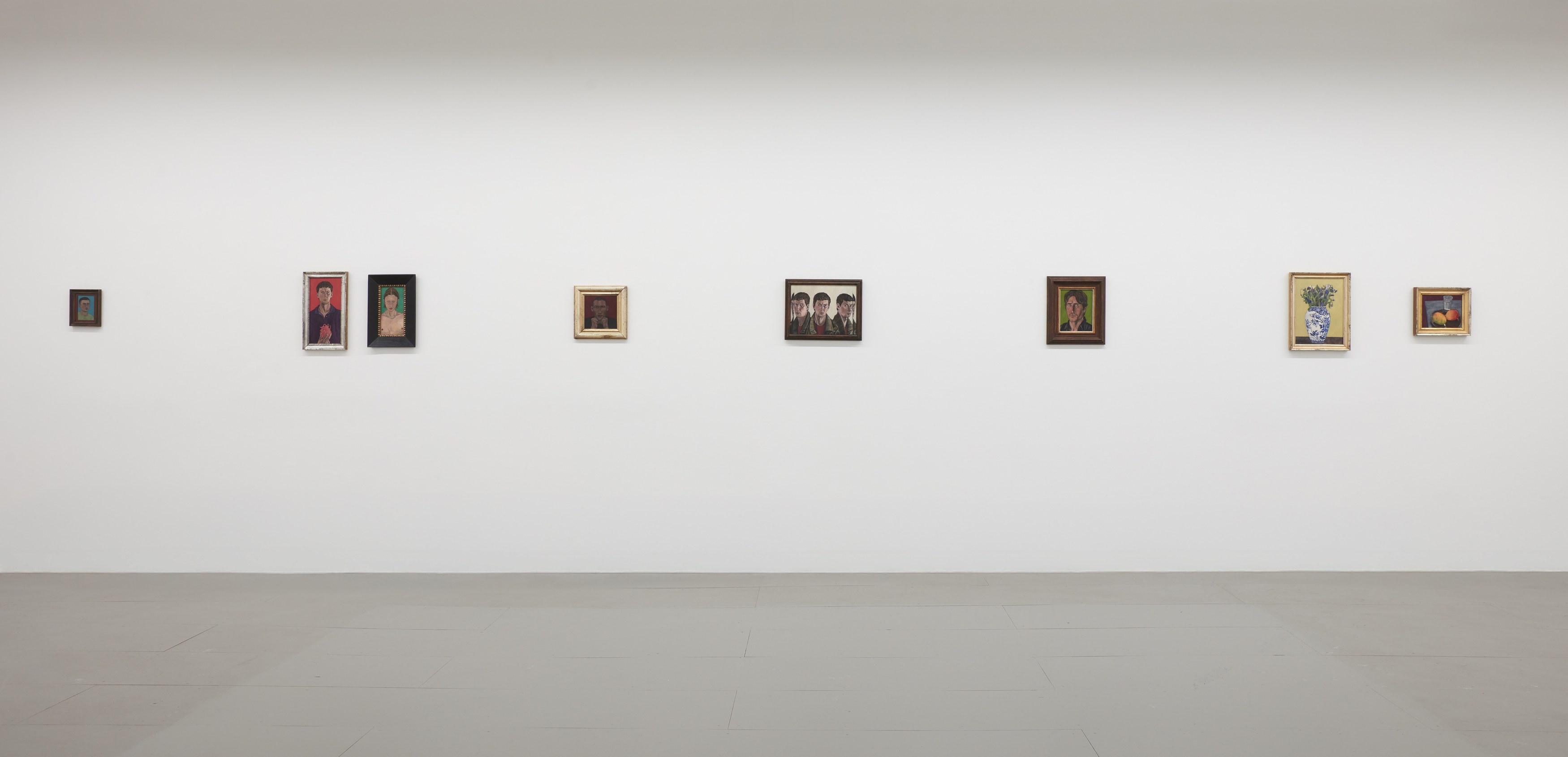
Gratin is pleased to present Time Spent Looking, Max Jahn's first solo exhibition in New York. Jahn’s paintings depict people from his close circle, shaped by familiarity, time, and repeated encounters. Knowing his subjects—spending time with them—is integral to the work itself, with each painting formed through prolonged observation, a product of “time spent looking.” His use of copper as a medium reinforces the historical weight of portraiture, giving the works a dense, concentrated surface that also carries traces of earlier contexts and histories. Jahn chooses each frame from his father's antique shop, treating them as an active element of the work, evoking domestic spaces, personal histories, and a tangible relationship to the past, the “still-life”. Max Jahn (b. 1998, Berlin) is a self-taught painter working primarily on a small scale, creating portraits and still lifes marked by a quiet, concentrated intensity. Growing up in Berlin and spending time in his father’s antique store shaped his sensitivity to objects, materials, and the presence they hold. He paints directly from life, allowing close observation to determine the rhythm and structure of each work. They have the sincerity of a love song and the spirit of punk.
 PastTouchdown by Venus
Iiu Susiraja
Dec 11 – Jan 26
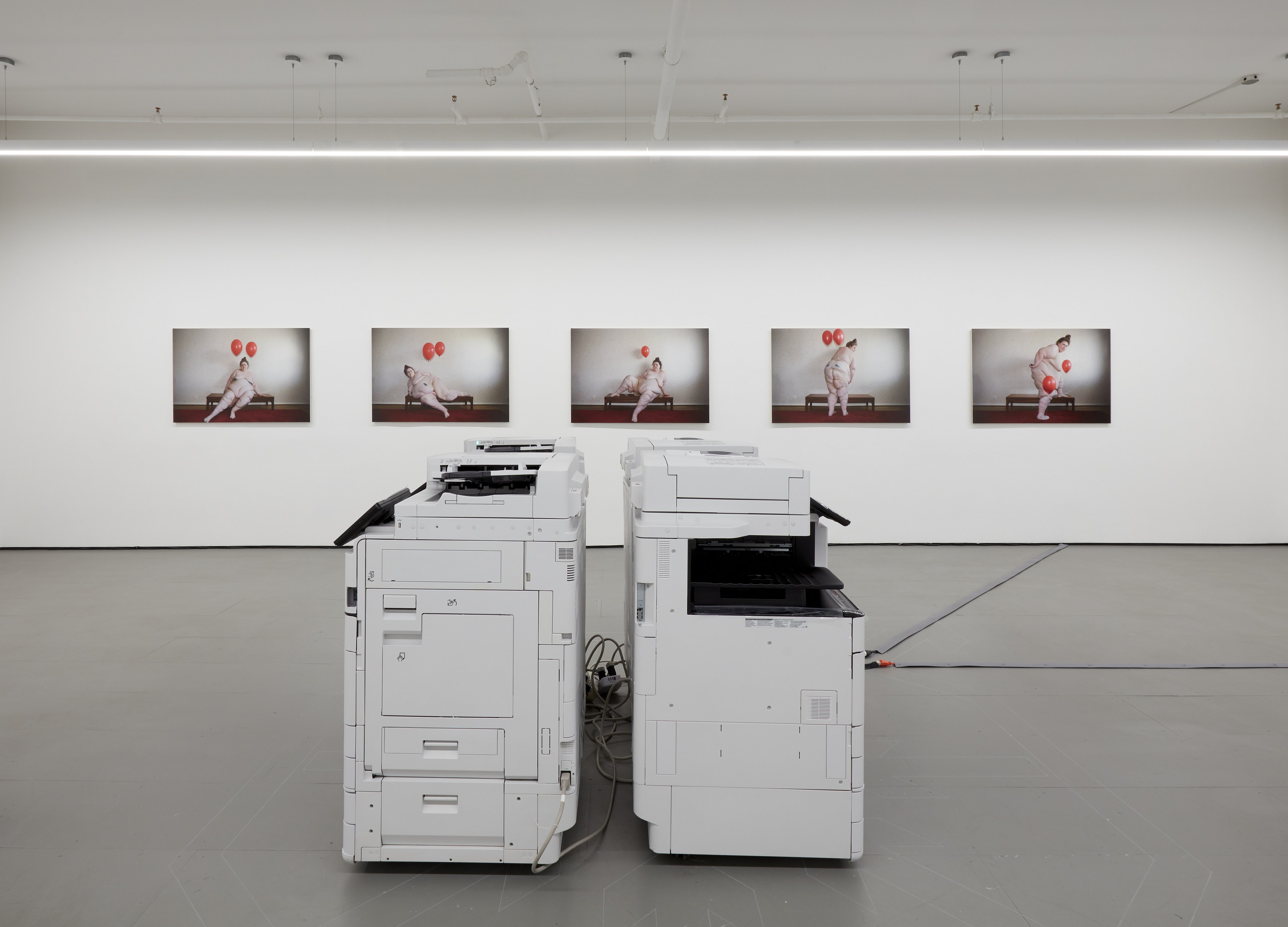
Gratin is pleased to present Touchdown by Venus, a solo exhibition by Iiu Susiraja. Since 2007, Iiu has created more than a thousand self-portraits. Staging herself alone in front of a camera—whether still or moving—Susiraja’s images are almost always situated in domestic interiors and most often depict her full body rather than a cropped headshot. She deploys prosaic objects as props—food, toys, furniture, balloons, tape, pantyhose, lingerie—using them to activate her remarkable body. Each image compels the viewer to scrutinize that body: its departure from canonical female “norms,” its folds of skin, its massive presence in relation to the modest scale of the middle-class, homey interiors in which these mise-en-scènes unfold. At first glance, the soft corporeal transgressions in these images disarm through humor; ultimately, however, they release something much darker that lurks beneath the surface. “If a fat person behaves badly in an artistic context, then they are doubly misbehaving,” Susiraja explains. “Being fat is a transgression in itself… An obese person’s simple existence constitutes misbehaving.”
 Past
Past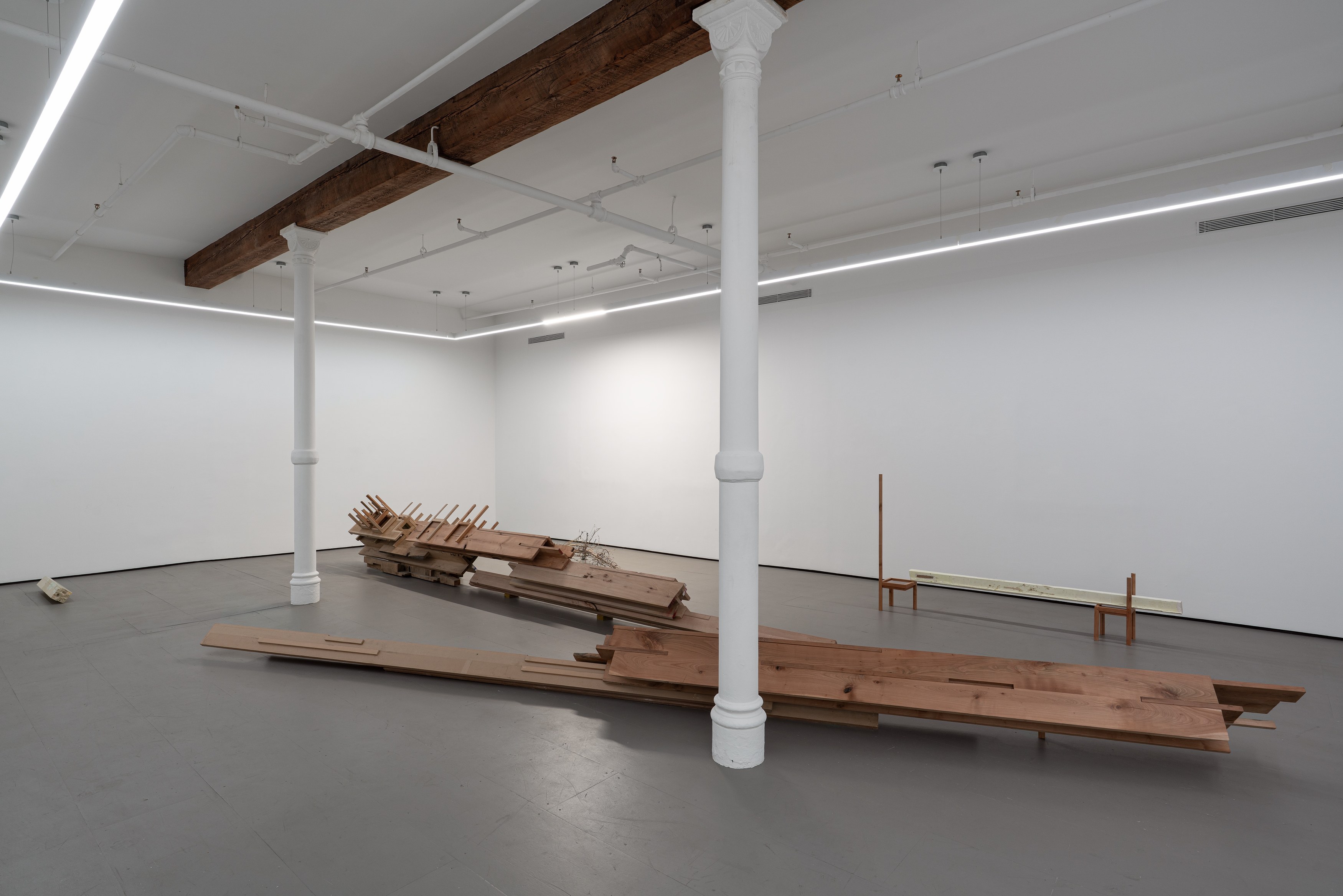 PastRiegel
Jan Hüskes
Oct 8 – Nov 2
Gratin is pleased to present Riegel, Jan Hüskes' first solo exhibition in the United States. On view is an installation composed of a sequence of units and fragments. An attempt to construct meaning that, through a balanced act of making and remaking, arranging and rearranging, seeks to capture an elusive moment, a suspicion. Jan Hüskes (b. 1991, Aachen, Germany) lives and works between Brussels and Düsseldorf. His practice encompasses sculpture, installation, etching, drawing, and photography. Hüskes studied at the Kunstakademie Düsseldorf and is a former participant of the residency program De Ateliers in Amsterdam. His work has been exhibited at Simo Bacar (Lisbon, PT), Flats (Brussels, BE), Lustwarande (Tilburg, NL), Hinterconti e.V. (Hamburg, DE), Marwan (Amsterdam, NL), De Ateliers (Amsterdam, NL), CAC Vilnius (LT), and De Appel (Amsterdam, NL), among others.
Past
Miss AmericaEd Bereal
Sep 3 – Oct 4
Gratin, in association with Elizabeth Leach Gallery and collaboration with Mitchell Algus, is pleased to present Miss America, the first solo exhibition of work by Ed Bereal in New York. Described as “The Most Important Activist-Artist You Don't Know” by Alex V. Cipolle on Hyperallergic, Bereal has engaged with a vast range of social, political and environmental issues across a career spanning seven decades. The works on view reflect formative experiences gained as an art student at Chouinard Art Institute in the 1950s and 60s, a young artist living and working in the greater Watts area during the 1965 riots, and a documentarian covering geopolitical shifts across the globe in the 1990s.
Past
Family AlbumGeorge Dureau
Jul 1 – Jul 31
George Dureau’s utter enchantment with the human figure is on full display in the sumptuous oil paintings and expressive charcoal drawings he regarded as the core of his artistic practice. This same fascination propelled the artist’s distinctive photographic portraits for which he has received even wider acclaim. This exhibition brings together Dureau’s output in what he considered the creative arts (painting and drawing) and the applied arts (photography), showcasing the convergences and divergences among his varying approaches to his favored subject: human form. A beloved fixture of the New Orleans art scene throughout much of the latter half of the twentieth century, Dureau created bombastic, operatic paintings he once described as “a bit gushy.” Though many such paintings depict epic, mythological scenes, Dureau also drew inspiration from the people and goings-on of his life in the French Quarter. The artist’s large-scale Dance For Six Street Dance at Comus Parade (1988/90) is somehow at once both raucous and subdued; it captures the bacchanalia of Carnival seemingly in slow motion, or as if seen through a languid humidity. In muted tones, the painting gathers a group of nude revelers rendered with pronounced muscular definition. In a nod to uninhibited Dionysian gaiety, one dancer is half human and half satyr; a single hoofed leg intermingles with those of the couple whose embrace anchors the composition. Flamelike swirls seem to lick at the party’s edges, imbuing the scene with additional flamboyance. In a concurrent practice, Dureau also produced a highly regarded body of work in black and white photography. His compelling portraits largely feature local men whose bodies took unconventional form due to congenital anomaly, genetic condition, or amputation. Many of the artist’s subjects had dwarfism, truncated limbs, or other evident physical disabilities, and were considered socially outcast. Dureau’s photographs unflinchingly confront the realities of non normative bodies, locating beauty in difference. Emphasizing the unique physical prowess of their subjects, images such as Craig Blanchette (1993) and B.J. Robinson (1979) showcase the remarkable upper body strength and adaptive ingenuity of those who must use their arms for mobility. Dureau considered his photographs, which featured sitters posed atop pedestals and shot squarely against spare backgrounds, to have a more clinical affect than his paintings, which exude sensuality and pulse with palpable atmosphere. However, the artist’s interpersonal connections with his subjects, most of whom were friends and some of whom were lovers, undeniably animates these portraits. As each sitter steadily holds the direct gaze of the camera, the mutual respect, regard, and affection between photographer and subject is apparent. Rather than presenting a detached formalist study of the anonymous human figure, Dureau’s portraits carry a recognition of the individual personhood and inherent dignity of each of his unique subjects. —Susan Thompson George Dureau showed his photographs in New York at Robert Samuel Gallery, 795 Broadway and 11th Street. The gallery existed for a mere four years, from 1978 to 1982. But with exhibitions curated by Sam Wagstaff focusing on photography, male erotica and the strange, the gallery was a pioneering enterprise: Robert Samuel was the first gallery to show the photography of Wagstaff’s partner, Robert Mapplethorpe, Peter Hujar, Duane Michals, Christopher Makos, Lynn Davis, and Charles Gatewood, as well as work by Charles Henri Ford, Agustín Fernández, Tom of Finland and Gerhardt Liebmann (whose paintings this gallery will exhibit in September). The extraordinary significance of Robert Samuel’s gallery’s programming is little known today. References to the gallery on the Internet are vanishingly few. There have been no exhibitions documenting the gallery, or collectively, the artists it exhibited and its revolutionary platform. Gratin along with the Mitchell Algus Gallery is working on an historical survey of the Robert Samuel Gallery for next year, the first exhibition of its kind. —Mitchell Algus
Past
The AgencyJohn Hodgkinson
May 3 – Jun 8
Gratin gallery is pleased to present John Hodgkinson's The Agency - the artist's first solo exhibition with the gallery. In October 2024, Hodgkinson began working as a background actor—often dressed as a Russian soldier—for The Agency, a TV series filmed for Paramount+. His experiences on set, particularly the repetitive journeys taken through the English countryside to shooting locations, inspired a new body of work. When traveling to shoot locations he began photographing fleeting landscapes from the window of a minibus. These blurred, rapid glimpses of trees, soil, and sky became the foundation of his paintings. At first glance, his works seem to belong to a romantic tradition of landscape art, but they often shift suddenly to capture the illusions of perception.
Past
Body CartographySeung Ah Paik
Mar 20 – Apr 27
Through her paintings, Seung Ah Paik defines a map of the body characterized by patterns and memory–recurring poses, gestures, and textures that surface unconsciously. Refusing to represent a mere image of the skin, Paik transforms her canvases into metaphorical skin–something deeply personal yet evocative of viewers' own bodies. As the canvases exist as extensions of the artist herself, Paik distorts the distance between artist and artwork, merging them into a singular entity characterized by intimacy and emotional closeness. Body Cartography represents skin and the human body as tangible, living records–each blemish, wrinkle, or callous signifying the passage of time. These topographical markers connect moments in time to physical sites of transformation, transfiguring skin into what Paik terms "emotional terrain." Paik is by no means new to the practice of morphing body and landscape, however. Her paintings serve as testament to the inextricable bond between nature and humanity, gradually eroding this barrier until her paintings become physical maps. With wrinkles as trajectories charting growth and defined lines suggestive of boundaries, the human form self-records its age while becoming a metaphor for external landscapes. Paik's paintings navigate both emotional and physical terrain, epitomizing "living records" that are textured with the substance of being. Through gentle explorations of the complexities of skin, Paik's paintings serve as living maps and personal archives. Charting a journey with her brushstrokes, she says "My background colors shift in response to my own internal landscape." Her artworks afford viewers the opportunity to map Paik's process and glimpse into her internal cartography. Paik seamlessly transforms that which is internal into external corporeal maps, meant to be followed and understood as one's own. She does exactly that by painting entangled limbs and sloping breasts from obscure perspectives, presenting the illusion of looking down on one's own body to establish a sense of familiarity. Paik reconstructs her body as a collection of objects observed from disjointed angles, complicating relationships between artist, viewer, and the created image.
Past
Mechanical WhisperJan 30 – Mar 3
Gabriele Adomaityte, Agustin Fernandez, Oshay Green, Lena Long, Elise Nguyen Quoc, WangShui Gratin is pleased to present the exhibition Mechanical Whisper.
Past
Butt Can You Feel It?John Kacere
Nov 21 – Dec 21
Gratin is excited to present the work of John Kacere (1920-1999), a key figure in the hyperrealist movement, renowned for his extraordinary precision in depicting women's midsections in lingerie. Using a meticulous oil-painting technique, he captured the details and textures of fabrics such as lace, silk and satin with such accuracy that their tactile quality goes beyond mere representation, further enhanced by the enlarged scale of his works. By layering paint to create smooth, luminous surfaces and emphasizing light, shadow and reflection, Kacere achieved a stunning photographic illusion that revealed the vast potential of oil painting.
Past
Omari’s Pop Up!Omari Douglin
Nov 8 – Nov 11
Gratin presents Omari’s Pop Up!, a merch drop in which the gallery in collaboration with artist Omari Douglin and designer Aristotle Skretas have made paintings ready to wear. The artist has admired the gallery's longstanding efforts to occasionally release their Gratin logo t-shirt in limited quantities to gallery goers, friends, and family. The design of the logo is just as good as any top designer and there’s something about t-shirts that is undeniably useful. It is friendly, universal and we see potential in it being a way for more people to access art. Several of Douglin’s works were selected to be put on t-shirts for this presentation. This isn’t the first time images of artworks have been put on clothing, but through choosing high quality materials and advanced printing processes, we aimed to elevate the clothing to the level of the artworks. We see the future of art expanding into clothing, everyday objects and functional products. Not everyone can afford to buy a painting, but making a painting into a shirt changes that. We like the idea that you can buy a shirt, wear it, travel, and the artwork stays with you being exposed to different people and places. Or you can keep it in the package, take it out, hang it on your wall or frame it as an Omari Douglin. That slippage is what we are interested in and people having something tangible that becomes part of their daily lived experience. It lives with you at home or goes with you out into the world. It’s your choice!