
Chelsea, New York
Tiffany Chung
Traces
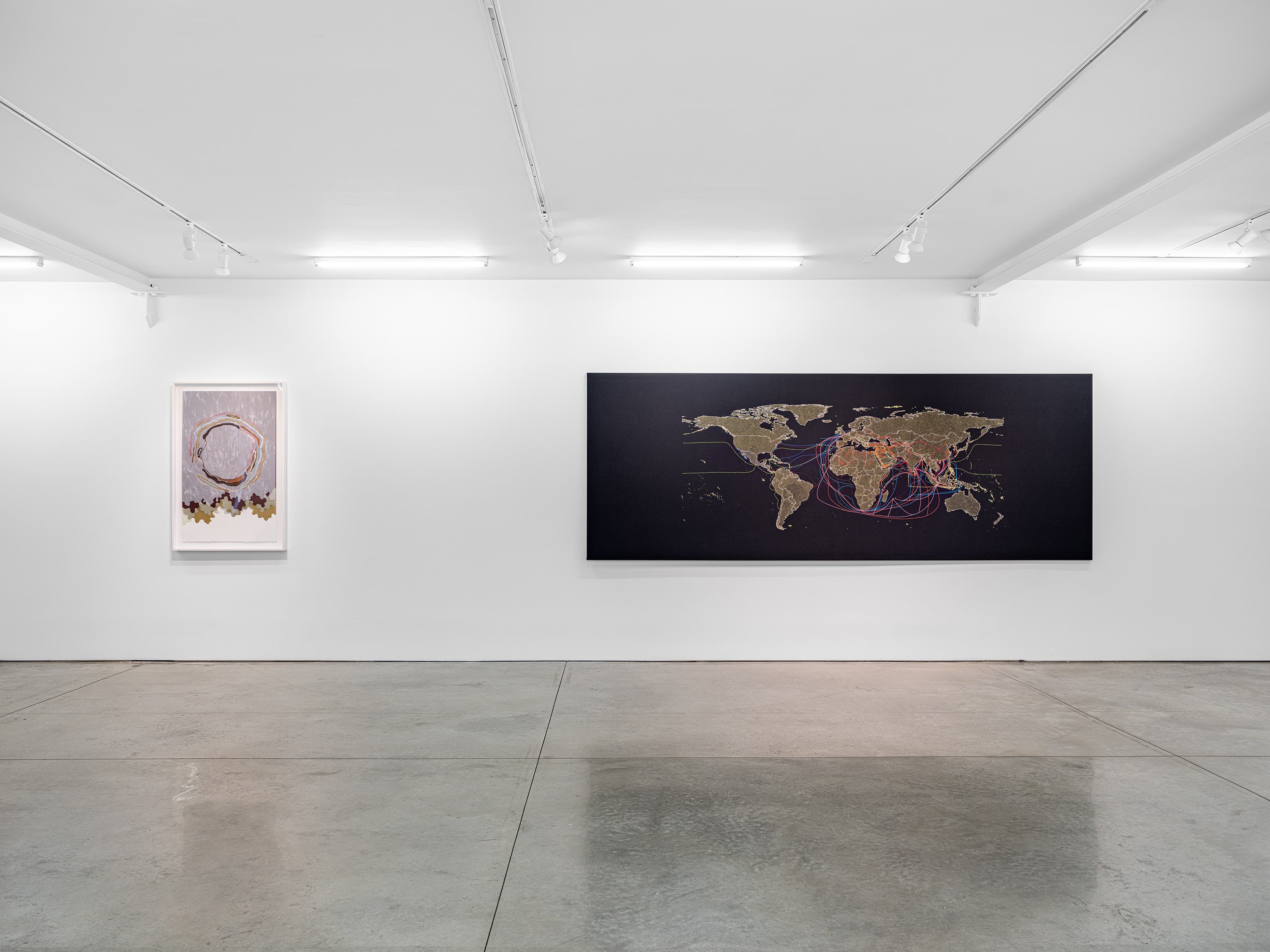
Ryan LeeRyan Lee Gallery is pleased to present traces, an exhibition of embroidery, installation, sculpture, video, and works on paper by Tiffany Chung. Chung’s recent projects explore earth’s deep times, Neolithic ditched and walled enclosures, and ancient global connections through the 3,500-year-old spice trade. Chung reorients the world through history, disentangling and reweaving the environmental, cultural, economic, and political threads that have created global narratives over millennia. Curator Orianna Cacchione has described Chung’s practice as an “insatiable search for knowledge itself.” Writing on Chung’s cartographic works, Cacchione explained, “The meticulously rendered infographics shuttle between legibility and illegibility, recognition and erasure, the poetic and the empirical, setting up a dialectical tension that is threaded throughout Chung’s works.” Chung’s conceptual framework is built upon two key pursuits. One is the multiplicity of his- tory, challenging accepted narratives by filling in the gaps left out of official accounts, to shift and reclaim the discourse. The other is the entanglements of social, political, economic, and environmental processes across times and terrains, entwined in landscape archaeology and historical ecology – the intricate relationship between humans, the built environment, and the natural world. In some of the work on view, Chung explores the movements of plants and spices through space and time, as they have been traded across the world from ancient times to today. In stud- ies of exotic botanical organisms and spices from the ends of the earth in quest of market dom- inance (2025), Chung pairs embroidered illustrations of spice plants with jars displaying the spices themselves. The embroidered map Global Spice Trade: routes from ancient time to the age of exploration/exploitation (2024-25) casts an overview of the early global economic integration. Proposing that globalization began long before the 1400s, the work charts ancient spice trade routes connecting Asia, Africa, Europe, and the Americas. Chung says, “The spices’ trajectories across time and space link commerce, maritime development, conflict, and colonialism, which led to modern capitalism. They tell stories about how globalization began – through trade, migration, linguistic movements, culinary and cultural adaptation – and how it is inevitably intertwined with wars.” Chung’s works on paper depict traces of Neolithic ditched and walled enclosures dating from 5000 BCE found across Central Europe and the Iberian Peninsula, as well as Vietnam and Cambodia (2300-300 BCE). While suggesting possible prehistoric global connections, Chung notes how these traces of our material culture also indicate the human-driven alterations of landscapes, flora, and fauna throughout history. Such traces take another physical form in Chung’s latest project, the world through my mother’s cabinets of curiosities (cabinet no.2) (2026), with whimsical miniature sculptures created from discarded objects and materials donated to her by family and friends. As Chung seeks to bring new meanings to old objects embedded with personal history, these sculptures depict and reflect on human experience of disasters and survival, our impact on the environment, and the rebound and taking over by nature in the aftermath.