
Chelsea, New York
Jeremy Frey
Permanence
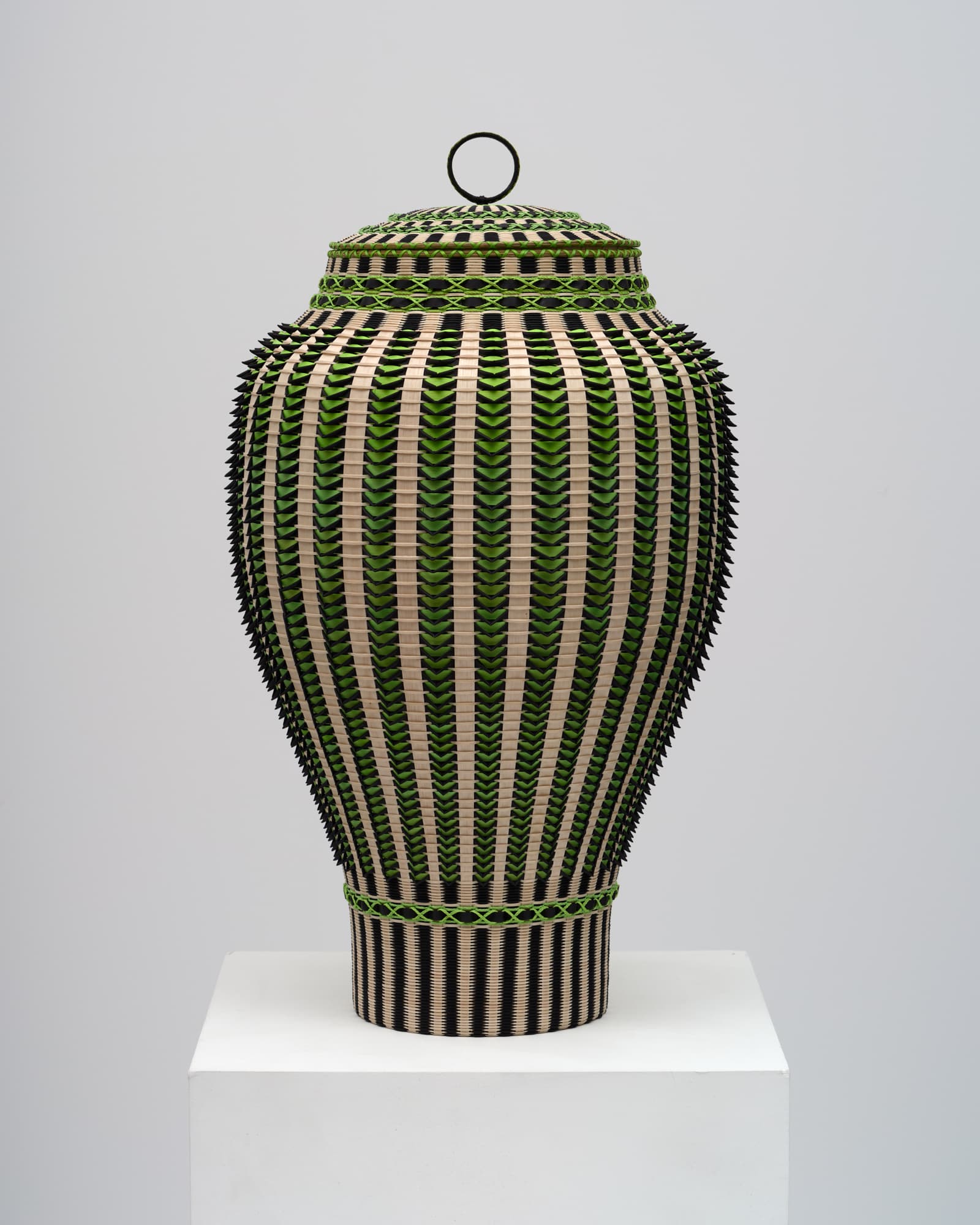
KarmaUsing primarily black ash and sweetgrass, Jeremy Frey innovates within the millennia-old tradition of Wabanaki basketry while maintaining its vital connection to the past. Permanence presents intricately patterned baskets and flat weaves made within the last year and debuts two new facets of his evolving practice. The artist embraces materials and processes that offer new avenues for stewardship of this ancient craft: an ambitiously-scaled wall work bridges weaving and painting, while bronze sculptures introduce an inventive medium to Wabanaki basketry. “Weaving is like a language,” he has explained, “though I’m writing it slightly differently, it’s a tradition that I guard.” A seventh-generation basketmaker, Frey learned the craft from his mother. Black ash wood has long been the practice’s primary medium. Known in the languages of the four Wabanaki Nations—Maliseet, Mi’kmaq, Passamaquoddy, and Penobscot—as the “basket tree,” black ash grows in the forests of what is now called eastern Maine, where the Wabanaki have lived for at least 12,000 years. Their lengthy history is echoed in the extended timeline of their basketry’s key material, which takes decades to reach maturity. Frey removes the bark of his carefully-chosen trees and pounds their flesh to separate their growth rings, then weaves thin slices of the layers to create the baskets’ warp and weft. Drawing on the resources of the present, which are themselves borne from history, Frey extends the long temporal throughline of basketry while multiplying its formal manifestations. The wall work Mirage (2026) is the first of its kind: woven flat and then mounted on stretched linen, black ash here evokes the language of painting. To create the abstract forms that move across its skin, Frey painted dye directly onto his warp strips. Though Mirage features compositional choices made in two-dimensions, this work troubles the distinctions between background and foreground that characterize much of both abstract and representational painting: the addition of black wefts snaking over and under the warps yields a pattern that is not on top of the surface but embedded within it. As in his baskets, color is central as a means of both revealing and concealing structure. In his unstretched flat weaves, like Dreams and Cherry Blossom (both 2026), Frey foregrounds the anatomy of his constructions by leaving the tails of spines exposed at the edges. No longer functional objects, these works put process on display. Wabanaki basketmakers have long tinted their wood splints, first using natural pigments like indigo and berries. Frey uses synthetic dyes—which allowed weavers to expand their palettes dramatically when they were introduced near the end of the nineteenth century—in order to achieve what he has described as the “holographic mesmerization” of his intricate, kaleidoscopic compositions. Though his baskets are sculptural, they do not share the unified surface of a marble carving or a clay figure; instead, multiple planes and diverse finishes create a hallucinatory effect. The addition of qinusqikon, or pointed weaves, which protrude from the body of a basket at angles that change relative to the curvature of the overall form, contributes another level of optical play. These concave points stack vertically along the sides of Monolith (2026), at turns exposing and concealing lime-green ribs that flash against the otherwise neutral palette. In other works, such as Absence (2025) and Sylvia (2026), Frey left the ash untreated, foregrounding the sumptuousness of the material itself, which catches and refracts light. Urchin (2026), woven entirely in a rigorous “fine weave” style that Frey has revitalized, vibrates like a Bridget Riley painting. Its bands of black and white, each thinner than a millimeter, trade places as they meet in space, one headed under a rib and the other over. In light of the ecological factors that threaten the black ash tree and thus the tradition of Wabanaki basketry writ large—not only climate change, but also an invasive beetle species—Frey understands his labor-intensive practice as a fight against time. The temporal tension plays out in his increased use of cedar, as in Harmony (2026), a wood more readily available than black ash but that requires particularly time-intensive braiding before it can be shaped. The bronzes he recently began casting from baskets translate an organic material into a monumental medium with its own ancient sculptural tradition. As Bob Nickas has written of Frey, “the artist looks back, setting his work upon foundational forms and motifs, and in elaborating on them, enlivening and reimagining them, carries the activity forward.” Each of Frey’s works, be it in black ash, cedar, or bronze, informs the next, inspiring new color combinations, small adjustments, or major interventions. His process-based approach builds on a long-evolving history of making, each iteration at once connected to the past a collection of gestures toward the future.