
Chelsea, New York
Katy Stone
Terrains
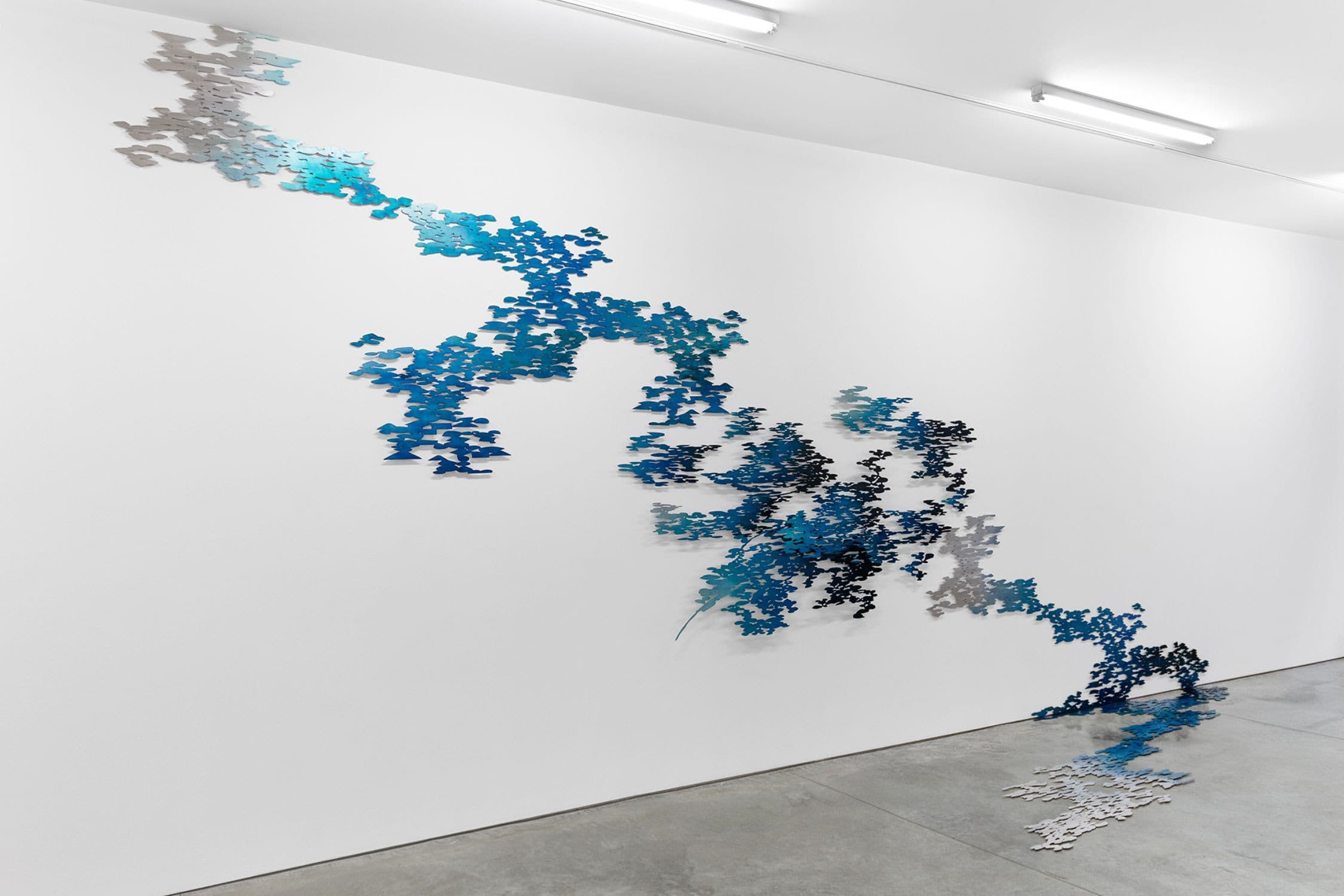
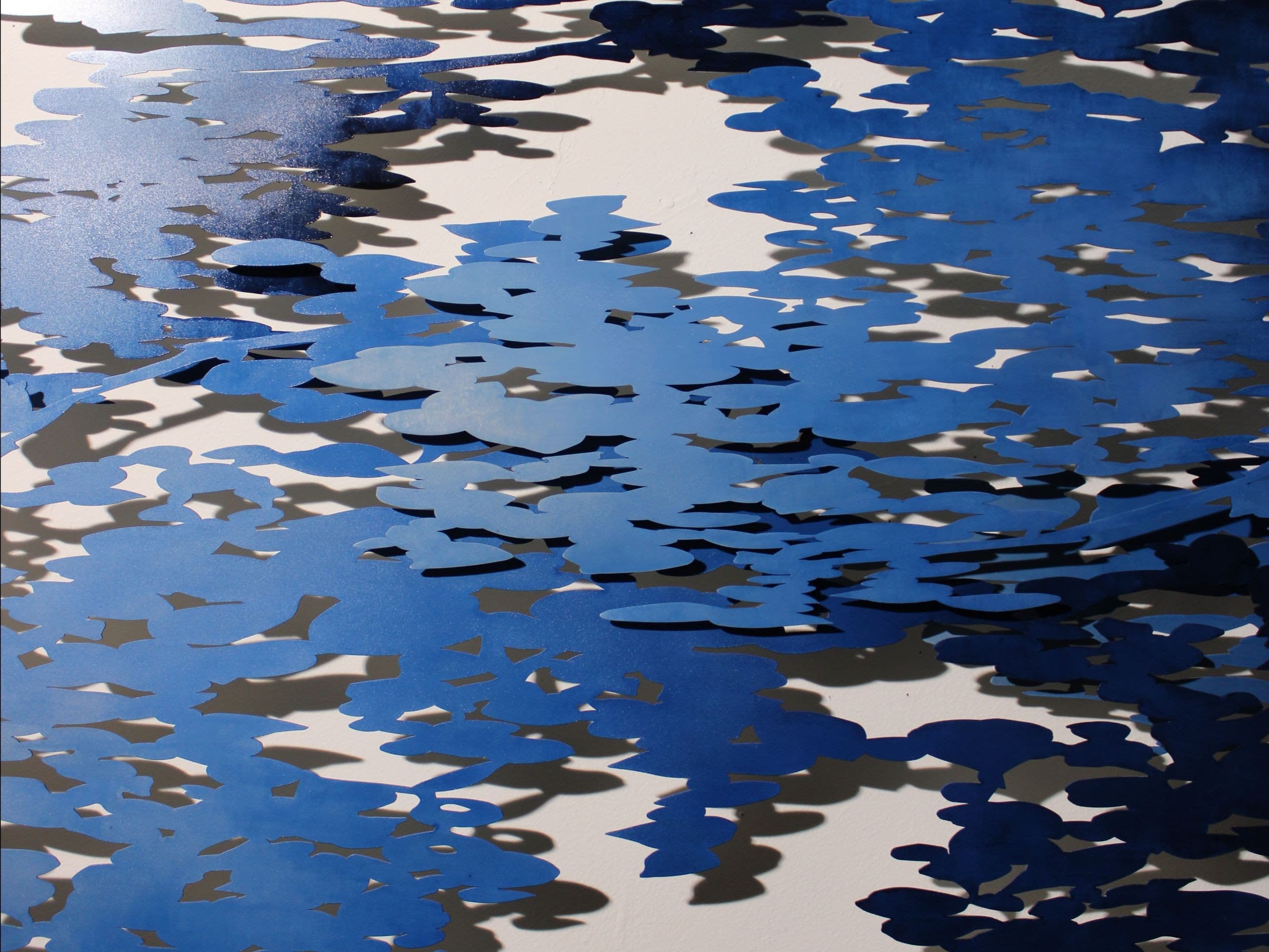
Ryan LeeRyan Lee is pleased to present Terrains, a new body of work by artist Katy Stone, which contemplates the natural world as both a literal and poetic landscape. Through large-scale installations of layered forms, Stone reimagines forests, ponds, and rich-hued terrains as metaphors for emotional states and collective experience in the present age. Each of Stone's works is as much about gesture as it is about the stationary image. In this series, the wall becomes the canvas. Stone looks to plant forms and their movement to create cascading, draping, appendage-like repetitions of pattern. She often begins with digital drawings, imbricating leaf-like shapes into rhythmic compositions that, in a sense, mimic the behaviors of plant growth and proliferation. Ripe with beautiful paradoxes, the works are fixed, yet ooze like fluid; they are still, yet evocative of the ephemeral spirit of all natural systems. In Terrains, Stone generates specific motifs that offer continuity to her past bodies of work. For example, allusions to willow trees and their petal-like catkins, which she embraces as emblematic of both grace and grief; the sacred cedar, whose branches posture like hands that are open or reaching; the surfaces of a pond, beckoning reflection and contemplation. Other motifs occur through color. Stone paints a full-spectrum experience across the exhibition's rooms, hearkening to the blues of water and to the dusty tail-end of a sunset, whose blazing corals seep into muted, burnt red. Inspired by philosopher Iris Murdoch's concept of "unselfing" – wherein nature acts as an invitation to step outside one's personal, physical limitations – the monumental sculptures aim to prompt viewers' reckoning with their own bodies in space. "Engaging with nature dissolves your boundaries, you melt into all the life energies going on around you," says Stone. The artworks' dense patterns supply an opportunity to abandon, shift, and reset one's perspective toward a more connected state. The grand scale of these works create tension between meticulous control and osmotic unruliness. As such, the works resonate with the subtext of contemporary turbulence. "There's a mood of darkness in the work," Stone acknowledges, "but also a kind of flourishing, a suggestion of continuances that are persisting around us, in spite of upheaval." With Terrains, Stone extends her ongoing exploration of nature as metaphor, but also as a mirror of our age. The works invite viewers into landscapes both external and internal, poetic and abundant spaces where grief, wonder, and resilience coexist. Katy Stone (b. 1969, Rockford, IL) is best known for her large-scale installations and wall sculptures. Working primarily in aluminum, Dura-Lar and plexiglass, Stone creates hybrids of drawing, painting, and sculpture that combine the visual language of organic forms with synthetic materials. Her work balances a sense of monumentality and durability with motion and fragility. Each layered, cascading work consists of scores of hand-painted gestures that seem suspended in a moment of falling, fluttering, waving, crashing or exhaling. Over her career, she has developed an intricate vocabulary of line, shape, form and mark-making that blur the boundaries between traditional techniques of drawing, painting and sculpture. She has exhibited at Boise Art Museum, ID; Boston University Art Gallery, MA; Center on Contemporary Art, WA; Kansas City Art Institute, KS; Jacksonville Museum of Contemporary Art, FL; MassArt Art Museum, MA; McNay Art Museum, TX; Missoula Art Museum, MT; Schneider Museum, OR; Sun Valley Museum of Art, ID; University of Akron, OH; University of Richmond, VA; Washington State Convention Center, WA; and Whatcom Museum of Art, WA. Her work is held in the public collections of Boise Art Museum, ID; City of Seattle, WA; Iowa State University, IA; McNay Museum of Art, San Antonio, TX; Missoula Art Museum, MT; Ross School of Business, University of Michigan, MI; Swedish Medical Center, Seattle, WA; and the GSA's Art in Architecture Program and US Art in Embassies in Baghdad.