
Chelsea, New York
Kota Ezawa & Julian Brave NoiseCat
Alcatraz is an Idea
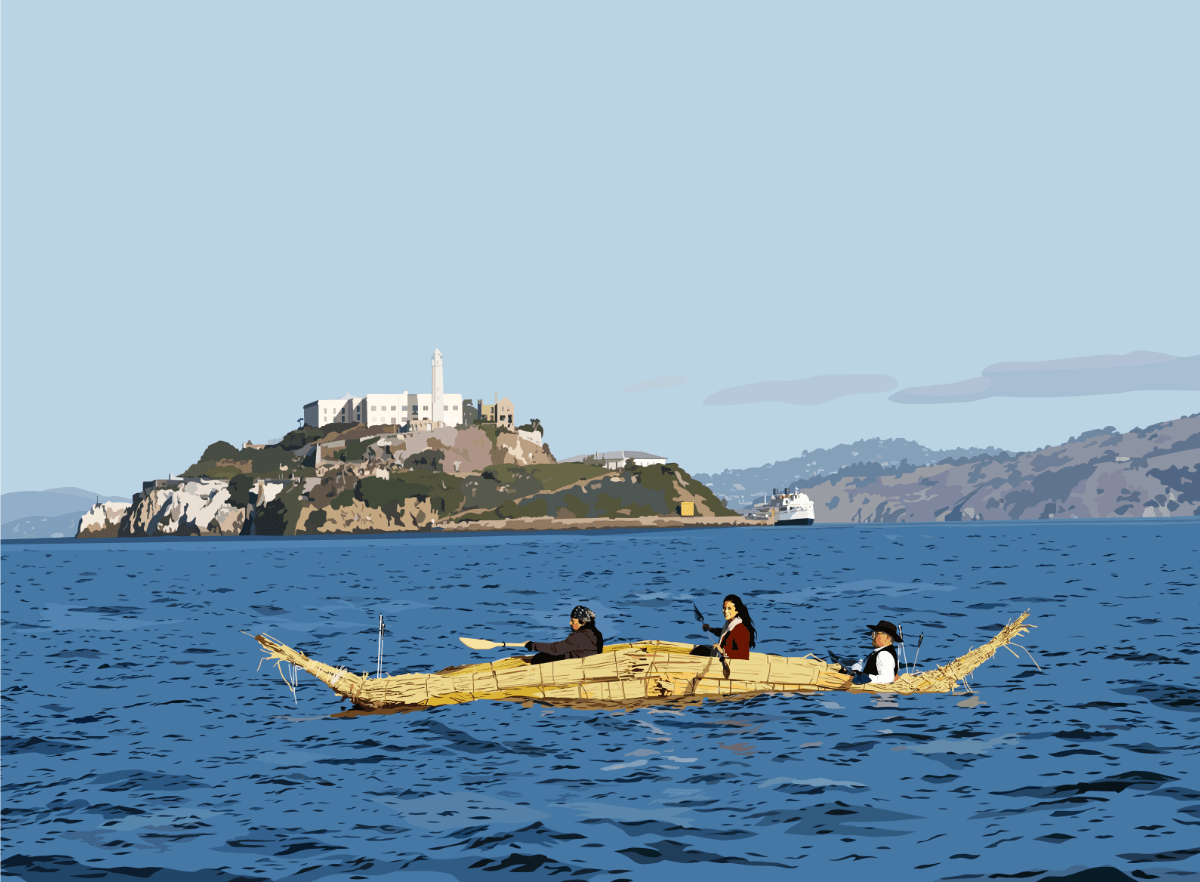
Ryan LeeRyan Lee Gallery is pleased to present Alcatraz is an Idea, an exhibition of work across media including video, lightboxes, and an acrylic pigment print on wood. Making its East Coast debut, the centerpiece two-channel video with vinyl mural is a collaboration between Ezawa and NoiseCat that depicts the 2019 Alcatraz Canoe Journey that commemorated 50 years since the Alcatraz Occupation. Ezawa used hand-drawn animation to reinterpret footage of the canoes traversing San Francisco Bay. Co-organized by NoiseCat, the event invited Indigenous peoples from across the West Coast and beyond to commemorate the fiftieth anniversary of the 1969 occupation of Alcatraz Island by the activist group Indians of All Tribes. The video installation was exhibited earlier this year at Ezawa's landmark solo exhibition at the Fort Mason Center for Arts & Culture in San Francisco, Kota Ezawa: Here and There — Now and Then. In 1969, as a protest against the government's mistreatment of Native Americans, Indians of All Tribes reclaimed Alcatraz Island through the Fort Laramie Treaty of 1868 that stipulated unused federal land be returned to tribes. The activists offered $24 in glass beads and red cloth to buy the island, a tongue-in-cheek reference to the purported 1626 purchase of another island, Manhattan, by the Dutch. Their proclamation, read aloud by Mohawk ironworker and activist Richard Oakes, states: "We, the Native Americans, reclaim the land known as Alcatraz Island in the name of all American Indians by right of discovery. We wish to be fair and honorable in our dealings with the Caucasian inhabitants of this land, and hereby offer the following treaty." Alcatraz is an Idea engages with layered histories as the artists pair the 1969 occupation with its 2019 commemoration. The audio brings together old and new as well: Oakes' voice is heard, accompanied by a contemporary composition by Mali Obamsawin. But the work pulls threads of history, culture, and mythology from Indigenous territories across the United States and beyond, reaching back to the colonization of this hemisphere by Europeans, probing enduring struggles over land stolen from First Peoples, and challenging the dominant narrative of the most potent symbol of the American carceral state. As Oakes said, "Alcatraz is not an island. It's an idea." As a former federal prison, Alcatraz has been mythologized in American culture as an inescapable penitentiary. The concept has returned under President Donald Trump, who has suggested Alcatraz should be reopened as a prison, and who has named a hastily constructed immigrant detention facility in Florida "Alligator Alcatraz." Alcatraz is an Idea suggests there are other histories—ones that point towards liberatory, decolonial, and Indigenous alternatives—that live on, obscured by powerful carceral and colonial forces and mythologies that continue to shape Alcatraz just as they continue to shape America. Soon after moving to the United States in the 1990s, Ezawa began making work that reflects on American culture, and the ways in which historical events echo across time. His work often examines events depicted on film or in photography and recreates them in flat planes of color using watercolors and digital drawing in an attempt to give them new relevance. "It's a meditation on an image," Ezawa explains of his practice. "I start out with a piece of archival or found footage and then I kind of take it apart into all its individual aspects - and then I recreate all these individual aspects in my drawing style and then put it back together. It's a little bit like taking a car apart and then recreating it out of clay or some other material and putting it back together." NoiseCat is a writer, filmmaker, and activist who helped organize the 2019 Alcatraz Canoe Journey. His first documentary, Sugarcane (2024) premiered at Sundance and was nominated for a Peabody and an Academy Award. In a 2019 New York Times op-ed, NoiseCat wrote of the 2019 event: "For a day — or maybe even just a morning — the canoes made it possible to see Alcatraz as what it is for Native people: a symbol of our rights, resistance and persistence; an island reclaimed by our elders half a century ago; an idea, a story and a moment of organized action that bent the arc of justice in favor of the Indigenous." Also on view are three new lightboxes depicting images related to Alcatraz is an Idea, two new lightboxes revisiting Ezawa's seminal History of Photography series, and one acrylic pigment print on wood. Kota Ezawa (b. 1969 Cologne, Germany) is best known for his light-boxes, works on paper and animations that make use of found images, video, and film to comment on contemporary culture and historical events. Described by the artist as "moving paintings," Ezawa's works serve as conduits of events for both history and pop culture, translating them into personal memories and experiences. His works have the ability to transcend the specificity of the image into a more universal realm by reducing the forms and content to their most essential elements. In 2025, Ezawa's work was the focus of a landmark solo exhibition at the Fort Mason Center of Arts & Culture in San Francisco, titled Kota Ezawa: Here and There — Now and Then. In 2019, his work was included in the Whitney Biennial at the Whitney Museum of American Art. His work has been included in recent exhibitions at the San Francisco Museum of Modern Art, CA (2024); Eli and Edyth Broad Art Museum, MI (2023); Rollins Museum, FL (2023); Everson Museum of Art, NY (2023); and Jan Shrem and Maria Manetti Shrem Museum of Art, CA (2022). Ezawa's work is in included in the collections of the Baltimore Museum of Art, MD; Buffalo AKG Art Museum, NY; Collection Neuflize Vie, France; Detroit Institute of Arts, MI; Harvard Art Museums, MA; Hirshhorn Museum and Sculpture Garden, Washington, DC; J. Paul Getty Museum, CA; Kunstmuseum Stuttgart, Germany; Kunsthalle Bremen, Germany; Metropolitan Museum of Art, New York, NY; Minneapolis Institute of Arts, MN; Musée d'art contemporain de Montréal, Canada; The Museum of Modern Art, NY; The National Gallery of Victoria, Australia; San Francisco Museum of Modern Art, CA; Smithsonian American Art Museum, Washington, DC; Whitney Museum of American Art, NY; and Yale University Art Gallery, CT, among others. Julian Brave NoiseCat (b. 1993) is a writer, Oscar-nominated filmmaker, champion powwow dancer, and student of Salish art and history. His first documentary, Sugarcane, directed alongside Emily Kassie, follows an investigation into abuse and missing children at the Indian residential school NoiseCat's family was sent to near Williams Lake, British Columbia. Sugarcane premiered at the 2024 Sundance Film Festival where NoiseCat and Kassie won the Directing Award in the U.S. Documentary Competition. The film was recognized with over 40 awards including Best Documentary from the National Board of Review and was nominated for a Peabody and an Academy Award. Sugarcane screened at film festivals around the world and in theaters across the United States, Canada, and the United Kingdom. NoiseCat's first book, We Survived the Night, is being published by Alfred A. Knopf in October 2025 as well as by Penguin Random House Canada, Profile Books in the United Kingdom and Commonwealth, Albin Michel in France, and Aufbau Verlag in Germany.